
SmCo cylinder magnets - parallel to the axis
Product sorting
Brands
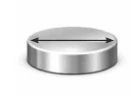
Diameter range A (mm)
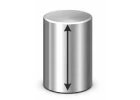
Height range B (mm)
Temperature resistance range
List of products


1Read the dimensions and the magnetisation
A cylinder listed as dia.15x10 has a diameter A of 15 mm and a height B of 10 mm. Both can be filtered separately on this page, with diameters running from about 3 to 30 mm and heights up to the 35 to 40 mm band.
The category name gives you the rest: these magnets are magnetised parallel to the axis, so the poles sit on the two circular faces and the magnet works through its flat end, not through the curved side.
2Use the fact that there is no coating
SmCo resists corrosion, so these cylinders are supplied bare. For a precision fit that is a real advantage: the diameter you order is the diameter you get, with no plating thickness and no plating tolerance to allow for when you machine the seat.
It also means nothing on the surface can chip and start corroding, which matters in a housing you do not intend to open again.
3Choose the proportions for the job
A flat disc gives the most force per volume in direct contact but loses it quickly across a gap. A taller cylinder carries the field further, which is what you usually want in a sensor or an encoder where the magnet works at a distance rather than touching anything.
Since this is a range of small precision components rather than holding magnets, start from the geometry your assembly needs and check the force afterwards.
4Mind the temperature and the stability
All of these cylinders fall in the 201 to 350 °C band, with working temperatures around 300 °C. Just as useful is how little the force changes on the way there, roughly 0.03 % per degree against roughly 0.11 % per degree for neodymium.
For a sensor that has to read the same on a cold morning and after eight hours of running, that stability is the reason to pay for SmCo.
5Fit it without breaking it
- Machine the seat about 0.1 mm larger than the magnet and bond it in with epoxy rated for the working temperature.
- Never press a cylinder into an interference fit. SmCo is the most brittle of the common magnet materials.
- Let magnets meet slowly and keep spacers between loose pieces in storage.
Tip: Choose the adhesive for the same temperature as the magnet. It is a common and expensive mistake to fit a 300 °C magnet with an epoxy that softens at 120 °C, and the assembly then fails for a reason that has nothing to do with the magnet.
Related categories to the SmCo cylinder magnets category
- Selection by diameter A
- Selection by height B
- Diameter up to 5 mm
- Diameter 5 to 10 mm
- Diameter 10 to 15 mm
- Diameter 15 to 20 mm
- Diameter 20 to 25 mm
- Diameter 25 to 30 mm
- Diameter 30 to 35 mm
- Height up to 5 mm
- Height 5 to 10 mm
- Height 10 to 15 mm
- Height 30 to 35 mm
- Height 35 to 40 mm
- SmCo rings
- SmCo blocks
- Heat-resistant magnets
- Neodymium cylinders
- Ferrite cylinders
- All samarium magnets
Frequently asked questions about SmCo cylinder magnets
The magnetic field runs along the axis of the cylinder, so the north and south poles sit on the two circular faces. The magnet works through its flat end, and the curved side surface is magnetically neutral. This is the standard arrangement for seats, bores and sensor positions.
Diameters from about 3 mm up to 30 mm, with heights reaching the 35 to 40 mm band. Diameter A and height B can be filtered separately, which is the fastest way to find a piece that fits an existing bore. This is a range of small precision components rather than large holding magnets.
SmCo resists corrosion, so it needs none. For a precision fit that is an advantage rather than a compromise: the diameter you order is the actual diameter, with no plating thickness or plating tolerance to allow for when machining the seat, and nothing on the surface that can chip and start corroding later.
Machine the seat about 0.1 mm larger than the magnet and bond it with a two-component epoxy rated for the working temperature of the assembly. Never press the magnet into an interference fit, because SmCo is the most brittle of the common magnet materials and will crack rather than seat.
Only for temperature and stability. These cylinders work in the 201 to 350 °C band, and their force changes by roughly 0.03 % per degree against roughly 0.11 % for neodymium, so a sensor reads almost the same cold and hot. Below 80 °C a neodymium cylinder does the same job for a small fraction of the price.
SmCo cylinders are precision components for hot and demanding assemblies. Ours run from about 3 to 30 mm in diameter, all magnetised parallel to the axis, all rated in the 201 to 350 °C band, and all supplied bare, without any surface treatment, so the dimension you order is the dimension you machine for. Diameter and height are filterable separately. Where a cheaper material would do the same job, we will say so.


