
Neodymium magnets
Neodymium magnets (NdFeB) are currently the strongest permanent magnets available. These magnets are very powerful despite their small size. Neodymium magnets are fragile and highly susceptible to corrosion, which is why they have a surface coating—nickel, zinc, epoxy resin, gold, or passivation. Neodymium magnets are also used to make fishing magnets, which can pull up to 200 kg of treasure out of the water.



Product sorting
Brands
According to the shape
Tearing force range (kg)
Temperature resistance range
List of products


1Choose the shape according to the way you will mount it
The shape decides how you attach the magnet:
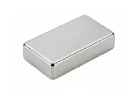
- Block (cuboid) for flat surfaces, for gluing and for door catches.
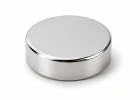
- Cylinder for point holding and for magnetic seats.
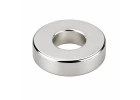
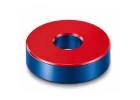
- Ring and cylinder with hole for screwing through the centre.
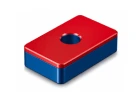
- Block with hole for mounting on a bolt or for hanging.
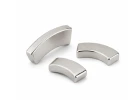
- Segment for rotors, motors and generators.
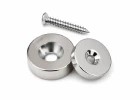
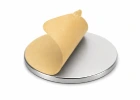
If the magnet has to be fixed with a screw, choose the version with a hole instead of a solid block. If gluing is enough, reach for the self-adhesive version.
2Read the pull force as a value measured under ideal conditions
The stated pull force applies to direct contact with a flat, clean steel plate whose thickness is at least equal to the height of the magnet, with no air gap and no paint coating. An air gap of just 1 mm, thin or painted sheet metal, rust and side (shear) loading all reduce the force noticeably.
So allow yourself a reserve in real use: choose a magnet with a pull force 2 to 3 times higher than the weight it has to hold.
3Pick the grade from N35 to N52
The number after the letter N states the energy product, in other words the "strength" of the material. N35 is the most common and cheapest grade, while N52 at the same dimension delivers the highest pull force. If you need the smallest possible magnet with maximum force, choose a higher grade. If the dimension is not critical, grades N35 to N42 usually give the best price to performance ratio.
4Check the temperature resistance
Ordinary neodymium magnets of the N grade work reliably up to roughly 80 °C. Above that limit they start to lose force irreversibly. For warmer environments choose the higher grades (M, H, SH, UH, EH) up to about 200 °C. You will find the exact maximum working temperature in the parameters of every product.
| Grade | Max. working temperature | Typical use |
|---|---|---|
| N | up to 80 °C | indoors, ordinary holding, household |
| M | up to 100 °C | moderately warm environments |
| H | up to 120 °C | machine building, warmer plants |
| SH | up to 150 °C | motors, industrial applications |
| UH | up to 180 °C | thermally demanding environments |
| EH | up to 200 °C | high temperature applications |
The values are indicative; for permanent temperatures above 200 °C samarium magnets are the more suitable choice.
5Consider the coating and the working environment
NdFeB material is prone to corrosion, which is why magnets are most often plated with a Ni-Cu-Ni (nickel) layer. Standard nickel is perfectly sufficient for dry interiors. For damp places, outdoor use or chemically aggressive environments choose an epoxy or rubberised version, or enclose the magnet in a plastic or steel pot. Damage to the coating speeds up corrosion.
6Handle magnets safely
Strong neodymium magnets snap together with considerable force and can pinch your fingers. The material is brittle and chips or cracks on impact. Separate larger pieces with spacers and handle them slowly. Keep magnets out of reach of children (risk of swallowing) and away from electronics, payment cards and pacemakers.
Tip: The strongest magnet is not always the best choice. A pull force of 2 to 5 kg is enough for ordinary holding on sheet metal; pick magnets above 15 kg only where they are genuinely needed, because handling them is harder and more dangerous.
Related categories to the Neodymium magnets category
- Neodymium block magnets
- Neodymium cylinder magnets
- Neodymium ring magnets
- Neodymium magnet segments
- Atypical neodymium magnets
- Cylinders with hole
- Blocks with hole
- Self-adhesive magnets
- Magnetic fastening kits
- Selection by pull force
- Selection by temperature resistance
- Pull force up to 0.3 kg
- Pull force 0.3 to 1 kg
- Pull force 1 to 2 kg
- Pull force 2 to 5 kg
- Pull force 5 to 15 kg
- Pull force 15 to 50 kg
- Pull force 50+ kg
- Temperature resistance 81 to 120 °C
- Temperature resistance 151 to 200 °C
Frequently asked questions about neodymium magnets
N52 is one of the highest commonly available NdFeB grades. The number (from 35 to 52) states the energy product of the material: at the same dimension N52 has a higher pull force than, for example, N35. However, the most suitable magnet for a specific application depends not only on the grade, but also on the dimension, shape and working conditions. A higher grade also tends to have lower temperature resistance.
A standard neodymium magnet of the N grade works without losing force up to roughly 80 °C. For higher temperatures there are the grades M (up to 100 °C), H (up to 120 °C), SH (up to 150 °C), UH (up to 180 °C) and EH (up to 200 °C). Once the maximum working temperature is exceeded, the magnet irreversibly loses part of its force. You will find the exact value in the parameters of every product. For permanent temperatures above 200 °C we recommend samarium magnets.
No. Pull force is measured with the magnet in direct contact with a thick, flat and clean steel plate. In practice it is reduced by an air gap (including a coat of paint or a layer of dust), thin sheet metal, rust or side loading instead of a perpendicular pull. So allow a reserve when choosing, ideally a stated force 2 to 3 times higher than the weight being held.
NdFeB material itself corrodes, which is why magnets are plated, most often with a Ni-Cu-Ni layer. For dry interiors the standard nickel surface is sufficient. Outdoors, in damp places or in chemically aggressive environments choose magnets with an epoxy or rubberised coating, or enclose them in a plastic or steel pot. Damage to the coating speeds up corrosion.
Neodymium is a hard but brittle material. When two magnets snap together sharply or the magnet hits a hard surface, it can chip or crack, so handle larger pieces slowly and use spacers. Permanent loss of force is caused by exceeding the maximum working temperature or by a strong opposing magnetic field.
A block (cuboid) suits flat surfaces and gluing, a cylinder is for point holding and seats, a ring and a cylinder with a hole are for screwing through the centre, and a segment is for rotors and motors. If the magnet has to be fixed mechanically with a screw, choose the version with a hole; if gluing is enough, reach for the self-adhesive version.
In the neodymium magnets category you will find blocks, cylinders, rings, segments and atypical shapes in grades from N35 to N52, with a pull force ranging from tenths of a kilogram up to tens of kilograms and with temperature resistance from the usual 80 °C up to more than 200 °C. For every magnet we state the dimensions, grade, pull force, coating and maximum working temperature, so you can choose precisely according to the application and not just by the highest stated force. Prices are shown in euro or Czech koruna, both including and excluding VAT.


