
Self-adhesive magnets
Are you looking for strong neodymium magnets with rectangular stickers? We have several sizes available and everything in stock.

Product sorting
Brands
According to the shape
Tearing force range (kg)
List of products


1Pick the shape from the surface you are sticking to
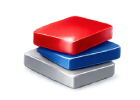
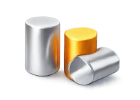
The range splits into blocks, in sizes such as 10 x 5 x 1, 20 x 20 x 1 or 40 x 12 x 1 mm, and cylinders, from 8 to 20 mm across and 0.75 to 2 mm thick.
Blocks give a longer contact line and suit edges, frames and strips. Cylinders take up the least space and work well for point fixing on flat panels, signs and covers.
2Understand what the adhesive can and cannot do
These magnets carry a 3M adhesive layer 0.06 mm thick, which is thin enough not to cost you noticeable holding force. Adhesive is strong in tension but weak in shear: it resists being pulled straight off far better than being dragged sideways.
For a hanging or sliding load, plan a mechanical stop, or use a magnet with a screw hole instead of relying on the tape alone.
3Decide between a single magnet and a pair
Some items are sold as a set of two mutually attracting magnets, marked SET N/S. That is the right choice when neither of the two surfaces is steel: you stick one magnet to each side and they close on each other.
A single magnet is enough when the counter surface is already steel, or when you add a thin steel counterplate. Magnet against magnet holds more than magnet against sheet steel, but both halves must be fitted the right way round.
4Prepare the surface properly
- Stick only to flat, smooth surfaces. Textured plastic, raw wood and dusty paint hold poorly.
- Degrease with alcohol and let the surface dry completely before you peel the liner.
- Press firmly for a few seconds and give the adhesive time to reach full strength before loading it.
- Stick at room temperature; adhesive tape bonds badly in the cold.
5Match the force to the job
Self-adhesive magnets in this range cover roughly 0.3 to 5 kg of pull force, which is exactly the window for keys, small tools, light covers, signage, curtains and cabinet doors. They are standard N grade for use up to roughly 80 °C in dry interiors.
Tip: Take the thickness into account before you order. Most of these magnets are 1 to 2 mm thick plus 0.06 mm of adhesive, so they fit into a closing gap where an ordinary magnet would stop the door from shutting.
Related categories to the Self-adhesive magnets category
- Self-adhesive block magnets
- Self-adhesive cylinder magnets
- Selection by pull force
- Pull force up to 0.3 kg
- Pull force 0.3 to 1 kg
- Pull force 1 to 2 kg
- Pull force 2 to 5 kg
- Counterpart to self-adhesive magnet
- Stickers for magnets
- Magnetic fastening kits
- Flat block magnets
- Flat cylinder magnets
- Neodymium block magnets
- Neodymium cylinder magnets
- Self-adhesive magnetic foils
- Magnetic adhesive tapes
- Magnets for cabinets
- Door magnets
- Magnetic closure
- All neodymium magnets
Frequently asked questions about self-adhesive magnets
A 3M adhesive layer 0.06 mm thick, applied to one face. It is thin enough not to cost noticeable holding force, and it is designed for flat, smooth surfaces. Degrease the surface with alcohol, let it dry, then press the magnet firmly and give the adhesive time to reach full strength before you load it.
It is a pair of two mutually attracting magnets, one with the north pole facing out and one with the south. You stick one to each side of the closure, which is what you need when neither surface is steel. If one side is already steel, or you add a steel counterplate, a single magnet is enough.
The range covers roughly 0.3 to 5 kg of pull force. That is the right window for keys, small tools, light covers, signage, curtains and cabinet doors. The exact figure is stated with each product, and as always it applies to direct contact with clean, thick steel rather than to a painted panel or thin sheet.
Not reliably. Adhesive tape is strong in tension, meaning a straight pull away from the surface, and much weaker in shear, meaning a load dragging it sideways or downwards. For a hanging load, add a mechanical stop or choose a magnet with a screw hole instead of relying on the tape.
These are standard nickel-plated neodymium magnets for dry interiors and temperatures up to roughly 80 °C, and the adhesive bonds best at room temperature. In damp conditions the plating corrodes over time and the adhesive loses grip, so for outdoor or wet use ask us about an epoxy or rubberised version mounted mechanically.
Self-adhesive magnets solve the problem of fixing a magnet where you cannot drill. Ours come as blocks and cylinders, mostly 1 to 2 mm thick, with a 3M adhesive layer of 0.06 mm and a pull force from 0.3 to 5 kg. Several sizes are also sold as a pair of mutually attracting magnets, which is what you need when neither surface is steel. Every product states its dimensions, pull force, coating and maximum working temperature.


