
Magnets
You can use magnets to attach anything to a metal surface or to hold things together. Neodymium magnets are very strong. If you want a magnet for fishing for treasures from the water, we recommend the popular magnet fishing, and for adult entertainment, magnetic balls. We also have magnets for refrigerators or boards, and these decorative magnets not only hold well, but also look nice.
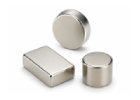
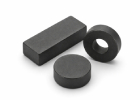
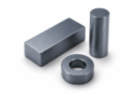


Magnets by Shape





Product sorting
Brands
According to the shape
Material
Tearing force range (kg)
Temperature resistance range
List of products


Listing controls
1Choose the material before the shape
Almost every disappointed customer picked the right shape and the wrong material. There are three to choose from, and each of them wins in a different situation.
| Material | Working temperature | Price | Choose it when |
|---|---|---|---|
| Neodymium | up to 80 °C, higher grades to 200 °C | medium | you need maximum force from the smallest body |
| Ferrite | 151 to 200 °C, part of the range beyond 200 °C | lowest | you need many pieces, or heat and damp with modest force |
| Samarium | 201 to 350 °C | highest | the assembly runs hot and the force must stay stable |
Neodymium covers the great majority of everyday and industrial uses. Reach for ferrite when the budget or the environment decides, and for samarium only when the temperature genuinely demands it.
2Read the pull force as a laboratory figure
Every stated pull force is measured with the magnet in direct contact with a thick, flat, clean steel plate, pulled straight off at a right angle. An air gap from 1 mm, a coat of paint, dust, rust or sheet metal thinner than the magnet all reduce it.
Choose a magnet rated 2 to 3 times the weight it has to hold, and more if the joint is opened often or the surface is painted.
3Let the mounting decide the shape
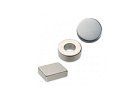
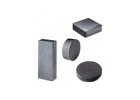
- Block for flat surfaces, edges and profiles, where a defined footprint stops a panel pivoting.
- Cylinder for point holding, bores and seats.
- Ring or cylinder with a hole when a screw has to pass through.
- Self-adhesive where you cannot drill at all.
- Segment for rotors, motors and generators.
Decide this before ordering. A finished magnet cannot be drilled, cut or ground to a new shape, whichever material it is made from.
4Check which way the load acts
A magnet resists a perpendicular pull far better than a sideways slide. A magnet rated at 10 kg can start to slip under a couple of kilograms of shear load, which is why a sign that stays put on a fridge door slides down a vertical panel.
If the load hangs along the surface rather than pulling away from it, add a lip, a stop or a screw that takes the shear and let the magnet supply only the pull.
5Match the coating to the environment
Neodymium corrodes and is therefore always plated, most often with Ni-Cu-Ni; for damp or chemically aggressive places choose an epoxy or rubberised version, and remember that a chipped coating is where corrosion starts. Ferrite and samarium are naturally corrosion resistant and are supplied bare, with nothing on the surface that can fail.
6Handle magnets safely
All three materials are hard but brittle and chip or crack on impact. Strong magnets snap together across several centimetres and can pinch or crush fingers. Keep larger pieces separated with spacers, slide them apart sideways rather than pulling them straight off, and keep them away from children, electronics, payment cards and pacemakers.
Tip: Before moving up to a stronger magnet, try adding a steel counterplate behind a thin panel or pairing two magnets with opposite poles facing. Both often solve the problem for less money, and they avoid the handling risks that come with the strongest pieces.
Related categories to the Magnets category
- Neodymium magnets
- Ferrite magnets
- Samarium magnets
- Office magnets
- Heat-resistant magnets
- Magnets by shape
- Block magnets
- Cylinder magnets
- Ring magnets
- Magnet segments
- Magnets with holes
- Self-adhesive magnets
- Magnetic fastening kits
- Coated magnets
- Strong magnets
- Large magnets
- Small magnets
- Magnetic cubes
- Magnet fishing
- Selection by pull force
Frequently asked questions about magnets
Neodymium for maximum force from the smallest magnet at normal temperature, which covers most applications. Ferrite when you need many cheap pieces, or when the place is warm or damp and the force requirement is modest; it works at 151 to 200 °C and does not rust. Samarium only when the assembly runs above 200 °C and the force has to stay stable, since it costs many times more.
It is measured with the magnet in direct contact with a thick, flat, clean steel plate, pulled straight off at a right angle. It is a comparison figure obtained under ideal conditions. On thin sheet metal, a painted surface or across any air gap the real hold is noticeably lower, so choose a magnet rated 2 to 3 times the weight you need to hold.
No, whichever material it is. Neodymium and samarium are hard and brittle and crack under a drill, while the heat generated demagnetises them permanently; ferrite is a ceramic that needs diamond tooling and breaks under an ordinary saw. Choose the dimension from the catalogue, use a version that already has a hole, or ask us about a custom piece.
Because the load is acting sideways. Magnets resist a perpendicular pull far better than a shear load dragging along the surface, so a magnet that easily holds its rated weight straight out can slip under a fraction of it vertically. Add a lip, a stop or a screw to carry the shear rather than buying a stronger magnet.
Ferrite and samarium are naturally corrosion resistant and are supplied without any coating. Neodymium always carries a protective layer, most often Ni-Cu-Ni, which suits dry interiors; for damp or chemically aggressive environments choose an epoxy or rubberised version, or a magnet enclosed in a steel or plastic pot, and watch for chips, because corrosion starts at the damage.
Yes, in three ways. Exceeding the maximum working temperature causes a permanent loss that does not come back on cooling. A strong opposing magnetic field does the same. And mechanical damage, a crack or a chipped corner, removes part of the working material for good. Handled within its limits, a permanent magnet keeps its strength for decades.
We stock all three permanent magnet materials side by side, neodymium, ferrite and samarium, in blocks, cylinders, rings, segments and atypical shapes, with a pull force from a few grams to more than 50 kg and working temperatures from ordinary interiors up to 350 °C. Every product states its dimensions, grade, pull force, coating and maximum working temperature, and the whole range is filterable by each of them. Because we sell all three materials, our recommendation follows your application rather than our stock.


