
How to Choose a Magnet: Materials, Strength and Shapes
How do you choose the right magnet for your project?
Choose a magnet according to its material, dimensions, shape, strength, magnetisation direction and the environment in which it will be used. Neodymium magnets offer high performance in a small size, while ferrite, SmCo and AlNiCo magnets have other advantages.
- Neodymium magnets are suitable for compact, strong connections.
- Ferrite magnets are durable and affordable.
- SmCo magnets suit higher temperatures and demanding environments.
- AlNiCo magnets are used in measuring equipment and sensors, for example.
- Pull force always applies only under defined conditions.
What types of magnets are there?
Neodymium magnets
Neodymium magnets are made from an alloy of neodymium, iron and boron. They provide high magnetic strength in a very small volume.
They are used, for example, for:
- magnetic closures,
- holders and mounting attachments,
- model making,
- sensors and electronics,
- loudspeakers and electric motors,
- home and workshop projects.
Ferrite magnets
Ferrite magnets are weaker than neodymium magnets of the same size but resist corrosion and higher temperatures well.
They are suitable, for example, for:
- school and office magnets,
- loudspeakers,
- magnetic separators,
- simple holders,
- outdoor applications with a suitable design.
SmCo samarium-cobalt magnets
Samarium magnets combine high magnetic strength with good resistance to temperature and corrosion. They are mainly used in industrial applications where an ordinary neodymium magnet is insufficient.
AlNiCo magnets
AlNiCo magnets are made from alloys of aluminium, nickel and cobalt. They offer high temperature resistance but are more easily demagnetised by an opposing field.
Quick material selection
- Small size and high strength: a neodymium magnet.
- A simple, affordable application: a ferrite magnet.
- Higher temperatures and demanding environments: an SmCo magnet.
- Measuring equipment and high temperatures: an AlNiCo magnet.
What should you consider when choosing a magnet?
Shape and dimensions
The range includes cylinders, blocks, cubes, spheres, rings and magnets with a screw hole. The shape must suit the available space and the direction of the applied force.
Pull force
Pull force is measured when separating a magnet perpendicularly from a clean, flat steel plate of sufficient thickness.
In a real application, it is reduced by:
- paint, adhesive or plastic between the magnet and steel,
- rust and dirt,
- thin or curved sheet metal,
- contact with only part of the face,
- sideways loading,
- vibration and impacts.
Magnetisation direction
Cylindrical magnets are most often magnetised parallel to their axis. Blocks are usually magnetised perpendicularly through their largest face. For a special application, the direction must be checked before ordering.
Temperature resistance
Ordinary neodymium magnets often have an operating temperature limit of 80 °C. For higher temperatures, choose a special neodymium grade, SmCo, AlNiCo or suitable ferrite.
Surface coating
Neodymium magnets are susceptible to corrosion, so they are usually protected with nickel, zinc, epoxy or gold coatings.
Use ordinary nickel-plated and gold-plated magnets mainly in dry indoor environments. A damaged coating may allow moisture to penetrate.
Self-adhesive magnets
Self-adhesive magnets have a ready-applied adhesive layer on one side. They are suitable for making:
- magnetic box closures,
- lightweight decorations,
- name badges and labels,
- photo holders,
- lightweight panels and covers.
The bonding surface must be smooth, flat, clean, dry and free of grease. The adhesive layer is not suitable for rough, dusty or strongly curved surfaces.
Magnets are strong but brittle
- Do not let them collide sharply.
- Do not drill or cut neodymium magnets with ordinary tools.
- Keep small magnets out of reach of children.
- Strong magnets can pinch fingers.
- Keep a safe distance from implants, cards and sensitive electronics.
Why buy from a magnet specialist?
A specialist shop offers more options than a basic selection of general-purpose magnets. One advantage is the ability to compare:
- different magnetic materials,
- sizes and shapes,
- pull force,
- magnetisation direction,
- temperature resistance,
- surface coatings,
- self-adhesive and mounting versions.
According to its official history, MAGSY has operated since 2002. As well as individual magnets, it offers magnetic sheets, pockets, boards, holders, tools for tradespeople and industrial separators.
Recommended neodymium magnets
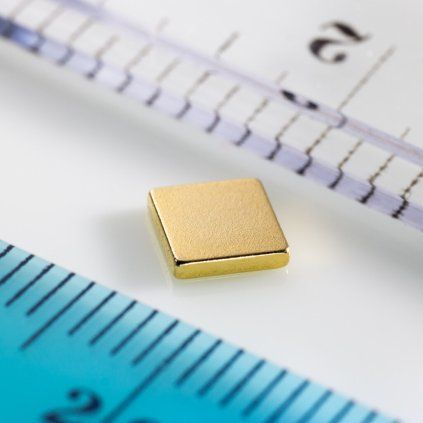
Neodymium block magnet 5 × 5 × 1 mm
A small gold-plated magnet for decorations, closures, photographs and small technical projects.
- Dimensions 5 × 5 × 1 mm
- Pull force 4.9 N
- Weight 0.19 g
- Magnetic grade N48
- Gold-plated surface
- Magnetised perpendicular to the face
- Temperature resistance up to 80 °C
- Product code 20908
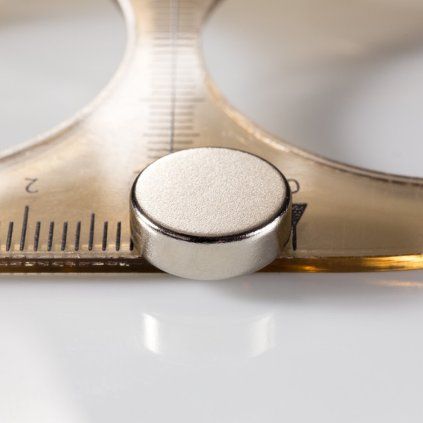
Neodymium cylinder magnet 12 × 4 mm
A versatile cylindrical magnet for holders, closures, model making and other projects requiring greater strength.
- Diameter 12 mm
- Height 4 mm
- Pull force 28 N
- Approximate pull force 2.8 kg
- Weight 3.4 g
- Magnetic grade N42
- Nickel-plated surface
- Temperature resistance up to 80 °C
- Product code 20132
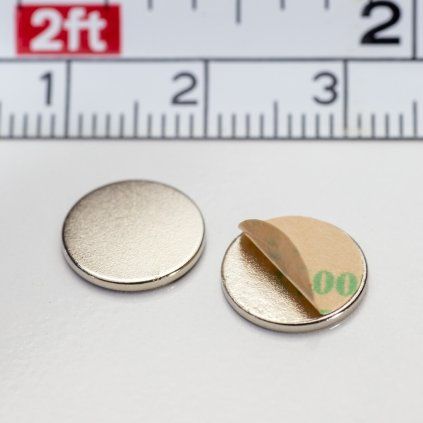
Self-adhesive neodymium magnets 10 × 1 mm
A pair of oppositely oriented magnets for making magnetic fasteners for boxes, containers and lightweight covers.
- Diameter 10 mm
- Height 1 mm
- Set contains 2 magnets
- Opposite magnetisation directions
- Pull force 5.5 N
- Set weight 1.2 g
- Magnetic grade N35
- 3M 467 MP self-adhesive layer
- Temperature resistance up to 80 °C
- Product code 20309.S
Frequently asked questions
Which magnet is strongest?
At the same size, neodymium magnets generally offer greater strength than ferrite magnets.
What do N42 and N48 mean?
They indicate the magnetic grade of the neodymium material. A higher number usually means a higher maximum energy product, but it does not determine the magnet’s final strength on its own.
Does a magnet stick to every metal?
No. It sticks strongly mainly to iron, ordinary steel and other ferromagnetic materials.
Can a neodymium magnet be used outdoors?
Ordinary nickel-plated or gold-plated magnets are mainly intended for dry indoor environments. A suitable protective design is needed for damp conditions.
How do I choose the right strength?
Consider the loading direction, steel thickness, coating, distance and a safety margin. The stated pull force applies under ideal conditions.
Summary
When choosing a magnet, material, shape, dimensions, pull force, temperature resistance, coating and magnetisation direction all matter.
Neodymium magnets suit applications requiring high strength in a small size. Ferrite, SmCo and AlNiCo magnets offer advantages in other environments and applications.
Choose a magnet by shape and strength
Browse neodymium, ferrite, samarium and AlNiCo magnets for home, model-making and industrial use.