
Ferrite magnets
A ferrite magnet is a classic black magnet. Depending on the manufacturing process, they are divided into isotropic (weaker) and anisotropic (stronger) magnets. They have a wide range of uses (in offices, households, etc.), and their low price is a major advantage. They are the most commonly used magnets on boards, but they are fragile and not as strong as neodymium magnets. We also offer colored magnets, which are also ferrite magnets.


Product sorting
Brands
According to the shape
Diameter range A (mm)
Tearing force range (kg)
Temperature resistance range
List of products


1Decide between ferrite and neodymium first
Ferrite is not a weaker neodymium, it is a different material with a different set of strengths. It wins on price, heat resistance and corrosion resistance; neodymium wins on force per millimetre.
- Need the smallest possible magnet with maximum force, indoors, at normal temperature: choose neodymium.
- Need many pieces cheaply, or a magnet that will sit in a warm or damp place: choose ferrite.
Prices here start at a few cents per piece, which is why ferrite still dominates boards, offices, classrooms and high volume production.
2Expect the force range of this material
Most ferrite magnets in this range hold under 1 kg, a smaller group covers 1 to 5 kg and only a handful of large pieces reach 15 to 50 kg. That is the honest working window of the material.
Apply the usual reserve of 2 to 3 times the weight you need to hold, and accept that to match a small neodymium disc you will need a visibly larger ferrite magnet.
3Use the temperature advantage
This is where ferrite beats neodymium outright. The magnets in this category are rated for 151 to 200 °C, and part of the range reaches the 201 to 350 °C band, while an ordinary neodymium magnet gives up at around 80 °C.
For a warm plant room, a light fitting, an oven area or machinery that runs hot, a cheap ferrite magnet often outlasts an expensive neodymium one.
4Remember there is nothing to plate
Ferrite is a ceramic oxide, so it does not rust. Neodymium magnets need a nickel, epoxy or rubber coating that can chip and start corroding; ferrite needs none and can be used bare in damp conditions without a protective layer failing.
The trade-off is the surface itself: raw ferrite is black and slightly dusty, and it can mark light paintwork or paper. For visible use on boards and in offices, reach for the coloured versions instead.
5Handle it as the ceramic it is
Ferrite is hard enough that it can only be machined with diamond tooling, and at the same time brittle and sensitive to impact and bending. It chips at the edges, cracks if dropped on a hard floor and breaks if you try to bend or drill it.
Tip: Never assume a ferrite magnet can be cut or drilled to size. Choose the dimension from the catalogue, or ask us about a custom piece. Attempting it with ordinary tools destroys the magnet and the drill bit in about the same amount of time.
Related categories to the Ferrite magnets category
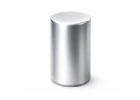
- Ferrite cylinders
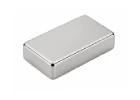
- Ferrite blocks
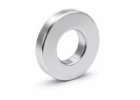
- Ferrite rings
- Coloured ferrite magnets
- Selection by pull force
- Selection by temperature resistance
- Pull force up to 0.3 kg
- Pull force 0.3 to 1 kg
- Pull force 1 to 2 kg
- Pull force 2 to 5 kg
- Pull force 5 to 15 kg
- Pull force 15 to 50 kg
- Temperature resistance 151 to 200 °C
- Temperature resistance 201 to 350 °C
- Office magnets
- Magnetic boards
- Sweepers with ferrite magnets
- Heat-resistant magnets
- Neodymium magnets
- All magnets
Frequently asked questions about ferrite magnets
It is the manufacturing process. Isotropic ferrite is pressed without an aligning magnetic field, so its magnetic domains point in all directions and the finished magnet is weaker, but it can be magnetised in more than one direction. Anisotropic ferrite is pressed in a magnetic field, so the domains are aligned and the magnet is considerably stronger, but only along that one axis.
For three reasons: price, heat and corrosion. Ferrite costs a fraction of neodymium per piece, works at 151 to 200 °C and in part of the range beyond 200 °C where ordinary neodymium fails at around 80 °C, and being a ceramic oxide it does not rust, so it needs no protective plating. The price is a lower force per millimetre, which means a physically larger magnet for the same hold.
Most pieces in this range hold under 1 kg, which suits notes, papers, light signage and board work. A smaller group covers 1 to 5 kg and a few large magnets reach the 15 to 50 kg band. As always the figure applies to direct contact with thick, clean steel, so allow 2 to 3 times the weight you actually need to hold.
Not with ordinary tools. Ferrite is a hard ceramic that can only be machined with diamond tooling, and it is brittle at the same time, so it chips and cracks under a standard drill or saw. Choose the dimension from the catalogue or ask us about a custom piece rather than modifying a finished magnet.
No. They are made from ceramic oxides and do not corrode, which is why they are sold bare while neodymium magnets always carry a nickel, epoxy or rubber layer. The only drawback of the raw surface is that it is black and slightly dusty, so it can mark light paintwork or paper. For visible use, the coloured versions solve that.
Ferrite is the classic black magnet, and it is still the right answer whenever price, heat or corrosion matter more than maximum force. Our range covers cylinders, blocks, rings and coloured office magnets, with temperature ratings of 151 to 200 °C and part of the range beyond 200 °C, a pull force from a few grams up to the 15 to 50 kg band, and prices starting at a few cents per piece. Because ferrite is a ceramic oxide, it does not rust and needs no protective plating at all.


