
Ferrite magnets blocks - perpendicular to the surface
Ferrite block magnets with magnetization perpendicular to the contact surface provide a smart and economical solution for many applications where reliable holding force and simple construction are important. This magnetization direction concentrates the magnetic force directly at the contact surface, making the magnets suitable for mounting, securing sheet metal and structural components, or use in assembly systems.

Product sorting
Brands
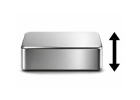
Height C range (mm)
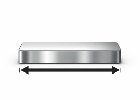
Length A range (mm)
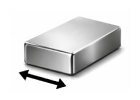
Width B range (mm)
Tearing force range (kg)
Temperature resistance range
List of products


Listing controls
1Read the dimensions and the magnetisation together
Blocks are described as length A, width B and height C, so a magnet listed as 20x20x5 is 20 mm long, 20 mm wide and 5 mm high. All three can be filtered separately on this page.
The category name tells you the rest: these blocks are magnetised perpendicular to the surface, through the height C. The two large A x B faces are the poles, and that is where the magnet holds. A flat block does not hold on its narrow edge.
2Use the block shape where a disc will not fit
The practical reason to choose a block over a cylinder is the footprint. A long block spreads its hold along a line, which suits door edges, frames, profiles and anywhere a round magnet would leave the panel free to pivot around a single point.
Lengths in this range reach up to the 65 to 150 mm band, so there are pieces that cover a whole edge rather than a spot.
3Choose the force band honestly
Ferrite blocks span the widest force range of the ferrite shapes, from under 0.3 kg up to the 15 to 50 kg band. The largest pieces are the only ferrite magnets in the shop that reach genuinely industrial holding force.
Allow the usual reserve of 2 to 3 times the weight, and remember that a large block reaching 15 kg or more is still a brittle ceramic that must not be allowed to snap onto steel.
4Plan the fixing before ordering
Ferrite cannot be drilled or cut with ordinary tools, so the mounting has to work with a complete block:
- Bond with two-component epoxy onto a clean, degreased flat surface.
- Recess into a milled pocket about 0.2 mm larger than the A x B footprint.
- Clamp with a strip, a plate or a frame that holds the block without loading its edges.
The larger the block, the more important it is that it sits on a genuinely flat surface. A block touching only at the corners cracks under the first real load.
5Take advantage of the material
Ferrite is rust proof and keeps working at 151 to 200 °C and in part of the range beyond 200 °C, where standard neodymium has long given up. For a warm workshop, an unheated outbuilding or a damp corner, a ferrite block will simply keep working without any coating to fail.
Tip: Two long blocks facing each other with opposite poles hold far more than one block on sheet metal, and they spread the load along the whole edge. For a large lid or a light cover, that pairing usually beats moving up to a single, more expensive magnet.
Related categories to the Ferrite block magnets category
- Selection by pull force
- Selection by length A
- Selection by width B
- Selection by height C
- Pull force up to 0.3 kg
- Pull force 0.3 to 1 kg
- Pull force 1 to 2 kg
- Pull force 2 to 5 kg
- Pull force 5 to 15 kg
- Pull force 15 to 50 kg
- Length 10 to 15 mm
- Length 15 to 20 mm
- Length 20 to 25 mm
- Length 65 mm and more
- Width 5 to 10 mm
- Width 10 to 15 mm
- Height up to 5 mm
- Height 5 to 10 mm
- Ferrite cylinders
- All ferrite magnets
Frequently asked questions about ferrite block magnets
The magnetic field runs through the height C, at a right angle to the large A x B face. The two large faces are therefore the poles and the block holds on them, not on its narrow edges. A block listed as 20x20x5 holds on the 20x20 face.
When the shape of the contact matters. A long block holds along a line, which stops a panel pivoting the way it can around a single round magnet, and it fits narrow edges, frames and profiles where a disc would not. Lengths here reach the 65 to 150 mm band, so a single block can cover a whole edge.
They cover the widest range of the ferrite shapes, from under 0.3 kg up to the 15 to 50 kg band. The largest blocks are the only ferrite magnets in the shop that reach genuinely industrial force. Allow 2 to 3 times the weight you need to hold, since the rating assumes direct contact with thick, clean steel.
No. Ferrite is a hard ceramic that needs diamond tooling and is brittle at the same time, so an ordinary saw or grinder simply breaks it. Choose a shorter piece from the catalogue, combine several smaller blocks along the edge, or ask us about a custom dimension.
Yes, and that is one of their real advantages. Ferrite is a ceramic oxide that does not rust, so unlike neodymium it needs no protective plating that could chip and let corrosion start. It also keeps working at temperatures well above 150 °C. Protect it from impact rather than from moisture.
Ferrite blocks are the strongest shape in our ferrite range, reaching from a few grams up to the 15 to 50 kg band, with lengths that run to the 65 to 150 mm class so a single piece can hold along a whole edge. All of them are magnetised perpendicular to the large face, so you always know which side holds. Length, width and height are filterable separately, and because ferrite is a rust proof ceramic rated well above 150 °C, these blocks work in damp and warm places where a neodymium magnet would need a coating that can fail.


