
Ferrite magnets, annular - parallel to the axis
Ferrite ring magnets with magnetization along parallel axes provide an efficient and economical solution for structural applications where the magnet is mounted around a shaft, pin, or hole and the magnetic field is oriented along the axis. This ensures strong and stable holding even with thin walls or when mounted in a hole. Our range includes ring magnets with various outer and inner diameters, heights, and grades (e.g. Y30, Y35), with operating temperatures of up to +250 °C.

Product sorting
Brands
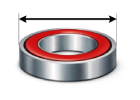
Diameter range A (mm)
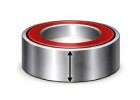
Height C range (mm)
Inner diameter range B (mm)
List of products


Listing controls
1Read the three dimensions
Ring magnets are described by the outer diameter A, the inner diameter B and the height C. All three can be filtered separately on this page, which matters because with a ring the hole is usually what decides the purchase.
The magnetisation runs parallel to the axis, so the poles sit on the two flat annular faces and the ring holds on its face, not on the inner or outer rim.
2Start from the hole
The whole point of a ring is the hole in the middle, so choose the inner diameter first and the outer diameter second. The range covers inner diameters from the 6 to 10 mm band up to over 30 mm.
Always leave clearance rather than aiming for a tight fit. Ferrite is brittle, and a screw or a shaft forced through an undersized hole will crack the ring instead of seating in it.
3Accept what the hole costs in force
The hole removes material from the centre of the magnet, which is where the field is strongest. A ring therefore holds less than a solid cylinder of the same outer diameter and height, and the difference grows as the hole gets larger.
Compare the stated pull force of the specific ring rather than estimating from the outer size, and apply the usual reserve of 2 to 3 times the weight to be held.
4Mount it without clamping force
A ferrite ring is a ceramic, not a steel washer, and it cannot be tightened down like one:
- Always use a large washer that spreads the load across the flat face.
- Use a cylindrical or pan head, never a countersunk screw. The hole is straight through, so a tapered head wedges against the edge and splits the ring.
- Tighten by hand, and use a thread locking compound for vibration instead of more torque.
5Use it where ferrite belongs
A ferrite ring is the practical choice when you need a screw fixing in a place that is warm, damp or simply needs a lot of cheap pieces. It will not rust and it keeps working well above 150 °C, so there is no plating to chip and no corrosion to start.
Tip: If the screw is only there to stop the magnet sliding and the real load is a straight pull, a solid ferrite cylinder bonded into a pocket holds more for the same outer diameter. Use a ring when you genuinely need something to pass through the centre.
Related categories to the Ferrite ring magnets category
- Selection by outer diameter A
- Selection by inner diameter B
- Selection by height C
- Inner diameter 6 to 10 mm
- Inner diameter 10 to 15 mm
- Inner diameter 30 mm and more
- Outer diameter 15 to 20 mm
- Outer diameter 20 to 25 mm
- Outer diameter 25 to 30 mm
- Outer diameter 55 mm and more
- Height up to 5 mm
- Height 5 to 10 mm
- Height 10 to 15 mm
- Height 15 to 20 mm
- Height 20 to 25 mm
- Selection by pull force
- Ferrite cylinders
- Ferrite blocks
- Neodymium ring magnets
- All ferrite magnets
Frequently asked questions about ferrite ring magnets
On the two flat annular faces. These rings are magnetised parallel to the axis, so the field runs through the height and the magnet holds on its face. The inner and outer rims are magnetically neutral, which means the ring will not grip a shaft passing through the hole.
The inner diameter, because that is what has to clear your screw or shaft. The range runs from the 6 to 10 mm band up to holes over 30 mm. Always leave clearance instead of aiming for a tight fit; ferrite is brittle and a forced fit cracks the ring rather than seating it.
No. The hole runs straight through and is not countersunk, so a tapered head wedges against the brittle ceramic edge and splits it as you tighten. Use a cylindrical or pan head screw with a large washer that spreads the load across the flat face, and tighten by hand only.
Yes. It removes material from the middle of the magnet, where the field is strongest, so a ring holds less than a solid cylinder of the same outer diameter and height, and the gap widens as the hole gets larger. Compare the pull force stated for the specific ring rather than estimating from its outer size.
For price, heat and corrosion. A ferrite ring costs a fraction of the neodymium equivalent, works at temperatures well above 150 °C and does not rust, so there is no plating to chip. If you need maximum force from the smallest possible ring at normal temperature, the neodymium version is the better answer.
A ferrite ring gives you a ready-made hole through a magnet that never needs drilling, which matters doubly with ferrite, since the material can only be machined with diamond tooling. Our rings are magnetised parallel to the axis, with inner diameters from the 6 to 10 mm band up to over 30 mm and outer diameters reaching beyond 55 mm. Outer diameter, hole and height are filterable separately, and being a rust proof ceramic rated well above 150 °C, these rings work where a plated magnet would eventually corrode.


