
Office magnets
In our e-shop, you will find a wide range of magnets and magnetic accessories suitable for offices. In addition to ordinary magnets, you may also find the following useful: magnets, magnetic letters, magnetic numbers, or magnetic pockets for storing important documents.




Product sorting
Brands
Material
Tearing force range (kg)
Temperature resistance range
List of products


1Decide what the magnet has to hold
Office magnets work in a narrow and very practical force range, from under 0.3 kg up to 5 kg. That is enough for everything a board or a fridge normally carries, and the choice is simpler than it looks:
- Up to 0.3 kg: single sheets, notes, photos, small cards.
- 0.3 to 1 kg: several sheets at once, plans, laminated documents.
- 2 to 5 kg: thick bundles, folders, anything you do not want sliding down the board.
If papers keep slipping, the answer is usually a stronger magnet rather than a bigger one.
2Choose the material with the use in mind
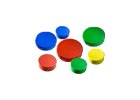
Roughly half the range is ferrite, the classic coloured office magnet, cheap enough to buy by the box and perfectly adequate for notes and board work. The other half is neodymium, which holds far more from a much smaller body.
Use ferrite where you need many pieces and a bit of colour, and neodymium where a small magnet has to hold a heavy bundle or where the magnet should stay visually discreet.
3Pick the diameter for the fingers, not just the force
Coloured office magnets come in 16, 20 and 26 mm. The difference matters less for holding power than for handling: a 16 mm disc is fiddly to lift off a board, while a 26 mm one can be grasped comfortably and repeatedly all day.
If the magnets will be moved constantly, as in a planning board or a classroom, go up a size. If they should disappear visually behind the paper, go down.
4Protect the board and the paper
A bare neodymium magnet dragged across a whiteboard scratches it, and raw ferrite has a slightly dusty surface that leaves grey marks on light paper over time.
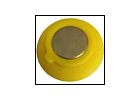
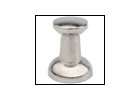
That is what the cased versions are for: magnets in a plastic, metal or silicone case give you a soft or smooth contact face, a comfortable grip and a much longer life for the board underneath. For coloured coding, the coloured ferrite discs and the cone magnets do the same job in a more visible way.
5Do not forget the symbols
Half the value of a planning board comes from what the magnets say, not how much they hold. The range includes magnetic numbers, letters, arrows and emoticons, with arrows supplied as sets of 8 in A4 format and emoticons in 60 mm sets, which turn a plain board into something a team can actually read at a glance.
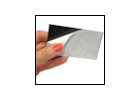
Tip: Before buying, check that your board is actually steel. Many modern whiteboards and glass boards are not magnetic at all, and no magnet will help. Hold a paperclip against the surface: if it does not stick, you need a magnetic foil, a magnetic paint or a different board rather than stronger magnets.
Related categories to the Office magnets category
- Coloured ferrite magnets
- Strong neodymium office magnets
- Coloured neodymium cone magnets
- Magnets in a plastic case
- Magnets in a metal case
- Magnets in a silicone case
- Small magnets
- Magnetic numbers
- Magnetic letters
- Magnetic arrows
- Magnetic emoticons
- Business card magnets
- Magnets for the board
- Fridge magnets
- Magnetic boards
- Magnetic pockets
- Magnetic labels
- Magnetic office strip
- Self-adhesive magnetic foils
- All magnets
Frequently asked questions about office magnets
For single sheets and notes, the band up to 0.3 kg is enough. For several sheets at once or laminated documents, choose 0.3 to 1 kg. For thick bundles and folders, go to the 2 to 5 kg band. Remember that the stated figure applies to clean, thick steel; a painted board reduces it, which is why papers sometimes slide with a magnet that looks strong on paper.
Ferrite for quantity and colour: it is the classic coloured office magnet, cheap enough to buy by the box and perfectly adequate for notes. Neodymium where a small magnet has to hold a heavy bundle, since it delivers several times more force from the same size of body. Roughly half our office range is each, so you can mix them as the task requires.
A bare magnet dragged across the surface can scratch it, and raw ferrite leaves faint grey marks on light surfaces over time. Magnets in a plastic, metal or silicone case solve both problems: the contact face is soft or smooth, and they are easier to lift off rather than slide. Always lift an office magnet rather than dragging it.
Test it with a paperclip: if nothing sticks, the board has no steel in it and no magnet will work, however strong. The solution is to add a magnetic surface rather than a stronger magnet. A self-adhesive magnetic foil, a magnetic board or magnetic paint all create a surface that magnets will hold on to.
The coloured discs come in 16, 20 and 26 mm. Choose by how often they will be handled rather than by force: a 16 mm disc is fiddly to pick off a board, while 26 mm is comfortable to grasp repeatedly, which matters on a planning board or in a classroom. Smaller sizes look more discreet behind the paper.
Our office range covers everything a board, a fridge or a planning wall needs: coloured ferrite discs in 16, 20 and 26 mm, strong neodymium office magnets for heavy bundles, magnets in plastic, metal and silicone cases that will not mark the board, and numbers, letters, arrows and emoticons for boards people actually read. Pull force runs from under 0.3 kg to 5 kg and prices start at a few cents per piece, so equipping a whole office costs less than most people expect.


