
Neodymium magnets cylinders with hole
We also offer magnets with holes for countersunk screws. We recommend purchasing magnets with holes, as drilling into magnets is not recommended due to their fragility and high likelihood of cracking.
Product sorting
Brands
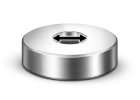
Diameter D1 (mm)
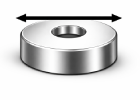
Diameter range A (mm)
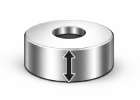
Height range B (mm)
Tearing force range (kg)
Temperature resistance range
List of products


Listing controls
1Start from the screw, not from the magnet
The parameter D1 is the diameter of the through hole at the narrow end, and it decides which screw fits. The range uses three values: 3.4 mm for an M3 screw and 4.3 or 4.5 mm for an M4 screw.
The hole is countersunk on the front face, so the head of a countersunk screw sits flush with the surface of the magnet and nothing sticks out into the contact area. That is the whole point of this design, and it only works with a countersunk head.
2Pick the outer diameter for the force you need
All the discs in this category are low, roughly 3 to 5 mm tall, so the pull force follows the diameter. The range runs from 8 mm up to 50 mm across and the force from under a kilogram to 15 kg.
Work with a reserve of 2 to 3 times the weight to be held, and remember the figure applies to direct contact with thick, clean steel. A screw head sitting proud, paint or a thin sheet will all cut into it.
3Never make the hole yourself
The hole in these magnets is made in the blank before magnetisation and before plating. Drilling into a finished magnet cracks it, destroys the coating so corrosion starts at the damage, and the heat from the drill demagnetises the material permanently.
If none of the stocked diameters fits your design, ask us for a custom piece rather than modifying a standard one.
4Mount it without cracking it
- Use a countersunk head screw matching the D1 value, never a pan or cap head.
- Tighten by hand until the magnet seats, then stop. NdFeB does not tolerate clamping force the way steel does.
- Seat the magnet on a flat, clean surface; a magnet bridging an uneven surface splits at the first load.
- For vibrating assemblies use a thread locking compound instead of more torque.
5Decide what the magnet will hold on to
These magnets are standard N grade for use up to roughly 80 °C. They reach their rated force against a solid steel plate, and much less against thin sheet, a painted surface or another screwed magnet whose head stands proud.
Tip: The cleanest pairing is magnet against a plain steel counterplate, not magnet against magnet. Two screwed magnets have to meet with opposite poles facing, and if anyone reassembles the part the wrong way round they will push each other apart instead of closing.
Related categories to the Cylinders with hole category
- Selection by pull force
- Selection by diameter A
- Selection by height B
- Selection by hole diameter D1
- Hole D1 3.4 mm, for M3
- Hole D1 4.3 mm, for M4
- Hole D1 4.5 mm, for M4
- Pull force 0.3 to 1 kg
- Pull force 1 to 2 kg
- Pull force 2 to 5 kg
- Pull force 5 to 15 kg
- Diameter 5 to 10 mm
- Diameter 10 to 15 mm
- Diameter 15 to 20 mm
- Diameter 20 to 25 mm
- Diameter 25 to 30 mm
- Height up to 5 mm
- Blocks with hole
- Magnetic fastening kits
- Counterpart to magnet with hole
Frequently asked questions about cylinder magnets with a hole
The hole diameter is listed as D1. The range uses 3.4 mm for an M3 countersunk screw and 4.3 or 4.5 mm for an M4 countersunk screw. You can filter the whole category by this value, so the quickest route is to pick the screw you already use and let the filter show you the matching diameters.
Yes. The hole is countersunk on the front face specifically so that the head of a countersunk screw sits flush with the magnet. A pan or cap head would stand proud, which pushes the magnet away from the steel it is supposed to hold and wedges against the brittle edge as you tighten it.
Because it does not survive it. The hole in these products is machined into the blank before the magnet is magnetised and plated. Drilling a finished magnet cracks the brittle material, breaks the corrosion protection and the heat from the drill causes a permanent loss of force. Buying the magnet with the hole already in it is always cheaper than replacing several broken ones.
From under a kilogram for the smallest 8 mm disc up to 15 kg for the largest sizes. Because all of them are low discs of about 3 to 5 mm, the force follows the outer diameter. Allow a reserve of 2 to 3 times the weight you need to hold, since the stated figure applies to direct contact with a thick, clean steel plate.
Against a plain steel counterplate in most cases. Two magnets facing each other hold more, but only if they are mounted with opposite poles facing, and anyone who reassembles the part the wrong way round will end up with two magnets pushing each other apart. A steel counterpart works in any orientation.
These discs have the countersunk hole machined before magnetisation and plating, which is the only way to get a screw through a neodymium magnet without cracking it. Diameters run from 8 to 50 mm, the hole diameter D1 is 3.4 mm for M3 or 4.3 and 4.5 mm for M4, and pull force reaches 15 kg. Every product states the diameter, height, hole size, pull force, coating and maximum working temperature, and you can filter the category by the screw size you already use.


