
Neodymium cylinder magnets

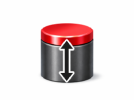


Product sorting
Brands
Diameter range A (mm)
Height range B (mm)
Tearing force range (kg)
Temperature resistance range
List of products


1Read the two numbers in the name as diameter and height
A cylinder described as dia.10x5 has a diameter A of 10 mm and a height B of 5 mm. The filters on this page use the same two letters, so you can narrow the range by diameter and by height independently.
Cylinders are magnetised parallel to the axis: the poles sit on the two circular faces and the magnet holds on its flat end. A few pieces in the range are magnetised radially, with the poles on the curved side surface, and those have the word radial in the product name.
2Pick the proportion of height to diameter for your job
A flat disc, meaning a cylinder whose height is a small fraction of its diameter, gives a strong hold in direct contact but drops off sharply as soon as anything separates it from the steel. A taller cylinder holds less in direct contact per millimetre of diameter, but keeps far more of its force across a gap.
Discs suit contact holding on clean steel, in office and display use. Choose a taller cylinder when the magnet will work through a wall of plastic, wood or a coat of paint.
3Choose the pull force with a reserve
The stated value applies to direct contact with a thick, flat, clean steel plate and a pull perpendicular to the surface. Sheet metal thinner than the magnet, paint, dust, rust and side loading all reduce it noticeably.
Work with 2 to 3 times the weight you actually need to hold. For a name plate, a light cover or a sensor, 0.3 to 2 kg is usually enough; above 15 kg the pieces are already difficult and risky to separate by hand.
4Check the maximum working temperature
Most cylinders in the range are standard N grade for use up to roughly 80 °C. The range also covers 81 to 120 °C, 121 to 150 °C and 151 to 200 °C, and a handful of pieces rated beyond 200 °C. Temperature resistance is a property of the grade, not of the size, so a larger magnet does not survive more heat than a small one.
5Plan the seat before you order
- Drilled or milled pocket: make it about 0.1 to 0.2 mm larger than the magnet diameter and bond the magnet in with epoxy.
- Screw fixing: choose a cylinder with a hole, which is made before magnetisation.
- Gluing to a flat surface: a plain cylinder, or a self-adhesive version with the tape already applied.
- Pot magnets: where you need the highest pull force from the smallest face, a magnet in a steel housing beats a bare cylinder of the same diameter.
6Handle the pieces safely
Cylinders stack easily and pull together hard along the axis. Slide two cylinders apart sideways instead of pulling them straight off, keep larger pieces separated with spacers, and never let a big magnet snap onto a steel surface with your fingers between the two. NdFeB is brittle and chips on impact.
Tip: When you need a cylinder to sit flush in a hole, order one diameter step smaller and fill the gap with adhesive. A magnet forced into a tight hole cracks, and a cracked coating starts to corrode within weeks in a damp place.
Related categories to the Neodymium cylinder magnets category
- Selection by diameter A
- Selection by height B
- Selection by pull force
- Selection by temperature resistance
- Pull force up to 0.3 kg
- Pull force 0.3 to 1 kg
- Pull force 1 to 2 kg
- Pull force 2 to 5 kg
- Pull force 5 to 15 kg
- Pull force 15 to 50 kg
- Pull force 50+ kg
- Diameter A up to 5 mm
- Diameter A 5 to 10 mm
- Diameter A 10 to 15 mm
- Height B up to 5 mm
- Temperature resistance 41 to 80 °C
- Temperature resistance 151 to 200 °C
- Cylinders with hole
- Self-adhesive cylinder magnets
- Flat cylinder magnets
Frequently asked questions about neodymium cylinder magnets
On the two circular faces. Cylinders are magnetised parallel to the axis, so the magnet holds on its flat end and the curved side surface is magnetically neutral. Radially magnetised pieces, with the poles on the side surface, are a separate design and carry the word radial in the product name.
The first number is the diameter A and the second the height B, both in millimetres. A dia.10x5 magnet is therefore a disc 10 mm across and 5 mm tall. Product names also carry the coating and the grade, for example N for nickel or Z for zinc, followed by the maximum working temperature and the material grade.
It depends on the gap. In direct contact with clean steel, a wide flat disc gives more pull force for the same volume of material. As soon as there is an air gap, a coat of paint or a plastic wall between the magnet and the steel, the taller cylinder keeps far more of its force. For holding through any kind of cover, choose height over diameter.
Drill the hole about 0.1 to 0.2 mm larger than the magnet diameter and bond the magnet in with two-component epoxy. Never press a magnet into an interference fit: the material is brittle and cracks, and damaged plating starts to corrode. If the magnet must be removable, use a version with a hole and a screw instead.
Not without protection. The standard Ni-Cu-Ni plating is designed for dry interiors and corrodes in prolonged damp. For wet and outdoor use choose an epoxy or rubberised version, or a magnet enclosed in a steel or plastic pot. Dry the magnet after every contact with water and watch for chips in the plating, because corrosion starts there.
Standard N grade cylinders work up to roughly 80 °C, and the range also covers 81 to 120 °C, 121 to 150 °C and 151 to 200 °C, plus a few pieces for even higher temperatures. Check the value in the parameters of the specific product, because temperature resistance follows the grade and not the size of the magnet.
Our neodymium cylinder magnets start at a diameter of under 5 mm and go up to pieces over 55 mm across, with heights from 1 mm discs to 40 mm columns and a pull force from a few grams to more than 50 kg. The standard design is magnetised parallel to the axis, with radially magnetised pieces available as well. Diameter A and height B can be filtered separately, and every product states its grade, pull force, coating and maximum working temperature.


