
Neodymium annular magnets
Product sorting
Brands
Diameter range A (mm)
Height C range (mm)
Inner diameter range B (mm)
Tearing force range (kg)
Temperature resistance range
List of products


1Read the three numbers in the right order
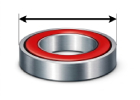
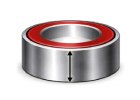
Ring magnets are described as outer diameter A, inner diameter B and height C. A magnet listed as dia.19,4x dia.5,1x16 is therefore 19.4 mm across, has a 5.1 mm hole through the middle and stands 16 mm tall.
All three can be filtered separately on this page, which matters because the hole usually decides the choice: the screw comes first, the outer diameter second.
2Choose the inner diameter according to the screw
The hole needs clearance, not a tight fit. A 5.1 mm hole takes an M5 screw, a hole between 3 and 6 mm covers M3 to M5, and a hole between 6 and 10 mm covers M6 to M8. Most of the range sits in these two bands.
Never force a screw through a hole that is too small. The magnet will crack, and even a hairline crack means a permanent loss of force in that piece.
3Know what the hole costs you in pull force
The hole removes material from the centre of the magnet, which is exactly where the field is strongest. A ring therefore holds less than a solid cylinder of the same outer diameter and height.
Compare the stated pull force of the specific ring rather than assuming it matches a cylinder of the same size. Rings in this range reach well over 50 kg, but most of them fall between 5 and 50 kg.
4Plan the screw head and the seating
The hole in a ring magnet is straight through, not countersunk. A countersunk screw head will stand proud of the surface and, worse, will wedge against the brittle edge and split the magnet as you tighten it.
- Use a cylindrical or pan head screw with a large washer that spreads the load across the face.
- Tighten by hand, not with an impact driver, and stop as soon as the magnet seats.
- Where you need a flush countersunk head, choose a cylinder with a countersunk hole instead of a ring.
5Check the working temperature and the coating
Rings are available from the standard N grade for use up to roughly 80 °C through to grades rated for 200 °C. Since rings often end up in motors, pumps and rotating assemblies where the temperature climbs, check the value in the parameters rather than assuming the standard 80 °C. Standard Ni-Cu-Ni plating suits dry interiors; for damp environments choose an epoxy or rubberised version.
6Handle the thin wall with care
A ring with a large hole has a thin wall that breaks more easily than a solid magnet of the same size. Keep rings apart with spacers, slide them off steel sideways rather than pulling them straight up, and never let two rings snap together across a gap.
Tip: If the screw fixing is only there to stop the magnet sliding and the real load is a straight pull, a solid cylinder bonded into a pocket will hold more for the same diameter. Use a ring when you genuinely need the fastener through the centre.
Related categories to the Neodymium ring magnets category
- Selection by outer diameter A
- Selection by inner diameter B
- Selection by height C
- Selection by pull force
- Inner diameter up to 3 mm
- Inner diameter 3 to 6 mm
- Inner diameter 6 to 10 mm
- Inner diameter 10 to 15 mm
- Outer diameter 15 to 20 mm
- Outer diameter 25 to 30 mm
- Outer diameter 55 mm and more
- Height C up to 5 mm
- Height C 15 to 20 mm
- Pull force 0.3 to 1 kg
- Pull force 2 to 5 kg
- Pull force 5 to 15 kg
- Pull force 15 to 50 kg
- Pull force 50+ kg
- Cylinders with hole
- Magnetic fastening kits
Frequently asked questions about neodymium ring magnets
They are the outer diameter A, the inner diameter B and the height C, in that order. A ring listed as dia.19,4x dia.5,1x16 measures 19.4 mm across the outside, has a 5.1 mm hole and stands 16 mm tall. All three dimensions can be filtered separately on this page.
A hole of 5.1 mm takes an M5 screw, a hole between 3 and 6 mm covers M3 to M5 and a hole between 6 and 10 mm covers M6 to M8. Always leave clearance rather than aiming for a tight fit. A screw forced through an undersized hole splits the magnet, and a cracked magnet permanently loses part of its force.
No. The hole in a ring magnet runs straight through and is not countersunk, so a tapered head wedges against the brittle edge and cracks the magnet as it is tightened. Use a cylindrical or pan head screw with a large washer, or choose a cylinder magnet with a ready-made countersunk hole if you need the head to sit flush.
Yes. The hole removes material from the middle of the magnet, where the field is strongest, so a ring holds less than a solid cylinder of the same outer diameter and height. The difference grows as the hole gets larger. Compare the pull force stated for each specific ring rather than estimating it from the outer size.
Only enough to seat the magnet. NdFeB is brittle and does not tolerate clamping force the way steel does, so tighten by hand, always use a washer that spreads the load across the face, and avoid impact drivers. If the assembly vibrates, use a thread locking compound rather than extra torque.
They are commonly used there, but check the maximum working temperature first, because the temperature inside a running motor is often well above 80 °C. The range covers rings rated up to 200 °C. Also secure the magnet mechanically rather than relying on adhesive alone, since centrifugal force acts in shear.
Our neodymium ring magnets cover outer diameters from 5 mm to over 100 mm, with holes from under 3 mm up to 30 mm and more, so you can match the magnet to the screw rather than the other way round. Pull force reaches from under a kilogram to more than 50 kg and the range includes grades rated up to 200 °C for motors and rotating assemblies. Outer diameter, inner diameter and height are each filterable on their own, and every product lists its grade, pull force, coating and maximum working temperature.


