
What is a hopper magnet?
Hopper Magnets for Injection Moulding Machines: Protecting Equipment from Metal Contaminants
A hopper magnet is an industrial magnetic grid that captures ferromagnetic contaminants from dry granulate, regranulate or shredded material before they enter the injection moulding machine. It helps protect the screw, nozzles and other sensitive parts of the equipment from damage caused by metal particles.
- Learn how a hopper magnet works.
- Find out which contaminants it can capture.
- Compare the ECO, Standard, Plastic and UP versions.
- Learn how to choose the correct diameter and number of magnetic rods.
- See how to position the separator correctly inside the hopper.
- Learn the safe cleaning and inspection procedure.
- Explore recommended products and frequently asked questions.
When processing plastic granulate, regranulate and shredded plastics, the material may contain metal shavings, wires, screw fragments or fine ferromagnetic dust. These contaminants can originate from previous crushing, transport, storage or wear on production equipment.
If a metal particle enters the injection moulding machine, it can damage the screw assembly, block the nozzle, spoil the product or cause downtime for the entire production line. A magnetic separator placed inside the hopper provides a simple form of protection that requires no electrical power.
What is a hopper magnet?
A magnet for an injection moulding machine hopper, also referred to as a magnetic hopper grid, is an assembly of several magnetic tubes arranged to cover as much of the hopper cross-section as possible.
Powerful permanent neodymium magnets are installed inside each tube. Their magnetic field passes through the protective casing and attracts iron and steel particles from the material falling through the grid.
Main components of a hopper magnet
- magnetic rods or tubes,
- neodymium magnetic cores,
- protective stainless-steel or plastic casing,
- connecting frame or circular body,
- optional removable magnetic cores,
- handles that make the separator easier to insert and remove.
What is a hopper magnet used for?
- protecting the screw and nozzles of the injection moulding machine,
- capturing iron and steel contaminants,
- reducing the risk of equipment blockage,
- helping extend the service life of production equipment,
- improving the purity of granulate or regranulate,
- reducing the risk of metal particles in the final product,
- operating without electricity.
How does a magnetic grid work inside the hopper?
The magnetic grid is placed inside a conical or circular hopper so that the material cannot easily fall outside the active magnetic tubes.
- Dry granulate enters the upper section of the hopper.
- The material falls through the magnetic rods.
- The grid divides the flow and guides particles close to the magnetic field.
- Ferromagnetic contaminants are attracted to the surface of the tubes.
- The cleaned material continues into the injection moulding machine.
- Metal contaminants remain on the grid until it is cleaned.
Separation efficiency depends not only on magnetic performance but also on whether the grid actually covers the cross-section of the hopper. If a large open gap remains around it, some material may fall outside the effective magnetic field.
Why is it important to cover the entire hopper?
The magnetic field is strongest in the immediate vicinity of the magnetic tubes. A particle that falls along the edge of the hopper far away from the rods may not be captured even by a very powerful magnet.
A correctly selected separator should:
- match the internal diameter of the hopper,
- sit securely and horizontally,
- minimise open gaps around the perimeter,
- create a magnetic flow labyrinth,
- allow the material to fall through evenly,
- be easy and safe to remove for cleaning.
A stronger magnet will not compensate for poor installation
If granulate falls through a large gap outside the magnetic tubes, high magnetic flux density alone will not ensure reliable contaminant capture. Effective separation depends on a combination of magnetic performance and correct hopper coverage.
Which contaminants can a hopper magnet capture?
A magnetic grid is designed for ferromagnetic materials – metals that can be strongly attracted by a permanent magnet.
Typical captured contaminants
- iron shavings and filings,
- particles of ordinary magnetic steel,
- wire fragments,
- small pieces of screws and bolts,
- steel scale,
- fine ferromagnetic dust,
- particles caused by crusher or conveyor wear,
- smaller metal fragments from recycled material.
What will a hopper magnet not capture?
- aluminium,
- copper,
- brass and bronze,
- plastic,
- glass,
- wood,
- stone and sand without a ferromagnetic component,
- some grades of stainless steel,
- metal parts completely enclosed inside a larger piece of plastic.
A magnetic grid is not a replacement for a screen. If the material contains larger plastic pieces, stones, glass or other non-magnetic contaminants, suitable mechanical screening must be installed upstream.
Can a hopper magnet capture metal dust?
Under suitable conditions, powerful neodymium magnets can also capture extremely fine ferromagnetic dust. However, success depends on the amount of dust, flow speed and distance from the magnetic tube.
Excessive amounts of fine metal dust can quickly coat the magnetic tubes. Ordinary granulate may then begin to accumulate on the captured metal layer, potentially blocking the entire grid.
If there is a large amount of metal dust, it is advisable to:
- clean the grid more frequently,
- add another separation stage,
- identify and inspect the source of the metal dust,
- consider a stronger or easier-to-clean separator,
- regularly monitor hopper flow.
Which materials are hopper magnets suitable for?
The specific application depends on the product design. Hopper magnets for injection moulding machines are primarily intended for dry plastics-processing materials.
Most commonly processed materials
- plastic granulate,
- plastic regranulate,
- fine plastic regrind,
- dry rubber regranulate,
- suitable recycled polymers,
- other homogeneous and free-flowing mixtures according to the specific model.
Selected standard stainless-steel models can also be used for certain dry food-processing, agricultural or industrial mixtures. However, suitability must be explicitly stated for the specific product.
What properties must the processed material have?
The material must fall freely between the magnetic rods. The grid is not intended for mixtures that are sticky, form lumps or tend to bridge.
Suitable material is:
- dry,
- homogeneous,
- non-sticky,
- free from greasy coatings,
- free-flowing,
- free from large hard pieces,
- free from excessive amounts of fibres,
- within the permitted particle-size range.
Unsuitable material can cause:
- blockage of the gaps between the rods,
- stoppage of granulate flow,
- coating of the magnetic grid,
- mechanical damage to the tubes,
- a significant reduction in capacity,
- difficult and hazardous cleaning.
How large can the granulate be?
For UP and Plastic versions, dry material with a regular particle size of approximately up to 3 × 3 × 3 mm is generally required. Always check the exact limit on the product page.
A larger ferromagnetic object may be captured by the grid, but it should not fall onto it regularly. Larger pieces of normal material can damage plastic or thin-walled tubes.
When should a screen be installed upstream?
If larger pieces of material, stones or other hard objects cannot be reliably excluded, install a suitable screen before the magnetic grid. However, its use may reduce hopper throughput.
Material drop height
Because high magnetic performance requires a relatively thin casing, hard material falling from a great height can dent, crack or puncture the magnetic tubes.
The permitted height varies according to the construction:
- for plastic models, it may be limited to approximately 0.3 m,
- for more robust standard stainless-steel models, a greater height may be permitted,
- hard or abrasive materials require a lower drop height,
- if uncertain, the application should be discussed with the manufacturer.
Maximum drop height is not universal
The same drop height may be safe for lightweight plastic granulate but hazardous for hard regrind or material containing glass fibres.
Is a hopper magnet suitable for abrasive materials?
Abrasive particles can gradually wear both plastic and stainless-steel tubes. Materials containing glass fibres, hard mineral particles or sharp recycled fragments present a particularly high risk.
For conditionally permitted applications:
- inspect the casing before every cleaning cycle,
- look for scratches and thinning of the wall,
- reduce the drop height,
- remove and inspect the grid more frequently,
- take any damaged tube out of service immediately.
Is a hopper magnet suitable for continuous operation?
Standard magnetic hopper grids are cleaned manually. The material flow must be stopped during cleaning, so they are primarily designed for non-continuous or interruptible operation.
If production cannot be stopped regularly, possible alternatives include:
- two hoppers used alternately,
- an automatically cleaned separator,
- a rotary magnetic separator,
- a telescopic separator with easy cleaning,
- another continuous system designed for the specific production line.
Protecting the injection moulding machine or improving product purity?
Equipment protection
The magnet is positioned immediately before the material enters the injection moulding machine. It captures particles that could damage:
- the injection nozzle,
- the screw assembly,
- the injection moulding barrel,
- closing and dosing components,
- the mould or the finished moulded part.
Improving material purity
A magnetic grid can also be used at the end of a recycling or mixing process. The cleaned material is then enclosed in packaging or a container to prevent recontamination.
For high purity requirements, relying on a single magnetic separation stage is not recommended. Several separators positioned at different points in the production process may be more suitable.
Types of hopper magnets
ECO version
ECO is a simple stainless-steel magnetic grid with fixed magnetic cores. It is intended for less demanding facilities where very frequent cleaning is not required.
Advantages of ECO
- simple construction,
- more affordable purchase price,
- durable stainless-steel frame,
- easy insertion into the hopper,
- powerful neodymium magnets.
Disadvantages of ECO
- contaminants must be removed manually from the active tubes,
- cleaning a powerful grid can be more physically demanding,
- less convenient for frequent maintenance.
Plastic version
The Plastic version uses a circular body made from suitable plastic together with plastic magnetic tubes. The body follows the shape of a conical hopper more closely and reduces material bypass around the edges.
Advantages of Plastic
- good coverage of a circular hopper,
- low weight,
- easy handling,
- suitable for plastic granulate and regranulate,
- easy installation without complex mounting.
Limitations of Plastic
- lower temperature resistance than stainless-steel models,
- greater sensitivity to abrasive material,
- limited drop height,
- not automatically suitable for food-processing applications,
- plastic tubes require regular inspection.
Standard version
A standard stainless-steel grid has magnetic cores enclosed in protective tubes. On selected models, the cores can be removed from the tubes during cleaning.
Advantages of Standard
- robust stainless-steel construction,
- greater durability,
- higher magnetic performance available,
- easier contaminant release after removing the cores,
- selected versions suitable for food-processing applications,
- availability of different diameters and temperature classes.
UP version
The UP version is designed for better hopper coverage, easier handling and more convenient operation. Some UP models combine a circular plastic body with magnetic rods.
Advantages of UP
- good distribution of rods within the hopper,
- low weight of selected models,
- easy installation,
- suitable for specific conical hopper dimensions,
- reduced open flow paths around the grid.
Quick comparison of the versions
- ECO: simple and affordable stainless-steel grid.
- Plastic: lightweight circular version for plastic granulate.
- Standard: robust stainless-steel construction and more convenient cleaning.
- UP: design optimised for hopper coverage and easy handling.
How do you choose the correct diameter?
The diameter of the magnetic grid must match the internal dimensions of the hopper at the point where the separator will be installed.
Measurement procedure
- Empty the hopper and shut it down safely.
- Determine the height at which the magnetic grid will sit.
- Measure the internal diameter of the hopper at this point.
- Take measurements in several directions.
- Check the conical shape and any obstructions.
- Make sure the grid can be inserted and removed.
- Compare the dimensions with the specific product.
What happens if the magnet is too small?
An open gap will remain around the grid and material may fall outside the magnetic field. This reduces separation efficiency.
What happens if the magnet is too large?
It may not fit into the hopper, may become jammed or may damage the hopper walls. Forcing the grid into position is not permitted.
How many magnetic rods should you choose?
More rods create a denser magnetic labyrinth and a larger active surface. At the same time, however, they reduce the gaps through which the granulate must fall.
More rods may mean:
- a higher probability of capturing particles,
- better coverage of the cross-section,
- a larger magnetic surface,
- lower throughput with poorly flowing material,
- a greater risk of blockage with an unsuitable particle size.
The number of rods therefore cannot be selected in isolation. The hopper diameter, particle size, flowability and required capacity must all be considered.
Magnetic flux density and pull-off force
Magnetic flux density in Gs
Magnetic flux density describes the intensity of the magnetic field at a specific point on the tube surface. The highest value is usually found around the pole pieces.
Pull-off force in N
Pull-off force indicates the force required to separate a defined steel test piece from the magnetic tube.
Which parameter is more important?
Both parameters must be assessed together with the grid design.
- magnetic flux density affects the action on fine particles,
- pull-off force describes the ability to retain a particle,
- the number of rods affects the active surface,
- rod arrangement determines the flow labyrinth,
- regular cleaning maintains separator performance.
Values apply under defined measurement conditions
Actual performance is affected by the size and shape of the contaminant, contact area, distance, material velocity and the layer of previously captured metal.
How should a hopper magnet be installed correctly?
- Stop the material feed.
- Disconnect or safely shut down the injection moulding machine according to the operating procedure.
- Empty the hopper.
- Clean all contaminants from the magnetic grid.
- Inspect the condition of the tubes and body.
- Place the separator in its designated position.
- Make sure the magnetic rods are horizontal.
- Check stability and cross-section coverage.
- Remove loose metal objects from the surrounding area.
- Run a small test batch of material.
- Make sure the hopper does not become blocked.
Do the magnetic rods have to be horizontal?
Yes. The material should fall through the rods by gravity. An inclined or vertical position may create an open path outside the magnetic labyrinth or cause uneven loading.
How far away should steel structures be?
A powerful magnetic grid can attract nearby ferromagnetic structures. This can cause part of the magnetic field to close through the hopper, frame or support, reducing the magnetic effect on the material.
If installing the magnet in your own structure:
- use non-magnetic materials,
- observe the manufacturer's minimum distances,
- do not position the grid on a steel support,
- remove loose tools,
- make sure the separator can be removed safely.
How often should a hopper magnet be cleaned?
There is no universal interval. Cleaning frequency depends on the amount of metal contamination, material flow, number of rods and required purity.
Clean the grid before:
- the tubes become coated with a thick layer of metal,
- the gaps available for granulate begin to decrease,
- ordinary material begins to accumulate,
- the hopper starts to become blocked,
- some captured metal begins to be released,
- mechanical damage occurs to the tubes.
When using the magnet for the first time, inspect it after every smaller production batch. A regular cleaning interval can then be established according to the amount of captured metal.
Why does an overloaded magnetic grid lose efficiency?
Captured particles create a layer on the tube that increases the distance between new contaminants and the magnetic core.
An overloaded grid can:
- capture new particles with less force,
- restrict granulate flow,
- cause material bridging,
- release some metal back into the hopper,
- damage plastic or stainless-steel tubes.
How do you clean ECO and Plastic versions?
On versions with fixed magnetic cores, the magnetic force at the tube surface remains active throughout cleaning.
- Stop the material flow.
- Empty the area around the magnetic grid.
- Wear sturdy work gloves.
- Carefully remove the grid from the hopper.
- Move it over a container for metal contaminants.
- Slide larger pieces towards the ends of the magnetic tubes.
- Remove fine contaminants using a non-magnetic scraper or dry cloth.
- Inspect the condition of every tube.
- Return the grid to the correct position.
How do you clean the Standard version?
On selected standard grids, the magnetic cores can be separated from the protective tubes.
- Stop the material flow and remove the grid.
- Place it on a safe non-magnetic surface.
- Unlock the magnetic cores according to the instructions.
- Slowly pull them out of the protective tubes.
- Once the cores are moved away, the magnetic force at the tubes decreases significantly.
- The captured contaminants fall into the prepared container.
- Remove any remaining particles with a dry brush or cloth.
- Inspect the tubes and magnetic cores.
- Return the cores to their operating position and secure them safely.
Do not place magnetic cores on a steel workbench
Powerful neodymium magnets can suddenly snap towards a workbench, tool or steel structure, causing trapped fingers, damage to the core or making it very difficult to pull the magnet away again.
Can a hopper magnet be washed with water?
The cleaning method depends on the specific construction. Magnetic cores generally must not be immersed in water or cleaned using high-pressure water.
Depending on the instructions, dry cleaning methods may include:
- a dry cloth,
- a dry brush,
- a non-magnetic plastic scraper,
- thoroughly dried compressed air,
- a suitable cleaning fixture.
For food-processing applications, the cleaning method must also comply with the hygiene rules of the facility and the product's material documentation.
How should the condition of a hopper magnet be inspected?
- inspect the surfaces of the magnetic tubes,
- check for scratches, cracks and dents,
- monitor wear of the plastic body,
- inspect connections and core locking components,
- check that the grid is level and stable,
- regularly check magnetic flux density,
- verify pull-off force using the same measurement method,
- keep records of cleaning and the amount of captured metal.
When should the separator be taken out of service?
Do not continue using the grid if a tube is worn through, cracked or heavily dented, if a magnetic core becomes loose or if the plastic body is mechanically damaged.
Temperature resistance of hopper magnets
The maximum temperature varies considerably depending on the construction and magnets used.
- plastic versions may be designed for approximately 45 or 70 °C,
- standard stainless-steel grids often use magnets rated up to 80 °C,
- special high-temperature models may operate at temperatures up to 120 °C,
- the exact limit must always be verified for the selected product.
Exceeding the permitted temperature may permanently weaken the magnets, deform plastic components or shorten the service life of the separator.
At high temperatures, the entire separator becomes hot
For a model operating at 120 °C, ordinary work gloves are not sufficient. Handling requires suitable heat-resistant protective equipment and a safe operating procedure.
Is a hopper magnet suitable for food-processing applications?
Some stainless-steel models made from AISI 304 are specified by the manufacturer as suitable for food-processing applications. This does not automatically apply to every version.
It is necessary to verify:
- material of the body and tubes,
- suitability for food contact,
- surface finish,
- joint design,
- possibility of hygienic cleaning,
- temperature and chemical resistance,
- material documentation,
- internal HACCP requirements.
A plastic model designed exclusively for an injection moulding machine hopper may not be approved for food production even if its construction is similar to a food-processing magnetic grid.
Is a hopper magnet suitable for outdoor or ATEX environments?
Standard stock models are intended for indoor industrial use. They must not automatically be installed:
- outdoors,
- in permanently wet conditions,
- in potentially explosive atmospheres,
- in aggressive chemical environments,
- in environments exceeding the permitted temperature.
Specially designed and approved equipment must be used for ATEX environments.
How do you choose the right hopper magnet?
Prepare the following information before selecting a model
- internal hopper diameter,
- shape and angle of the conical section,
- type of processed material,
- regular and maximum particle size,
- bulk density,
- flowability and tendency to bridge,
- presence of glass fibres or abrasive additives,
- material drop height,
- operating temperature,
- required throughput,
- amount of ferromagnetic contamination,
- required cleaning frequency.
For lower weight and simple installation
A circular plastic version that follows the internal shape of the hopper may be suitable.
For higher temperatures and greater durability
Choose a standard stainless-steel grid with magnets rated for the maximum operating temperature.
For frequent cleaning
A model with removable magnetic cores or another system that makes captured contaminants easier to release is more practical.
For extremely fine particles
Consider magnetic flux density, pull-off force, rod arrangement and the number of separation stages. The highest Gs value alone does not necessarily guarantee the best result.
Safety when working with a hopper magnet
Basic safety rules
- Stop the material flow before inserting or removing the grid.
- Secure the injection moulding machine against accidental start-up.
- Wear work gloves and safety glasses.
- Do not place magnetic cores on steel surfaces.
- Remove loose metal tools from the surrounding area.
- Protect your fingers from being trapped.
- Do not immerse magnetic cores in water unless explicitly permitted by the manufacturer.
- Do not use high-pressure water.
- Do not exceed the maximum operating temperature.
- Do not continue using a damaged grid.
- Maintain a safe distance from sensitive electronics and measuring equipment.
- People with medical implants must observe the required safety distances.
Recommended hopper magnets
The selected products represent a lightweight UP plastic version for a large conical hopper, a compact 200 mm Plastic circular grid and a high-temperature DN 250 stainless-steel grid.
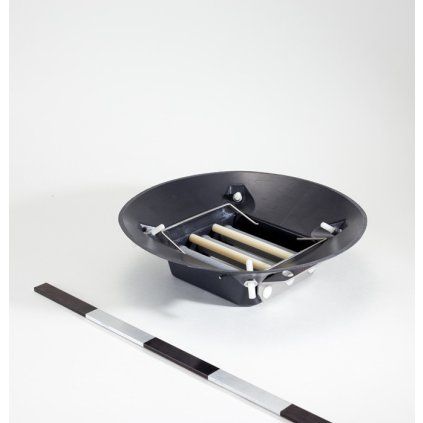
Magnet for injection moulding machine hopper UP – model M
Lightweight circular magnetic grid with a plastic body for cleaning dry plastic granulate, regranulate and fine regrind in an injection moulding machine hopper.
- Designation MDN 320 MVM UP – M
- Diameter DN 320
- 3 magnetic rods
- Rod diameter 23 mm
- Magnetic flux density on the tube 3,900 Gs
- Magnetic flux density at a distance of 1 mm 2,690 Gs
- Pull-off force on the tube 36 N
- NdFeB neodymium magnets
- ABS plastic body
- Weight approximately 1.5 kg
- Operating range −20 to +45 °C
- Not intended for food-processing applications
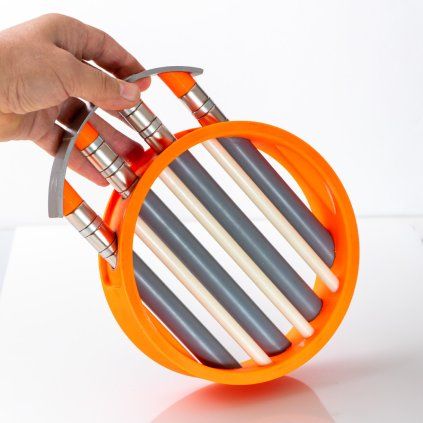
MDN 200 MVM-STEFF-STD, 4,530 Gs, 35.5 N
Circular magnetic separator with a PET body and plastic tubes that covers the inlet of a conical hopper with a diameter of 200 mm.
- Diameter DN 200
- 4 magnetic rods
- Magnetic rod diameter 22 mm
- Magnetic flux density 4,530 Gs
- Pull-off force 35.5 N on the tube
- NdFeB neodymium magnets
- PET body
- ABS tubes
- Weight approximately 1.4 kg
- Temperature resistance up to 70 °C
- Plastic version
- Designed for dry and free-flowing materials
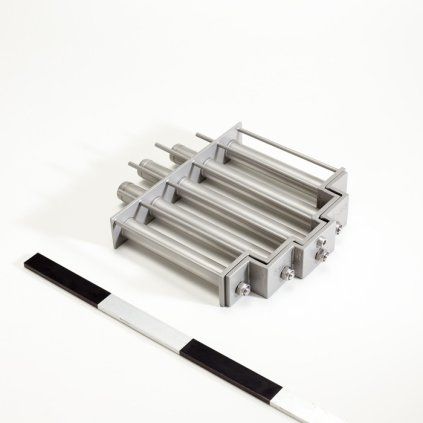
Hopper magnet DN 250, 120 °C
Robust stainless-steel magnetic grid with five rods and high-temperature neodymium magnets for dry industrial mixtures.
- Designation MDN 250 MVMT
- Diameter DN 250
- 5 magnetic rods
- Magnetic rod diameter 22 mm
- Magnetic flux density on the tube 5,100 Gs
- Magnetic flux density at a distance of 1 mm 3,600 Gs
- Pull-off force 50 N on the tube
- AISI 304 / 1.4301 stainless steel
- Weight approximately 3.6 kg
- Magnetic core weight approximately 2.7 kg
- Magnet temperature resistance up to 120 °C
- Specified by the manufacturer as suitable for food-processing applications
Choose the model according to the specific hopper and material
The same diameter does not necessarily mean the same throughput or durability. The number and spacing of rods, particle size, flowability, temperature, drop height and abrasiveness of the material are also important.
Frequently asked questions about hopper magnets
What is a hopper magnet?
A hopper magnet is a magnetic grid positioned before material enters an injection moulding machine. It captures ferromagnetic contaminants from dry granulate or regranulate.
Why is a hopper magnet used?
It protects the screw, nozzles and other parts of the injection moulding machine from damage caused by metal particles and helps improve the purity of the processed material.
Which metals can it capture?
Primarily iron, ordinary magnetic steel, cast iron, nickel, cobalt and their ferromagnetic alloys.
Will it capture aluminium?
No. Aluminium is not ferromagnetic and is not attracted by a permanent magnet.
Will it capture stainless steel?
Some grades of stainless steel may respond weakly, but a standard hopper magnet is not designed for reliable separation of weakly magnetic stainless-steel particles.
Will it capture extremely fine metal dust?
Yes. Under suitable conditions, it can also capture extremely fine ferromagnetic particles. However, large amounts of dust quickly coat the grid and require frequent cleaning.
Can the magnet be used for plastic granulate?
Yes. This is its primary application in the plastics industry.
Can it be used for regranulate?
Yes, provided that it is dry, free-flowing, non-sticky and within the permitted particle-size range.
Can the magnet be used for plastic regrind?
Yes, provided that it is fine, regular and does not contain long fibres or large sharp pieces that could block or damage the grid.
Can it be used for material containing glass fibres?
Use is risky because of abrasion. Glass fibres can gradually wear plastic or stainless-steel tubes.
Can the magnet be used for wet granulate?
No. Wet material may stick, form lumps and block the gaps between the rods.
Can it be used for liquids?
A standard injection moulding machine hopper magnet is intended for dry mixtures. Flow-type magnetic separators are used for liquids.
What is the maximum particle size?
For selected plastic models, the regular fraction is limited to approximately 3 × 3 × 3 mm. Always follow the specifications of the particular product.
What if the material is larger?
There is a risk of blockage or tube damage. A suitable screen should be installed upstream of the magnetic grid.
How do I choose the correct diameter?
Measure the internal diameter of the hopper exactly where the grid will be positioned. The magnet should cover as much of the hopper cross-section as possible.
What if the grid is smaller than the hopper?
Material may fall around the edge outside the active magnetic field, reducing separation efficiency.
What if the hopper magnet does not fit?
Do not force it into place. Choose a smaller model or have a version manufactured to match the specific hopper.
How many rods do I need?
It depends on the diameter, particle size, flowability and capacity. More rods increase the active surface but also reduce the flow gaps.
How should the magnet be positioned?
The tubes should lie horizontally and the grid must be stable. Material should fall freely through the magnetic labyrinth.
Can it be installed vertically?
No. Vertical rods will not create the correct gravity-flow labyrinth and some material may bypass the magnetic field.
How far away should steel structures be?
Observe the minimum distance specified by the manufacturer. Nearby steel structures can divert the magnetic field and increase the risk of injury.
How often should the magnet be cleaned?
It depends on the amount of captured contamination. During initial use, inspect it after every smaller batch and then establish a regular interval.
How can I tell that the grid is overloaded?
The tubes are coated with metal, flow gaps become smaller, granulate accumulates or the hopper begins to lose throughput.
Why does an overloaded magnet lose performance?
New contaminants are farther away from the magnetic core and are held with less force.
How is a grid with fixed magnets cleaned?
It is removed from the hopper and contaminants are manually slid or wiped away from the tubes using a suitable non-magnetic tool.
How is a grid with removable cores cleaned?
The cores are pulled out of the protective tubes. The magnetic force at the empty casing decreases and the captured contaminants fall away.
Can magnetic cores be washed with water?
Not without explicit approval from the manufacturer. Magnetic cores generally must not be immersed in water or cleaned using high-pressure water.
Can the grid be cleaned during operation?
No. The material flow must be stopped and the equipment secured against accidental start-up before the grid is removed.
What temperature can the magnet withstand?
It depends on the model. Plastic versions may be limited to 45 or 70 °C, standard stainless-steel versions to 80 °C and special versions to as much as 120 °C.
What happens if the temperature limit is exceeded?
The magnets may permanently weaken, while plastic components may deform or lose mechanical strength.
Is a hopper magnet suitable for food-processing applications?
Only if the specific model is specified by the manufacturer as suitable for food-processing use and meets the requirements of the particular facility.
Is the plastic version suitable for food-processing applications?
Not automatically. Some plastic models are intended exclusively for the plastics industry.
Is the magnet suitable for outdoor use?
Standard models are intended for indoor use and should not be exposed to rain, snow or permanently wet conditions.
Is it suitable for ATEX environments?
Not automatically. Specially designed and approved equipment must be used in potentially explosive atmospheres.
What does 5,100 Gs mean?
It is the magnetic flux density measured at the strongest point of the magnetic tube.
What does a pull-off force of 50 N mean?
It is the force required to separate a defined steel test piece from the tube under specified measurement conditions.
Is a higher Gs value always better?
No. Pull-off force, the number and arrangement of rods, hopper coverage, material flow and cleaning interval are also important.
Can all metal contaminants be guaranteed to be captured?
No. The result depends on the amount, size and magnetic properties of the contaminants as well as the specific production process.
Can additional magnetic separation stages be added?
Yes. In demanding applications, several separators can be installed in sequence or a hopper magnet can be combined with another type of magnetic separation.
Can a hopper magnet damage electronics?
A strong magnetic field may affect certain sensors, measuring instruments, magnetic cards and mechanical watches.
Is it dangerous for people with pacemakers?
People with medical implants must observe the safe distance specified by the manufacturer of their device.
Can a magnetic grid be repaired?
Damaged tubes, a plastic body or a magnetic core must be assessed by the manufacturer or a specialist service provider. Do not drill, glue or weld the grid yourself.
Can the magnet be custom-made?
Yes. The diameter, shape, number of rods, magnetic performance, material, temperature resistance and cleaning system can all be customised.
Summary
A magnet for an injection moulding machine hopper captures ferromagnetic contaminants from dry plastic granulate, regranulate and fine regrind before they enter the screw and nozzle assembly.
Efficiency depends on magnetic performance, pull-off force, the number of rods, hopper coverage, particle size and material flowability. The grid must lie horizontally and the material should fall freely through the magnetic labyrinth.
Plastic and UP versions offer low weight and good coverage of circular hoppers. Standard and ECO stainless-steel versions provide greater durability and may also be available in high-temperature or food-processing versions.
The magnetic grid must be cleaned regularly. Overloaded tubes lose efficiency, restrict material flow and can cause the hopper to become blocked.
Looking for a magnet for an injection moulding machine hopper?
Choose the appropriate diameter, number of magnetic rods, temperature resistance and cleaning method according to the hopper and processed material.