
Welding magnets
Welding Magnets and Magnetic Squares: Precise Positioning of Steel Parts
Magnetic squares help hold ferromagnetic profiles, tubes and sheet metal in the required position before welding. They act as an extra pair of hands when assembling structures, speed up tack welding and make it possible to work with several parts at the same time.
- Learn how a welding magnet works.
- Find out which metals it is suitable for and which materials it will not hold.
- Compare fixed and adjustable magnetic squares.
- See the correct procedure for positioning and tack welding a structure.
- Learn why it is advisable to remove the magnet before completing the weld.
- Understand arc deflection, overheating and weld spatter.
- Explore recommended products, safety rules and frequently asked questions.
When assembling a frame, gate, shelving unit or another steel structure, it is often necessary to hold several profiles at the correct angle while operating the welding torch at the same time. Without an assistant, jig or clamps, accurate tack welding can be difficult.
A magnetic square attaches to both parts being welded and temporarily holds them in the required position. This leaves the welder's hands free to check dimensions, measure diagonals and create the first tack welds.
What is a welding magnet?
A welding magnet, also referred to as a magnetic square, is a workshop positioning tool with a permanent magnet enclosed in a rigid protective body.
Its edges create several fixed angles, or in the case of an adjustable model, the individual arms can be moved relative to one another. When placed against ferromagnetic material, the magnet attracts both parts and helps hold them in the selected position.
A magnetic square can be used for:
- welding steel profiles,
- assembling frame structures,
- tack welding square hollow sections and tubes,
- assembling steel components,
- drilling and marking holes,
- light grinding and machining,
- bonding or sealing ferromagnetic components,
- temporarily holding material during measurement.
What does a magnetic square actually do?
A magnetic square is intended for temporary positioning and holding of steel parts. It does not replace accurate measurement, a rigid welding clamp, an assembly jig or the work clamp of the welding machine.
How does a welding magnet work?
The permanent magnet inside the square creates a magnetic field. When its working edges are placed against a steel profile or sheet, part of the magnetic circuit closes through the material being held.
If two parts are placed against the square, the magnetic force holds them against the respective working edges and helps maintain their relative position.
- Clean the working surfaces of the magnetic square and the material.
- Place the magnet against the first part.
- Carefully move the second part towards the next working edge.
- Check the angle using a measuring square.
- Check the dimensions of the entire assembly.
- Create light tack welds at the joints.
- Remove the magnetic square.
- Check the assembly again and complete the welding.
Why does a magnetic square not guarantee a perfectly accurate angle?
The magnetic tool holds the parts according to the geometry of its working edges, but the final accuracy can be affected by contamination, gaps, uneven surfaces or deformation of the material.
Deviations can be caused by:
- a metal shaving caught on the magnet,
- a thick layer of paint or rust,
- an uneven or twisted profile,
- a rounded edge on a square hollow section,
- burrs left after cutting,
- insufficient contact area,
- movement of the structure during tack welding,
- thermal contraction caused by the first welds.
Before making the tack welds, always check the angle with a separate precision square. For frames, also measure the side lengths and both diagonals.
Which materials are welding magnets suitable for?
Magnetic squares only hold materials with a sufficiently strong ferromagnetic response.
They most commonly work on:
- standard carbon steel,
- structural steel,
- steel square hollow sections,
- steel tubes,
- steel sheet,
- steel flat bar,
- cast iron,
- ferritic and martensitic grades of stainless steel.
Which materials will the magnet not hold?
- aluminium,
- copper,
- brass,
- bronze,
- titanium,
- zinc,
- plastic and wood,
- most austenitic stainless steels.
A welding magnet is not designed for aluminium
An aluminium profile will not be attracted to an ordinary permanent magnet. Use a mechanical clamp, welding jig or another positioning system intended for non-magnetic materials.
Will a welding magnet hold stainless steel?
It depends on the specific stainless-steel grade. The term “stainless steel” alone does not indicate whether the material will be magnetic.
Ferritic stainless steels
These are usually ferromagnetic and a magnetic square generally holds them well.
Martensitic stainless steels
These also usually show a strong magnetic response.
Austenitic stainless steels
These may be non-magnetic or only weakly magnetic. A magnetic square may therefore not provide sufficient holding force for safe positioning.
The easiest solution is to test the material at several points with an ordinary magnet before starting work.
Which angles can be set using a welding magnet?
A fixed magnetic square has several working edges. The available angles depend on the shape of the specific product.
Common options include:
- 45° for diagonal braces and angled joints,
- 90° for frame corners, gates and shelving,
- 135° on selected magnetic square designs,
- 180° for holding two parts in the same plane.
Not every model offers all of these angles. Always follow the shape, markings and product description of the specific magnetic square.
Fixed magnetic square
A fixed magnetic square consists of one compact body with several working edges. It is simple, quick to position and requires no adjustment.
Advantages of a fixed version
- quick handling,
- simple and durable construction,
- repeatable fixed angles,
- lower purchase price,
- available in several sizes,
- suitable for common workshop tasks.
Disadvantages of a fixed version
- arbitrary angles cannot be set,
- accuracy depends on the cleanliness of the working surfaces,
- a large model may not fit inside a small frame,
- a small model may not hold a heavy or long profile,
- the magnetic force is permanently active.
Adjustable magnetic square
An adjustable magnetic square consists of two magnetic arms connected by a joint. Their relative position can be adjusted according to the required joint.
Advantages of an adjustable model
- different angles can be set,
- suitable for non-standard structures,
- can hold wider profiles and sheet metal,
- useful when making inclined frames,
- greater flexibility than a fixed magnetic square.
Disadvantages of an adjustable model
- higher purchase price,
- the angle must be measured accurately,
- larger dimensions and weight,
- more moving parts,
- the setting must be carefully tightened or secured.
Fixed or adjustable magnetic square?
- Fixed magnetic square: fast, repetitive joints at common angles.
- Adjustable magnetic square: non-standard structures and different inclinations.
- Small fixed model: small frames, thinner square hollow sections and limited space.
- Large fixed model: larger and heavier profiles.
Where can a magnetic square be used?
Frame production
Magnetic squares help when assembling frames for tables, shelving, gates, doors, stands and other rectangular structures.
Metalworking
They can be used when making brackets, supports, braces, protective frames and steel assemblies.
Automotive and service workshops
They can help position smaller steel brackets, reinforcements or structural components during repairs.
Home workshop
They are suitable for making shelves, stands, workbenches, barbecues and simple garden structures.
Assembly and drilling
A magnet can temporarily hold a profile during marking, drilling or assembly before a rigid clamp is applied.
Painting and coating
Under certain conditions, it can hold a small steel part in a convenient position. It must not be used as the only load-bearing element above people or sensitive equipment.
How should a welding magnet be used correctly?
1. Clean the material
Remove the following from the contact areas:
- loose rust,
- scale,
- thick layers of paint,
- oil and grease,
- metal shavings,
- burrs left after cutting.
A cleaner and flatter surface provides a larger contact area and higher holding force.
2. Prepare the parts
Remove burrs, align the cut edges and check that the profiles are not twisted.
3. Position the magnetic square
Place it against one part first and carefully move the second profile towards it. Do not allow the magnet to snap suddenly into place and pinch your fingers.
4. Check the angle
The magnetic tool makes positioning easier, but verify the exact angle using a separate measuring tool.
5. Measure the entire structure
For a frame, check the side lengths and both diagonals. Equal diagonals are an important indication that the frame has been assembled squarely.
6. Make the tack welds
Create several small tack welds in a sensible sequence so that the assembly does not move or begin to deform due to heat.
7. Remove the magnet
Once the parts have been sufficiently tack welded, remove the magnetic square from the immediate vicinity of the weld.
8. Measure the structure again
The first tack welds may cause slight contraction of the material. Check the angle and dimensions again before completing the welds.
9. Complete the welding
Work alternately and take thermal deformation of the structure into account.
Why should the parts only be tack welded first?
Tack welds stabilise the structure while introducing less heat into the material than a long continuous weld.
This allows you to:
- remove the magnet in time,
- check the final geometry,
- correct a small deviation,
- reduce overheating of the magnetic square,
- reduce the risk of the magnetic field affecting the welding arc,
- reduce weld spatter sticking to the magnet.
Remove the magnet before completing the weld
Use the magnetic square primarily for assembly and tack welding. Prolonged exposure to high temperatures may damage its surface, internal magnet or the accuracy of its working edges.
Can a welding magnet affect the welding arc?
Yes. The magnetic field of the square can interact with the magnetic field generated by the welding current and cause the arc to deflect.
This phenomenon is known as magnetic arc blow or simply arc blow.
How can it appear?
- the arc bends away from the joint,
- the weld pool moves irregularly,
- the weld forms more strongly on one side,
- arc ignition becomes more difficult,
- weld spatter increases,
- an irregular weld profile develops.
How can the risk be reduced?
- remove the magnet after tack welding,
- position it farther away from the weld area,
- change the position of the work clamp,
- use a shorter arc,
- reduce the current if permitted by the welding procedure,
- change the welding direction,
- use a mechanical clamp instead of a magnet,
- consider alternating current where appropriate for the welding process.
If the arc becomes unstable only when the magnetic square is attached, remove the magnet and secure the structure mechanically.
Does the magnetic square replace the work clamp of the welding machine?
No. A magnetic square is used to position material. It is not designed to act as a work clamp, return conductor or replacement for the welding circuit cable.
Connect the work clamp, sometimes informally referred to as the “earth clamp”, directly to a clean conductive surface of the welded part according to the instructions provided by the welding machine manufacturer.
Incorrectly passing welding current through the magnetic square can cause:
- overheating of the magnet,
- damage to the protective casing,
- sparking at contact points,
- an unstable welding arc,
- damage to the magnetic system,
- risk of injury or fire.
The magnetic square does not earth the welding circuit
Always connect the welding machine work clamp separately. A magnetic square is neither an electrical safety component nor a current-carrying clamp.
How can you protect a welding magnet from heat?
A permanent magnet may partially or permanently lose its magnetic strength if its permitted temperature is exceeded. The paint, adhesive or internal construction of the square may also be damaged.
You can reduce the risk of overheating by:
- using the magnet only during assembly and tack welding,
- not making a long weld directly next to its edge,
- moving it away from the heat-affected zone after tack welding,
- not placing it on a freshly welded hot part,
- not cooling it suddenly with water,
- allowing it to cool naturally before using it again.
How can you protect the square from weld spatter?
Hot droplets of metal can stick to the steel surface of the magnetic square. Metal shavings and weld spatter are also attracted by its magnetic field.
To reduce contamination:
- position the square as far away from the weld joint as possible,
- remove it immediately after tack welding,
- use a suitable anti-spatter product if permitted by the manufacturer,
- clean the working edges regularly,
- do not remove welded-on spatter by aggressively grinding the working surfaces.
Damage or unevenness of the working edges may reduce accuracy during subsequent use.
How do you choose the right size of magnetic square?
A larger model is not automatically better. Its dimensions must correspond to the size, weight and shape of the profiles being welded.
Smaller magnetic square
Suitable for:
- smaller square hollow sections,
- thinner sheet metal,
- small frames,
- confined working areas,
- light assembly work.
Larger magnetic square
Suitable for:
- larger steel profiles,
- longer parts,
- heavier frame structures,
- applications requiring a larger contact area,
- more robust workshop work.
Adjustable magnetic square
Choose an adjustable model if you regularly make structures with different or non-standard angles.
What affects holding force?
Holding or pull-off force is usually specified under ideal conditions. In practice, a profile may be held with significantly less force.
Holding force is reduced by:
- thin sheet metal,
- a small contact area,
- a rounded profile,
- a layer of paint,
- rust and scale,
- a gap between the magnet and material,
- contamination on the working edge,
- weakly magnetic stainless steel,
- sideways pulling force,
- vibration and impact.
A magnetic square is not a lifting magnet
Do not use it for lifting, suspending or securing a structure above people. It is designed only for temporarily positioning parts on a stable working surface.
Can several welding magnets be used at the same time?
Yes. When assembling a frame, several magnetic squares can be used at different corners to hold multiple profiles at the same time.
When using several magnets:
- first assemble the entire frame without welding,
- check the lengths and diagonals,
- do not position the magnets too close together,
- check that they are not attracting one another,
- tack weld the structure gradually and alternately,
- remove all magnets after tack welding,
- measure the frame again before completing the welds.
Can a magnetic square be used on tubes?
Yes, but the contact area of a cylindrical tube is smaller than that of a flat square hollow section. The actual holding force may therefore be lower.
When working with tubes:
- use a model with suitably shaped edges or an opening,
- secure the tube against rolling,
- check the alignment of both parts,
- add a mechanical clamp for heavier components,
- do not rely solely on a small point of magnetic contact.
Can a welding magnet be used on thin sheet metal?
Yes, but thin sheet may not close the magnetic circuit as effectively as a thicker profile. The holding force may be lower and the sheet can move or deform more easily due to heat.
For thin material, use smaller tack welds, monitor deformation and add mechanical holding where necessary.
How do you clean a magnetic square?
The magnet attracts metal grinding dust, shavings and small amounts of weld spatter. Contaminants must be removed from the working edges regularly.
- Allow the magnetic square to cool completely.
- Wear work gloves.
- Move larger contaminants towards the edge using a non-magnetic scraper.
- Remove fine metal dust with a brush or cloth.
- Check that the working edges remain straight.
- Remove oil and grease using a suitable cleaning agent.
- Dry the square thoroughly.
- Store it away from loose metal shavings and tools.
What should you avoid during cleaning?
- rapidly cooling a hot magnet with water,
- aggressively grinding the working edges,
- striking it with a hammer,
- prying into the casing with a screwdriver,
- drilling or disassembling the body,
- long-term storage in damp conditions.
How should a welding magnet be stored?
- In a dry place away from high temperatures.
- Away from sensitive electronics and measuring equipment.
- Separately from loose steel tools.
- In a position where it cannot fall or suddenly snap towards another tool.
- With clean working edges.
- With adjustable models secured in position.
Safety when using welding magnets
Basic safety rules
- Wear a welding helmet, gloves and suitable protective clothing.
- Protect your fingers from being pinched by the magnet.
- Check the stability of the entire structure before welding.
- Do not use the magnet as the welding machine work clamp.
- Remove it from the weld area after tack welding.
- Do not use it for lifting or suspending loads.
- Do not rely on it when working overhead.
- Do not continue using a damaged or deformed magnetic square.
- Keep strong magnetic fields away from pacemakers and other implants.
- Protect magnetic cards, watches, sensors and sensitive measuring instruments.
- Do not expose the magnetic square to high temperatures for prolonged periods.
- Protect the workplace against fire and ensure adequate ventilation.
Recommended magnetic squares
The selected products represent a larger fixed magnetic square for more robust profiles, an adjustable tool for different angles and a compact model for smaller workshop structures.
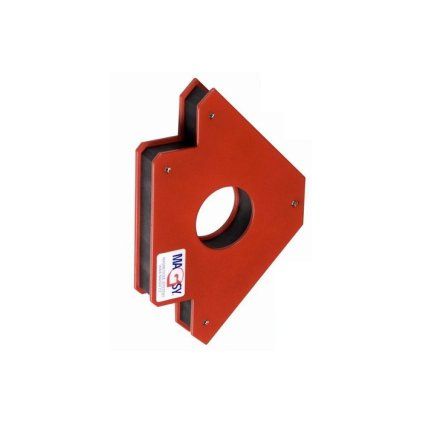
Magnetic square 190 × 120 × 26 mm
Large fixed magnetic square for positioning larger steel profiles, tubes, flat bar and sheet metal during assembly and tack welding.
- Dimensions 190 × 120 × 26 mm
- Product designation MU 190 × 120 × 26 mm
- Product code 280003
- Fixed working angles
- Suitable for welding steel profiles
- Can be used for electrode welding
- Suitable for welding with shielding gas
- Suitable for tack welding larger frame structures
- Central opening for easier handling
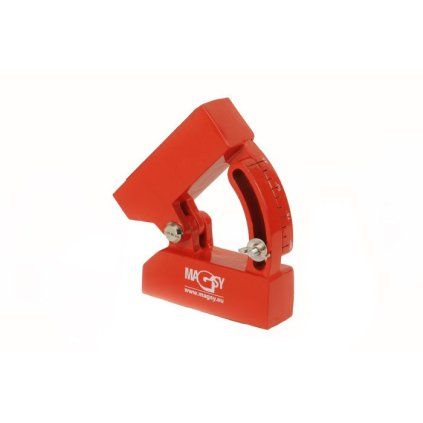
Adjustable magnetic square
Adjustable magnetic tool for positioning and accurately joining steel parts at different angles during welding, assembly and tack welding.
- Adjustable position of two magnetic arms
- Product code 32007
- Suitable for non-standard angles
- Allows precise setting using a separate measuring tool
- Suitable for sheet metal, tubes and profiles
- Robust workshop design
- Suitable for repeated assembly work
- Practical for producing inclined frames and braces
- The angle must be checked accurately before tack welding
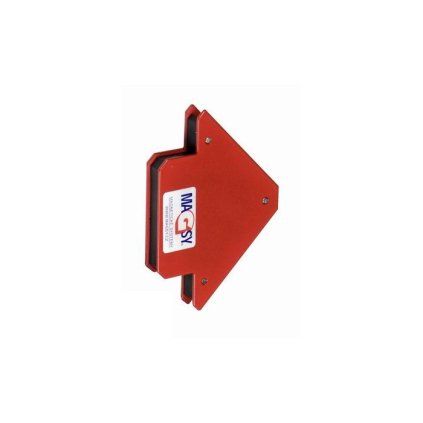
Magnetic square 120 × 82 × 16 mm
Lightweight fixed magnetic square for assembling smaller frames, square hollow sections, tubes and sheet-metal structures in home and professional workshops.
- Dimensions 120 × 82 × 16 mm
- Weight approximately 0.25 kg
- Designation MU 120 × 82 × 16 mm
- Product code 280001
- Red finish
- Positioning at 45° and 90° angles
- Can hold parts in the same plane
- Suitable for tubes, flat bar, square hollow sections and sheet metal
- Practical for confined working areas
Holding force depends on the specific material
Carry out a practical test before welding. A thin, rounded, rusty or painted profile may be held with considerably less force than clean, thick steel sheet.
Frequently asked questions about welding magnets
What is a welding magnet?
It is a magnetic positioning tool that temporarily holds ferromagnetic parts at the required angle before tack welding or assembly.
Is a welding magnet the same as a magnetic square?
Yes. Both terms are commonly used for the same type of workshop positioning tool.
Which angles can be set?
Common fixed models may provide 45°, 90° and same-plane positioning. Some designs also provide 135°. An adjustable model allows a wider range of positions.
Is the angle created by the magnet perfectly accurate?
Not automatically. Check it with a precise measuring square before tack welding and verify the dimensions of the entire structure.
Will the magnet hold steel?
Yes. Standard carbon and structural steel are ferromagnetic and suitable for welding magnets.
Will the magnet hold cast iron?
Usually yes, because cast iron contains iron and has a magnetic response.
Will a welding magnet hold aluminium?
No. Aluminium is not ferromagnetic. Use a mechanical clamp or special jig.
Will the magnet hold stainless steel?
It depends on the specific grade. Ferritic and martensitic stainless steels are usually magnetic, while austenitic grades often are not.
Will the magnet hold copper or brass?
No. Neither copper nor brass is ferromagnetic.
Can the magnet be used for MIG/MAG welding?
Yes, primarily for assembling and tack welding ferromagnetic parts. Remove it before completing the weld.
Can it be used for stick welding?
Yes, provided that it holds the welded material securely and does not affect arc stability.
Can it be used for TIG welding?
Yes, for positioning ferromagnetic parts. However, a strong magnetic field can deflect the welding arc, so remove the magnet after tack welding.
Can it be used for gas welding?
Yes, provided that it is not exposed to excessive heat for a prolonged period. Remove it from the heat source in good time.
Why does the magnet affect the welding arc?
Its magnetic field can alter the distribution of magnetic forces around the electric arc and cause it to deflect.
What is arc blow?
Arc blow is unwanted magnetic deflection of the electric arc away from the intended welding direction.
How can arc blow be reduced?
Remove the magnet, change the position of the work clamp, shorten the arc, adjust the welding direction or use mechanical clamping.
Does the magnet replace the work clamp?
No. The welding machine work clamp must be connected separately and directly to the welded part.
Can welding current pass through the magnetic square?
No. It is not designed for this purpose and may become damaged or dangerously overheated.
Why should the magnet be removed after tack welding?
This reduces the risk of overheating, weld spatter build-up and magnetic interference with the welding arc.
How many tack welds should I make?
It depends on the size and rigidity of the structure. It must be stable enough not to move after the magnet is removed.
Can I complete the entire weld with the magnet in place?
This is not recommended. Use the magnetic square mainly for assembly and tack welding.
Can a welding magnet overheat?
Yes. Prolonged exposure to high temperatures can damage both the surface and magnetic system.
Can the magnet become weaker after overheating?
Yes. Exceeding the permitted temperature may cause partial or permanent loss of magnetic strength.
Can a hot magnet be cooled with water?
Rapid cooling is not recommended. Allow it to cool naturally in a safe place.
What size magnetic square should I choose?
A smaller model is suitable for lightweight profiles and confined spaces. A larger model provides a greater contact area for larger structures.
Is a larger magnet always stronger?
It often has a larger working surface and magnetic system, but the specifications of the particular product and operating conditions are what ultimately matter.
What reduces holding force?
Rust, paint, contamination, thin sheet metal, a small contact area, curved profiles and gaps between the magnet and material.
Why does the magnetic square slide along the profile?
The cause may be weakly magnetic material, insufficient contact area, contamination or excessive weight of the part being held.
Can two or more magnets be used at the same time?
Yes. This is useful when assembling frames. At the same time, make sure the magnets are not attracting one another and moving the structure.
Can a welding magnet be used on a tube?
Yes, but the curved surface provides a smaller contact area. Add a mechanical clamp for heavier tubes.
Can it be used on thin sheet metal?
Yes, but holding force may be lower and the sheet can deform more easily due to heat.
Can the magnet be used during drilling?
It can temporarily hold a lightweight ferromagnetic part. However, use secure mechanical clamping for the actual drilling operation if there is a risk of the drill bit catching the workpiece.
Can it be used during grinding?
Only for light positioning. The magnetic square does not replace a rigid clamp and will attract grinding dust and metal shavings.
How do you remove metal shavings?
Move them towards the edge with a non-magnetic scraper or remove them with a brush. Wear protective gloves.
How do you remove weld spatter?
After cooling, remove it carefully without grinding away or deforming the precision working edges.
Can the magnetic square be disassembled?
No. Do not drill into it, cut it open or make your own modifications to the magnetic system.
Can the magnet be used to lift steel?
No. It is not a lifting magnet and is not designed for lifting or transporting material.
Can it be used for overhead work?
Not as the only securing element. The structure must be safely supported or mechanically secured.
Can the magnet damage electronics?
A strong magnetic field may affect certain sensors, measuring instruments, magnetic cards, watches and data storage media.
Is it dangerous for people with pacemakers?
People with medical implants must observe the safe distance specified by the manufacturer of their device.
How should the magnetic square be stored?
In a dry environment, away from high temperatures, loose metal shavings, sensitive electronics and locations where it could fall.
How can I recognise a damaged welding magnet?
It may have deformed working edges, a damaged casing, loose parts, significantly reduced holding force or signs of overheating.
Is a magnet or mechanical clamp more suitable?
A magnet is faster for initial positioning. A mechanical clamp is generally more suitable for high loads, non-magnetic materials and completing the weld.
Can both methods be combined?
Yes. A magnet can quickly position the parts and a mechanical clamp can then secure them firmly before the welding is completed.
Summary
Welding magnets and magnetic squares help quickly hold steel profiles, tubes and sheet metal while assembling a structure. They free up the hands and make it easier to create the first tack welds.
Fixed models provide common working angles such as 45°, 90° or same-plane positioning. An adjustable magnetic square is suitable for non-standard structures and different inclinations.
The magnet only works on ferromagnetic materials. It will not hold aluminium, copper, brass or most austenitic stainless steels.
A magnetic square does not replace precise measurement, a mechanical clamp or the welding machine work clamp. First tack weld the parts, remove the magnet, check the geometry and only then complete the welds.
Looking for a magnetic square for welding?
Choose a compact, large or adjustable model according to the profile dimensions, required angles and type of structure being produced.