
Magnetic Testing and Separation Rods for Industry
Magnetic testing and separation rods
Magnetic rods help detect and capture iron and steel contaminants in bulk solids and liquids. A testing rod is mainly used to check a sample, while a fixed separation rod can form part of a production line or magnetic grate.
- A testing rod allows a quick material check.
- A sliding magnetic core makes contaminants easy to remove.
- A fixed rod is suitable for continuous or repeated separation.
- The rods capture ferromagnetic particles, not all metals.
What is the difference between testing and separation rods?
Magnetic testing rod
A testing rod is inserted manually into a container of bulk solids or liquid. A circular movement collects any ferromagnetic particles present.
After removing the rod, simply pull the plastic handle. The magnetic core moves and the captured contaminants drop into a prepared container.
Fixed separation rod
A fixed magnetic rod has neither a sliding core nor a handle. It is installed individually or as part of an assembly of several rods, such as a magnetic grate.
It is mainly used for:
- protecting mills, crushers and nozzles,
- checking material before packaging,
- separating iron particles from dry mixtures,
- capturing contaminants from suitable liquids.
Quick comparison
- One-off sample check: a testing rod.
- Easy release of contaminants: a testing rod with a sliding core.
- Installation in production equipment: a fixed separation rod.
- Building a magnetic grate: several fixed rods.
Which contaminants can a rod capture?
Magnetic rods are primarily designed for:
- iron and steel swarf,
- fine ferromagnetic dust,
- fragments of wire and fasteners,
- particles produced by wear in production equipment.
They are not designed to separate aluminium, copper, brass or most non-magnetic stainless steels.
How do you use a testing rod?
- Check that the stainless steel surface is clean and in good condition.
- Insert the magnetic section into the material being tested.
- Make slow circular movements.
- Withdraw the rod and inspect the captured particles.
- Hold it over a container for metal contaminants.
- Pull the handle and let the contaminants drop off.
What should you watch out for?
- Always check the rod’s suitability for the material, temperature and chemical environment.
- During cleaning, stop the production line and secure it against start-up.
- Do not wipe metal swarf off with bare hands.
- Protect the stainless steel casing from impacts and punctures.
- Do not exceed the permitted temperature of the magnetic system.
- A magnetic rod is not a substitute for a complete separation system design.
Recommended magnetic rods
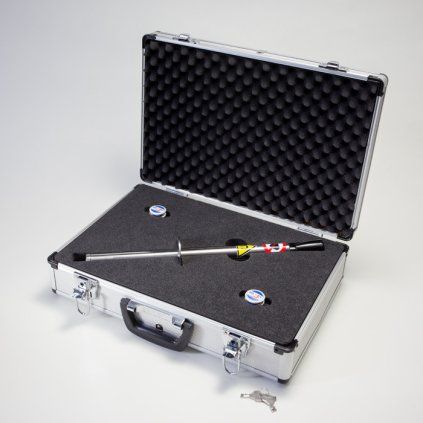
Magnetic testing rod 30 mm – box
A manual testing rod with a sliding neodymium core and a case for safe transport.
- Sold as 30 mm diameter
- Actual diameter stated in the description: 31 mm
- Magnetic section length 140 mm
- Magnetic flux density 7,400 Gs
- Pull force 97 N
- Weight 1.2 kg
- AISI 304 stainless steel
- Temperature resistance up to 80 °C
- Product code 50805.BOX
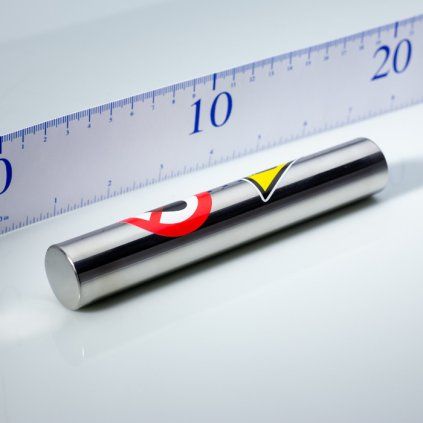
NdFeB magnetic rod 25 × 150 mm
A fixed industrial rod for individual installation or building a magnetic grate.
- Diameter 25 mm
- Overall length 150 mm
- Magnetic surface length 110 mm
- Magnetic flux density 7,200 Gs
- Weight 0.5 kg
- M8 × 12 thread
- Temperature resistance up to 80 °C
- Product code 50796
Important: this is a fixed separation rod. It has no sliding core for automatically releasing contaminants.
View product
Magnetic testing rod 28 mm
A powerful manual rod for checking dry mixtures and suitable liquid materials.
- Magnetic section diameter 28 mm
- Magnetic section length 140 mm
- Magnetic flux density 10,257 Gs
- Pull force 81 N
- Weight 1.1 kg
- AISI 304 stainless steel
- Polished surface
- Temperature resistance up to 80 °C
- Product code 52943
Frequently asked questions
How is a testing rod cleaned?
After removing it from the material, hold it over a container and pull the handle. The magnetic core moves and the contaminants drop off.
How is a fixed separation rod cleaned?
The material flow must be stopped and the contaminants removed manually while wearing protective gloves.
Will a rod capture every metal?
No. It is intended mainly for iron, ordinary steel and other ferromagnetic particles.
Can the rod be used in food processing?
Selected models have an AISI 304 stainless steel casing. However, the suitability of the whole application must be assessed for the specific operation.
Is a higher Gs value always better?
Not automatically. Pull force, active surface length, particle distance and the way material passes the rod also matter.
Summary
A testing rod is suitable for quickly checking a sample for ferromagnetic contamination. Its sliding core allows the contaminants to be released easily.
A fixed magnetic rod is used for industrial separation, either on its own or in a magnetic grate assembly. Material properties, flow rate, temperature and cleaning method must be considered before choosing.
Need to check material purity?
Choose a manual testing rod or a fixed separation rod according to the application and required magnetic performance.