
Industrial Magnets: Separation, Handling and Workshop Uses
Industrial magnets: how do they help in production and workshops?
Industrial magnets are used to separate ferromagnetic contaminants, hold steel parts, clean workplaces and test materials. The correct product must be chosen according to the specific operation, material and intended use.
- Separators remove ferromagnetic contaminants from mixtures.
- Magnetic angles hold steel profiles during welding.
- Mats capture metal swarf from work footwear.
- Sorting magnets help check for magnetic material.
- Lifting magnets are used for controlled handling of steel parts.
Magnetic separation of materials
Magnetic separators capture ferromagnetic particles that may be present in raw materials or finished products.
Depending on the design, they can separate:
- dry bulk materials,
- granules and powders,
- certain liquid and slurry mixtures,
- material conveyed through pipes or on a belt.
Examples include magnetic rods, grates, overband plates, drums and in-line separators. The appropriate type depends on contaminant size, flow rate, temperature, material flowability and the required level of cleaning.
A magnet does not capture every metal
Magnetic separators are mainly intended for iron, nickel, cobalt and ferromagnetic alloys. Aluminium, copper, brass and most non-magnetic stainless steels require another method of detection or separation.
Tools for handling steel sheets
Magnetic sheet separators
Individual steel sheets can be difficult to separate because of oil, smooth surfaces or a vacuum. A sheet separator creates like magnetic poles in the sheets, which repel one another and help separate the upper layers.
The equipment must be selected according to:
- sheet dimensions and thickness,
- the height of the entire stack,
- the material’s magnetic properties,
- the method of automatic or manual handling.
Magnetic welding angles
A magnetic angle holds ferromagnetic profiles, hollow sections, sheets or pipes in the required position during assembly and tack welding.
The usual procedure is to position the angle, check alignment, tack-weld the parts, remove the tool and then complete the weld.
Cleaning metal debris from the workplace
Magnetic mats
An industrial mat helps capture ferromagnetic filings, swarf and small fragments carried on the soles of work footwear.
It is suitable, for example, at transitions:
- from metalworking into a cleaner area,
- from a workshop into a warehouse,
- between production sections,
- into an area where the transfer of metal particles needs to be limited.
Magnetic sweepers
A magnetic sweeper collects ferromagnetic nails, nuts, screws, swarf and grinding dust from floors. Both manually guided versions and models designed for forklifts or cleaning vehicles are available.
Sorting and inspection magnets
Conical magnets with chains are used in scrap yards, workshops and warehouses to check whether an object or material contains a ferromagnetic component.
They can help with:
- quickly sorting scrap metal,
- checking steel and non-ferrous components,
- retrieving small objects from gaps,
- preliminary material checks at a scrap yard.
A magnetic test does not identify the exact chemical composition or material grade. It serves only as a quick preliminary check.
Industrial magnet safety
- Pull force measured under ideal conditions is not automatically a safe load capacity.
- Use lifting magnets only according to their documentation and specified working load limit.
- Never stand beneath a suspended load.
- Allow for the risk of pinched fingers during handling.
- Clean and inspect separators regularly.
- Keep strong magnets away from implants and sensitive equipment.
Recommended industrial magnetic tools
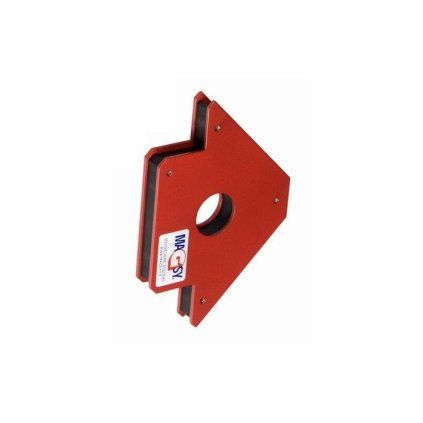
Magnetic welding angle 155 × 102 × 16 mm
A practical aid for temporarily holding ferromagnetic profiles, sheets and pipes during assembly and tack welding.
- Dimensions 155 × 102 × 16 mm
- For working with steel profiles
- Allows 45° and 90° positioning
- Also suitable for working in a flat plane
- Central hole for easier handling
- Product code 280002
Important: first tack-weld the construction, then remove the angle and complete the weld.
View product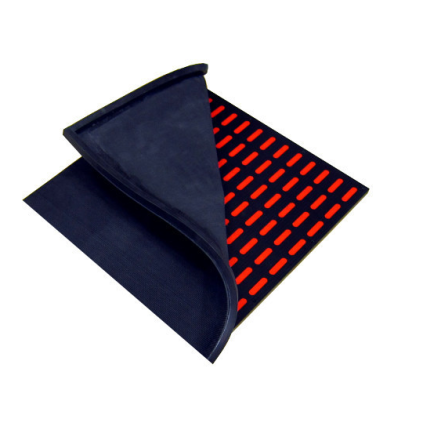
Magnetic mat 500 × 500 mm
An industrial mat for capturing ferromagnetic contaminants carried on work footwear.
- Dimensions 500 × 500 mm
- Weight 6 kg
- Strong neodymium magnetic core
- Removable rubber cover
- Average core flux density 3,572 Gs
- Average core pull force 18 N
- Product code 50337
Readings above the rubber cover are lower than directly on the magnetic core. The mat must be cleaned regularly to remove captured particles.
View product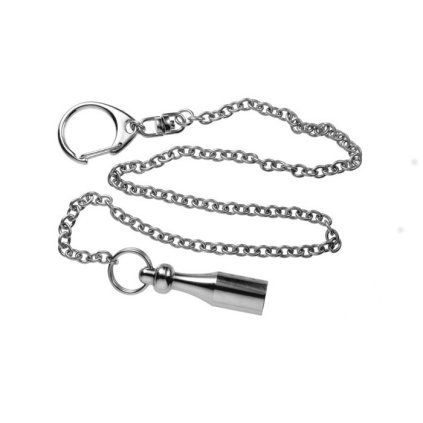
Conical sorting magnet with chain
A portable inspection magnet for scrap yards, workshops and preliminary checks for ferromagnetic material.
- Neodymium magnetic core
- Approximate pull force 25 N
- Magnetic flux density 5,300 Gs
- Weight 75 g
- Chain with a snap hook
- MK 7/14 designation
- Product code 50702
Frequently asked questions
Will a separator remove all metal contaminants?
No. It mainly captures ferromagnetic particles. Additional technologies are needed for aluminium, copper and other non-ferrous metals.
Can one separator be used for every mixture?
No. The design is selected according to physical state, flow rate, temperature, stickiness, abrasiveness and the size of particles to be captured.
Is a magnetic angle a replacement for a welding clamp?
It mainly serves to position and tack-weld parts. Additional mechanical clamping may be needed for some jobs.
Will a magnetic mat capture aluminium swarf?
No. It is designed for ferromagnetic particles, especially iron and steel contaminants.
Can pull force be treated as load capacity?
No. Pull force measured under ideal conditions is not a safe working load or permission to lift loads.
Summary
Industrial magnets help with material separation, welding, sheet handling, workplace cleaning and waste sorting. However, every application requires a correctly selected product.
The material type, operating temperature, contaminant size, loading method and safety requirements of the specific operation are decisive.
Choose an industrial magnet for your operation
Browse separators, handling tools, mats, magnetic sweepers and sorting magnets.