
Testing and magnetic rods
Magnetic and Testing Rods: Separating Metal Contaminants from Bulk and Liquid Materials
Magnetic rods are designed to capture ferromagnetic contaminants from dry, bulk and selected liquid materials. They can be used individually or as the basis of a magnetic grate integrated into production equipment.
- Learn how a magnetic rod works and what it can capture.
- Understand the difference between a magnetic rod and a testing rod.
- Find out when to use an individual rod and when to use a complete magnetic grate.
- Learn what magnetic flux density and pull-off force mean.
- Discover how magnetic rods are used in dry and liquid materials.
- Learn how to install, clean and inspect rods correctly.
- Explore recommended products, safety guidelines and frequently asked questions.
Ferromagnetic contaminants can enter material during production, storage, transport or as a result of wear on processing equipment. These may include metal shavings, filings, scale, wire fragments, pieces of fasteners or extremely fine magnetic dust.
A magnetic rod creates a strong magnetic field that attracts these particles to its stainless-steel surface and holds them there until cleaning. This helps protect machinery while also improving the purity of the processed product.
What is a magnetic rod?
A magnetic rod is a sealed stainless-steel tube containing a permanently installed magnetic core made from powerful neodymium magnets and pole pieces.
In a standard separation rod, the magnetic core is not removable. The stainless-steel casing protects the magnets from direct contact with the material, moisture and part of the mechanical stress.
Main components of a magnetic rod
- outer stainless-steel tube,
- permanent neodymium magnets,
- pole pieces that concentrate the magnetic field,
- sealed and permanently installed magnetic core,
- internal thread for attachment to a frame or supporting structure.
What is a magnetic rod used for?
- capturing iron and steel contaminants,
- protecting mills, crushers, presses, nozzles and other equipment,
- cleaning products before packaging or dispatch,
- building magnetic grates,
- individual installation in a container or material flow,
- magnetic separation in industrial and food-processing facilities.
How does a magnetic rod work?
Powerful permanent magnets inside the rod create magnetic poles on its surface. A ferromagnetic particle that comes close to them is attracted to the stainless-steel tube and remains captured on it.
The strongest magnetic force is usually found around the pole pieces. Captured contaminants therefore form characteristic rings on the surface of the rod.
- Material flows, passes or falls around the magnetic rod.
- Ferromagnetic particles enter the magnetic field.
- The particles are attracted to the surface of the stainless-steel tube.
- They remain on the rod until it is cleaned.
- The cleaned material continues to the next stage of the process.
What can a magnetic rod capture?
A magnetic rod is primarily designed to separate fully ferromagnetic metals and their particles.
Typical captured contaminants
- iron shavings,
- steel filings,
- particles of ordinary magnetic steel,
- scale,
- wire fragments,
- small screws, bolts and washers,
- particles caused by machine wear,
- fine ferromagnetic dust.
What will a standard magnetic rod not capture?
A permanent magnet will not capture ordinary non-magnetic materials or non-ferrous metals.
- aluminium,
- copper,
- brass,
- bronze,
- plastic,
- glass,
- wood,
- some grades of stainless steel,
- other non-magnetic contaminants.
A magnetic rod does not replace a mechanical filter
The rod separates materials according to their magnetic properties. If you also need to capture plastic, glass, aluminium or other non-magnetic particles, a screen, filter or another separation device must be used.
What is the difference between a magnetic rod and a testing rod?
Magnetic rods and testing rods may look similar, but their construction and method of use are different.
Magnetic separation rod
A magnetic rod has a fixed, non-removable core. It can be used individually or attached to the frame of a magnetic grate using its thread.
Captured contaminants must be manually wiped or pulled off the surface using a suitable tool.
Magnetic testing rod
A testing rod is a handheld inspection tool. It has a movable magnetic core and a plastic handle. It is used to check for the presence of ferromagnetic contaminants in a material sample, container or production batch.
After testing, the handle is pulled. The magnetic core moves into the upper section, allowing contaminants captured on the lower active section to fall away more easily.
Quick comparison
- Magnetic rod: fixed installation or continuous material separation.
- Testing rod: manual sample inspection and quick detection of metal contaminants.
- Magnetic rod: non-removable magnetic core.
- Testing rod: movable core for easier cleaning.
- Magnetic rod: can be used to build a magnetic grate.
- Testing rod: not designed to serve as a permanently installed separation grate.
How is a magnetic testing rod used?
- Verify that the rod is suitable for the material being tested.
- Check that the stainless-steel surface is clean and undamaged.
- Insert the active section of the rod into the sample or container.
- Move it slowly in circular or longitudinal motions.
- Remove the rod and inspect the captured particles.
- Move the rod over a container intended for metal waste.
- Pull the handle to move the core into the upper section.
- Safely remove the released contaminants.
- Clean and inspect the rod before further use.
Can the test confirm that the material is completely clean?
No. A testing rod only inspects the portion of material that comes into contact with its magnetic surface. The result depends on the sample size, testing time, distribution of particles and the selected testing procedure.
For regular quality control, it is advisable to use a predefined procedure with the same sample size, testing time and evaluation method.
Magnetic rods in dry and bulk materials
Magnetic rods can be used in homogeneous materials with good flowability. The material must be able to flow freely around the rod and must not create a thick sticky layer on its surface.
Examples of suitable dry materials
- flour and fine food powders,
- sugar and salt after verifying chemical compatibility,
- spices,
- cereals,
- seeds,
- plastic granulate and regranulate,
- rubber regranulate,
- fine construction mixtures,
- ceramic raw materials,
- feed mixtures.
What can cause problems?
- poor flowability,
- material bridging above the rods,
- stickiness,
- large pieces of material,
- high abrasiveness,
- excessive impact velocity,
- blockage of the space between several rods.
Magnetic rods in liquid materials
Selected magnetic rods can also be inserted into liquid mixtures. The stainless-steel casing protects the magnetic core from moisture, but suitability always depends on the chemical composition, pH, temperature and viscosity of the liquid.
Examples of applications in liquids
- cooling water,
- cooling emulsions,
- technical oils,
- vegetable oils,
- syrups,
- milk,
- fruit juices,
- yoghurts and semi-liquid food mixtures,
- ceramic glazes and liquid compounds.
A specific product may have a limited pH range, maximum medium temperature or maximum particle size. These parameters must be checked in the product instructions.
The magnet's temperature resistance is not the same as the permitted liquid temperature
The magnetic core may, for example, withstand temperatures up to 80 °C, but the manufacturer may specify a lower maximum medium temperature for a particular type of immersion. Always follow the complete product instructions rather than relying solely on the magnet's temperature rating.
Magnetic rods for building a magnetic grate
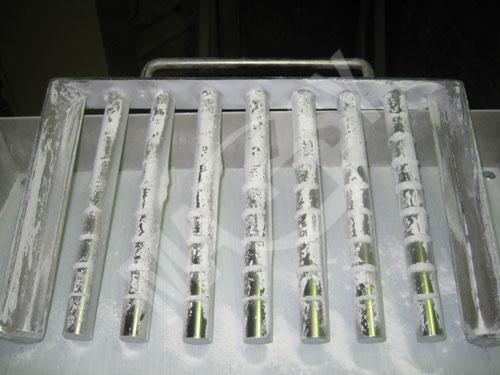
Individual magnetic rods can be attached to a frame using their threads to create a magnetic grate. The grate covers a larger flow area and forces the material to pass close to several active magnetic points.
Advantages of a magnetic grate
- larger active separation area,
- more even capture of contaminants,
- ability to customise the number and length of rods,
- use in hoppers, pipelines and storage containers,
- ability to replace an individual damaged rod,
- higher efficiency than a single freely positioned rod.
What material should the grate frame be made from?
The frame and fasteners immediately surrounding the rods must be made from a suitable non-magnetic material. A ferromagnetic structure would attract the magnetic field, reduce its effect on the processed material and make installation more difficult.
What spacing should be used between the rods?
The spacing must ensure safe installation while maintaining sufficient material flow. A gap that is too small can cause bridging, blockage or mutual attraction between the rods.
The minimum and optimum spacing always depends on the specific product, material and grate design.
Installing several powerful rods can be hazardous
During installation, the rods can suddenly attract each other, tools or a steel workbench. Separate them using non-magnetic spacers and follow the manufacturer's safety instructions when designing your own assembly.
Magnetic rods for textile filters
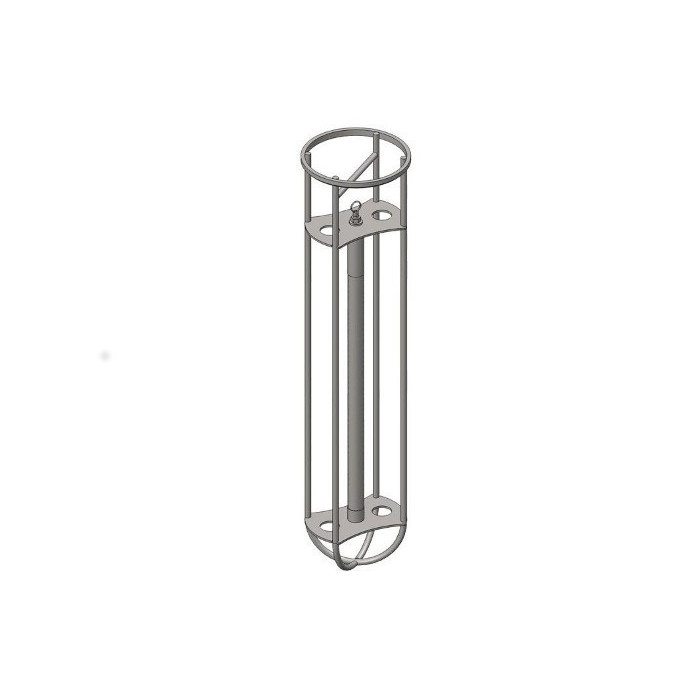
Special magnetic separators can also be installed in textile filters and other filtration systems. They contain one or more magnetic rods that capture ferromagnetic contaminants from flowing liquid media.
Possible versions
- separator with one magnetic rod,
- separator with two magnetic rods,
- standard AISI 304 version,
- AISI 316L version for more demanding chemical environments,
- custom version adapted to the filter dimensions and connection.
For use in aggressive, acidic or hygienically demanding environments, the appropriate stainless-steel grade, seals and surface finish must be selected.
Where are magnetic and testing rods used?
Food industry
Rods can help remove ferromagnetic particles from flour, sugar, spices, milk, oils and other materials. The specific design must meet the hygiene and material requirements of the facility.
Agriculture
They are used in feed mixtures, seeds, cereals and other agricultural products.
Plastics and rubber industry
They help protect injection moulding machines, extruders, crushers and other equipment from metal contaminants in granulate or regranulate.
Chemical industry
Rods can be used in chemical powders, liquids and intermediate products provided that the separator materials are chemically compatible with the processed substance.
Ceramics and glass industry
Magnetic separation helps remove metal particles from ceramic compounds, glazes and other raw materials.
Construction
Rods can be used in fine bulk construction mixtures provided that the material is not excessively abrasive, sticky or coarse.
Engineering
They are suitable, for example, for cleaning cooling fluids, emulsions and selected technical oils.
Magnetic flux density and pull-off force
Magnetic rods are most commonly specified by magnetic flux density in gauss and pull-off force in newtons.
Magnetic flux density in Gs
Magnetic flux density describes the intensity of the magnetic field at a specific measurement point. The highest values are usually found on the rod surface around the pole pieces.
Pull-off force in N
Pull-off force indicates the force required to pull a defined steel test piece away from the magnetic surface.
Which is more important, Gs or N?
Both parameters must be assessed together. High magnetic flux density helps act on small particles, while pull-off force indicates the ability to hold a defined steel object against the surface.
Overall efficiency is also influenced by:
- distance between the particle and the rod,
- thickness of the stainless-steel casing,
- flow or falling velocity,
- properties of the processed material,
- size and shape of the contaminant,
- build-up of already captured particles,
- spacing between multiple rods.
Values from different manufacturers may not be directly comparable
Measurement results are affected by the type of probe, dimensions of the test piece, measurement location, surface and air gap. When comparing products, also consider the specified measurement method.
What diameter and length of magnetic rod should you choose?
Standard magnetic rods are produced in several diameters and lengths. The dimensions must correspond to the available space, flow area and amount of material.
Rod diameter
A larger diameter may allow the use of a more powerful magnetic core and provide a larger active surface. At the same time, however, it takes up more space in the material flow.
Overall length
The overall length also includes the end sections and thread. It may not be the same as the actual length of the active magnetic surface.
Magnetic surface length
This specifies the section of the rod where the active magnetic field is intended for separation. When designing a grate, this surface must cover the required part of the material flow.
Thread
The thread size and length must match the frame or supporting structure. Screw the rod in carefully using non-magnetic tools or suitable installation equipment.
How do you choose the right magnetic rod?
Prepare the following information before selecting a rod
- type of material to be separated,
- whether the application is dry or liquid,
- particle size and granularity,
- flowability or viscosity,
- operating temperature,
- pH and chemical composition of the liquid,
- quantity and size of metal contaminants,
- required level of cleanliness,
- flow rate or capacity,
- available installation space,
- number and spacing of rods,
- cleaning method and planned shutdowns.
Magnetic strength
Lower magnetic performance may be sufficient for coarser particles and equipment protection. Finer ferromagnetic particles require a stronger rod and appropriately designed contact between the material and the rod surface.
Material flow
An excessively large gap around the rod may allow particles to pass outside the effective magnetic field. A gap that is too small may restrict flow or cause material bridging.
Temperature resistance
Standard neodymium rods are typically designed for temperatures of approximately up to 80 °C. Higher temperatures require a special magnetic grade and a suitable structural design.
Stainless-steel tube material
AISI 304 is suitable for many standard and food-processing applications. AISI 316L or another specialised version may be required for more aggressive chemical environments.
Cleaning method
For applications requiring frequent cleaning, a complete grate with sliding cores or another easy-cleaning system may be more practical than several individual fixed rods.
Are magnetic rods suitable for abrasive materials?
The stainless-steel casing is usually very thin to achieve high magnetic performance. Abrasive material can gradually wear, thin or completely penetrate it.
Examples of abrasive materials may include:
- sand,
- ceramic compounds,
- crushed glass,
- certain construction mixtures,
- materials containing sharp mineral particles,
- granulates containing glass additives.
If use in abrasive material is permitted, the condition of the stainless-steel casing must be inspected more frequently. A damaged rod must be removed from service.
Are magnetic rods suitable for sticky materials?
Sticky material can build up on the rod surface, cover captured contaminants and restrict flow. Bridging or blockage may also occur between several rods.
For thick, sticky or poorly flowing materials, another type of separator may be more suitable, such as a flow-type, rotary or specially designed magnetic grate.
Using magnetic rods in the food industry
A magnetic rod may be suitable for food contact if its material, surface finish and construction meet the requirements of the specific application.
In particular, verify:
- stainless-steel grade,
- smoothness and condition of the surface,
- chemical resistance,
- ability to clean the rod completely,
- operating temperature,
- material documentation,
- internal hygiene requirements,
- installation method without hygienically problematic gaps.
The AISI 304 designation alone does not automatically guarantee that an entire custom-built magnetic grate is suitable for a specific food-processing facility.
How should a magnetic rod be installed?
- Verify that the product is suitable for the specific material.
- Check the rod and thread dimensions.
- Prepare a structure made from non-magnetic material.
- Remove steel tools and loose metal parts from the working area.
- Separate individual rods using non-magnetic spacers.
- Install the rods one at a time.
- Maintain the specified minimum spacing.
- Check that the construction does not obstruct material flow.
- Verify the strength of all connections before operation.
- Carry out a test run and cleaning check.
How far away should steel structures be?
A powerful magnetic rod can attract nearby steel beams, tables, hoppers or tools. This can cause part of the magnetic field to close through the structure and reduce its effect on the material being separated.
Always maintain the minimum distances specified by the manufacturer of the particular product.
How often should a magnetic rod be cleaned?
There is no universal interval. The rod must be cleaned before the layer of captured metal begins to reduce magnetic performance or restrict material flow.
Cleaning frequency is affected by:
- amount of metal contamination,
- material flow rate and volume,
- particle size,
- number of rods,
- required product purity,
- risk of damage to downstream equipment.
When first introducing the rod into operation, inspect it more frequently. A regular cleaning interval can then be established according to the actual amount of captured particles.
How do you clean a fixed magnetic rod?
The material flow must be stopped before cleaning. Remove the rod or complete grate from the equipment and move it to a safe location.
- Stop the material supply.
- Secure the equipment against accidental start-up.
- Carefully remove the rod or grate.
- Wear work gloves.
- Slide larger particles along the surface towards the end of the rod.
- Wipe away fine contaminants using a suitable non-magnetic tool.
- Place the captured metal into the designated container.
- Wash or clean the rod according to the operating procedure.
- Inspect the condition of the stainless-steel casing.
- Return the rod to the correct operating position.
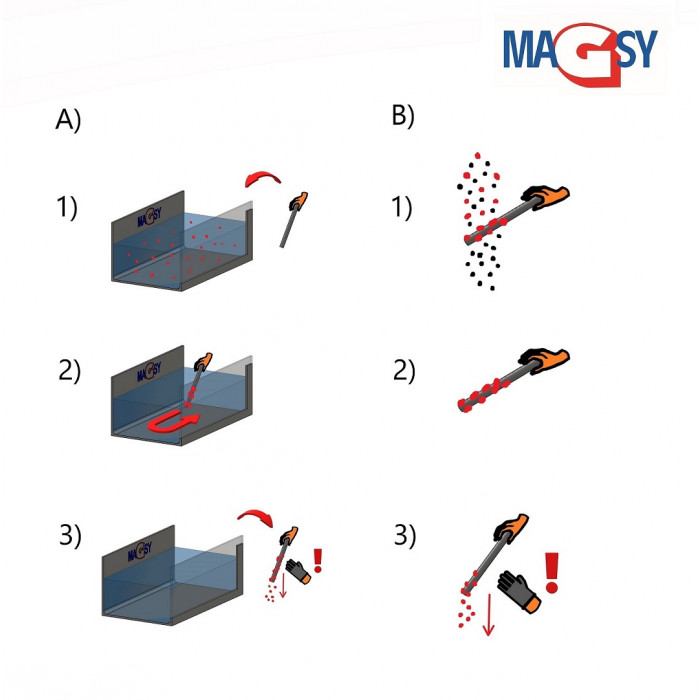
How do you clean a testing rod?
A testing rod allows the magnetic core to be moved away from the lower active section.
- Remove the rod from the tested material.
- Move it over a container for metal contaminants.
- Pull the plastic handle.
- The magnetic core moves into the upper section.
- The magnetic field at the lower section weakens significantly.
- Captured particles fall away or can be easily wiped off.
- Clean the rod and return the core to the operating position.
How do you inspect the condition of a magnetic rod?
- Inspect the surface before each use.
- Look for scratches, dents and signs of abrasion.
- Inspect welds and end sections.
- Check the condition of the thread.
- Look for signs of corrosion.
- Regularly measure magnetic flux density and pull-off force.
- Always compare results using the same measurement method.
- Remove damaged rods from service.
Why should magnetic performance be measured?
Magnets can weaken due to excessive temperature, mechanical damage or a strong opposing magnetic field. Regular measurement helps document the condition of the separator and identify any changes over time.
Safety when working with magnetic rods
What should you watch out for?
- Powerful rods can suddenly attract steel tools.
- Protect your fingers from being trapped or pinched.
- Use non-magnetic spacers when installing multiple rods.
- Do not work on a steel table without suitable protection.
- Keep loose metal objects away from the working area.
- Wear gloves resistant to sharp metal shavings during cleaning.
- Maintain a safe distance from electronics and measuring instruments.
- People with medical implants must observe the required safety distances.
- Do not exceed the maximum operating temperature.
- Do not use a rod with a damaged or worn-through casing.
- Do not drill, weld or make any other unauthorised modifications to the rod.
Recommended magnetic and testing rods
The selected products represent a long separation rod for a larger working area, a compact rod for smaller assemblies and a handheld testing rod that allows contaminants to be released easily.

NdFeB magnetic rod dia. 25 × 300 mm
Powerful magnetic rod for individual use or for building a magnetic grate designed to separate ferromagnetic contaminants.
- Overall length 300 mm
- Magnetic surface length 264 mm
- Rod diameter 25 mm
- Magnetic flux density 14,500 Gs
- Pull-off force 95 N
- Temperature resistance up to 80 °C
- Internal thread M8 × 12
- Weight approximately 1.1 kg
- Powerful neodymium magnetic core
- Includes a measurement report for the specific rod

NdFeB magnetic rod dia. 25 × 150 mm
Shorter high-performance magnetic rod for smaller grates, containers, hoppers and applications with limited installation space.
- Overall length 150 mm
- Rod diameter 25 mm
- Magnetic flux density 14,500 Gs
- Pull-off force 95 N
- Temperature resistance up to 80 °C
- Powerful neodymium magnetic core
- Designed for industrial magnetic separation
- Suitable for dry and selected liquid materials
- Several rods can be assembled into a magnetic grate

Magnetic testing rod, diameter 20 mm
Handheld testing rod with a movable magnetic core for checking the presence of ferromagnetic contaminants in dry and selected liquid materials.
- Magnetic section diameter 20 mm
- Magnetic surface length 140 mm
- Magnetic flux density 5,000 Gs
- Pull-off force 60 N
- Weight approximately 0.7 kg
- Neodymium magnetic core
- AISI 304 stainless steel
- Polished surface with low roughness
- Temperature resistance up to 80 °C
- Movable core for easy contaminant release
- Plastic handle for manual operation
The stated values apply under defined measurement conditions
Magnetic flux density and pull-off force can vary according to the measurement location, test piece used, air gap, surface contamination and product wear. Carry out your own operating test when assessing a specific application.
Frequently asked questions about magnetic rods
What is a magnetic rod?
A magnetic rod is a stainless-steel tube containing a sealed permanent magnetic core. It is designed to capture ferromagnetic contaminants from bulk and selected liquid materials.
What is the difference between a magnetic rod and a grate?
A magnetic rod is one individual separation element. A magnetic grate is an assembly of several rods mounted in a frame so that they cover a larger flow area.
What is the difference between a magnetic rod and a testing rod?
A magnetic rod has a fixed core and is used for separation. A testing rod has a movable core and is primarily intended for manual inspection of a material sample.
Which metals can a magnetic rod capture?
It primarily captures iron, ordinary magnetic steel, nickel, cobalt and other ferromagnetic materials.
Will a magnetic rod capture aluminium?
No. Aluminium is not ferromagnetic and is not attracted by an ordinary permanent magnet.
Will the rod capture stainless steel?
It depends on the specific stainless-steel grade. Ferritic and martensitic stainless steels are generally magnetic, while austenitic grades may be only weakly magnetic or completely non-magnetic.
Can a magnetic rod capture very fine metal dust?
Under suitable conditions, powerful neodymium rods can also capture extremely fine ferromagnetic particles. The result depends on the properties of the material, flow velocity and contact with the magnetic field.
Can the rod be used in flour?
Yes, provided that the flour is dry, flows well and the specific rod meets the hygiene and material requirements of the facility.
Can the rod be used in plastic granulate?
Yes, but the granulate must not contain unsuitable abrasive additives and must have appropriate particle size and flowability.
Can a magnetic rod be immersed in liquid?
Selected rods can. However, the permitted pH, temperature, chemical composition and other requirements of the specific product must be observed.
Is a magnetic rod waterproof?
The sealed stainless-steel construction protects the magnetic core against moisture. However, suitability for complete immersion must be confirmed by the manufacturer of the specific model.
Can the rod be used in acid?
A standard AISI 304 version may not be suitable for acidic or aggressive environments. AISI 316L or a custom-designed version may be required.
What temperature can a magnetic rod withstand?
Standard neodymium versions are typically designed for temperatures up to 80 °C. However, the permitted temperature of the processed material may be lower.
What does 14,500 Gs mean?
It is the magnetic flux density measured at the strongest point of the magnetic circuit on the rod surface.
What does a pull-off force of 95 N mean?
It is the force required to pull a defined steel test piece away under specified measurement conditions.
Is a rod with a higher Gs value always better?
Not automatically. Pull-off force, active surface length, grate design, material flow and cleaning frequency are also important.
How far away can a rod attract contaminants?
Magnetic force decreases rapidly with distance. It is therefore important to guide the material as close as possible to the rod surface.
How often should a magnetic rod be cleaned?
It depends on the amount of captured metal. The rod must be cleaned before a thick layer of contamination forms and reduces its effectiveness.
Why does a layer of contaminants reduce performance?
Additional particles are captured farther away from the magnetic core and can be more easily removed by the material flow.
How is a fixed magnetic rod cleaned?
After stopping the material flow, the rod is removed and contaminants are manually wiped off or moved towards the end using a suitable non-magnetic tool.
How is a testing rod cleaned?
Pulling the handle moves the magnetic core into the upper section. The magnetic force at the lower surface weakens and contaminants can easily fall away.
Can the rod be washed with water?
It depends on the specific design and operating procedure. After washing, the rod must be thoroughly dried and inspected.
Can a magnetic rod be used with abrasive material?
This is risky because abrasive particles can wear through the thin stainless-steel casing. Frequent inspection or a different type of separator may be necessary.
Can the rod be used with sticky material?
Sticky materials can adhere to the surface and restrict flow. A specially designed separator may be more suitable for such applications.
How do you build a grate using several rods?
The rods are attached using their threads to a frame made from non-magnetic material. Safe spacing must be maintained while preserving sufficient material flow.
Why must the frame be non-magnetic?
A ferromagnetic frame would attract the magnetic field from the rods, reduce its effect on the processed material and increase installation risks.
Can a magnetic rod be welded?
No. Welding could overheat the magnets, damage the stainless-steel casing and cause permanent loss of magnetic performance.
Can the rod be shortened or drilled?
No. The rod contains a precisely assembled magnetic core. Mechanical modification would damage the product.
Is a magnetic rod suitable for food contact?
Some products are. The material, documentation, surface finish and suitability of the complete installation for the specific food-processing facility must be verified.
How can I verify that the rod is not losing strength?
Regularly measure magnetic flux density and pull-off force using the same method and compare the results with previous measurements.
Can a magnetic rod become weaker over time?
When used correctly, it is generally stable. Excessive temperature, a strong opposing magnetic field or damage to the magnetic core can cause weakening.
Can a testing rod replace a permanent separator?
No. A testing rod is intended for manual sample inspection. A suitable grate or another magnetic separator is required for continuous separation of the entire material flow.
Which product should I choose for frequent cleaning?
For frequent maintenance, a testing rod with a movable core or a complete separator with an easy-cleaning system may be more suitable.
Summary
Magnetic rods capture ferromagnetic contaminants from dry, bulk and selected liquid materials. They can be used individually or several rods can be assembled into a magnetic grate.
A standard magnetic rod has a fixed, non-removable core. A testing rod has a movable core that makes it easier to release captured contaminants.
When selecting a rod, consider magnetic flux density, pull-off force, diameter, magnetic surface length, temperature resistance, casing material and the operating characteristics of the separated mixture.
Magnetic rods are not automatically suitable for all abrasive, sticky, acidic or coarse materials. The specific application must be assessed according to the product instructions and, in more demanding cases, discussed with the manufacturer.
Looking for a magnetic rod for your operation?
Choose magnetic and testing rods according to their dimensions, magnetic performance, temperature resistance and the type of material being separated.