
Sorting magnets for recycling centers
Sorting Magnets for Recycling Centres: How to Identify Magnetic Metals
Sorting magnets provide a quick way to check whether a tested object or material contains iron, magnetic steel or another ferromagnetic component. They are used at recycling centres, scrap metal yards, recycling facilities, workshops, construction sites and for inspecting metal waste.
- Learn which metals and materials are attracted by a magnet.
- Find out why some stainless steels are magnetic while others are not.
- Compare neodymium and samarium-cobalt magnets.
- Discover conical, swing-type and super-strong sorting magnets.
- Learn how to perform a magnetic material test correctly.
- Find out how to choose a sorting magnet according to the environment and intended use.
- Review safety rules, recommended products and frequently asked questions.
A mixture of metal waste may contain iron, steel, aluminium, copper and brass parts together. Simply looking at an object is not always enough to determine what material it is made from.
A sorting magnet provides a quick preliminary test. If it is strongly attracted to the object, the object probably contains ferromagnetic material. If there is no reaction, it may be aluminium, copper, brass or a non-magnetic grade of stainless steel.
What is important to know?
A magnetic test helps distinguish between magnetic and non-magnetic materials, but it cannot determine the exact chemical composition or specific alloy grade on its own. Additional tests or measuring instruments are required for precise material identification.
What is a sorting magnet and what is it used for?
A sorting magnet is a handheld or suspended magnetic tool designed for testing metals, locating ferromagnetic objects and performing basic material sorting.
It can be used, for example, for:
- distinguishing ferrous and non-ferrous metals,
- inspecting metal waste at recycling centres,
- locating steel parts in aluminium or other non-magnetic materials,
- checking compressed bales of metal waste,
- locating metal profiles behind plasterboard,
- retrieving screws and components from difficult-to-reach areas,
- collecting spilled nails, screws and other fasteners,
- basic inspection of metal products and semi-finished components.
How does a magnetic material test work?
A permanent magnet generates a magnetic field. When a suitable ferromagnetic material is located nearby, the magnetic domains within that material align and an attractive force is created.
The closer the magnet is to the tested object, the greater the attractive force usually becomes. The result is also affected by the size, shape, thickness and composition of the object, as well as its distance from the working surface of the magnet.
How to test metal correctly
- Clean heavy dirt or deposits from the area being tested.
- Check that there are no sharp metal shavings attached to the magnet.
- Move the magnet towards the object slowly and in a controlled manner.
- Observe whether you can feel attraction, resistance or movement of the magnet.
- Test several different areas of the object.
- Compare the result with a known steel sample and a known non-magnetic sample.
- For sensitive surfaces, place a thin cloth between the magnet and the material.
Why is it useful to test several areas?
A single product may consist of several different materials. An aluminium cover may contain a steel screw, reinforcement or internal component. A magnetic reaction in one area therefore does not necessarily mean that the entire object is made from magnetic metal.
Which materials are attracted by magnets?
In everyday applications, magnets react most strongly to iron, cobalt, nickel and many of their alloys. In metal waste, iron and steel are the most common magnetic materials.
Typical ferromagnetic materials
- Iron (Fe) – a fundamental ferromagnetic element.
- Cobalt (Co) – a ferromagnetic metal also used in magnetic alloys.
- Nickel (Ni) – a ferromagnetic metal and a component of many alloys.
- Carbon steel – usually strongly attracted by magnets.
- Cast iron – typically exhibits a strong magnetic response.
- Ferritic stainless steels – generally magnetic.
- Martensitic stainless steels – generally magnetic.
- Some other alloys containing iron, nickel and cobalt.
Is gadolinium magnetic?
Gadolinium has unusual magnetic properties and behaves ferromagnetically only below its Curie temperature, which is approximately around room temperature. It is therefore not a practically significant material for ordinary metal-waste sorting.
Which metals are not normally attracted by a magnet?
Many metals are not ferromagnetic and either do not react to an ordinary permanent magnet or react only very weakly.
- aluminium,
- copper,
- brass,
- bronze,
- gold,
- silver,
- zinc,
- lead,
- titanium,
- some grades of stainless steel.
Be careful with products made from several materials
A non-magnetic object may contain magnetic screws, springs, inserts or reinforcements. For example, an aluminium component may react to a magnet only where a steel part is concealed inside it.
Will a magnet stick to stainless steel?
The term “stainless steel” alone does not tell you whether the material will be magnetic. Its specific structure and alloy composition are what matter.
Ferritic stainless steel
Ferritic stainless steels are generally magnetic, and a sorting magnet will usually be clearly attracted to them.
Martensitic stainless steel
Martensitic stainless steels, used for example in certain knives and tools, are generally magnetic as well.
Austenitic stainless steel
Common austenitic stainless steels may be non-magnetic or only weakly magnetic. Mechanical forming, bending or pressing can partially alter their magnetic response.
A magnet can therefore provide a basic indication, but it cannot reliably identify a specific stainless-steel grade.
Can a magnet identify aluminium?
Aluminium is not ferromagnetic, so an ordinary permanent magnet will not attract it. If an aluminium object reacts strongly to a magnet, it probably contains a steel component or another magnetic material.
A magnetic test is therefore useful when inspecting compressed aluminium cans or other aluminium waste that should not contain ferrous contamination.
Can a magnet distinguish iron from steel?
A magnet is attracted to both iron and most common steels. A magnetic test alone therefore usually cannot reliably distinguish pure iron from a particular grade of steel.
For more precise identification, it may also be useful to examine:
- weight and density,
- surface appearance,
- spark testing,
- hardness,
- conductivity,
- chemical analysis,
- X-ray fluorescence analysis.
Which magnets are among the strongest?
NdFeB neodymium magnets
Neodymium magnets are among the strongest commonly available permanent magnets. They are made from an alloy of neodymium, iron and boron and provide high magnetic performance despite their relatively compact size.
They are used in sorting magnets because they can react to smaller ferromagnetic components or metal objects at a greater distance.
Advantages of neodymium magnets
- very high strength in a compact size,
- strong response to ferromagnetic materials,
- suitable for handheld sorting tools,
- wide range of shapes and dimensions,
- can be incorporated into ergonomic holders.
Disadvantages of neodymium magnets
- they are hard and brittle,
- they may corrode if the surface coating is damaged,
- standard versions are often designed for temperatures of approximately up to 80 °C,
- strong magnets can trap and pinch fingers,
- they can attract tools and other metal objects from a considerable distance.
Special high-temperature neodymium magnets are also available for higher operating temperatures. Always follow the specifications of the particular product.
SmCo samarium-cobalt magnets
Samarium-cobalt magnets are made from an alloy of samarium and cobalt. They provide high magnetic strength, excellent resistance to demagnetisation and can operate at significantly higher temperatures than standard neodymium magnets.
Advantages of samarium-cobalt magnets
- temperature resistance of selected versions up to approximately 300 °C,
- good stability of magnetic properties as temperature changes,
- high resistance to demagnetisation,
- better natural corrosion resistance than conventional neodymium magnets,
- suitable for specialised industrial applications.
Disadvantages of samarium-cobalt magnets
- higher purchase price,
- very brittle material,
- sensitive to impact and mechanical stress,
- smaller range of standard shapes and dimensions.
When should you choose neodymium and when samarium-cobalt?
A neodymium magnet is suitable for ordinary manual sorting where high strength in a compact size is important. A samarium-cobalt magnet is more suitable where high operating temperatures, temperature stability or greater corrosion resistance are required.
Types of sorting magnets
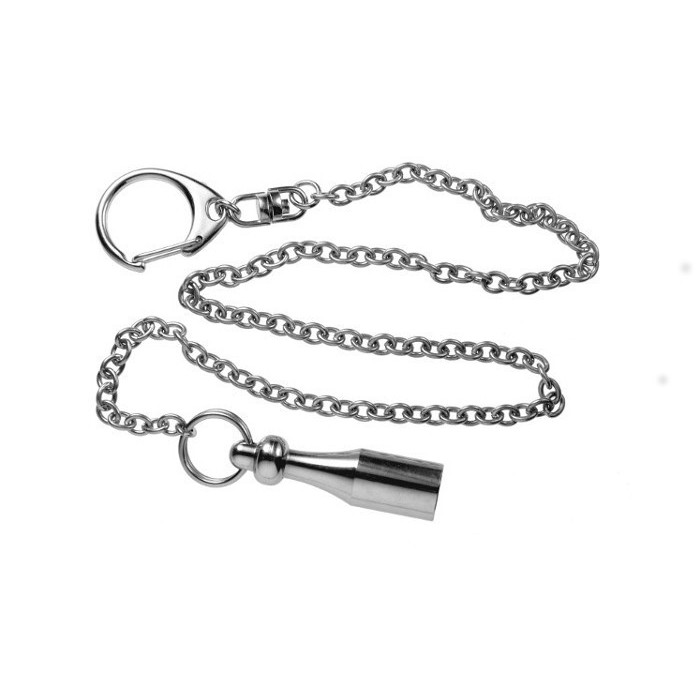
Conical sorting magnet with chain
A conical sorting magnet has a tapered working end that can be positioned close to specific areas of the material being tested. A chain with a carabiner allows the magnet to be attached to work clothing and helps reduce the risk of losing it.
It is particularly suitable for:
- quick inspection of smaller metal parts,
- basic distinction between ferrous and non-ferrous metals,
- work at scrap metal yards,
- checking individual objects within a mixed load,
- testing difficult-to-reach areas.
How should a conical magnet be used?
Hold the magnet by the chain or body and slowly bring its working end towards the material being tested. Do not allow it to snap uncontrollably onto a large steel object, as this could damage the magnet or the tested surface.
Conical swing-type sorting magnet
A swing-type sorting magnet is mounted on a longer rod. This allows the material to be tested without having to bring your hand directly next to the metal object.
The rod can also be used to retrieve screws, nuts, washers and other magnetic components from engines, openings, machinery and difficult-to-reach areas.
Advantages of the swing-type design
- comfortable handling,
- greater reach than a magnet held directly in the hand,
- more precise testing of a specific area,
- ability to retrieve small metal objects,
- low weight,
- suitable for workshops, service centres and recycling centres.
Super-strong handheld sorting magnet
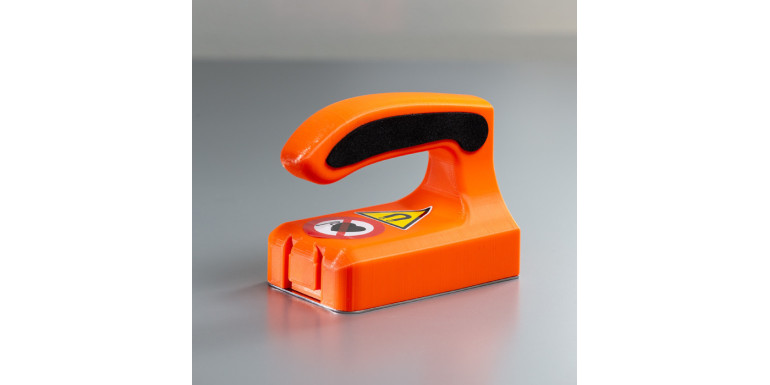
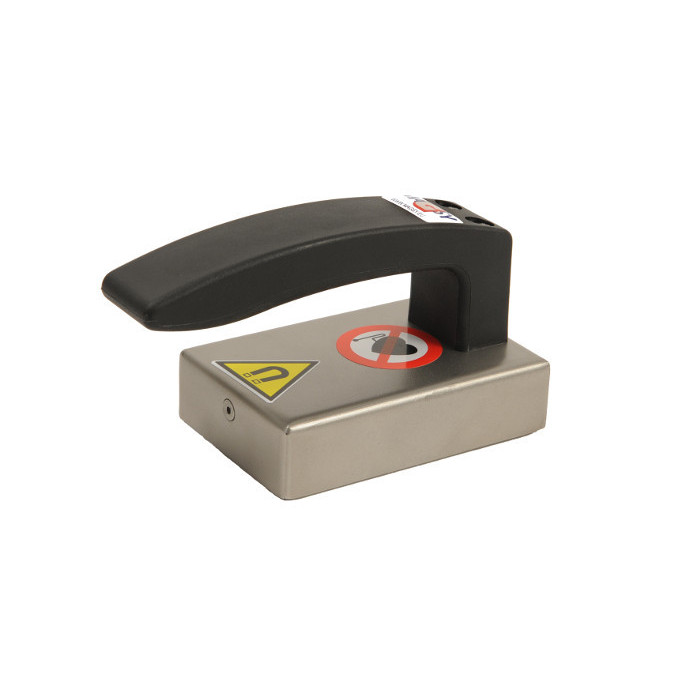
A super-strong sorting magnet contains a powerful neodymium magnet housed in a robust structure with a handle. The operator moves it around the tested material and observes whether the magnet reacts by being attracted towards it.
It can be used, for example, for:
- checking compressed bales of aluminium waste,
- locating ferrous contaminants in non-magnetic mixtures,
- locating steel profiles behind plasterboard,
- collecting nails and screws from grass, sand or floors,
- inspecting metal materials at recycling centres,
- industrial and construction applications.
How to test a compressed bale of metal
- Check that there are no loose steel tools nearby.
- Hold the magnet firmly by the handle.
- Move the working surface around the bale while maintaining a small distance.
- Observe any change in resistance or direction of attraction.
- Repeat the test on several sides and at different heights.
- Mark any area that produces a reaction for further inspection.
The effective range of the magnetic field always depends on the size, shape and position of the hidden ferromagnetic object. A small screw located deep inside the material may be more difficult to detect than a larger steel component close to the surface.
Super-strong sorting magnet with high temperature resistance
For high-temperature environments, SmCo magnetic material or another specialised high-temperature design can be used. However, the magnetic material itself must be incorporated into a structure that can also withstand the relevant temperature and operating environment.
It is therefore not sufficient to check only the temperature limit of the magnet. The following parts must also have suitable resistance:
- holder and handle,
- fasteners,
- adhesive,
- housing,
- surface finish,
- seals and other components.
The magnet's temperature resistance does not automatically apply to the entire tool
If a product specifies the temperature resistance of the active magnetic surface, this does not mean that the handle, adhesive or all other parts of the product can withstand the same temperature continuously.
Magnetic test rod
A magnetic test rod has a cylindrical active section and a handle. It is used for basic inspection of bulk, piece or liquid materials and for checking the presence of ferromagnetic particles.
Compared with a small conical magnet, it offers a larger active surface. It may therefore be suitable for:
- checking larger quantities of material,
- testing granulates and bulk mixtures,
- inspecting metal shavings,
- quick material testing during operation,
- checking magnetic response over a larger area.
A test rod does not replace a full magnetic separator. It is primarily intended as an inspection or preliminary testing tool.
UP sorting magnet
The UP sorting magnet features an ergonomic handle and a design intended for more comfortable manual handling. It is suitable for regular use at scrap metal yards, recycling operations and recycling centres.
For frequent use, magnetic strength is not the only important factor. You should also consider:
- tool weight,
- shape and position of the handle,
- balance,
- size of the active surface,
- ease of cleaning,
- durability of the construction.
Where are sorting magnets used?
Recycling centres and scrap metal yards
A magnet helps quickly distinguish between ferrous and non-ferrous metals and detect steel components in otherwise non-magnetic material.
Recycling facilities
A handheld inspection magnet can be used to check material before further sorting, baling or processing.
Automotive workshops
A swing-type magnet can help retrieve dropped screws, nuts and other steel components from an engine compartment.
Construction
A strong magnet can help locate steel profiles, screws or reinforcement beneath a surface. However, it is not a substitute for a professional detector for electrical cables, pipes and structural elements.
Metalworking
A sorting magnet can assist with preliminary identification of semi-finished products, inspection of waste and detection of ferromagnetic contamination.
Cleaning industrial areas
A stronger magnet can be used to collect nails, screws, wires and other steel objects from floors, grass or loose surfaces.
How do you choose the right sorting magnet?
Answer these questions before purchasing
- How large are the objects or components I need to locate?
- How far away can the magnet be from the tested material?
- Will I use the magnet occasionally or throughout the working day?
- Do I need to test difficult-to-reach areas?
- Will the magnet be exposed to high temperatures?
- Will it operate in wet conditions or in a liquid?
- Do I only need to test materials, or also retrieve objects?
- What tool weight and size are acceptable for the operator?
- Is there a risk of scratching the tested surface?
Magnetic flux density
Magnetic flux density in gauss describes the intensity of the magnetic field at a particular measurement point. A higher value may improve the response to smaller or weakly magnetic components, but it is not the only performance parameter.
Pull-off force
Pull-off force indicates the force required to separate a defined steel test piece from the magnet under specified conditions.
An actual object may be held with less force due to:
- small contact area,
- curved surface,
- paint or corrosion,
- thin material,
- irregular shape,
- distance from the magnet.
Magnetic field range
The manufacturer may specify an approximate maximum range. However, this distance does not apply equally to every metal object. A large piece of steel may produce a detectable response from a greater distance than a small washer or thin wire.
Temperature resistance
Standard neodymium magnets are often designed for temperatures of approximately up to 80 °C. For higher temperatures, choose a specialised neodymium grade or a samarium-cobalt magnet.
Ergonomics
For regular sorting work, tool weight, length and handle shape are important. An excessively heavy magnet can quickly tire the operator and increase the risk of uncontrolled movement.
How can the tested surface be protected from scratches?
A strong magnet can snap suddenly onto a sensitive or painted surface. Scratches are often caused not by the magnet itself, but by metal shavings or contaminants attached to its active surface.
How can the risk be reduced?
- clean the active surface before use,
- move the magnet towards the object slowly,
- maintain a small distance from the surface,
- use a thin clean cloth or protective film,
- do not allow the magnet to slide uncontrollably across the surface,
- remove captured metal particles after every use.
How do you clean a sorting magnet?
Remove captured metal shavings and objects carefully. On very strong magnets, particles may be held firmly and can have sharp edges.
- Place the magnet on a stable work surface.
- Wear work gloves.
- Slide larger objects sideways rather than pulling them directly away.
- Remove fine shavings with a suitable tool.
- With a strong magnet, a removable cardboard or plastic cover can be used.
- Check that no sharp particles remain on the active surface.
How does a removable cover work?
Before collecting material, place a thin non-magnetic layer such as cardboard over the magnet. Metal parts are attracted through the cover. Once finished, move the cover away from the magnet and the particles will easily fall off.
How should a sorting magnet be stored?
- Store it in a dry place.
- Do not leave it loose among steel tools.
- Cover the active surface with a protective cover.
- Protect it from falls and impacts.
- Maintain a safe distance from sensitive electronics and measuring instruments.
- Store strong magnets away from normal pedestrian areas.
- Keep them out of reach of children.
Safety when working with sorting magnets
What should you watch out for?
- A strong magnet can suddenly snap towards a steel object.
- Protect your fingers from being trapped or pinched.
- Wear work gloves during handling.
- When handling brittle magnets, also wear safety glasses.
- Do not allow the magnet to strike a metal surface.
- Keep it out of reach of children.
- Maintain a safe distance from pacemakers and other medical implants.
- A strong magnetic field may affect certain measuring instruments, sensors, cards and watches.
- Do not use the magnet to test objects that could become loose or fall when attracted.
- Do not work near loose, sharp steel objects.
Recommended products
The selected products represent three different solutions: a samarium-cobalt magnet for high-temperature technical applications, a lightweight swing-type magnet for precise testing and a super-strong handheld magnet for checking larger quantities of material.

Samarium magnet prism 12 × 10 × 3 mm
Compact samarium-cobalt magnet for technical assemblies, testing tools and applications where high temperature resistance is important.
- Length 12 mm
- Width 10 mm
- Height 3 mm
- Samarium-cobalt material
- Temperature resistance up to 300 °C
- Rectangular prism shape
- Good resistance to demagnetisation
- Higher natural corrosion resistance
- Very brittle magnetic material
Warning: this is an individual magnet, not a complete handheld sorting tool. For regular use, it must be safely incorporated into a suitable holder.
View product
Conical sorting magnet – swing type
Lightweight handheld sorting magnet on a long rod for testing materials and retrieving ferromagnetic components from difficult-to-reach areas.
- Total length 160 mm
- Rod diameter 14 mm
- Powerful NdFeB neodymium magnet
- Magnetic flux density 5,300 Gs
- Pull-off force 25 N
- Weight approximately 0.06 kg
- Designation MK 160/14
- Suitable for recycling centres and automotive workshops

Super-strong sorting magnet, 80 °C
Robust neodymium magnet with a practical handle for manual inspection of metal waste, compressed bales and larger quantities of non-magnetic material.
- Powerful neodymium magnet
- Weight approximately 1.5 kg
- Designation MR 114 × 72
- Temperature resistance of the active surface up to 80 °C
- Approximate magnetic field range up to 200 mm
- Practical handle for manual operation
- Suitable for recycling centres and scrap metal yards
- Suitable for locating steel in non-magnetic material
Warning: the actual detection range depends on the size, shape and position of the ferromagnetic object being tested.
View productThe stated values are for guidance
Magnetic flux density, pull-off force and magnetic field range are measured under defined conditions. Actual results vary depending on the tested material, contact area, distance, object shape, surface finish and tool wear.
Frequently asked questions about sorting magnets
What is a sorting magnet?
A sorting magnet is a handheld or suspended tool used to check for the presence of ferromagnetic material and to make a basic distinction between magnetic and non-magnetic metals.
Which metals are attracted by a magnet?
Magnets most strongly attract iron, ordinary steel, cast iron, nickel, cobalt and many of their alloys.
Which metals are not attracted by a magnet?
An ordinary permanent magnet does not attract aluminium, copper, brass, bronze, gold, silver, zinc or lead.
Is stainless steel magnetic?
Some grades are, while others are not. Ferritic and martensitic stainless steels are generally magnetic, whereas austenitic grades may be non-magnetic or only weakly magnetic.
Can a magnet identify aluminium?
Aluminium itself is not attracted by a magnet. If an aluminium object reacts, it may contain a steel insert, screw or another ferromagnetic component.
Can a magnet identify the exact type of metal?
No. A magnetic test only shows whether the material reacts to a magnetic field. Its precise composition must be determined using another analytical method.
Is cast iron attracted by magnets?
Yes. Ordinary cast iron contains iron and is generally strongly attracted by magnets.
Is nickel attracted by magnets?
Yes. Pure nickel is ferromagnetic. The behaviour of nickel alloys, however, depends on their specific composition.
Is cobalt attracted by magnets?
Yes. Cobalt is one of the ferromagnetic elements.
Is titanium attracted by magnets?
Not in the conventional sense. Titanium is not ferromagnetic and is not normally attracted by a handheld sorting magnet.
Why is the magnet attracted to only part of an object?
The object may contain several different materials. The magnet may be responding, for example, to an internal steel reinforcement, screw or spring.
What is the difference between a neodymium magnet and a samarium-cobalt magnet?
A neodymium magnet generally provides greater maximum strength in a compact size. A samarium-cobalt magnet offers better temperature stability and can operate at significantly higher temperatures.
What is the typical temperature resistance of a neodymium magnet?
Standard neodymium magnets are often designed for temperatures of approximately up to 80 °C. Special grades may withstand higher temperatures.
Is a samarium-cobalt magnet suitable for use in water?
Samarium-cobalt material has good corrosion resistance, but the suitability of the entire product for use in water also depends on the holder, joints, surface finish and other structural components.
What does magnetic flux density in Gs mean?
It indicates the intensity of the magnetic field at a specific measurement point. A higher value may indicate a stronger field, but it does not describe the overall performance of the tool on its own.
What does pull-off force in N mean?
It is the force required to separate a defined steel test piece from the magnetic surface under specified conditions.
Is a magnet with a higher Gs value always better?
Not automatically. Pull-off force, active surface size, design, range, weight and the intended method of use are also important.
How far can a sorting magnet detect metal?
The range depends on the strength of the magnet and the size, shape and material of the tested object. A large steel component can be detected from a greater distance than a small wire.
Can a magnet locate a steel profile behind plasterboard?
A strong sorting magnet may react to a metal profile behind the board if it is not too deep. However, it does not replace a professional detector for electrical wiring, pipes and structural components.
Can a magnet be used to collect nails from grass?
Yes. A strong magnet fitted with a protective cardboard or plastic cover can help collect ferromagnetic nails and screws. The cover can then simply be moved away from the magnet to release them.
Can a sorting magnet be used in liquid?
Only if the entire product is specified by the manufacturer for use in that particular liquid. The resistance of the magnetic material alone is not sufficient.
How can I prevent the tested material from being scratched?
Keep the magnet at a slight distance or place a clean, thin cloth over the working surface. Clean both the magnet and the tested surface before carrying out the test.
How do I remove metal shavings from a magnet?
Use gloves, a non-magnetic scraper or a removable cardboard cover. Do not wipe sharp shavings away with bare hands.
Can a strong sorting magnet damage electronics?
A strong magnetic field may affect certain sensors, measuring instruments, magnetic cards, watches and data storage media.
Is a sorting magnet dangerous for a pacemaker?
A strong magnet may affect certain medical implants. Users must observe the safe distances specified by the implant manufacturer.
Is a sorting magnet suitable for children?
It is not a toy. Strong magnets can trap fingers, and small magnetic parts can present a serious hazard if swallowed.
How often should a sorting magnet be inspected?
Before every use, inspect the active surface, holder, handle and any signs of damage. For regular industrial use, periodic verification of magnetic performance is also recommended.
Can a sorting magnet become weaker over time?
When used correctly, a permanent magnet generally remains stable for a long time. High temperature, a strong opposing magnetic field, corrosion or mechanical damage can weaken it.
Can an individual magnet be used instead of a sorting tool?
Yes, for occasional testing, but regular use of a standalone powerful magnet is less safe. A design with a handle, rod or protective housing is more suitable.
Which magnet should I choose for a recycling centre?
A conical or swing-type magnet is suitable for small and precise tests. A super-strong magnet with an ergonomic handle is more suitable for checking larger objects and bales of waste.
Summary
Sorting magnets provide a quick way to check whether a metal object or mixture contains ferromagnetic material. They most commonly react to iron, ordinary steel, cast iron, nickel, cobalt and magnetic grades of stainless steel.
Aluminium, copper, brass, gold, silver and other non-ferrous metals are not attracted by an ordinary magnet. However, a magnetic test cannot determine the precise chemical composition of an alloy and should be supplemented by another method where necessary.
A conical or swing-type magnet is suitable for precise testing of individual objects. For regular inspection of larger quantities of material, a super-strong sorting magnet with a handle is more suitable. Samarium-cobalt magnets or other special versions can be used in high-temperature applications.
When using sorting magnets, protect your hands, sensitive surfaces, electronics and medical implants. Always move strong magnets towards the tested material slowly and in a controlled manner.
Looking for a magnet for sorting metal materials?
Choose from conical, swing-type, test and super-strong sorting magnets for recycling centres, scrap metal yards, workshops and recycling facilities.