
Magnetic Separators: How They Work and How to Choose
How do magnetic separators work?
Magnetic separators capture iron and steel contaminants in bulk solids or liquids. They protect production equipment from damage and help improve the purity of the finished product.
- A rotary separator is also suitable for mixtures that do not flow easily.
- A plate separator allows larger particles to pass through more freely.
- A magnetic drum operates automatically in continuous production.
- Special in-line separators are used for liquids.
What can a magnetic separator capture?
Magnetic separators primarily remove ferromagnetic contaminants, such as:
- iron and steel swarf,
- screws, nuts and pieces of wire,
- fragments of tools or machine components,
- fine ferromagnetic dust,
- particles produced by wear in production equipment.
They do not capture aluminium, copper, brass or other non-magnetic materials. A different sorting technology is needed to separate these.
How does magnetic separation take place?
The material passes through a strong magnetic field. Ferromagnetic particles are attracted to the surface of magnetic tubes, plates or a drum, while the cleaned material continues along the production line.
Efficiency is influenced mainly by:
- the size and shape of the metal contaminants,
- the speed of the material flow,
- the distance from the magnetic surface,
- the flowability or fluidity of the mixture,
- the magnetic performance of the separator,
- regular cleaning.
Machine protection or product purity?
A separator can be installed before a crusher, mill or other equipment to protect it from damage. To improve product purity, it is often installed at the end of a production line or at several successive stages.
Separating bulk solids
Magnetic grates, drawer separators, magnetic plates, rotary separators and drums are among the devices used for dry mixtures.
Rotary magnetic separator
The magnetic tubes rotate during operation. This agitates the material and helps it pass through, making the equipment suitable for mixtures with poor flowability or a tendency to form lumps.
Plate magnetic separator
The material passes between two magnetic plates. The larger open space reduces the risk of clogging and also enables materials with larger particles to be cleaned.
Magnetic drum
The material moves around a rotating drum with a stationary magnetic core. Ferromagnetic particles are held for longer and drop separately outside the flow of cleaned material.
Separating liquid materials
In-line magnetic separators are used for oils, cooling emulsions, syrups, food mixtures and other liquids.
The liquid must be compatible with the design of the particular device, especially in terms of:
- viscosity and flow rate,
- temperature,
- chemical composition and pH,
- the size of solid particles,
- the hygiene requirements of the operation.
Manual and automatic cleaning
Manually cleaned separator
The material flow must be stopped before cleaning. The magnetic parts are withdrawn or moved away from the cover tubes, allowing the captured contaminants to drop into a prepared container.
Automatically cleaned separator
The equipment continuously removes captured metals without regular manual cleaning. It is particularly suitable for continuous operations or materials containing larger amounts of metal contamination.
Safe cleaning
Before manual cleaning, always stop the production line and secure it against accidental start-up. Wear work gloves and protect the magnetic cores from impact, water and mechanical damage.
How do you choose a suitable separator?
Before choosing, you need to know:
- the type and properties of the material,
- the particle size or liquid viscosity,
- the required capacity,
- the quantity and size of metal contaminants,
- the operating temperature,
- the dimensions of the pipe or conveyor,
- the required cleaning method,
- the hygiene and safety requirements.
Choosing solely on the basis of the highest gauss value is not enough. Pull force, magnetic circuit design and the way the material passes the active surfaces also matter.
Magnetic separators in practice
Recommended magnetic separators
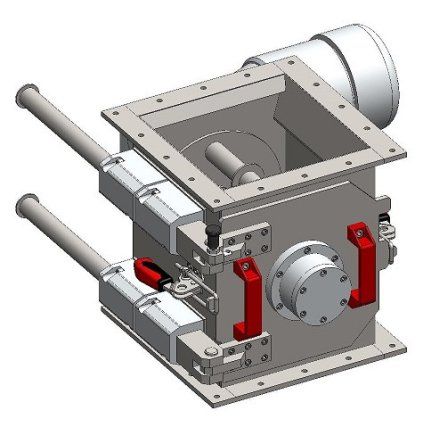
Rotary separator MSVR 260 × 260/4
A separator with four rotating tubes for dry mixtures with poor flow properties.
- Inlet and outlet 260 × 260 mm
- 4 magnetic tubes, each 32 mm in diameter
- Magnetic flux density 7,400 Gs
- Pull force 100 N per tube
- 250 W motor, 35 rpm
- Weight 80 kg
- Magnet temperature resistance up to 80 °C
- Product code 51412
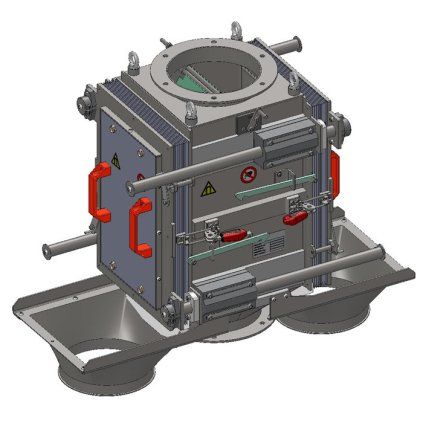
Plate separator MSP 200 F-UP
A ferrite separator for dry mixtures with larger particles or poor flowability.
- Inlet and outlet DN 200
- 2 magnetic plates
- Magnetic flux density 1,560 Gs
- Pull force 8.4 N
- Manual cleaning system
- AISI 304 stainless steel construction
- Magnet temperature resistance up to 150 °C
- Product code 51494
Important: the temperature limit applies to the magnetic system, not automatically to every part of the equipment.
View product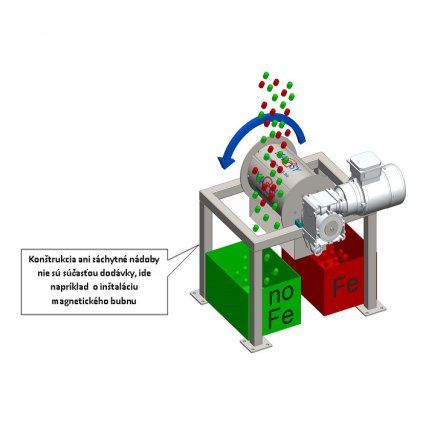
Magnetic drum MB 204 × 340/300 F
An automatically cleaned drum separator for the continuous cleaning of dry, free-flowing materials.
- Drum diameter 204 mm
- Working width 340 mm
- Ferrite magnetic system
- Magnetic flux density 1,350 Gs
- Pull force 4.6 N
- Speed 17 or 34.5 rpm
- Weight 50 kg
- Temperature resistance up to 80 °C
- Product code 52291
Frequently asked questions
Which metals can a separator capture?
Primarily iron, ordinary steel, cast iron and other strongly ferromagnetic materials.
Does it also capture aluminium or copper?
No. A different type of separation technology is needed for non-ferrous metals.
When should you choose a rotary separator?
For dry mixtures with poor flowability that may clog a conventional static grate.
When is a magnetic drum suitable?
For continuous operations where captured metal contaminants need to be removed automatically.
How often should a separator be cleaned?
This depends on the amount of metal captured. A manually cleaned separator must be cleaned before the build-up starts to restrict the flow or magnetic performance.
Summary
Magnetic separators protect production equipment and improve the purity of bulk solids and liquids. The appropriate type is selected according to the properties of the mixture, line capacity, the size of metal contaminants and the required cleaning method.
A rotary separator helps with poorly flowing mixtures, a plate model offers a more open passage for larger particles, and a magnetic drum provides automatic separation in continuous operation.
Need help choosing a magnetic separator?
Browse separators for bulk solids and liquids, or have a solution designed for your specific production line.