
Magnetic sweepers
Magnetic Brooms: Fast Collection of Metal Contaminants from Floors and Industrial Areas
Magnetic brooms help quickly collect ferromagnetic contaminants from the floors of production halls, workshops, warehouses, car parks and other large areas. They can capture steel shavings, nails, screws, nuts and wires without the need to pick up each item by hand.
- Learn how a magnetic broom works and which contaminants it can collect.
- Compare brooms with ferrite and neodymium magnets.
- Understand the difference between a handheld broom and versions designed for cleaning vehicles or forklift trucks.
- Find out how to choose the right magnetic width and working height.
- Learn how to clean and maintain a magnetic broom.
- Discover safety risks and unsuitable methods of use.
- Explore recommended products and answers to frequently asked questions.
Metal contaminants on the floor can puncture tyres, damage the wheels of handling equipment, injure employees or spread into other areas of the facility.
A magnetic broom makes it possible to collect these objects during normal driving or manual cleaning. It requires no electricity or batteries because it operates using permanent ferrite or neodymium magnets.
What is a magnetic broom?
A magnetic broom, sometimes also referred to as a magnetic sweeper, is a device with a long active magnetic surface positioned at a low height above the floor.
Depending on the design, it can be:
- manually pushed on wheels,
- equipped with a long handle,
- attached to a cleaning vehicle,
- mounted on the forks of a forklift truck,
- made with ferrite magnets,
- made with more powerful neodymium magnets,
- designed for smooth and selected unpaved surfaces.
What is a magnetic broom used for?
- collecting ferromagnetic contaminants from floors,
- protecting tyres on vehicles and handling equipment,
- reducing the risk of injury from metal objects,
- speeding up the cleaning of large areas,
- supplementing conventional sweeping and vacuuming,
- regular inspection of traffic routes within production facilities.
How does a magnetic broom work?
Permanent magnets are installed inside the body of the broom. The magnetic field acts towards the floor and attracts ferromagnetic objects that enter its effective range.
- The broom moves over the surface being cleaned.
- A steel or iron object enters the magnetic field.
- The magnet attracts it to the underside of the broom.
- The object remains attached to the magnetic surface.
- After cleaning, the broom is moved over a collection container.
- The captured contaminants are removed according to the design of the specific model.
A magnetic broom is sometimes compared to a magnetic vacuum cleaner. However, it does not use airflow to suck up dirt – it only attracts materials that respond to a magnetic field.
Which contaminants can a magnetic broom collect?
A magnetic broom is designed for ferromagnetic contaminants – materials that can be attracted by a permanent magnet.
Typical captured objects
- steel shavings and chips,
- nails,
- screws and bolts,
- nuts and washers,
- steel wires,
- paper clips and staples,
- small pieces of sheet metal and offcuts,
- fastener fragments,
- ferromagnetic grinding dust,
- particles produced when machining ordinary steel.
What will a magnetic broom not collect?
A magnetic broom will not collect non-magnetic contaminants or most non-ferrous metals.
- aluminium,
- copper,
- brass,
- plastic parts,
- wood shavings,
- glass,
- sand and ordinary dust without ferrous content,
- some grades of stainless steel,
- oil and liquid contaminants.
A magnetic broom does not replace complete cleaning
The broom only captures magnetically attractable materials. Non-magnetic dust, sand, plastics, wood and other contaminants must be removed using a vacuum cleaner, brush or conventional cleaning machine.
Where are magnetic brooms used?
Production halls
The broom helps remove shavings, fasteners and offcuts from main walkways, areas around production lines and locations where handling equipment operates.
Metalworking and machining
It is suitable for metalworking shops, grinding areas, welding shops, assembly facilities and other workplaces where ferromagnetic chips and shavings are generated.
Automotive workshops and tyre service centres
It helps collect screws, nails and wires that could damage the tyres of vehicles or service equipment.
Warehouses and logistics centres
Magnetic brooms can be used on routes used by pallet trucks and forklifts, in loading areas and around racking systems.
Car parks and outdoor areas
Selected models can be used on asphalt, concrete and some paved or slightly unpaved surfaces.
Airport and service areas
Metal objects on taxiways and service areas can damage tyres or equipment. Wider brooms attached to vehicles are used for large sites.
Construction sites
A magnetic broom can help collect nails, screws, wires and other steel objects after assembly or demolition work.
Handheld magnetic brooms
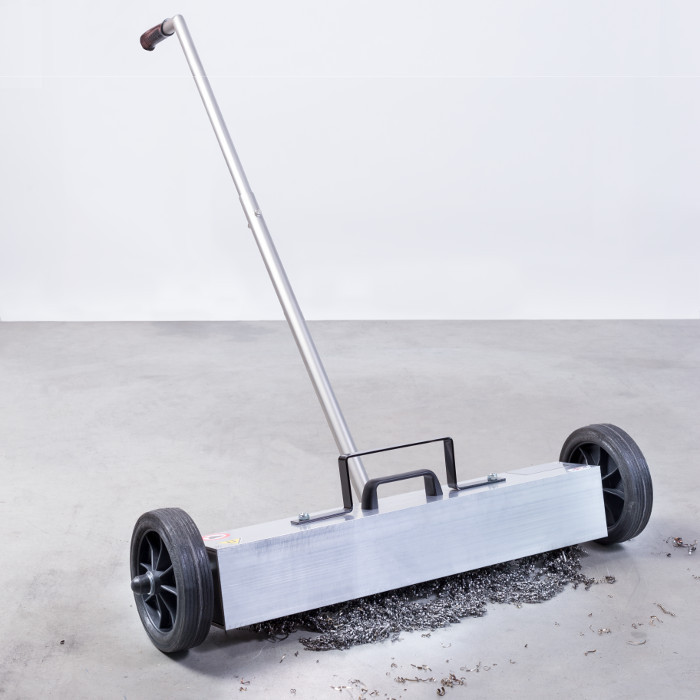
A handheld broom typically consists of a magnetic body, guide rod, handle and wheels. The operator pushes it ahead in a similar way to a mechanical sweeper.
Advantages of a handheld broom
- simple operation,
- no cleaning vehicle or forklift truck required,
- easy access between machines and racks,
- suitable for regular inspection of smaller areas,
- operates without electricity,
- height adjustment available on selected models.
When is a handheld broom the best choice?
It is suitable for workshops, garages, smaller production halls, service centres or facilities where several thousand square metres do not need to be cleaned regularly.
Magnetic brooms with ferrite magnets
Ferrite magnets provide an affordable and durable solution for the routine collection of screws, nails, nuts, washers and larger steel objects.
Advantages of ferrite magnetic brooms
- lower purchase price,
- good corrosion resistance,
- suitable for routine industrial cleaning,
- long-term stability of magnetic properties,
- simple construction,
- suitable for indoor use and selected outdoor areas.
Disadvantages of ferrite magnetic brooms
- lower magnetic strength than neodymium magnets of the same volume,
- shorter magnetic field range,
- higher performance may require a larger or heavier construction,
- lower efficiency when collecting very fine or more distant particles.
A ferrite magnetic broom is suitable for regular cleaning where the floor mainly contains larger and strongly magnetic steel objects.
Magnetic brooms with neodymium magnets
Neodymium magnets generate a significantly stronger magnetic field at comparable dimensions. They can therefore capture objects from a greater distance or respond more effectively to smaller ferromagnetic particles.
Advantages of neodymium magnetic brooms
- higher magnetic strength,
- greater potential working range,
- more effective capture of finer particles,
- better performance at higher travel speeds,
- suitable for more uneven and slightly irregular surfaces.
Disadvantages of neodymium magnetic brooms
- higher purchase price,
- greater forces during handling and cleaning,
- magnets are sensitive to excessive operating temperatures,
- the magnetic section must be protected against damage and corrosion.
Ferrite or neodymium?
Choose a ferrite magnetic broom for routine collection of larger steel objects and a more affordable price. A neodymium magnetic broom is more suitable when you need higher performance, a greater working distance or better capture of finer particles.
Wide magnetic brooms for large areas
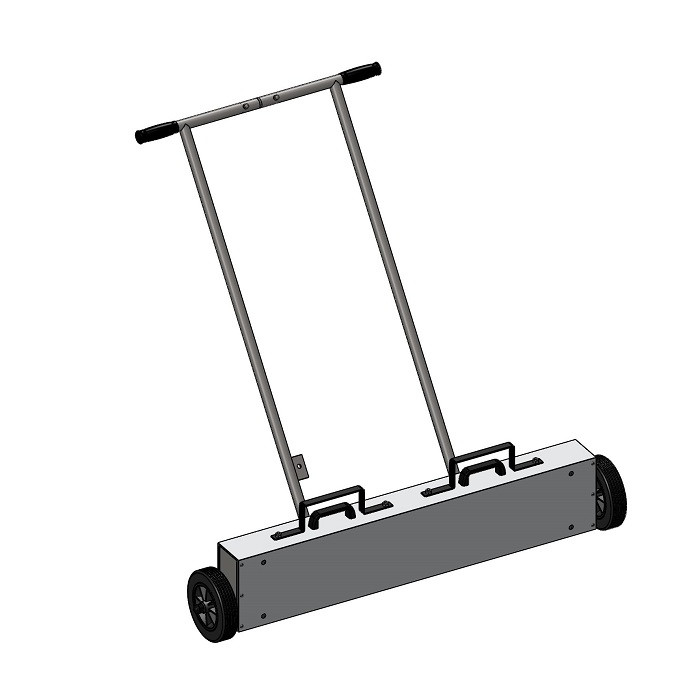
Brooms with a magnetic surface approximately 1,000 mm wide can clean a wider strip in a single pass. They are suitable for large production halls, warehouses, service areas or car parks.
Advantages of a wider broom
- greater area covered in one pass,
- faster cleaning of long routes,
- greater capacity for captured objects,
- fewer passes required,
- suitable for main routes used by handling equipment.
Disadvantages of a wider broom
- higher weight,
- more difficult manoeuvring in narrow aisles,
- more storage space required,
- more demanding manual handling and cleaning.
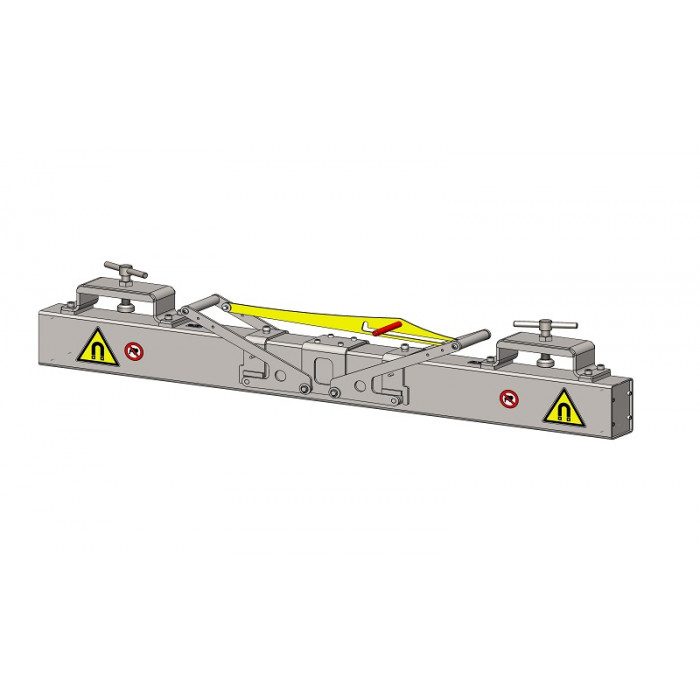
Magnetic sweepers for cleaning vehicles
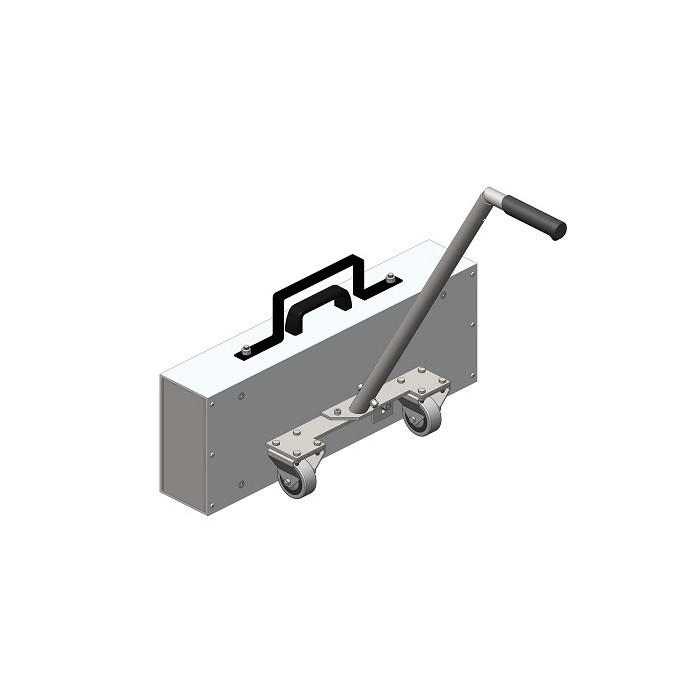
A magnetic sweeper for a cleaning vehicle is attached to the front or rear of the machine using a suitable mounting mechanism. Metal contaminants are collected during the vehicle's normal cleaning route.
Main advantages
- no need for a separate operator with a handheld broom,
- magnetic collection takes place during routine cleaning,
- suitable for larger production and warehouse areas,
- regular cleaning of main traffic routes,
- reduced physical effort for employees,
- easier integration into everyday operations.
What should be checked before installation?
- compatibility of the mounting mechanism with the vehicle,
- sufficient load capacity of the structure,
- height of the magnetic surface above the floor,
- space required for turning and reversing,
- possibility of safe cleaning,
- effect of the sweeper on passing through doors and narrow spaces.
Magnetic brooms for forklift trucks
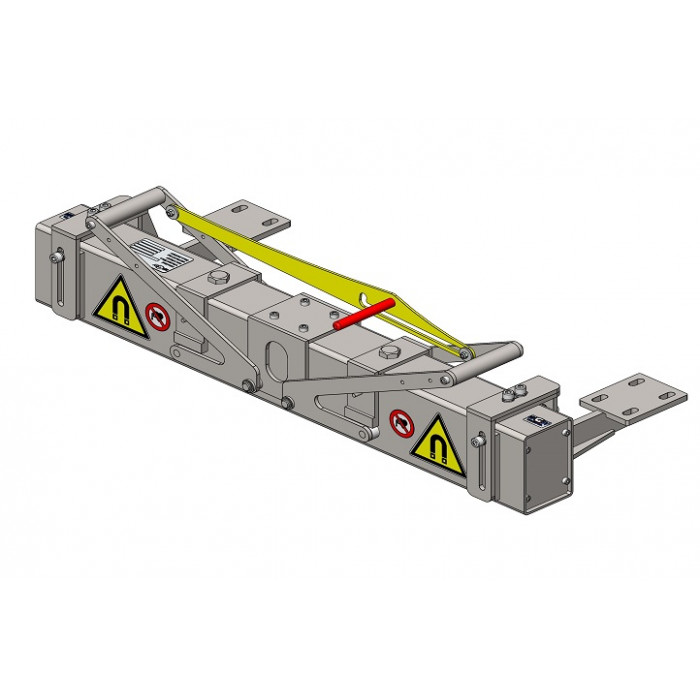
A magnetic broom for a forklift truck is mounted on the forks using a clamping structure suitable for the dimensions of the specific forklift.
During normal operation around the facility, the forklift can therefore collect ferromagnetic contaminants from traffic routes at the same time.
Advantages of use on a forklift truck
- fast cleaning of large halls and sites,
- uses a vehicle that already moves around the facility,
- wide magnetic surface,
- reduced need for manual collection,
- regular cleaning of main transport routes,
- protection of tyres and wheels on handling equipment.
What should you watch out for?
The broom must be securely mounted, correctly balanced and must not restrict safe forklift operation. The operator must be aware of its dimensions and adjust driving speed, turning and manoeuvring around obstacles accordingly.
How high should a magnetic broom be above the floor?
Magnetic force decreases rapidly with distance. The broom should therefore be positioned as close to the surface as possible without striking it.
Setting it too high
- reduces the ability to capture heavier objects,
- reduces the collection of finer shavings,
- may cause some contaminants to remain on the floor.
Setting it too low
- increases the risk of hitting the floor,
- may damage the broom or its mounting system,
- makes it more difficult to pass over uneven surfaces,
- may cause the broom to catch on a kerb, threshold or obstacle.
The correct height must be set according to the specific model, surface and type of contamination.
Maximum range is not guaranteed for every object
A lightweight paper clip, a long screw and a heavy nut may be captured from different distances. The result is affected by the weight, shape, material and contact area of the specific object.
How fast can you move with a magnetic broom?
Excessive speed reduces the amount of time the contaminant remains within the magnetic field. The object may not have enough time to be lifted or may fall away again after striking the broom structure.
Safe speed depends on:
- the type and performance of the magnets,
- height above the floor,
- size of the contaminants,
- surface evenness,
- broom design,
- method of attachment to the vehicle,
- the manufacturer's instructions for the specific model.
In an unfamiliar facility, begin with a slow test pass and gradually verify the collection efficiency.
Can a magnetic broom be used on unpaved surfaces?
Selected handheld models with adjustable height can also be used on grass, gravel or other slightly uneven surfaces.
However, bear in mind that:
- the magnetic surface will be farther away from contaminants,
- stones and uneven surfaces may strike the broom,
- smaller objects may be hidden by soil or gravel,
- efficiency will be lower than on smooth concrete.
For unpaved surfaces, a more powerful neodymium broom with sufficient ground clearance is generally more suitable.
How do you choose the right magnetic broom?
Answer these questions before purchasing
- How large an area do you need to clean regularly?
- Which objects are most commonly found on the floor?
- Is the surface smooth concrete, asphalt, paving or unpaved?
- Do you need a handheld broom or a vehicle-mounted version?
- What width will fit through the aisles and passageways?
- How often will the broom be used?
- Do you need the higher performance of neodymium magnets?
- How will the broom be cleaned and emptied?
- Where will the broom be stored?
- What is the maximum operating temperature of the environment?
Size of the area to be cleaned
For a smaller workshop, a handheld broom 60 to 90 cm wide may be sufficient. For a large production hall or outdoor site, a 1,000 mm broom or a vehicle-mounted version may be more suitable.
Size and type of contaminants
For nails, nuts and larger screws, a ferrite magnetic broom is usually sufficient. Finer shavings, a greater working distance or faster travel may require a neodymium version.
Aisle width
An excessively wide broom may not fit between machines, racks or doors. Measure the narrowest point along the entire planned route.
Weight and handling
Wider and more powerful brooms can weigh tens of kilograms. Consider how they will be moved, cleaned, installed and stored.
Mounting method
A magnetic broom for a forklift or cleaning vehicle must be compatible with its construction. The mounting mechanism must not be modified in an unprofessional manner.
How should a magnetic broom be used correctly?
- Check the condition of the body, wheels, handle or mounting mechanism.
- Remove previously captured contaminants from the broom.
- Set the correct height above the floor.
- Define the route and remove large obstacles.
- Move slowly and evenly.
- Slightly overlap individual cleaning passes.
- Regularly check the amount of captured metal.
- When the broom is full, stop work and clean it.
- After finishing, inspect the cleaned area.
Why should cleaning passes overlap?
The magnetic field may be strongest in the centre or in specific parts of the structure. Slightly overlapping the routes helps prevent uncleaned strips from being left behind.
How do you clean a magnetic broom?
The cleaning method depends on the construction of the specific model. Some brooms have a release mechanism, sliding magnetic core or removable cover. On other models, contaminants must be mechanically removed from the magnetic surface.
- Move the broom to the designated cleaning area.
- Prepare a container for metal waste.
- Secure the broom against movement or falling.
- Wear work gloves resistant to sharp edges.
- Activate the release mechanism if the broom is equipped with one.
- Slide larger objects sideways or towards the edge.
- Remove fine shavings using a non-magnetic scraper or brush.
- Check that no sharp fragments remain on the surface.
- Inspect the condition of the body, wheels and mounting components.
Do not wipe metal shavings away with bare hands
Shavings, wires and offcuts can be extremely sharp. Wear protective gloves and use a suitable non-magnetic tool during cleaning.
How often should a magnetic broom be emptied?
Clean the broom before a thick layer of captured material builds up on its surface.
A heavy build-up can:
- increase the distance between newly captured particles and the magnets,
- reduce the ability to capture new contaminants,
- cause previously captured objects to fall away,
- damage the broom surface,
- increase the weight of the entire structure,
- create a handling hazard.
When using the broom for the first time, inspect it more frequently. A regular cleaning interval can then be established according to the amount of material captured.
Magnetic broom maintenance
- Regularly clean the magnetic surface.
- Inspect the wheels, bearings and height adjustment.
- Tighten loose bolted connections according to the manufacturer's instructions.
- Inspect handles and guide rods.
- Check for damage to the body or protective surface.
- Inspect the mounting mechanism on vehicle-mounted versions.
- Clean and dry the broom after use in wet conditions.
- Protect it from prolonged contact with aggressive chemicals.
- Do not use a damaged structure.
Can a magnetic broom damage the floor?
When correctly adjusted, the magnetic section does not touch the floor directly. Damage can occur if the broom is set too low, strikes an obstacle or a hard object becomes trapped between the structure and the floor.
On painted, polished or otherwise sensitive surfaces, first test the broom in a less visible area.
Safety when working with a magnetic broom
What should you watch out for?
- A powerful broom can attract loose steel tools.
- Protect your hands from being pinched during cleaning.
- Wear gloves resistant to sharp metal shavings.
- Install vehicle-mounted brooms only using an approved mounting mechanism.
- Check all connections and locking elements before driving.
- Adjust speed according to the dimensions and weight of the broom.
- Maintain a safe distance from sensitive measuring instruments and magnetic cards.
- People with medical implants must observe the required safety distances.
- Do not exceed the permitted operating temperature.
- Do not use a damaged or deformed broom.
- The broom is not designed for lifting loads or people.
Recommended magnetic brooms
The selected products represent three different applications: manual cleaning of small and medium-sized areas, collection using a cleaning vehicle and a wide broom for forklift trucks.

Magnetic broom, width 90 cm, ferrite magnets
Simple handheld magnetic broom for the regular collection of screws, nails, nuts, washers, shavings and other ferromagnetic objects.
- Magnetic surface width 90 cm
- Ferrite permanent magnets
- Total weight approximately 8 kg
- Body made from lightweight and durable duralumin
- Selected steel objects can be collected from distances of up to 25 mm
- Manual operation using a long handle
- Suitable for workshops, garages and production halls
- Operates without electricity or batteries

Magnetic broom for forklift trucks MM 1700 DM-UP F
Wide industrial magnetic broom designed for mounting on forklift forks and regular collection of metal contaminants from main traffic routes.
- Magnetic surface length 1,700 mm
- Magnetic surface width 80 mm
- Ferrite permanent magnets
- Total weight approximately 44 kg
- AISI 304 stainless-steel construction
- Glass bead blasted surface
- UP version
- Mounting on forklift forks
- Maximum short-term temperature of the magnetic surface 80 °C
- Suitable for large production and warehouse facilities

Magnetic sweeper for cleaning vehicles MM 800 DM-UP F
Industrial magnetic sweeper designed to integrate the collection of ferromagnetic contaminants into the normal operation of a cleaning vehicle.
- Magnetic surface length 800 mm
- Magnetic surface width 80 mm
- Ferrite permanent magnets
- Total weight approximately 25 kg
- AISI 304 stainless-steel construction
- Glass bead blasted surface
- UP version
- Mounted using a special clamping mechanism
- Recommended maximum operating temperature 80 °C
- Suitable for production halls, warehouses and logistics facilities
Verify performance under real operating conditions
Collection efficiency is affected by the height above the floor, travel speed, material, shape and weight of the object, and the condition of the surface. Before introducing the broom into regular operation, carry out a test using typical contaminants from your workplace.
Frequently asked questions about magnetic brooms
What is a magnetic broom?
A magnetic broom is a device with a long magnetic surface designed to collect ferromagnetic contaminants from floors, traffic routes and other flat surfaces.
Which objects can a magnetic broom collect?
It can collect steel shavings, nails, screws, bolts, nuts, washers, wires and other magnetically attractable objects.
Will the broom collect aluminium objects?
No. Aluminium is not ferromagnetic and is not attracted by an ordinary permanent magnet.
Will a magnetic broom collect stainless-steel shavings?
It depends on the specific stainless-steel grade. Some grades are magnetic, while others are only weakly magnetic or completely non-magnetic.
Will the broom collect metal dust?
Yes, if the dust consists of ferromagnetic material and comes sufficiently close to the magnetic surface.
Can a magnetic broom replace a vacuum cleaner?
No. It only captures magnetic contaminants. Ordinary dust, sand, plastic chips and non-magnetic materials must be removed using another method.
What is the difference between a ferrite and a neodymium broom?
A ferrite broom is more affordable and suitable for routine collection. A neodymium broom creates a stronger field and can capture smaller objects or operate at a greater distance.
How high should the broom be above the ground?
As low as possible without touching the floor or obstacles. The specific setting depends on the model, surface and type of contamination.
From what distance can a magnetic broom collect objects?
The range depends on the type of magnets and the tested object. For the recommended handheld ferrite broom, successful tests with selected steel objects are stated at distances of up to 25 mm.
Why does the broom fail to pick up some screws?
The cause may be excessive working height, high speed, unsuitable material, small contact area, contamination covering the object or excessive object weight.
Can the broom be used on grass?
Selected height-adjustable models can. However, efficiency is generally lower than on smooth concrete because objects may be hidden among vegetation or soil.
Can a magnetic broom be used on gravel?
Conditionally, with a suitable model and greater ground clearance. The broom body must be prevented from striking stones.
Is the broom suitable for outdoor use?
Selected models can be used outdoors. After use in wet conditions, clean and dry them and follow the manufacturer's specified conditions.
Can a magnetic broom rust?
It depends on the construction material and surface protection. Damage, prolonged moisture or aggressive environments may cause corrosion of certain parts.
How is a magnetic broom cleaned?
The broom is moved over a collection container and the captured contaminants are released using the product's mechanism or removed with a suitable non-magnetic tool.
How often should the broom be cleaned?
Before a thick layer of metal builds up on the magnetic surface. In heavily contaminated facilities, cleaning may be required several times during a shift.
Why does a layer of metal reduce efficiency?
New objects are farther away from the magnetic core and can be more easily dislodged as the broom moves.
What broom width should I choose?
Handheld brooms around 60 to 90 cm wide are suitable for smaller workshops. Wider versions or vehicle-mounted brooms are more suitable for large production halls.
Is a wider broom always better?
No. A wider broom covers a large area faster, but it is heavier and more difficult to manoeuvre in narrow aisles.
Can a magnetic broom be attached to a forklift truck?
Yes, but it must be a model designed for forklift trucks and compatible with the fork dimensions and mounting mechanism of the specific vehicle.
Can a broom be attached to a cleaning vehicle?
Yes. Special versions for cleaning vehicles are available. Installation must match the machine's construction and the manufacturer's instructions.
Can a broom be towed behind a car?
Only if the specific model is designed and approved for towing behind a vehicle. Do not modify a handheld broom or vehicle-mounted version for this purpose.
How fast can you drive with a vehicle-mounted broom?
Observe the speed specified by the manufacturer and operating rules. Higher speed can reduce collection efficiency and increase the risk of impact.
Can a magnetic broom damage forklift tyres?
A correctly installed broom helps protect the tyres. However, captured sharp objects must be removed regularly and their position checked.
Can a magnetic broom scratch the floor?
Yes, if it is set too low, strikes the surface or a hard object becomes trapped between the broom and the floor.
Does a magnetic broom require electricity?
No. Permanent magnets operate without electricity or batteries.
Can a magnetic broom become weaker?
When used correctly, permanent magnets generally remain stable for a long time. Excessive temperature, a strong opposing magnetic field or mechanical damage can weaken them.
Can magnets in the broom damage electronics?
A strong magnetic field may affect certain sensors, measuring instruments, magnetic cards, mechanical watches and data storage media.
Is a magnetic broom dangerous for people with pacemakers?
People with medical implants must observe the safe distances specified by the manufacturer of their device.
Can a magnetic broom be used for lifting loads?
No. The broom is designed to collect small contaminants and does not replace a lifting magnet or certified lifting equipment.
How should the broom be stored?
Store it in a dry and stable place, away from loose steel tools, sensitive electronics and normal traffic routes. Secure vehicle-mounted brooms against tipping over.
How can I verify the effectiveness of the broom?
Carry out a test pass using typical screws, shavings and other contaminants from your facility. Evaluate the results at different heights and safe travel speeds.
Summary
Magnetic brooms make it possible to quickly collect ferromagnetic contaminants from the floors of production halls, workshops, warehouses, car parks and outdoor areas.
Handheld brooms are suitable for small and medium-sized areas. For large facilities, wide brooms or versions attached to cleaning vehicles and forklift trucks can be used.
Ferrite magnets provide an economical solution for routine cleaning. Neodymium magnets offer greater strength and a potentially longer working range.
When choosing a broom, consider the width of traffic routes, size of contaminants, type of surface, operating speed, equipment weight and cleaning method. Always verify performance under the actual conditions of your facility.
Need to speed up the collection of metal contaminants?
Choose a handheld magnetic broom or a version for a cleaning vehicle or forklift truck according to the size of the area and the required performance.