
Magnetic separators with pull-out grids
MSV Telescopic Magnetic Separators: Removing Metal Contaminants from Dry Mixtures
MSV telescopic magnetic separators are designed to capture ferromagnetic contaminants from dry, homogeneous and free-flowing materials. They are installed in vertical pipelines through which material falls by gravity across a system of powerful magnetic grids.
- Learn how a telescopic magnetic separator works.
- Find out which materials can be safely cleaned using an MSV separator.
- Compare the ECO, Classic and UP product ranges.
- Understand the difference between equipment protection and product purification.
- Learn how to choose the correct diameter, number of rods and magnetic performance.
- See the correct installation, cleaning and inspection procedure.
- Explore recommended products and answers to frequently asked customer questions.
Metal contaminants can enter dry production mixtures during processing, transport, storage or as a result of wear on production equipment. These may include iron shavings, filings, wire fragments, scale, pieces of screws or extremely fine ferromagnetic dust.
A telescopic separator captures these particles before the material enters a mill, crusher, injection moulding machine, press, fine screen or packaging equipment. This helps prevent damage to production technology while improving the purity of the final product.
What is a telescopic magnetic separator?
An MSV telescopic magnetic separator is a housing-type grid separator designed for industrial piping systems carrying dry material.
The device consists of an enclosed body containing removable magnetic grids. These grids are made from stainless-steel tubes with powerful neodymium magnetic cores inside.
Main components of the separator
- stainless-steel body installed in the pipeline,
- one or more removable magnetic grids,
- magnetic rods with neodymium cores,
- protective stainless-steel tubes,
- flanges or other pipeline connections,
- locking elements and handling handles,
- optional separate cleaning fixture.
What is an MSV separator used for?
- removing ferromagnetic contaminants from dry mixtures,
- protecting mills, crushers, presses and injection moulding machines,
- cleaning products before packaging and dispatch,
- capturing metal particles caused by machine wear,
- separation in the food industry, agriculture and processing industries,
- repeated inspection of material at several stages of production.
How does a telescopic magnetic separator work?
The separator is installed in a vertical pipeline. Material enters from above and falls under its own weight through the magnetic grids.
- Dry material enters the upper section of the separator.
- The grids create a magnetic labyrinth and divide the material flow.
- Ferromagnetic contaminants enter the strong magnetic field.
- The particles are attracted to the surface of the stainless-steel tubes.
- The cleaned material continues through the lower outlet.
- Captured contaminants remain on the grids until cleaning.
In the Classic range, the grids are usually arranged in two levels above one another. The material therefore cannot simply fall through one open path but must change direction several times and pass close to the magnetic tubes.
Why is the magnetic labyrinth important?
A powerful magnet can only act effectively on a particle that comes sufficiently close to its surface. If material were able to fall through the separator along a straight open path, some metal contaminants could bypass the magnetic field.
A correctly designed labyrinth:
- spreads the material across the separator area,
- guides it around several magnetic tubes,
- reduces the formation of unrestricted flow paths,
- increases the exposure time to the magnetic field,
- improves the likelihood of capturing fine particles.
A high Gs value alone is not enough
Separation efficiency is also affected by pull-off force, the number of tubes, labyrinth design, material feed rate, particle size, material flowability and regular cleaning of the grids.
Which metal contaminants can an MSV separator capture?
A telescopic separator is designed for ferromagnetic materials that can be strongly attracted by a permanent magnet.
Typical captured contaminants
- iron and steel shavings,
- particles of ordinary magnetic steel,
- scale,
- wire fragments,
- fine ferromagnetic dust,
- particles caused by machine wear,
- small fragments of screws and fasteners.
What will a standard MSV separator not capture?
- aluminium,
- copper,
- brass and bronze,
- plastic,
- glass,
- wood,
- ordinary non-magnetic contaminants,
- some grades of stainless steel,
- products containing only a small enclosed steel component.
The equipment is not a substitute for a mechanical screen or filter. If the material may contain large non-magnetic pieces, suitable protection must be installed upstream of the separator.
Which materials can pass through the separator?
MSV separators are designed for dry, homogeneous, non-sticky and free-flowing materials. The mixture must be able to fall freely through the magnetic grids and must not form bridges or lumps between them.
Examples of suitable materials
- plastic granulate and regranulate without glass additives,
- rubber regranulate and suitable rubber crumb,
- grain and finely processed agricultural products,
- rice, lentils, chickpeas and selected seeds,
- sugar, cocoa, coffee and spices,
- animal feed mixtures,
- dried food powders,
- fine dry sand with more frequent wear inspection,
- selected construction mixtures,
- finely shredded PET and other free-flowing recycled materials.
What properties must the material have?
- it must be dry,
- it must not be greasy or sticky,
- it must have good flowability,
- it must not contain large hard pieces,
- it must not form solid clumps,
- its particle size must be suitable for the specific separator,
- it must not clog or mechanically damage the grids.
Maximum standard material fraction
For the recommended separators, the material being cleaned is generally limited to a regular fraction of approximately 5 × 5 × 5 mm. Larger pieces may block the grids, dent them or puncture the thin protective tubes.
Why is an MSV separator unsuitable for wet and sticky materials?
Wet, greasy or sticky mixtures can adhere to the magnetic tubes and gradually close the flow gaps.
Problems may also occur with extremely fine powders that tend to bridge, such as some finely milled flours or starches.
Possible consequences of unsuitable material
- blocked magnetic grids,
- uneven loading of the separator,
- significantly reduced capacity,
- captured particles becoming coated with normal material,
- reduced magnetic performance,
- difficult and hazardous cleaning.
Flow-type magnetic separators of a different design are intended for wet, liquid or semi-liquid materials.
Is an MSV separator suitable for abrasive material?
The magnetic tubes have very thin stainless-steel walls in order to achieve high magnetic performance. Abrasive material can gradually wear them down.
Higher-risk materials include:
- sand,
- crushed glass,
- ceramic particles,
- granulates containing glass fibres,
- hard mineral mixtures,
- material falling from a great height.
If use with a particular abrasive material is permitted, the condition of the tubes must be checked more frequently. A worn-through or dented tube creates a risk of damage to the magnetic core and contamination of the product.
What is the maximum permitted material drop height?
Material must not fall onto the magnetic grids from an unlimited height. Hard or heavy particles can damage the thin protective tubes on impact.
For this type of separator, a general maximum drop height of approximately 1 metre is often stated. However, the actual safe height depends on the density, size, hardness and velocity of the material.
A one-metre drop is not safe for every material
For hard, heavy or abrasive mixtures, a significantly lower drop height, a dispersing element or a different type of separator may be required.
Equipment protection or product purity?
Separation for equipment protection
The separator is installed upstream of equipment that could be damaged by metal objects.
- mills and crushers,
- cutting blades,
- granulation and regranulation lines,
- injection moulding machines and extruders,
- pressing equipment,
- fine screens,
- ceramic and glass presses.
In this case, the main objective is to capture particles that could cause mechanical failure, blockage or production downtime.
Separation for improved product purity
If the objective is product purity, the separator is installed at the end of the process or at several consecutive points along the production line.
After the final separation stage, the cleaned material should be enclosed in packaging or a container as quickly as possible to prevent recontamination.
Why is the separator intended for non-continuous operation?
Manually cleaned MSV separators must be removed from the material flow during maintenance. The material feed must therefore be stopped before the magnetic grids are withdrawn.
If production cannot be interrupted regularly, a more suitable solution may be:
- an automatically cleaned telescopic separator,
- a rotary magnetic separator,
- two separators used alternately,
- another continuous magnetic separation solution.
Why is an MSV separator installed in a vertical pipeline?
The equipment uses gravity to move the material through the magnetic labyrinth. In a vertical position, the mixture naturally falls through the separator.
In a horizontal pipeline, material could accumulate inside the separator body, load the grids unevenly and gradually cause blockage.
Do not improvise with horizontal installation
If the equipment cannot be installed vertically, choose a different type of separator or have the suitability of the proposed installation confirmed by the manufacturer.
Telescopic magnetic separator product ranges
MSV ECO
The ECO range offers a more economical solution for applications where maximum cleaning convenience is not a priority.
Main features
- simpler construction,
- lower purchase price,
- powerful neodymium magnetic rods,
- manual removal of contaminants from the tube surfaces,
- versions for round and rectangular pipelines,
- suitable for less frequent cleaning.
The ECO version is suitable where the amount of captured metal is low and the grid does not need to be cleaned several times during a shift.
MSV Classic
The Classic range is the most common universal version with removable magnetic grids. Material normally passes through two levels of magnetic rods that create an effective labyrinth.
Main features
- high level of separation,
- versions for round and rectangular pipelines,
- removable magnetic grids,
- removable magnetic cores,
- easier manual cleaning,
- wide range of sizes,
- powerful neodymium magnets.
The Classic range is suitable for most standard industrial applications involving dry and free-flowing materials.
MSV UP
The UP range is designed for more demanding applications and frequent cleaning. Its construction allows individual components to be withdrawn separately and reduces direct handling of the powerful magnetic cores.
Main features
- very high magnetic performance,
- compact modern construction,
- convenient cleaning system,
- improved operator safety,
- no separate external cleaning fixture required,
- versions for round and rectangular pipelines,
- custom dimensions available.
Which range should you choose?
- ECO: lower price and less frequent cleaning.
- Classic: universal industrial use and a proven grid system.
- UP: frequent maintenance, greater convenience and safer handling.
How do you choose the right MSV size?
The separator dimensions must match the pipeline, amount of material and required capacity.
Inlet and outlet diameter
The DN designation must match the pipeline or transition components in the production system. A separator that is too small can significantly restrict material flow.
Number of magnetic rods
More rods create a larger active surface and a denser labyrinth. At the same time, however, they reduce the open area available for the material to pass through.
Material properties
Two different materials may achieve very different capacities in the same separator size. Flowability, particle size, particle shape, bulk density and tendency to bridge are all important.
Required level of purity
Lower magnetic performance may be sufficient for protecting equipment. Higher-performance magnetic cores are used for fine particles and higher product purity.
What does magnetic flux density in Gs mean?
Magnetic flux density describes the intensity of the magnetic field at a specific measurement point on the surface of the magnetic tube.
A higher value may help capture finer ferromagnetic particles, but on its own it does not describe the overall efficiency of the separator.
What does pull-off force in N mean?
Pull-off force indicates the force required to separate a defined steel test piece from the surface of the magnetic tube.
A higher pull-off force helps keep captured particles attached to the tube as material passes through.
Which is more important, Gs or N?
Both values must be assessed together with the separator design.
- magnetic flux density,
- pull-off force,
- number of magnetic tubes,
- tube diameter,
- spacing and arrangement of the grids,
- material feed rate,
- cleaning frequency.
Measured values are for guidance
Results are affected by the test piece used, measurement probe, air gap, surface contamination and equipment wear. Parameters from different products should only be compared when the same measurement method is used.
How is a telescopic separator installed?
- Check the pipeline diameter and design.
- Make sure there is enough space to fully withdraw the grids.
- Install the separator only in a vertical position.
- Provide a secure and leak-tight pipeline connection.
- Make sure the weight of the equipment does not place unsuitable loads on weak piping.
- Provide a safe working area for cleaning.
- Remove loose ferromagnetic objects from the surrounding area.
- Check all clamps and locking elements before operation.
- Carry out a flow test using a smaller amount of material.
How much space is required for cleaning?
The grids must be able to slide completely out of the separator body. Sufficient handling space must therefore remain beside the separator to accommodate the full component length and cleaning fixture.
How often should an MSV separator be cleaned?
There is no universal interval. The separator must be cleaned before a thick layer of metal builds up on the magnetic tubes or begins to reduce the flow gaps.
Cleaning frequency depends on:
- amount of ferromagnetic contamination,
- volume of processed material,
- size of metal particles,
- number of rods,
- required product purity,
- risk of damage to downstream equipment.
When first commissioning the separator, inspect the grids more frequently. A fixed cleaning interval can then be established according to the actual amount of captured metal.
Why does an overloaded grid lose efficiency?
New metal particles are captured on top of the existing build-up and are therefore farther away from the magnetic core.
A heavy build-up can:
- reduce magnetic holding force,
- reduce flow gaps,
- trap ordinary material,
- cause blockages,
- allow some of the captured metal to be released again,
- damage the stainless-steel tubes.
How do you clean an MSV separator safely?
Cleaning may only be carried out after the material flow has been completely stopped and the production equipment has been secured.
- Stop material dosing and flow.
- Secure the equipment against accidental start-up.
- Open or unlock the separator according to the instructions.
- Carefully withdraw the magnetic grids.
- Secure the grid in a cleaning fixture if one is used.
- Unlock the magnetic cores.
- Slowly pull the cores out of the protective tubes.
- Place them in a safe non-magnetic holder.
- Allow the captured contaminants to fall into a container.
- Remove any remaining particles with a dry brush or suitable tool.
- Inspect the condition of the protective tubes.
- Return the cores to their operating position.
- Slide the grids back in and secure them safely.
The magnetic cores are extremely powerful
Once removed, they can suddenly snap towards a steel table, tool, railing or other component. Do not place them on a ferromagnetic surface and protect your hands from being trapped.
Can the separator be cleaned with water?
The magnetic cores must not be immersed in water or cleaned using high-pressure water. Water may enter the construction and damage the magnets or internal components.
Suitable methods for removing residues include:
- a dry cloth,
- a dry brush,
- a non-magnetic scraper,
- thoroughly dried compressed air, if permitted by the operating procedure.
The cleaning method used for components that come into contact with the product must also comply with the hygiene requirements of the specific facility.
Why use a cleaning fixture?
A separate fixture holds the grid and magnetic cores in a safe position during maintenance.
Main advantages
- improved operator safety,
- lower risk of magnetic cores snapping towards a steel structure,
- more convenient removal of the magnets,
- easier release of captured metal,
- protection of the protective tubes,
- faster routine maintenance.
How should the condition of the separator be inspected?
- inspect the surfaces of the protective tubes,
- look for dents, scratches and abrasion,
- inspect welds and joints,
- check the condition of flanges and seals,
- inspect clamps and locking mechanisms,
- make sure the grids move freely,
- regularly measure magnetic flux density,
- regularly measure pull-off force,
- keep records of cleaning and inspections.
When should the separator be taken out of service?
Do not use the equipment if a tube is punctured, heavily dented or worn through, if the grid cannot be secured safely or if the magnetic core is damaged.
Is an MSV separator suitable for the food industry?
Selected models made from AISI 304 stainless steel can be used in food-processing applications provided that the complete design and installation meet the requirements of the specific facility.
In particular, verify:
- material of all parts in contact with the product,
- surface finish,
- weld design,
- seals,
- possibility of hygienic cleaning,
- risk of dead spaces,
- internal HACCP and audit requirements,
- chemical resistance to cleaning agents.
Can the separator be used outdoors or in an ATEX environment?
Standard stock MSV separators are designed for indoor industrial use only.
They are not automatically suitable for:
- outdoor environments,
- permanently wet conditions,
- potentially explosive atmospheres,
- aggressive chemical environments,
- areas with uncontrolled high temperatures.
An explicitly designed and approved version must be used for ATEX or other special operating conditions.
Safety when working with MSV separators
Basic safety rules
- Always stop the material flow before cleaning.
- Secure the equipment against accidental start-up.
- Wear work gloves and safety glasses.
- Do not place magnetic cores on a steel table or floor.
- Remove tools and other ferromagnetic objects from the surrounding area.
- Protect your fingers from being trapped.
- Do not immerse the magnetic cores in water.
- Do not use high-pressure water.
- Do not exceed the maximum operating temperature.
- Repair damaged tubes or locking components immediately.
- Maintain a safe distance from electronics and sensitive measuring equipment.
- People with medical implants must observe the required safety distances.
Recommended telescopic magnetic separators
The selected products represent three different separator sizes from the Standard range – a compact DN 50 model, a universal DN 150 model and a larger DN 200 separator with a greater flow area.
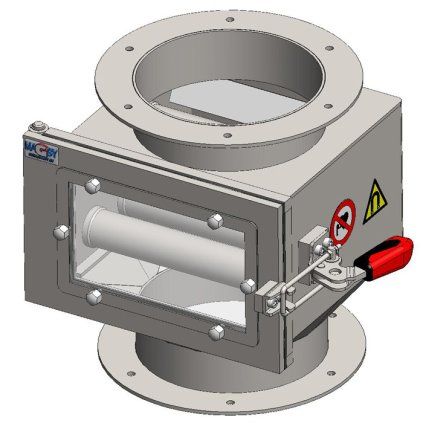
MSV 150/5 VVM-P-1-80-TP-RP-D
Standard-range telescopic magnetic separator for cleaning dry and free-flowing mixtures in DN 150 pipelines.
- DN 150 inlet and outlet
- 5 magnetic rods
- Magnetic rod diameter 31 mm
- Magnetic flux density 7,400 Gs
- Pull-off force 100 N on the tube
- Powerful NdFeB neodymium magnets
- Magnet temperature resistance up to 80 °C
- AISI 304 / 1.4301 stainless steel
- Total weight approximately 14 kg
- Magnetic core weight approximately 7.2 kg
- Flanged connection
- Glass bead blasted surface
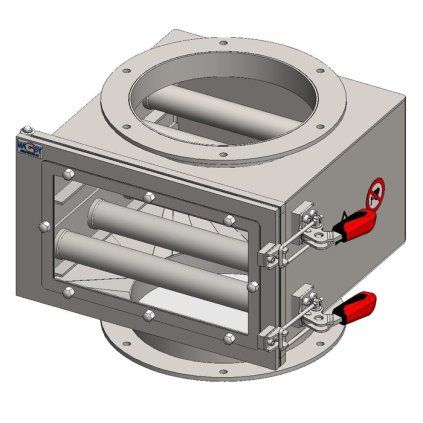
MSV 200/7 VVM-P-1-80-TP-RP
Larger Standard-range telescopic separator with seven magnetic rods for DN 200 gravity pipelines.
- DN 200 inlet and outlet
- 7 magnetic rods
- Magnetic rod diameter 31 mm
- Magnetic flux density 7,400 Gs
- Pull-off force 100 N on the tube
- NdFeB neodymium magnetic core
- Magnet temperature resistance up to 80 °C
- AISI 304 / 1.4301 stainless steel
- Total weight approximately 25.5 kg
- Magnetic core weight approximately 13 kg
- Flanged connection
- Manual cleaning
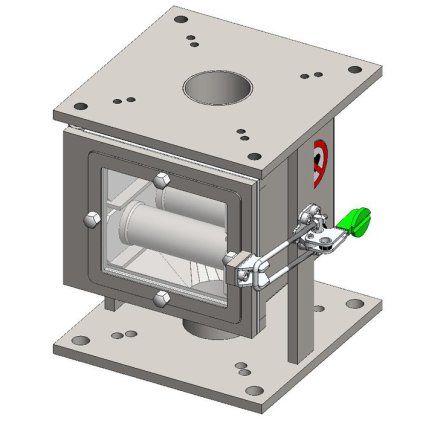
MSV 50/3 VVM-P-2-80-TP-RP-MODEL 1
Compact Standard-range separator for smaller piping systems and facilities with limited installation space.
- DN 50 inlet and outlet
- 3 magnetic rods
- Magnetic rod diameter 31 mm
- Magnetic flux density 9,300 Gs
- Pull-off force 68 N on the tube
- Powerful NdFeB neodymium magnets
- Magnet temperature resistance up to 80 °C
- AISI 304 / 1.4301 stainless steel
- Total weight approximately 10.5 kg
- Magnetic core weight approximately 2.8 kg
- Flanged connection
- Manual cleaning
Do not choose separator size based solely on DN
Material flowability, particle size, required capacity, amount of metal contamination, required purity and the available space for withdrawing and cleaning the grids are also important.
Frequently asked questions about telescopic magnetic separators
What is a telescopic magnetic separator?
It is a housing-type separator with removable magnetic grids that captures ferromagnetic contaminants from dry material falling through a vertical pipeline.
Which materials are suitable for an MSV separator?
Dry, non-sticky, homogeneous and free-flowing mixtures with a small and regular particle fraction.
Can the separator be used for flour?
Selected coarser flours may be suitable, but very fine flour can bridge and block the grids. The suitability of the specific material must be verified.
Can an MSV separator be used for plastic granulate?
Yes, provided that the granulate is dry, free-flowing, contains no glass fibres and meets the permitted particle-size requirements.
Can it be used for rubber regranulate?
Yes, provided that it is dry, free-flowing and does not contain fine fibrous parts that could block the grids.
Can the separator be used for liquids?
No. A flow-type magnetic separator of a different design is intended for liquid and semi-liquid materials.
Can it be used for wet material?
No. Wet material can stick to the tubes, form bridges and block the separator.
What is the maximum material size?
For the recommended products, the standard maximum regular fraction is approximately 5 × 5 × 5 mm.
Can the separator capture a larger piece of metal?
It may occasionally capture a larger ferromagnetic contaminant, but large objects must not routinely enter the equipment because they could damage the protective tubes.
Is a screen required upstream of the separator?
Yes, if the presence of pieces larger than those permitted for the specific product cannot be ruled out.
Will an MSV separator capture stainless steel?
It is not designed to separate ordinary stainless steel or weakly magnetic paramagnetic materials.
Will it capture aluminium or copper?
No. Aluminium, copper and brass are not ferromagnetic.
Will it capture fine metal dust?
Powerful neodymium grids can capture extremely fine ferromagnetic dust. However, large amounts of dust can quickly coat the grids and block the separator.
Why must the material be free-flowing?
It must be able to fall freely between the tubes. Material that tends to bridge can stop the flow completely.
Why is the separator installed vertically?
It uses gravity to move the material through the separator. In a horizontal position, the mixture would accumulate inside the body.
Can an MSV separator be used in continuous operation?
A manually cleaned version requires the material flow to be stopped. For truly continuous production, an automatically cleaned system is more suitable.
How often must the separator be cleaned?
It depends on the amount of captured contamination. It must be cleaned before the metal build-up restricts flow or reduces magnetic performance.
How can I tell that cleaning is required?
A thick layer of metal is visible on the tubes, flow capacity decreases or captured contaminants begin to become coated with the normal material.
Can the grids be cleaned during operation?
No. The material feed must be stopped and the equipment secured against accidental start-up before the grids are withdrawn.
Can magnetic cores be washed with water?
No. The cores must not be immersed in water or cleaned using high-pressure water.
How are contaminants removed?
After the magnetic cores are pulled out of the protective tubes, the magnetic force weakens and the contaminants fall away or can be removed with a dry brush.
Is a cleaning fixture necessary?
It is not always mandatory, but it improves safety, convenience and the speed of routine maintenance.
What does DN 150 mean?
It is the nominal size of the separator's inlet and outlet pipeline connection.
Is a larger DN always better?
No. An oversized separator can unnecessarily increase cost and take up more space. A separator that is too small may restrict capacity and flow.
What does the number of rods mean?
It indicates the number of magnetic tubes in the separation component. More rods generally create a denser magnetic labyrinth.
Is a higher number of rods always better?
Not automatically. More rods also reduce the free space available for material flow and may increase the risk of blockage.
What does 9,300 Gs mean?
It is the magnetic flux density measured on the tube surface at the strongest point of the magnetic circuit.
What does a pull-off force of 100 N mean?
It is the force required to separate a defined steel test piece from the tube under specified conditions.
Is a separator with a higher Gs value always more efficient?
No. Pull-off force, number of grids, material flow, cleaning frequency and contaminant size also affect the result.
What temperature can the separator withstand?
For the recommended products, the magnetic section is designed for temperatures up to 80 °C. The actual material and ambient temperatures must comply with the complete product instructions.
Can the separator be used outdoors?
Standard stock versions are intended for indoor use.
Is an MSV separator suitable for ATEX environments?
Not automatically. Specially designed and approved equipment must be used in potentially explosive atmospheres.
Is AISI 304 suitable for food applications?
This material is commonly used in many food-processing applications. However, the suitability of the complete installation also depends on the surface finish, welds, seals and hygiene procedures.
Can the separator be used for salt?
Use may be limited because of the corrosive effects of salt. The material design and expected service life should be verified.
Can an MSV separator be used for sand?
Conditionally, yes, for fine dry sand, but the protective tubes must be inspected frequently because of abrasion.
Can a magnetic rod wear through?
Yes. The thin stainless-steel casing can be damaged by abrasive material or the impact of a large hard object.
How is magnetic performance checked?
By measuring magnetic flux density with a gaussmeter and pull-off force using a defined steel test piece.
Can the separator become weaker over time?
When used correctly, the magnets generally remain stable. Weakening can be caused by excessive temperature, a strong opposing magnetic field or damage to the magnetic core.
Can the separator be custom-made?
Yes. Dimensions, pipeline connections, material, number of rods, magnetic performance and cleaning method can all be customised.
Which model should be chosen for frequent cleaning?
For very frequent maintenance, the UP range or an automatically cleaned separator is more suitable.
Which model should be chosen for smaller pipelines?
For compact gravity pipelines, a DN 50 model with three rods may be suitable.
Which model should be chosen for higher capacity?
A larger DN and more rods may provide a greater flow area, but the final choice must be based on the specific flowability and bulk density of the material.
Summary
An MSV telescopic magnetic separator removes ferromagnetic contaminants from dry, homogeneous and free-flowing mixtures. It is installed in a vertical pipeline and uses one or more removable magnetic grids.
The equipment can protect production technology or improve the purity of the final product. It is not suitable for liquid, wet, sticky, coarse or highly abrasive materials without prior technical assessment.
When selecting a separator, consider the pipeline DN, particle size, flowability, required capacity, amount of metal contamination, number of rods, magnetic performance and available cleaning space.
A manually cleaned separator requires the material flow to be stopped. The magnetic cores are extremely powerful and must be cleaned according to a safe procedure, ideally using a suitable cleaning fixture.
Looking for a telescopic separator for a dry mixture?
Choose a stock model or have a solution designed according to your pipeline, capacity, material particle size and required separation level.