
Magnetic plates for fast and efficient separation of ferromagnetic material
Magnetic Plates Above Conveyor Belts: Separating Metal Contaminants from Material
Magnetic plates are suspended above conveyor belts to capture ferromagnetic objects from transported material. They help protect crushers, mills, screens and other processing equipment while also improving the purity of the final product.
- Learn how a magnetic plate works.
- Find out which metals it can capture and which it cannot.
- Learn where to position the plate correctly above the conveyor.
- See how distance, material layer height and belt speed affect separation.
- Compare ferrite and neodymium magnetic plates.
- Understand the difference between manually and automatically cleaned separators.
- Explore recommended products, safety guidelines and frequently asked questions.
Material transported on a conveyor belt may contain screws, nuts, pieces of tools, steel fragments, wires, shavings and other ferromagnetic contaminants. If these enter a crusher, mill, screen or other processing equipment, they can cause damage, downtime or product contamination.
A magnetic plate creates a strong magnetic field above the conveyor. Ferromagnetic particles are pulled upwards out of the material and remain attached to the lower active surface of the plate until it is cleaned.
What is a magnetic plate?
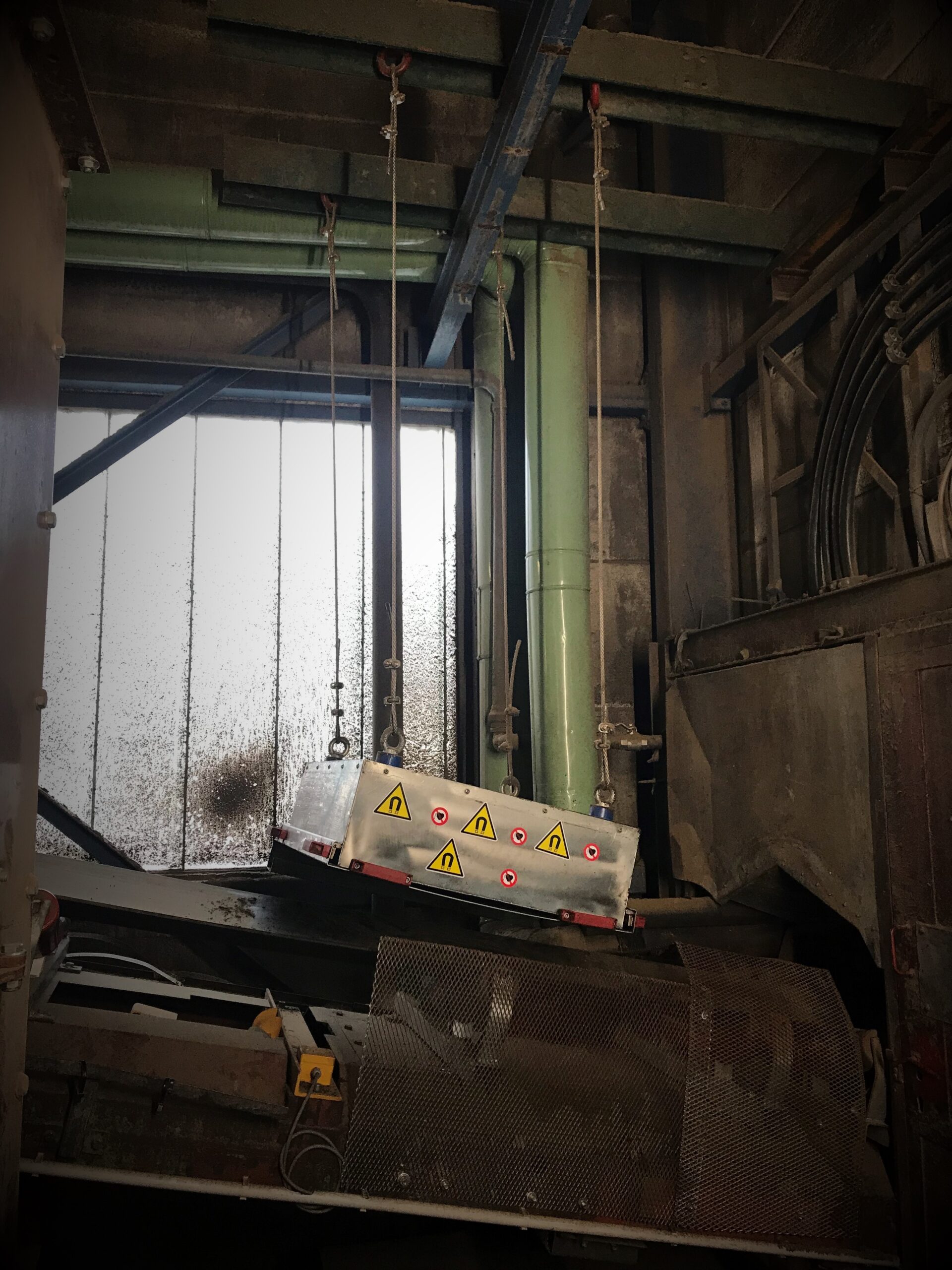
A magnetic plate is an industrial permanent magnetic separator designed primarily for installation above a conveyor belt.
It typically has a rectangular or square body with four suspension eyes positioned at the corners. Ferrite or neodymium magnets are installed inside the structure and direct the magnetic field towards the lower working surface.
Main components of a magnetic plate
- rigid separator body,
- permanent ferrite or neodymium magnets,
- lower active magnetic surface,
- four suspension eyes,
- protective cover for the magnetic system,
- optional separate cleaning plate.
What is a magnetic plate used for?
- capturing larger ferromagnetic objects,
- protecting crushers, mills and screens,
- removing metal contaminants from products,
- recycling and sorting waste materials,
- cleaning bulk and free-flowing mixtures,
- reducing the risk of damage to processing equipment.
How does a magnetic plate work?
The transported material passes underneath the suspended magnetic plate. As soon as a ferromagnetic contaminant enters the effective magnetic field, it is attracted towards the plate.
- The material is transported evenly along the belt.
- A ferromagnetic object enters the magnetic field.
- The magnetic force overcomes its weight and the resistance of the surrounding material.
- The object is pulled out of the material layer towards the lower surface of the plate.
- It remains captured on the active surface.
- After the equipment has been shut down, it is removed manually.
Efficiency is not determined solely by the strength of the magnets. The material layer height, plate distance, belt speed, particle size and the presence of ferromagnetic conveyor components between the plate and material are also important.
Which contaminants can a magnetic plate capture?
A magnetic plate primarily captures fully ferromagnetic materials that respond strongly to a permanent magnet.
Typical captured objects
- iron and steel screws,
- nuts and washers,
- nails and screws,
- steel wires and wire-rope fragments,
- pieces of tools,
- parts of machinery,
- steel sheet fragments and offcuts,
- larger ferromagnetic shavings,
- particles created by equipment wear.
What will a magnetic plate not capture?
A standard magnetic plate is not designed to separate non-magnetic metals or materials.
- aluminium,
- copper,
- brass and bronze,
- plastics,
- wood,
- glass,
- stone,
- ordinary non-magnetic dust,
- some grades of stainless steel.
“Metal” does not automatically mean magnetic
Aluminium, copper, brass and most non-ferrous metals are not ferromagnetic. Other technologies, such as an eddy current separator, optical sorting or manual inspection, are required to separate them.
Which materials can be transported underneath the plate?
Magnetic plates work best above dry, free-flowing and evenly distributed materials. The mixture should not be excessively sticky, wet, prone to bridging or made up of large irregular pieces.
Examples of suitable materials
- plastic granulate and regranulate,
- crushed plastics and PET bottles,
- rubber crumb and rubber regranulate,
- shredded tyres,
- grains, seeds and animal feed,
- flour, sugar and other bulk food mixtures,
- cement, lime and fine construction mixtures,
- shredded wood and wood chips,
- shredded municipal waste,
- glass and aggregates of a suitable fraction,
- sand and foundry mixtures,
- recycled cables and metal scrap after suitable shredding.
When can problems occur?
- the material is wet or sticky,
- the layer on the belt is too high,
- the material contains large irregular pieces,
- the material is not distributed evenly across the full width,
- it moves too quickly,
- the metal contaminant is buried deep in the layer,
- the material is very dense or difficult for the magnetic field to penetrate.
Where are magnetic plates used?
Waste recycling
Magnetic plates are installed above belts transporting plastic waste, shredded cables, rubber crumb, municipal waste or mixtures intended for further sorting.
Mining and quarrying
They help protect crushers, mills and other equipment from larger ferrous objects in aggregates, sand or extracted material.
Plastics and rubber industry
They capture steel contaminants from granulate, regranulate, shredded products, tyres and rubber mixtures.
Agriculture
They can be used above conveyors carrying grain, feed, seeds, maize or other free-flowing agricultural products.
Food industry
A magnetic plate can help remove larger ferromagnetic contaminants from dry bulk raw materials. The specific design, installation and surfaces must meet the requirements of the particular facility.
Construction industry
They can be used when transporting cement, lime, fine mixtures, crushed construction materials or recycled construction waste.
Woodworking industry
They help capture nails, screws and other steel parts from wood chips, shredded pallets or wood waste before the material enters a crusher.
Equipment protection or product purity?
A magnetic plate can be installed for two main reasons. The required objective affects the plate size, magnetic system, distance and position within the production line.
Protecting processing equipment
The plate primarily captures larger objects that could damage:
- a crusher,
- a mill,
- a screen,
- a press,
- a conveyor roller,
- a hopper,
- other downstream equipment.
The separator is installed upstream of the equipment being protected. The emphasis is on capturing larger and hazardous objects before they can cause damage.
Improving product purity
If the aim is to improve the purity of the final product, a stronger or more appropriately positioned plate and a lower material layer may be required.
For very fine ferromagnetic particles, a magnetic plate above the belt may not be the best solution on its own. Depending on the material, a magnetic grate, drum, roller or multi-stage separation system may be more suitable.
Ferrite magnetic plates
Ferrite magnetic plates provide a robust and long-term stable solution for capturing larger ferromagnetic contaminants.
Advantages of ferrite versions
- good corrosion resistance,
- long-term stability of magnetic properties,
- suitable for larger plates,
- more economical magnetic material,
- reliable capture of larger ferrous objects.
Disadvantages of ferrite versions
- higher overall plate weight,
- greater construction height,
- lower magnetic performance than neodymium at the same volume,
- greater demands on the supporting and suspension structure.
Neodymium magnetic plates
Neodymium magnets provide high magnetic strength in a smaller volume. A neodymium plate can therefore be lighter and have a lower construction height than a comparable ferrite solution.
Advantages of neodymium versions
- high magnetic strength,
- lower construction height,
- lower weight at comparable performance,
- better effect on smaller ferromagnetic contaminants,
- suitable where installation space is limited.
Disadvantages of neodymium versions
- higher purchase price,
- greater sensitivity to operating temperature,
- the magnetic system requires high-quality protection,
- stronger attraction of steel objects during maintenance.
Ferrite or neodymium?
A ferrite plate is suitable for robust industrial applications and capturing larger ferrous objects. A neodymium version makes sense where space is limited, lower weight is required or greater sensitivity to smaller particles is needed.
ECO, Standard and Extra Strong product ranges
Magnetic plates can be designed in several performance and construction levels. Exact dimensions and parameters vary according to the specific product and customised solution.
ECO
The economical version is suitable for less demanding conditions, a thinner layer of free-flowing material and lower belt speeds.
- capture of medium-sized and larger objects,
- free-flowing dry material,
- lower material layer on the belt,
- lower operating speed,
- more affordable purchase price.
Standard
The Standard version covers most common conveyor-belt applications.
- equipment protection,
- cleaning of free-flowing materials,
- standard industrial belt speeds,
- medium-sized to larger ferromagnetic contaminants,
- universal use across different industries.
Extra Strong
A more powerful design is used in more demanding conditions, with a higher material layer or when smaller ferromagnetic contaminants need to be captured.
- higher magnetic performance,
- more demanding operating conditions,
- higher or less permeable material layer,
- smaller ferromagnetic particles,
- greater emphasis on product purity.
Conveyor belt speed
The faster the material moves, the less time the magnetic field has to act on a ferromagnetic particle. Higher speed also increases the force with which the moving material resists the removal of the object from the layer.
For common stock magnetic plates, a maximum conveyor belt speed of 1.5 m/s is specified. However, the exact limit must always follow the technical conditions of the selected model.
Excessive belt speed can cause:
- insufficient removal of metal from the material,
- previously attracted objects to be pulled away again,
- shorter exposure to the magnetic field,
- lower efficiency for smaller particles,
- the need for a stronger or automatically cleaned separator.
Material layer height
A ferromagnetic object lying on top of the material layer is closer to the plate than an object located directly on the belt. As the layer height increases, separation efficiency therefore decreases.
For some stock plates, the general material layer height must not exceed 100 mm. For denser or less permeable materials, the permitted layer may need to be significantly lower.
How can the layer be reduced and spread evenly?
- use a levelling element before the separator,
- feed the entire belt width evenly,
- prevent piles and uneven distribution,
- adjust the feeding rate,
- consider a wider conveyor or multiple separation stages.
Distance between the plate and the material
Magnetic force decreases rapidly with distance. The plate must therefore be suspended as close as possible to the upper surface of the transported material while still leaving enough space for captured objects.
For some stock plates, the maximum distance between the top of the material and the lower working surface is specified as 100 mm. For certain materials, an even smaller distance may be required.
Every extra centimetre can reduce efficiency
Do not suspend the plate higher simply to make it easier for large pieces to pass underneath. Larger objects and an excessively high material layer may require a different type of separator or changes to the entire conveying process.
Where should a magnetic plate be installed?
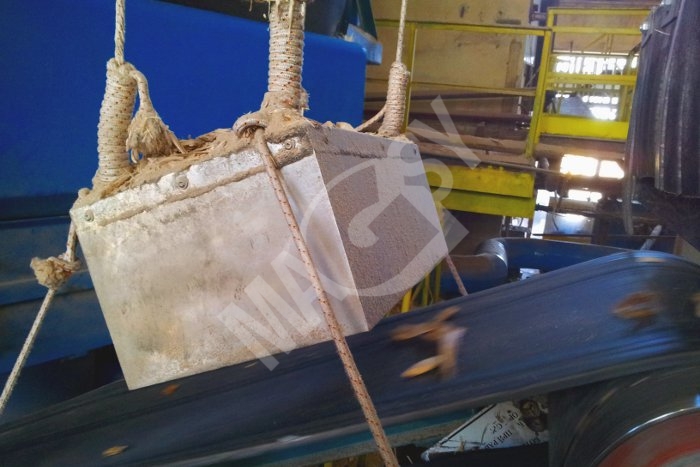
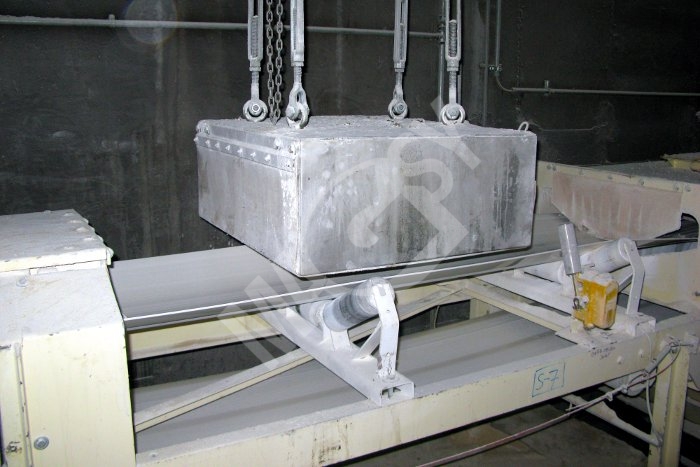
The plate is typically suspended above a flat section of the belt or above a transfer point. The specific position must allow effective separation, safe cleaning and secure suspension.
Installation above a flat section of the belt
The plate is positioned parallel to the conveyor belt and suspended at the same height across the entire active surface.
Installation above an inclined conveyor
If the belt runs at an angle, the plate must be installed at the same angle. The distance from the upper surface of the material must remain the same across the entire length.
Installation above a discharge point or return roller
This position can improve material release and access to the magnetic field. However, an ordinary ferromagnetic roller or structure that diverts the magnetic field must not be present within the separation zone itself.
Why must the area around the separation zone be non-magnetic?
A steel structure close to the magnetic plate can cause part of the magnetic field to close outside the transported material. This reduces the force acting on contaminants on the belt.
In the active zone, check in particular:
- roller supports,
- the conveyor support frame,
- return or drive rollers,
- metal cleats on the belt,
- steel covers,
- supports and reinforcements,
- other ferromagnetic components.
Depending on the installation, these parts may need to be replaced with non-magnetic material or completely removed from the separation zone.
How should a magnetic plate be suspended?
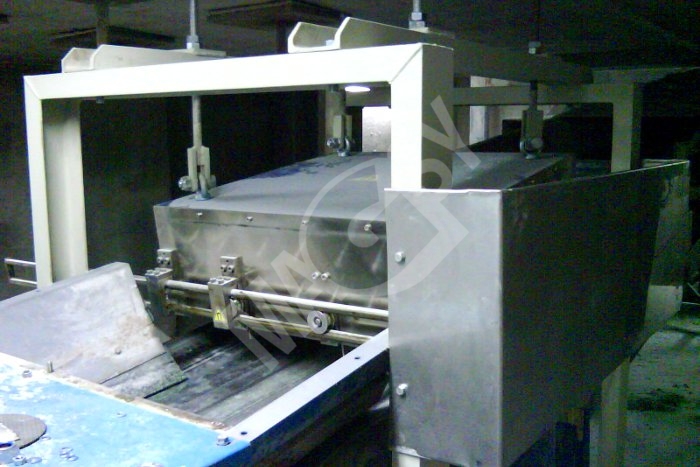
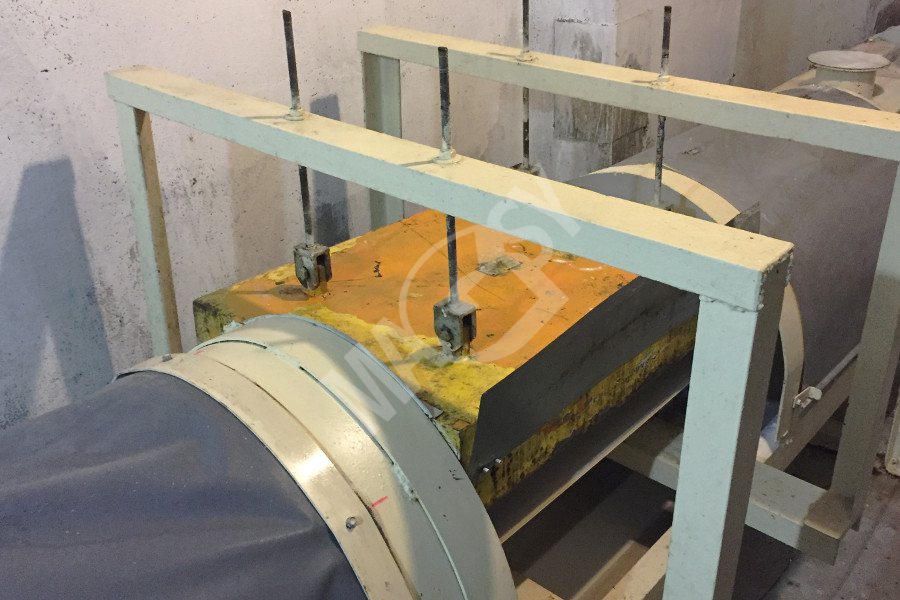
The plate is suspended using four eyes positioned at the corners. The support structure and suspension system are generally not included with the plate itself and must be designed according to its weight and local installation conditions.
Requirements for the suspension structure
- sufficient load capacity with a safety margin,
- strength and rigidity,
- resistance to vibration,
- protection against accidental loosening,
- precise height adjustment,
- even loading of all suspension points,
- safe access for inspection and cleaning.
Why use height-adjustable suspension points?
They allow the distance to be set precisely according to the material layer height and make it possible to react later to changes in the material or conveying process.
How much space is required around the plate?
Sufficient space must remain around the equipment for inspection, cleaning, servicing and safe removal if required.
- Do not install the plate directly underneath a ceiling or beam.
- Provide a safe walking surface around the equipment.
- Do not plan maintenance from a ladder or unstable platform.
- Prepare lifting equipment for heavy plates.
- Allow space for a container for captured metal.
- Provide access for at least two workers.
Manual or automatic cleaning?
Manually cleaned magnetic plate
Ferromagnetic contaminants remain on the lower surface and are removed during equipment shutdown.
A manually cleaned plate is suitable when:
- the amount of captured metal is low,
- the conveyor can be shut down regularly,
- there is safe access around the plate,
- the cleaning interval is not too short.
Automatically cleaned overband magnetic separator
If there is a large amount of metal contamination or production cannot be stopped frequently, a separator with an automatic cleaning belt may be more suitable.
Ferromagnetic material is continuously carried away from the conveyor, so the active surface does not need to be cleaned manually after every loading cycle.
Magnetic head roller
Another option is to replace the end roller of the conveyor with a magnetic roller. Ferromagnetic parts remain attached to the belt longer than ordinary material and fall away separately behind the roller.
How often should a magnetic plate be cleaned?
There is no universal interval. Cleaning frequency depends on the amount of metal contamination, plate size, belt speed and required level of protection.
The plate should be cleaned before:
- a thick layer of metal builds up on the lower surface,
- captured objects begin to reduce the effective working distance,
- particles are pulled away again by the moving material,
- the build-up reduces the ability to capture additional contaminants,
- sharp parts damage the lower cover.
When first commissioning the plate, inspect it more frequently. A regular interval can then be established according to the actual amount of captured metal.
How do you clean a magnetic plate safely?
- Stop the material feed.
- Switch off the conveyor belt.
- Secure the equipment against accidental start-up.
- Wait until all moving parts have come to a complete stop.
- Prepare a solid container for metal waste.
- Wear work gloves and safety glasses.
- Remove contaminants using a suitable non-magnetic tool.
- If the plate is equipped with a cleaning plate, follow the instructions.
- Inspect the lower surface and suspension structure.
- Remove all tools from the surrounding area before restarting.
Do not clean the plate while the belt is running
Workers must not move underneath suspended equipment or near a moving conveyor unless the equipment has been safely shut down and secured.
How does a cleaning plate work?
A cleaning plate creates a separating layer between the active magnetic surface and the captured metal. During cleaning, the plate and contaminants are moved away from the magnetic field.
Once the distance increases sufficiently, the magnetic holding force decreases and the metal parts can be removed more easily.
Advantages of a cleaning plate
- faster manual cleaning,
- less worker contact with sharp parts,
- easier removal of finer contaminants,
- lower risk of scratching the active surface,
- handles can be used for safer operation.
Inspection and maintenance of a magnetic plate
In addition to cleaning, the entire separation system should be inspected regularly.
- condition of the lower active surface,
- dents and punctures in the cover,
- corrosion or surface damage,
- suspension eyes,
- chains, ropes or threaded suspension elements,
- support structure,
- security of all connections,
- parallel alignment of the plate with the belt,
- current distance from the material,
- magnetic performance.
Why measure magnetic performance regularly?
Regular measurements make it possible to monitor any weakening or damage to the magnetic system. Results must always be compared using the same measurement method.
Individual plates may be supplied with a measurement report containing values recorded for that specific unit.
Magnetic flux density and pull-off force
Magnetic flux density in Gs
Magnetic flux density indicates the intensity of the magnetic field at a specific measurement point. On a plate, it can be measured directly on the active surface and at different distances from it.
Pull-off force in N
Pull-off force indicates the force required to separate a defined steel test piece from the magnetic surface.
Why can you not compare just one value?
The actual efficiency of a magnetic plate also depends on:
- size of the active surface,
- depth of the magnetic field,
- distance from the material,
- size and shape of the metal contaminant,
- belt speed,
- height and permeability of the material layer,
- ferromagnetic structural components nearby.
How do you choose the right magnetic plate?
Prepare the following information before selecting a plate
- conveyor belt width,
- belt speed,
- material layer height,
- type and fraction of transported material,
- size and weight of metal contaminants,
- required level of purity,
- purpose – equipment protection or product purity,
- operating temperature,
- indoor or outdoor installation,
- amount of metal to be captured,
- possible shutdown and cleaning frequency,
- available space for suspension and maintenance.
Plate width
The active magnetic surface must cover the entire material flow. A metal contaminant must not be able to pass along the edge of the belt outside the effective zone.
Plate length
A longer plate increases exposure time to the magnetic field. However, it also increases weight and suspension requirements.
Equipment weight
Large ferrite plates can weigh hundreds of kilograms. The support structure, suspension elements and handling equipment must be designed with a sufficient safety margin.
Operating temperature
The magnetic system must not be exposed to temperatures above those permitted for the specific product. Some stock ferrite plates are specified for temperatures up to 45 °C.
Outdoor installation
If the specific plate is approved for outdoor use, it must still be protected from direct rain, snow and prolonged exposure to sunlight.
ATEX environments
A standard plate cannot automatically be used in an ATEX environment. An explicitly designed and approved solution must be used for potentially explosive atmospheres.
When should you choose another type of separator?
A magnetic plate is not the best solution for every application.
Choose an automatically cleaned separator when:
- there is a large amount of metal contamination,
- the conveyor cannot be stopped regularly,
- continuous operation is required,
- manual cleaning would be too frequent or unsafe.
Choose a magnetic roller when:
- you want to separate material directly at the end of the belt,
- continuous self-cleaning is required,
- ferromagnetic parts can remain attached to the belt beyond the discharge point.
Choose a magnetic grate when:
- you need to capture finer contaminants,
- the material flows or falls through a pipeline,
- the material can be guided closely around magnetic rods.
Safety when working with a magnetic plate
Basic safety rules
- The support structure must be designed by a qualified person.
- Stop and secure the conveyor before maintenance.
- Do not clean the equipment from a ladder or unstable platform.
- Wear work gloves and safety glasses.
- Do not bring loose steel tools close to the plate.
- Protect your hands from being trapped or pinched.
- Maintain a safe distance from electronics and measuring instruments.
- People with medical implants must follow the manufacturer's instructions.
- Do not stand underneath the suspended plate.
- Damaged suspension eyes or structural components must be repaired immediately.
- Do not use the plate for lifting or handling loads.
- Do not drill, weld or otherwise modify the plate body without authorisation.
Recommended magnetic plates
The selected products represent three different sizes of industrial magnetic plates designed for suspension above conveyor belts and manual cleaning of captured ferromagnetic contaminants.
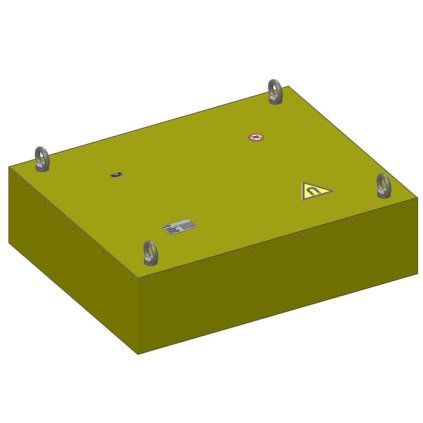
Magnetic plate MD 835 × 667 × 227 F
Large ferrite magnetic plate for separating larger ferromagnetic contaminants from free-flowing materials transported on a conveyor belt.
- Length 835 mm
- Width 667 mm
- Height 227 mm
- Ferrite magnetic system
- Weight approximately 615 kg
- Temperature resistance up to 45 °C
- 4 suspension eyes
- Manual cleaning
- Maximum belt speed according to product specifications 1.5 m/s
- Product code 62003
- Suspension structure is not included with the plate
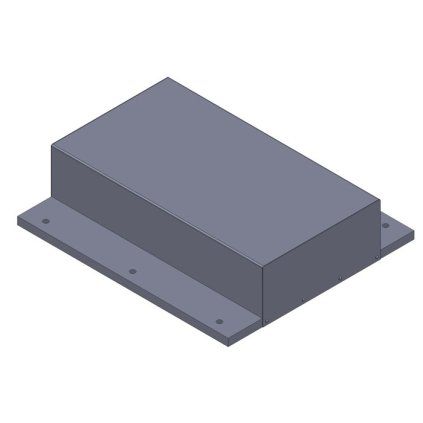
Magnetic plate MD 854 × 474 × 210
Industrial magnetic plate with a narrower active surface for capturing ferromagnetic contaminants from material transported on a conveyor belt.
- Length 854 mm
- Width 474 mm
- Height 210 mm
- Product code 61001
- Designed for suspension above a conveyor belt
- 4 suspension points typical of this product range
- Manual removal of captured contaminants
- Suitable for dry and free-flowing materials
- Supplied without a separate support structure
- Adjustable suspension points are recommended for setting the installation height
Note: before ordering, verify the weight, magnet type, temperature resistance and other technical specifications of the specific unit on the current product page.
View product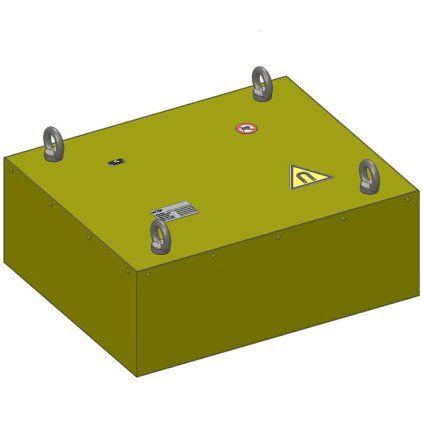
Magnetic plate MD 610 × 496 × 227 F
More compact ferrite magnetic plate for protecting conveyor equipment and capturing larger iron and steel contaminants.
- Length 610 mm
- Width 496 mm
- Height 227 mm
- Ferrite magnetic system
- Weight approximately 337 kg
- Temperature resistance up to 45 °C
- 4 suspension eyes
- Manual cleaning
- Maximum belt speed according to product specifications 1.5 m/s
- Product code 62001
- Suitable for free-flowing materials
Do not choose the plate size based solely on belt width
Material layer height, speed, contaminant size, distance, magnetic performance and conveyor construction are also important. Before ordering an industrial separator, the specific application should be technically assessed.
Frequently asked questions about magnetic plates
What is a magnetic plate?
A magnetic plate is a permanent magnetic separator suspended above a conveyor belt. It captures ferromagnetic objects from transported material.
How does a magnetic plate work?
The magnetic field attracts iron and steel contaminants towards the lower active surface, where they remain until cleaning.
Which metals can the plate capture?
Primarily iron, ordinary magnetic steel, cast iron, nickel, cobalt and ferromagnetic alloys.
Will a magnetic plate capture aluminium?
No. Aluminium is not ferromagnetic and is not attracted by an ordinary permanent magnet.
Will the plate capture stainless steel?
It depends on the specific stainless-steel grade. Some grades are magnetic, while others are only weakly magnetic or completely non-magnetic.
Will the plate capture fine metal dust?
Stronger plates can also capture smaller ferromagnetic particles, but a neodymium grate, magnetic rod or multi-stage separation system may be more suitable for extremely fine dust.
Where is a magnetic plate installed?
Above a flat section of the conveyor, above a transfer point or above a suitably modified end roller. The specific installation method must comply with the instructions for the selected model.
How high should the plate be above the belt?
As close as possible to the upper surface of the transported material while leaving enough space for captured objects. The specific maximum distance is specified by the manufacturer.
Why should the plate not be suspended too high?
Magnetic force decreases rapidly with distance, and contaminants buried deep in the material may not be pulled out.
How high can the material layer be?
It depends on the material's density, fraction and permeability. For some stock models, the general limit is 100 mm, while many materials require a considerably lower layer.
How fast can the conveyor belt run?
For standard stock models, a maximum speed of 1.5 m/s is specified. Higher speeds require an individually designed solution.
Why does belt speed affect separation?
The particle spends less time inside the magnetic field and is subjected to greater force from the moving material.
How wide should the magnetic plate be?
The active surface must cover the entire width of the material flow. It is not enough to consider only the outer width of the belt.
What if the conveyor belt is inclined?
The plate must be installed at the same angle so that it remains at the same distance from the material across the entire active surface.
Why must the area around the plate be non-magnetic?
A ferromagnetic structure diverts part of the magnetic field and can significantly reduce its effect on the material.
Can a steel roller remain underneath the plate?
Only if such an arrangement is explicitly permitted by the manufacturer. A non-magnetic roller and non-magnetic structure are usually required in the active zone.
How is a magnetic plate suspended?
Using four suspension eyes attached to a rigid structure with sufficient load capacity. Height-adjustable suspension points are practical.
Is the suspension structure included with the product?
It is generally not included with standard stock plates. It must be designed according to the weight of the plate and installation conditions.
How often should the plate be cleaned?
It depends on the amount of captured metal. It must be cleaned before a heavy build-up begins to reduce efficiency.
Why does a build-up of contaminants reduce magnetic performance?
New particles are farther away from the magnets and can be pulled away again by the transported material.
Can a magnetic plate be cleaned while the conveyor is running?
No. The conveyor must be stopped and safely secured against accidental start-up.
How is captured metal removed?
Manually using a suitable non-magnetic tool or by moving a separate cleaning plate away from the active magnetic surface.
What is an automatically cleaned separator?
It is a magnetic block with a moving cleaning belt that continuously transports captured metal away from the material flow.
When should automatic cleaning be used?
When there is a large amount of metal, during continuous operation or where manual cleaning would be too frequent or hazardous.
What is the difference between a ferrite and a neodymium plate?
A ferrite plate is robust, durable and generally heavier. A neodymium plate can be smaller and lighter while providing higher magnetic strength.
Is a neodymium plate always better?
No. The correct choice depends on contaminant size, distance, temperature, budget, weight and conveyor construction.
What temperature can the plate withstand?
It depends on the specific model. The recommended ferrite plates are specified for temperature resistance up to 45 °C.
Can the plate be installed outdoors?
Only if the manufacturer permits outdoor use for the specific model. Even then, protection from rain, snow and direct sunlight may be required.
Is a magnetic plate suitable for ATEX environments?
Not automatically. An explicitly designed and approved version must be used in potentially explosive atmospheres.
Can the plate be used for handling steel?
No. A magnetic plate installed above a conveyor is not a lifting magnet and is not designed for lifting or transporting steel objects.
How can the performance of a magnetic plate be verified?
By measuring magnetic flux density and pull-off force using the same method and comparing the results with the original measurement report.
Can a magnetic plate become weaker over time?
When used correctly, permanent magnets generally remain stable for a long time. Excessive temperature, a strong opposing magnetic field or mechanical damage can weaken them.
What should you do if the lower cover is damaged?
Take the equipment out of service and have it professionally inspected. Sharp contaminants can cause the damage to worsen.
Can a magnetic plate be custom-made?
Yes. Dimensions, magnetic material, performance and construction can be customised according to the conveyor and transported material.
Which parameter is the most important when choosing a plate?
No single parameter is sufficient. Belt width, speed, material layer, distance, contaminants, temperature, weight and cleaning method must all be assessed together.
Summary
A magnetic plate is an industrial permanent separator suspended above a conveyor belt. It captures iron and steel contaminants from transported material and helps protect downstream equipment.
Efficiency is affected by the strength and depth of the magnetic field, belt speed, material layer height and permeability, plate distance and the presence of ferromagnetic structural components nearby.
Ferrite plates are robust, stable and suitable for larger objects. Neodymium versions can offer higher performance, lower construction height and lower weight.
The plate is suspended using four eyes from a rigid structure and cleaned regularly during a safely secured shutdown. If there is a large amount of contamination, an automatically cleaned separator or magnetic roller may be more suitable.
Looking for a magnetic plate for installation above a conveyor?
Choose a stock model or have a magnetic separator designed according to the belt width, speed, material layer and size of metal contaminants.