
Flow-through magnetic separators
Flow-Type Magnetic Separators: Removing Metal Contaminants from Liquid Mixtures
Flow-type magnetic separators, sometimes referred to as magnetic filters, are designed to capture ferromagnetic contaminants from liquid and semi-liquid materials transported through piping systems.
- Learn how a flow-type magnetic separator works.
- Understand the difference between protecting production equipment and cleaning the final product.
- Compare the Classic, UP and EKO versions.
- Find out how to choose the right size, magnetic performance and connection type.
- Learn what affects the efficiency of magnetic separation.
- See the correct cleaning and maintenance procedure for the separator.
- Explore specific products for different operating requirements.
Ferromagnetic contaminants can enter liquid material during production, transport, storage or through wear of processing equipment. They may take the form of metal shavings, chips, scale, fragments, wires or extremely fine particles created by equipment abrasion.
A flow-type separator is installed directly into the pipeline. The material flows through an arrangement of magnetic tubes, where ferromagnetic particles are captured on their surface. The cleaned material then continues to the next stage of the process.
What is a flow-type magnetic separator?
A flow-type magnetic separator is an enclosed stainless-steel device containing several magnetic cores housed inside protective tubes. The tubes are arranged to create a flow labyrinth that brings the processed medium close to a strong magnetic field.
Depending on its design and operating conditions, the separator can be used for:
- free-flowing liquid mixtures,
- pressurised piping systems,
- liquid and semi-liquid products,
- horizontal pipelines,
- vertical pipelines,
- protecting pumps, nozzles, filters and other equipment,
- improving the purity of the final product.
Quick answer: what is the separator used for?
A flow-type magnetic separator captures iron and magnetic steel particles directly from flowing material. It protects production equipment from damage and helps reduce the presence of metal contaminants in the final product.
How does a flow-type magnetic separator work?
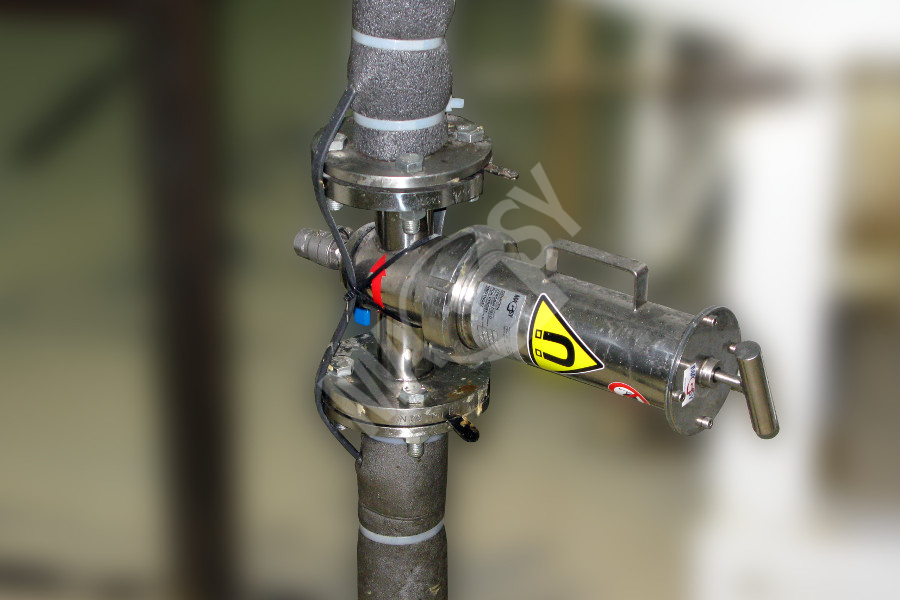
Inside the separator body are stainless-steel protective tubes containing powerful neodymium magnetic cores. The medium must flow between the individual tubes, bringing it into close proximity to the magnetic field.
- The liquid or semi-liquid mixture enters the separator body.
- The flow labyrinth divides and directs the medium between the magnetic tubes.
- Ferromagnetic particles become magnetised within the magnetic field.
- The particles are attracted to the surface of the protective tubes.
- The captured contaminants remain on the tubes until cleaning.
- The cleaned medium exits the separator and returns to the piping system.
Contaminants often accumulate on the side of the tube facing away from the direction of flow. This makes it more difficult for the flowing material to dislodge them again.
Why is the flow labyrinth important?
High magnetic flux density alone does not guarantee effective separation. A ferromagnetic particle must pass sufficiently close to the surface of the magnetic tube.
A correctly designed labyrinth:
- distributes the medium between the magnetic tubes,
- reduces areas where material could flow through without effective magnetic exposure,
- makes use of the working length of the magnetic tubes,
- ensures sufficient contact between the medium and the magnetic field,
- maintains the required flow capacity of the pipeline.
The strongest magnet does not necessarily provide the best separation
Efficiency depends on the combination of magnetic flux density, pull-off force, the number and arrangement of tubes, material flow rate and the operating properties of the medium. Even an extremely high magnetic flux density cannot compensate for a poorly designed flow labyrinth.
What can a flow-type magnetic separator capture?
The separator is primarily designed for ferromagnetic contaminants, meaning materials that can be attracted by a permanent magnet.
Typical captured contaminants
- iron shavings and chips,
- particles of ordinary magnetic steel,
- scale,
- fragments of wires and fasteners,
- particles caused by wear of pumps and pipelines,
- fine ferromagnetic dust,
- weakly magnetic particles created during mechanical processing.
What will a standard magnetic separator not capture?
A standard permanent magnet does not attract materials such as aluminium, copper, brass, plastic, glass or other non-magnetic materials. Some grades of stainless steel may be only weakly magnetic or completely non-magnetic.
If non-magnetic particles also need to be removed, magnetic separation must be supplemented with another filtration or separation system.
Which liquid materials can be separated?
Flow-type separators can be used for a wide range of liquid and semi-liquid materials. However, the suitability of a specific device always depends on the viscosity, temperature, pressure, chemical composition, flow rate and abrasiveness of the medium.
Examples of applications
- oils and cooling emulsions,
- rinsing baths,
- syrups and sugar solutions,
- yoghurts and other liquid food products,
- ketchups, sauces and semi-liquid mixtures,
- vegetable oils,
- ceramic compounds and glazes,
- chemical mixtures,
- technical fluids,
- liquid intermediate products in manufacturing.
Suitability must be assessed individually
The same separator may not be suitable for thin oil, a thick food mixture and an abrasive ceramic compound. The operating parameters of the medium and piping system must be known before selecting the separator.
Two main objectives of magnetic separation
1. Protecting production equipment
The separator is installed upstream of equipment that could be damaged or excessively worn by metal contaminants.
It most commonly protects:
- pumps,
- valves,
- nozzles,
- heat exchangers,
- mechanical filters,
- measuring equipment,
- dosing systems,
- other sensitive parts of the production line.
In this case, the separator is installed before the protected equipment. The aim is primarily to capture particles that could cause mechanical damage, blockages or equipment downtime.
2. Improving product purity
The second objective is to remove as many ferromagnetic particles as possible directly from the final product.
The separator can be installed:
- at the end of the production process,
- before filling or packaging,
- at several points along the production line,
- before a sensitive inspection or finishing operation.
Achieving a high level of purity often requires stronger magnetic equipment, a suitable labyrinth and correctly adjusted flow velocity.
Magnetic flux density and pull-off force
When comparing separators, two values are commonly stated – magnetic flux density in gauss and pull-off force in newtons.
Magnetic flux density in Gs
Magnetic flux density describes the intensity of the magnetic field at a specific measurement point. A higher value can help capture fine particles, but on its own it does not describe the overall efficiency of the separator.
Pull-off force in N
Pull-off force indicates the force with which a defined steel test piece is held against the surface of the tube or magnetic core.
A higher pull-off force helps keep captured particles attached to the tube even while material is flowing past them.
Which value is more important?
Both values must be assessed together with the separator design. The number of tubes, their spacing, length and diameter, the thickness of the protective casing and the properties of the flowing medium are also important.
Can very fine metal particles also be captured?
Under suitable conditions, powerful neodymium separators can also capture very fine ferromagnetic particles. However, it is not possible to guarantee one universal minimum particle size for all materials and applications.
The result is influenced mainly by:
- the magnetic properties of the contaminant,
- particle size, shape and weight,
- viscosity of the medium,
- flow velocity,
- distance of the particle from the tube,
- the build-up of previously captured contaminants,
- the magnetic performance of the separator.
Flow-type separators for gravity and pressurised flow
Flow-type separators can operate in systems where material moves by gravity or in pressurised pipelines.
Gravity flow
The medium flows through the separator under its own weight or without significant overpressure. Correct orientation, sufficient flow capacity and prevention of thick material build-up are important.
Pressurised pipelines
The separator must be structurally designed for the specific operating pressure. Standard flow-type separators are commonly manufactured for conventional pressurised systems, while special versions can also be designed for higher pressures.
Never exceed the permitted pressure
The maximum operating pressure specified for the particular product must always be observed. Also check the pressure rating of flanges, couplings, seals, welds and all other components of the piping system.
Types of flow-type magnetic separators
MAGSY flow-type separators are available in several design ranges. They differ in size, magnetic equipment, flow labyrinth, cleaning system, operator safety and price level.
MF Classic flow-type magnetic separator
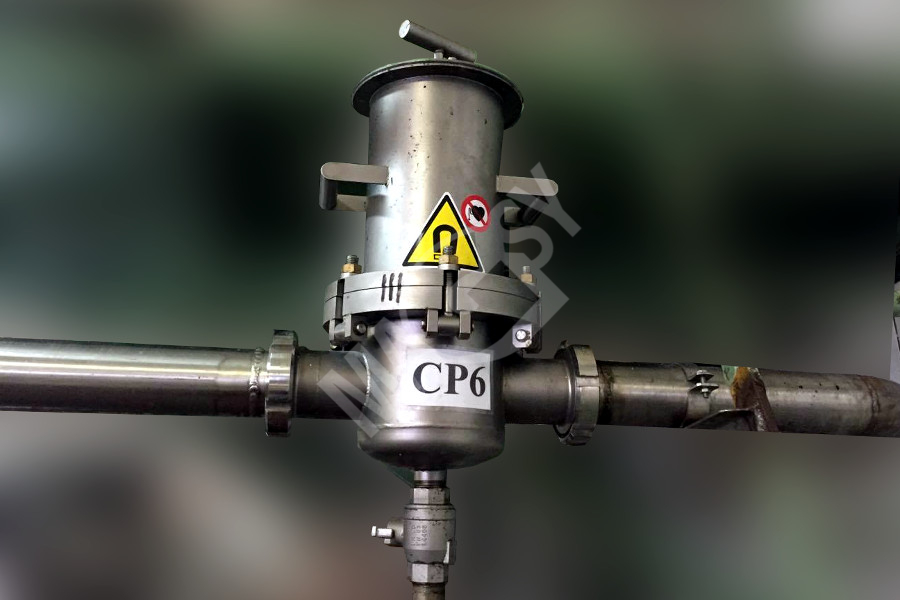
The Classic range is a proven universal solution for manually cleaned flow-type separators. The magnetic cores are housed inside protective tubes and move vertically during cleaning.
Main advantages of the Classic range
- proven flow labyrinth,
- powerful neodymium magnets,
- sliding magnetic cores,
- easier manual cleaning,
- protection of magnetic cores from direct contact with the medium,
- several magnetic performance levels,
- wide range of pipeline sizes,
- option of manufacturing from different stainless-steel grades.
The Classic range is normally manufactured for round pipelines in several sizes, approximately from DN 50 to DN 250.
MF UP flow-type magnetic separator
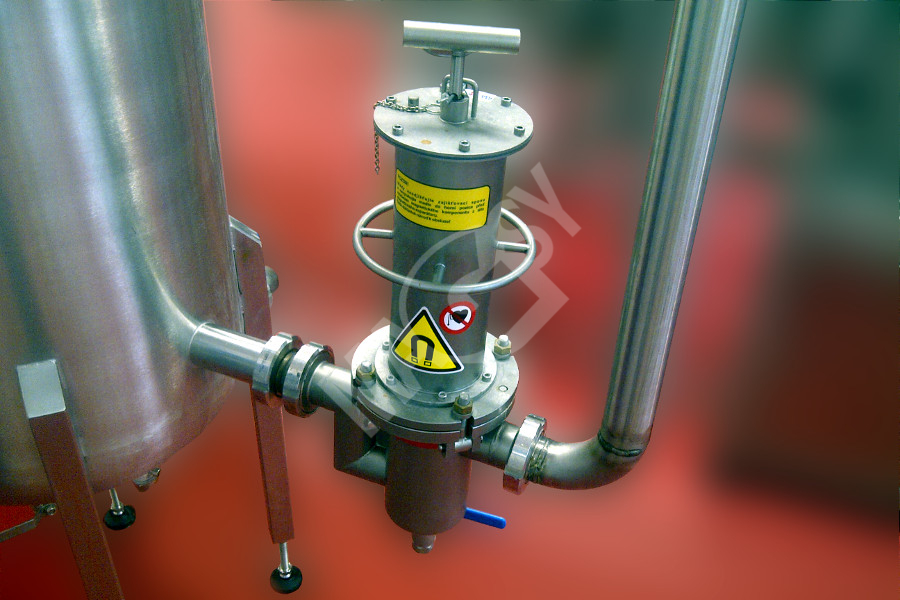
The UP range is designed for more demanding applications where high magnetic performance, efficient use of the magnetic tubes and more convenient operation are important.
Main advantages of the UP range
- cascade flow arrangement,
- efficient use of the working length of the magnetic tubes,
- magnetic flux density of selected versions up to 17,000 Gs,
- magnetic tubes with a diameter of approximately 30 mm,
- replaceable protective tubes,
- vertically sliding magnetic cores,
- option to lock the handling mechanism,
- option to use a cleaning fixture,
- suitability for more demanding operating conditions.
Replaceable protective tubes are advantageous, for example, when processing more abrasive media. However, faster wear must be expected and the tubes need to be inspected regularly.
MF EKO flow-type magnetic separator
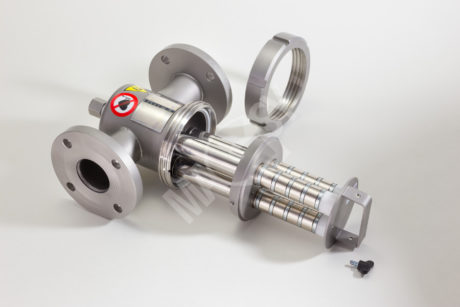
The EKO range is a more economical version of the flow-type separator. It is based on the proven principle of magnetic cores housed in stainless-steel tubes, but uses a simpler cleaning system.
Main advantages of the EKO range
- lower purchase price,
- simpler construction,
- powerful neodymium magnets,
- effective flow labyrinth,
- stainless-steel construction,
- choice of magnetic performance level,
- standard pipeline connections.
What should you be aware of?
Cleaning the EKO range is less convenient and requires more careful handling of the magnetic cores. It is therefore best suited to applications where simpler manual cleaning is acceptable.
What is the difference between Classic, UP and EKO?
Quick comparison
- Classic: a universal and proven solution with sliding cores and convenient manual cleaning.
- UP: a higher-performance version with cascade flow, replaceable tubes and more convenient operation.
- EKO: a simpler and more affordable design with less convenient cleaning.
Flow-type separator design
The basic construction consists of the separator body, a removable magnetic component and pipeline connection elements.
Separator body
The body is permanently installed in the piping system. Its dimensions and material thickness must correspond to the pipe diameter, pressure and operating conditions.
Magnetic component
The removable component contains:
- stainless-steel protective tubes,
- magnetic cores,
- a sliding or pull-out mechanism,
- a handling rod,
- a flange or another element for connection to the separator body.
Connection elements
Depending on the design, the separator can be connected using, for example:
- fixed flanges,
- loose flanges,
- food-grade couplings,
- CLAMP connections,
- custom-designed pipeline connections.
What materials are the separators made from?
The standard material is typically stainless steel 1.4301, also known as AISI 304.
For acidic, more chemically aggressive or hygienically demanding environments, depending on the specific application, the following can be used:
- stainless steel 1.4404 / AISI 316L,
- stainless steel 1.4571 / AISI 316Ti,
- special seals compatible with the processed medium,
- customised surface finishes.
The choice of material must be based on the chemical composition of the medium, temperature, cleaning method and hygiene requirements of the operation.
Magnetic cores and protective tubes
The magnetic cores consist of permanent magnetic rings and pole washers. Their precise arrangement determines the resulting magnetic flux density and pull-off force.
The cores are positioned inside stainless-steel protective tubes, which:
- separate the magnets from the processed medium,
- protect the magnets from moisture and chemical exposure,
- allow hygienic and mechanical cleaning,
- partially protect the cores against abrasive wear,
- provide a smooth surface for the flowing medium.
The tubes have thin walls so that the distance between the magnet and the captured particle is as small as possible. Damage or wear to the tube can therefore significantly affect the safety and service life of the equipment.
How is a flow-type separator cleaned?
A manually cleaned flow-type separator must first be safely shut down, depressurised and isolated from the flowing medium.
- Stop the material flow.
- Close the relevant sections of the pipeline.
- Release the pressure and check the equipment temperature.
- Disconnect or remove the magnetic component from the separator body.
- Move the component to a safe location or cleaning fixture.
- Move the magnetic cores away from the separation section of the protective tubes.
- Once the magnetic field has weakened, remove the captured contaminants.
- Clean the tubes using a suitable brush or according to the operating procedure.
- Inspect the condition of the tubes, seals and connecting parts.
- Return the magnetic cores to the operating position.
- Reinstall the component into the separator body.
- Before restarting, check that the system is correctly closed and leak-tight.
Do not clean the separator while it is operating
Before dismantling, the equipment must be shut down, depressurised and at a safe temperature. Follow the instructions for the specific separator and your internal operational safety procedures.
How often should the separator be cleaned?
There is no universal cleaning interval. The required frequency depends on the quantity of metal contaminants in the medium, the flow rate, operating time and the required level of cleanliness.
The separator should be cleaned before the layer of captured material begins to:
- cover the active surface of the tubes,
- reduce the available magnetic field,
- restrict the flow of the medium,
- increase pressure loss,
- cause previously captured particles to be released again.
When commissioning the equipment, it is advisable to inspect the separator more frequently and then establish a suitable operating interval based on the actual amount of captured contamination.
Why does an overloaded separator lose efficiency?
Captured ferromagnetic particles form a layer on the surface of the tube. Newly arriving particles are then located farther from the magnetic core and can be more easily carried away by the flowing medium.
Regular cleaning is therefore an essential part of proper operation. Even a very powerful separator may not deliver the expected result without suitable maintenance.
How do you choose the right flow-type separator?
When selecting a separator, you need to assess the pipeline, material, operating pressure, temperature, required separation level and available cleaning options.
Prepare the following information
- type and name of the processed medium,
- viscosity and density,
- operating and maximum temperature,
- normal and maximum pressure,
- flow rate or required capacity,
- internal pipe diameter,
- pipeline connection type,
- pipeline orientation,
- chemical properties of the medium,
- size, quantity and origin of metal contaminants,
- required level of cleanliness,
- hygiene requirements and material certificates,
- possibilities for shutdown and manual cleaning.
Pipe diameter
The size of the separator body must match the piping system. An incorrectly selected size can restrict flow, increase pressure loss or complicate installation.
Medium flow rate
Excessively high flow velocity can reduce the time during which particles are exposed to the magnetic field and increase the force exerted by the flow on captured particles.
Viscosity
Thick and sticky media may require a different labyrinth, larger flow gaps or a specially designed solution.
Temperature
The magnetic cores, seals and structural components must be designed for the highest actual operating temperature. Standard magnetic equipment is often designed for temperatures up to 80 °C, while more temperature-resistant versions may be available on request.
Pressure
The maximum operating pressure cannot be determined solely from the separator diameter. The design of the body, connections, welds, seals and the pressure specification of the particular product are decisive.
Abrasiveness
Abrasive material can gradually wear down the protective tubes. Regular inspection of their wall thickness and the option of easy replacement are therefore important in such applications.
Can the separator be used in the food industry?
Yes, but the specific design must meet the food-processing and hygiene requirements of the operation.
In particular, check:
- the material of all parts in contact with the product,
- the stainless-steel grade,
- the material and certification of the seals,
- surface roughness and finish,
- weld design,
- the possibility of thorough cleaning,
- resistance to the cleaning agents used,
- internal hygiene and process requirements.
How can the efficiency of a magnetic separator be verified?
Efficiency can be monitored in several ways:
- regular inspection of the amount of captured particles,
- analysis of material before and after the separator,
- measurement of magnetic flux density on the tubes,
- measurement of pull-off force using a suitable test piece,
- monitoring flow rate and pressure loss,
- monitoring wear of the protected equipment,
- implementing testing and validation procedures.
Measurements must always be performed using the same method and under comparable conditions. Values measured with different instruments, test pieces or at different locations cannot be directly compared.
Flow-type separator maintenance
In addition to regular cleaning, the mechanical and hygienic condition of the entire device must also be inspected.
- check the protective tubes for wear,
- look for dents, grooves or corrosion,
- inspect the seals and their flexibility,
- verify correct operation of the sliding mechanism,
- inspect flanges, couplings and welds,
- regularly verify magnetic performance,
- keep records of cleaning and inspections,
- replace damaged parts in good time.
Safety when working with a flow-type separator
What should you watch out for?
- Always shut down and depressurise the separator before opening it.
- Check the temperature of the equipment and medium.
- Follow the lockout and tagging procedure for shut-down equipment.
- Use suitable work gloves and personal protective equipment.
- Protect your fingers from being trapped by the magnetic component.
- The magnetic cores can strongly attract steel tools.
- Maintain a safe distance from equipment sensitive to magnetic fields.
- People with medical implants must observe the required safety distances.
- Do not make unauthorised modifications to pressure-containing parts.
- Always verify the leak-tightness of the piping system after installation.
Recommended flow-type magnetic separators
The selected products represent three different solutions: a compact CIS version with manual cleaning, the UP range with replaceable tubes and a high-performance separator with a semi-automatic cleaning system.
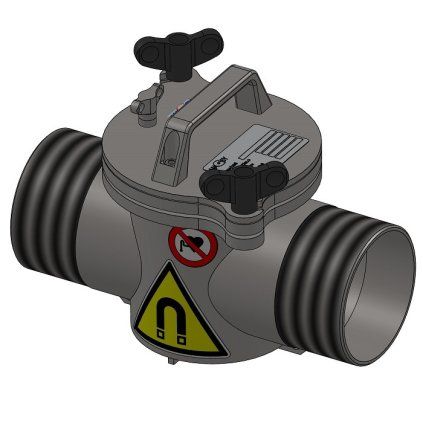
MF 100/1-CIS-4P-N-1.1-80-N-P-MODEL 1
Stainless-steel flow-type separator with manual cleaning and four magnetic tubes for liquid mixtures in piping systems.
- CIS version
- Material AISI 304 / 1.4301
- 4 magnetic tubes
- Magnetic flux density on the core 11,800 Gs
- Magnetic flux density on the casing 8,300 Gs
- Pull-off force on the core 147 N
- Pull-off force on the casing 104 N
- Internal inlet and outlet diameter 105.3 mm
- Maximum operating pressure 2 bar
- Magnet temperature resistance up to 80 °C
- Manual cleaning
- Total weight approximately 10 kg
- Silicone seal also suitable for food-processing applications

MF 50/1-UP-P6-N-4-80-S-P
UP series flow-type separator with replaceable tubes, powerful neodymium magnets and DN 50 flange connections.
- UP version
- Material AISI 304 / 1.4301
- 3 magnetic tubes with a diameter of 30 mm
- Magnetic flux density 10,200 Gs
- Pull-off force 93 N
- Inlet and outlet 50 mm
- Connection: 2× DN 50 PN 6 flange
- Maximum operating pressure 6 bar
- Magnet temperature resistance up to 80 °C
- Replaceable protective tubes
- Manual cleaning using sliding cores
- Silicone seal
- Total weight approximately 18 kg
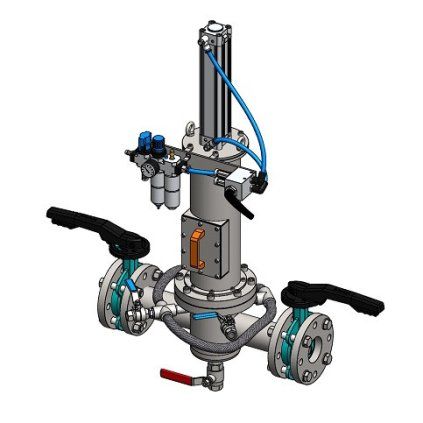
MF 80/1-76,1-SAC-P6-N-5-80-N-P
High-performance flow-type separator with seven magnetic tubes and a semi-automatic cleaning system for pressurised pipelines.
- Standard version
- SAC semi-automatic cleaning system
- Material AISI 304 / 1.4301
- 7 magnetic tubes
- Magnetic flux density on the core 15,300 Gs
- Magnetic flux density on the casing 10,500 Gs
- Pull-off force on the core 158 N
- Pull-off force on the casing 125 N
- Internal inlet and outlet diameter 72.1 mm
- Connection: 2× DN 80 PN 16 flange
- Maximum operating pressure 6 bar
- Magnet temperature resistance up to 80 °C
- NBR seal
- Total weight approximately 55 kg
Product parameters cannot be compared using a single value
Magnetic flux density and pull-off force values are measured under defined conditions. When selecting a separator, the number of tubes, flow labyrinth, flow rate, pressure, medium, connection type and possibilities for regular cleaning must also be assessed.
Frequently asked questions about flow-type magnetic separators
What is a flow-type magnetic separator?
It is a device installed in a pipeline that uses magnetic tubes to capture ferromagnetic contaminants from flowing liquid or semi-liquid material.
What is the difference between a magnetic separator and a mechanical filter?
A magnetic separator captures particles according to their magnetic properties. A mechanical filter separates contaminants according to size using a screen, filter element or another mechanical barrier.
Will the separator capture all metal particles?
No. It is primarily intended for ferromagnetic materials such as iron and magnetic steel. Aluminium, copper and brass are not captured by a standard permanent magnet.
Will the separator remove metal dust?
Under suitable conditions, powerful neodymium separators can also capture very fine ferromagnetic particles. The result depends on the medium, flow rate, magnetic performance and labyrinth design.
What is the smallest particle size that can be captured?
There is no single universal value. It depends on the magnetic properties, shape and weight of the particle, its distance from the tube and the operating conditions.
Can the separator be used for oil?
Yes. A suitable flow-type separator can be used, for example, with technical oils, cooling oils or vegetable oils. Viscosity, temperature, pressure and chemical compatibility must be verified.
Can the separator be used for water?
Yes, provided that the materials, seals and pressure specification are suitable for the specific water or process application.
Can the separator be used for a thick mixture?
Yes, but thick and sticky media may require larger flow gaps or a custom design. An unsuitable labyrinth could cause excessive pressure loss or clogging.
Is a flow-type separator suitable for the food industry?
Yes, provided that it has the appropriate stainless-steel construction, seals, surface finish, certification and hygienic design for the specific product and cleaning method.
Can the separator be installed horizontally?
Yes. Depending on the specific design, flow-type separators can be installed in both horizontal and vertical pipelines.
What separator diameter do I need?
The size is selected according to the internal pipe diameter, required flow rate, connection and properties of the medium. The DN designation alone may not contain all the required information.
What pressure can the separator withstand?
It depends on the specific design. Some standard products are designed, for example, for 2 or 6 bar, while special units can also be designed for higher pressures.
What temperature can the separator withstand?
Standard magnetic equipment is often designed for temperatures up to 80 °C. For higher temperatures, suitable magnets, seals and structural components must be ordered.
How often should the separator be cleaned?
It depends on the amount of metal contamination. The interval should be determined through practical inspection so that a layer reducing efficiency does not build up on the tubes.
What happens if the separator is not cleaned?
A layer of contaminants can shield the active surface, reduce holding force, restrict flow and allow some previously captured particles to be carried back into the medium.
Can the separator be cleaned while operating?
A manually cleaned separator must be shut down, depressurised and safely isolated from the material flow before it is opened.
What is the difference between manual and semi-automatic cleaning?
With a manual system, the operator removes the component and mechanically moves the cores. A semi-automatic system simplifies part of the handling process, but still requires correct operating procedures and equipment shutdown.
What does magnetic flux density in gauss mean?
It indicates the intensity of the magnetic field at a specific measurement point. On its own, however, it does not describe the overall efficiency of the separator.
What does pull-off force in newtons mean?
It indicates the force required to pull a defined steel test piece away from the magnetic surface under specified conditions.
Is a higher Gs value always better?
Not automatically. Pull-off force, tube design, the flow labyrinth and the contact between particles and the magnetic field are also important.
Why are the magnets enclosed inside stainless-steel tubes?
The tubes protect the magnetic cores from water, chemical exposure, mechanical damage and direct contact with the product.
Can the protective tubes be replaced?
In some versions, such as the UP range, the protective tubes are designed to be replaced if they become damaged or worn.
Is the separator suitable for abrasive media?
Some versions can also be used conditionally with abrasive materials. However, faster tube wear and more frequent inspection must be taken into account.
Will the separator reduce the flow rate?
Any component installed in a pipeline can affect flow. A correctly designed body and labyrinth must maintain the required flow capacity and acceptable pressure loss.
Where should the separator be installed in the pipeline?
To protect equipment, it is installed upstream of the protected machinery. To improve product purity, it can be installed at the end of the line or at several points in the process.
Can the separator replace all filters?
No. It captures only magnetically attractable particles. Mechanical, gravity-based or other filtration systems may be required for non-magnetic contaminants.
How can I tell whether the separator is working?
Monitor the amount of captured contamination, the cleanliness of the material downstream of the separator, magnetic performance, tube condition and the operating results of the protected equipment.
Can a separator be custom-made?
Yes. The design can be adapted to the pipe size, pressure, material, temperature, type of medium, connection and required magnetic performance.
Summary
A flow-type magnetic separator captures ferromagnetic contaminants from liquid and semi-liquid materials directly as they pass through a pipeline. It can protect production equipment or improve the purity of the final product.
Efficiency is not determined by magnetic flux density alone. Pull-off force, the number and arrangement of tubes, the flow labyrinth, flow velocity, medium viscosity and regular cleaning are also important.
The Classic range provides a universal and proven solution, the UP range offers higher performance and a more convenient design, while the EKO range provides a simpler and more affordable option.
Before selecting a separator, you need to know the type of medium, flow rate, temperature, pressure, pipe diameter, connection type, contaminant size and required level of separation. For industrial applications, it is advisable to consult the specific solution with a specialist.
Looking for a flow-type separator for your production line?
Choose from available flow-type magnetic separators or have a solution designed according to your medium, piping system, pressure and required level of separation.