
Do You Run a Scrap Yard or Recycling Center?
Sorting Magnets for Scrap Yards and Recycling Centres: How to Choose the Right Type
Sorting magnets help quickly distinguish between ferromagnetic and non-magnetic materials, detect steel contaminants in metal scrap and collect small iron objects. They are useful in recycling centres, scrap yards, recycling facilities, workshops, construction and material inspection.
- Learn how a sorting magnet works and what it can detect.
- Compare a conical magnet, testing rod and super-strong handheld magnet.
- Understand the difference between metal and plastic conical versions.
- Learn how to inspect compressed bales and mixed metal scrap.
- Find out what magnetic flux density, pull-off force and magnetic field range mean.
- Learn how to use, clean and store magnets safely.
- Explore recommended products and answers to frequently asked questions.
Recycling centres and scrap-processing facilities often handle mixtures of steel, aluminium, copper, brass, stainless steel and other materials. Some may look similar at first glance, but their subsequent processing methods and scrap value can differ significantly.
A sorting magnet provides a quick preliminary check. If it is attracted to the tested material, the material contains a ferromagnetic component – most commonly iron, ordinary steel or cast iron. If the magnet does not react, the material may be aluminium, copper, brass or non-magnetic stainless steel.
What is a sorting magnet?
A sorting magnet is a handheld permanent magnet designed for the preliminary identification of magnetically attractive materials.
Depending on its construction, it may take the form of:
- a small conical magnet with a chain,
- a conical magnet in a plastic casing,
- a swing-type magnet on a longer rod,
- a handheld magnetic testing rod,
- a large super-strong magnet with a handle,
- a magnetic rod for collecting small steel objects.
What is a sorting magnet used for?
- distinguishing ferrous and non-ferrous metals,
- inspecting metal scrap,
- detecting steel contaminants in compressed aluminium,
- preliminary inspection of stainless-steel materials,
- locating ferromagnetic parts in difficult-to-access areas,
- collecting scattered nails, screws and bolts,
- locating steel profiles behind plasterboard,
- checking for iron contaminants in a material sample.
How does a sorting magnet work?
A permanent magnet creates a magnetic field. If a ferromagnetic object enters this field, the magnetic domains within the material align and an attractive force develops between the magnet and the object.
The closer the magnet is to the object, the stronger its effect generally becomes. However, the result is also affected by the size, shape, thickness and composition of the tested material.
How do you perform a basic magnetic test?
- Inspect the magnet and remove any old metal shavings.
- Choose a clean area on the object being tested.
- Move the magnet closer slowly and in a controlled manner.
- Observe attraction, changes in resistance or movement of the magnet.
- Repeat the test at several points on the object.
- Compare the result with a known sample of steel and non-ferrous metal.
- For sensitive surfaces, keep the magnet slightly away or use a thin protective cloth.
What can a magnetic test determine?
The test shows whether an object or part of it contains material that reacts to a magnetic field.
It can help determine, for example:
- whether an object is made from ordinary steel,
- whether an aluminium component contains a steel insert,
- whether iron parts are hidden inside a compressed bale,
- whether a particular stainless-steel grade is magnetic,
- whether steel reinforcement is present below a surface,
- whether a mixture contains ferromagnetic contaminants.
What can a magnetic test not determine?
A magnet alone cannot accurately determine the chemical composition or exact grade of an alloy.
A magnetic test by itself cannot distinguish, for example:
- pure iron from ordinary carbon steel,
- individual grades of magnetic stainless steel,
- the exact proportion of iron in an alloy,
- the chemical composition of an object,
- the value or purity of a precious metal,
- aluminium from copper if neither material reacts to the magnet.
A magnet provides an indicative test, not a laboratory analysis
For precise alloy identification, another method must be used, such as X-ray fluorescence analysis, chemical analysis, conductivity measurement, density measurement or a spark test carried out by a qualified operator.
Which materials does a magnet attract?
Iron
Iron is one of the basic ferromagnetic elements and an ordinary permanent magnet is strongly attracted to it.
Ordinary structural and carbon steel
Most standard steel profiles, sheets, screws, nails and wires are strongly magnetic.
Cast iron
Cast iron contains iron and generally shows a clear magnetic response.
Nickel and cobalt
Nickel and cobalt are also ferromagnetic elements. However, the magnetic properties of their alloys can vary depending on the exact composition.
Some stainless steels
Ferritic and martensitic stainless steels are generally magnetic. Austenitic stainless steels may be non-magnetic or only weakly magnetic.
Which metals are not normally attracted by a magnet?
- aluminium,
- copper,
- brass,
- bronze,
- zinc,
- lead,
- gold,
- silver,
- titanium,
- some grades of stainless steel.
If an aluminium or copper product reacts to a magnet only in one area, it probably contains a steel screw, reinforcement, spring or another ferromagnetic component.
Why is magnetic inspection important when recycling aluminium?
A compressed bale of aluminium cans or other aluminium scrap may contain steel parts that were not removed before baling.
These may include:
- steel screws and nails,
- wires,
- parts of packaging,
- steel inserts,
- tools or tool fragments,
- other incorrectly sorted waste.
A powerful handheld magnet allows a bale to be inspected from several sides. If the magnet begins to pull or change direction in a particular area, a ferromagnetic object may be hidden inside.
How do you inspect a compressed bale?
- Place the bale in a stable and safe location.
- Remove loose steel tools from the surrounding area.
- Hold the magnet firmly by the handle.
- Move it around the bale at a slight distance.
- Gradually inspect all sides and corners.
- Observe changes in resistance or direction of attraction.
- Mark any suspicious area.
- Carry out further inspection or reject the bale according to your operating procedure.
Why should you test from all sides?
A small steel object hidden deep inside a bale may not be detectable from one side. From the opposite side, it may be significantly closer to the magnet.
A range of 200 mm is not guaranteed for every object
A large steel object can be detected from a greater distance than a small screw or thin wire. The actual range depends on the size, shape, weight, orientation and position of the ferromagnetic object.
Conical sorting magnet with chain
A conical sorting magnet is a compact handheld tool designed for quick inspection of individual objects or specific areas within a mixture.
Its tapered working section allows the magnet to be brought close to small surfaces, joints or gaps. The chain with a carabiner can be attached to work clothing, a belt or another suitable part of the equipment.
Advantages of a conical magnet
- compact size,
- low weight,
- easy to carry,
- quick inspection of individual parts,
- chain reducing the risk of loss,
- powerful neodymium magnet,
- more precise testing of small areas.
Where is it useful?
- at recycling centres,
- at scrap metal yards,
- during intake of metal scrap,
- in automotive workshops,
- in warehouses for metal semi-finished products,
- when inspecting individual pieces of material.
Plastic conical sorting magnet
A plastic conical sorting magnet works on the same principle as the metal version, but the magnetic core is enclosed in a coloured plastic casing.
Advantages of the plastic casing
- the bright orange colour is highly visible,
- lower weight,
- more comfortable handling in cold environments,
- partial mechanical protection of the magnet,
- lower risk of direct contact between the hard magnet and the tested surface,
- chain with carabiner to reduce the risk of loss.
What should you watch out for?
- the plastic casing can crack mechanically,
- it is not intended for high temperatures unless confirmed by the manufacturer,
- a thick plastic layer reduces the magnetic effect compared with an unprotected surface,
- a damaged casing must be inspected,
- the product is not designed as a lifting magnet.
Metal or plastic conical magnet?
- Metal version: higher magnetic performance and robust construction.
- Plastic version: lower weight and highly visible colour.
- Metal magnet: more suitable for demanding everyday inspections.
- Plastic magnet: practical for lightweight mobile inspection and easy identification of the tool.
What are the chain and carabiner used for?
The chain helps keep the magnet attached to work clothing or equipment. It reduces the risk of the magnet falling into a container, scrap pile, engine compartment or another difficult-to-access area.
The chain is not intended for:
- lifting heavy objects,
- securing a person,
- working at height,
- towing vehicles or equipment,
- replacing certified lifting equipment.
The chain prevents loss; it is not designed for lifting
Even if the magnet attracts a heavier steel object, the chain, carabiner and complete product may not be designed to lift it safely.
Magnetic testing rod
A magnetic testing rod is a handheld inspection tool with a longer active magnetic section.
Unlike a small conical magnet, it allows a larger volume of material or a longer section to be tested. Selected models have a movable magnetic core that makes releasing captured contaminants considerably easier.
How is a testing rod used?
- Check that its surface is clean.
- Insert the active section into the sample or material.
- Move the rod slowly in circular and longitudinal motions.
- Remove the rod and inspect the captured particles.
- Move it over a container for metal waste.
- Move the magnetic core into the upper section.
- Allow the contaminants to fall away or wipe them off.
- Clean the rod before the next test.
Where is a testing rod used?
- when inspecting dry bulk materials,
- when inspecting selected liquid mixtures,
- in the food industry,
- in the plastics and rubber industries,
- in chemical production,
- in recycling,
- when checking samples before and after magnetic separation.
Is a testing rod suitable for retrieving objects?
It can capture and remove smaller steel parts, but its primary purpose is testing and material inspection. A swing-type or telescopic magnet may be more practical for deep, narrow spaces.
Super-strong sorting magnet
A super-strong sorting magnet is a larger handheld device with a powerful neodymium magnetic system and a rigid handle.
It is primarily designed for:
- inspecting compressed bales of metal scrap,
- locating steel parts inside non-magnetic material,
- inspecting larger containers or piles,
- locating steel profiles behind thin structures,
- collecting scattered screws and nails,
- industrial inspection of metal products.
Advantages of the super-strong version
- larger active magnetic surface,
- greater magnetic field depth,
- practical handle for manual use,
- quick inspection of larger areas,
- ability to react to larger objects at a certain distance.
Disadvantages of the super-strong version
- higher weight,
- greater risk of pinching,
- strong attraction of nearby tools,
- more difficult release of captured objects,
- risk of scratching sensitive surfaces,
- need for a larger safe handling area.
Super-strong sorting magnet 3D
The super-strong sorting magnet 3D has a robust three-dimensional construction with a rigid handle. Its shape resembles an iron and allows the active surface to be moved around the material being tested.
The product can be used, for example, for:
- inspecting compressed aluminium bales,
- preliminary detection of steel in non-magnetic scrap,
- locating ferromagnetic parts behind plasterboard,
- collecting nails and screws from floors or grass,
- inspecting larger metal products,
- work in recycling centres and recycling facilities.
What does magnetic field range mean?
The range indicates the approximate distance at which a magnet may react to a ferromagnetic object under suitable conditions.
The actual range depends primarily on:
- the size of the steel object,
- its thickness and weight,
- its orientation relative to the magnet,
- how deeply it is embedded,
- the material between the magnet and object,
- surface curvature and contact area,
- surrounding ferromagnetic structures.
Example of different behaviour
A large steel plate may be detectable by a magnet from a relatively large distance. A small screw at the same distance may produce no noticeable reaction.
What does magnetic flux density in Gs mean?
Magnetic flux density describes the intensity of the magnetic field at a specific measurement point. For handheld magnets, the highest value is usually measured on the active working surface.
A higher value may indicate a stronger field close to the surface, but by itself it does not describe the entire field range or practical effectiveness of the product.
What does pull-off force in N mean?
Pull-off force describes the force required to separate a defined steel test piece from the magnet under specified conditions.
As an approximate rule:
10 N corresponds roughly to the force generated by a mass of 1 kg.
However, this does not mean that a magnet rated at 25 N will safely lift every real object weighing 2.5 kg.
Actual force is reduced by:
- a curved surface,
- rust and dirt,
- paint or coating,
- a small contact area,
- thin sheet metal,
- sideways force,
- vibration and impact,
- a gap between the magnet and object.
A sorting magnet is not a lifting magnet
Pull-off force is used to compare magnetic performance. A sorting magnet is not certified for safely lifting or transporting heavy steel loads.
How do you locate a metal profile behind plasterboard?
A powerful magnet can react to a metal profile or to the steel screws used to attach the plasterboard panel.
Basic procedure
- Remove sensitive electronics from the surrounding area.
- Place a thin clean cloth over the working surface of the magnet.
- Move the magnet slowly at a slight distance from the wall.
- Observe changes in resistance or attraction.
- Repeat the test vertically and horizontally.
- Mark several points where the profile is likely to be located.
- Before drilling, also use a suitable detector for wiring and structural elements.
A magnet cannot locate electrical wiring
A magnet may react to a steel profile, screws or another metal object. It does not reliably detect electrical cables, plastic pipes or every type of structural element. Use a suitable detector before drilling.
How do you collect scattered nails and screws?
A super-strong magnet can be used to collect ferromagnetic fasteners from floors, grass, sand or other surfaces.
Practical procedure using a protective cover
- Make a simple cover from rigid cardboard or plastic.
- Place the cover over the active surface of the magnet.
- Move the magnet close above the surface.
- Allow nails and screws to be captured through the cover.
- Move the magnet over a collection container.
- Move the cover away from the magnet.
- The metal objects will fall away from the cover.
Advantages of using a cover
- easy release of objects,
- lower risk of scratching the magnet,
- reduced direct contact with sharp nails,
- faster repeated cleaning.
How can you protect the tested surface?
A powerful magnet can snap suddenly towards a steel surface. Scratches are often caused not by the magnet itself but by a metal shaving caught on its working surface.
You can reduce the risk by:
- cleaning the magnet before use,
- moving it closer slowly,
- not sliding it uncontrollably across the surface,
- using a thin clean cloth,
- maintaining a slight distance,
- preventing the magnet from striking the material suddenly.
How do you choose the right sorting magnet?
Answer these questions before purchasing
- Will you test individual pieces or entire bales?
- How large is the object you need to detect?
- How far below the surface could it be hidden?
- Do you need to carry the magnet with you at all times?
- Will you inspect sensitive painted surfaces?
- Do you only want to test materials or also collect objects?
- How often will you use the magnet?
- What tool weight is acceptable for the operator?
- Will the product be exposed to elevated temperatures?
- Do you need captured material to be released easily?
For inspecting individual metal parts
Choose a conical sorting magnet with a chain.
For a lightweight portable tool
A plastic conical version with a highly visible casing may be suitable.
For inspecting samples and mixtures
Choose a magnetic testing rod with a movable core.
For compressed bales and larger surfaces
A super-strong sorting magnet with a rigid handle is suitable.
For difficult-to-access areas
A swing-type or telescopic magnet may be more practical.
How often should magnetic performance be checked?
For regular industrial use, it is advisable to establish periodic magnetic performance checks.
The inspection may include:
- visual inspection,
- measurement of magnetic flux density using a gaussmeter,
- measurement of pull-off force using a defined test piece,
- comparison with the original measurement report,
- recording the date, result and method used.
What can weaken a magnet?
- exceeding the maximum temperature,
- a strong opposing magnetic field,
- mechanical damage,
- corrosion of the magnetic material,
- cracking or displacement of internal components.
How do you clean a sorting magnet?
Shavings, metal dust and other ferromagnetic particles gradually accumulate on the active surface. These must be removed regularly.
Cleaning procedure for a small conical magnet
- Wear work gloves.
- Place the magnet on a stable non-magnetic surface.
- Move larger particles towards the tip or edge.
- Remove fine shavings with a non-magnetic scraper.
- Wipe the surface with a dry cloth.
- Inspect the chain, carabiner and casing.
Cleaning procedure for a super-strong magnet
- Move the magnet above a metal waste container.
- Secure it against uncontrolled movement.
- Wear sturdy gloves resistant to sharp edges.
- Move the protective cardboard or plastic cover away.
- Remove remaining contaminants with a non-magnetic scraper.
- Inspect the working surface and handle.
Do not wipe away metal shavings with your bare hand
Fine shavings can be extremely sharp and may penetrate unsuitable work gloves. Use appropriate protective equipment and a non-magnetic cleaning tool.
How should a sorting magnet be stored?
- In a dry and stable location.
- Away from loose steel tools.
- Away from normal staff walkways.
- With the working surface protected.
- Away from magnetic cards and sensitive electronics.
- Out of reach of children.
- Away from high temperatures.
- In a position where it cannot fall or snap violently towards another structure.
Safety when using sorting magnets
Basic safety rules
- Powerful magnets can pinch fingers.
- Wear sturdy work gloves.
- Also wear safety glasses when handling brittle magnets.
- Move the magnet towards steel slowly and in a controlled manner.
- Do not place your hands between the magnet and a large steel object.
- Do not use the magnet for lifting loads.
- Do not overload the chain or handle.
- Maintain a safe distance from pacemakers and other medical implants.
- Protect measuring instruments, sensors, watches and magnetic cards.
- Do not exceed the permitted product temperature.
- Do not continue using a damaged magnet, casing, chain or handle.
- The magnet is not intended as a children's toy.
What does the temperature resistance of the working surface mean?
For the super-strong sorting magnet 3D, the value of 80 °C applies to the active magnetic surface and does not automatically apply to the entire product.
Different temperature limits may apply to:
- the handle,
- adhesive,
- plastic components,
- fasteners,
- surface finish.
Do not place the magnet inside hot material or a high-temperature environment unless the suitability of the entire construction has been confirmed.
Recommended sorting magnets
The selected products represent three different levels of use: a compact metal magnet for everyday inspection, a super-strong model for larger bales and a lightweight plastic version for mobile sorting.
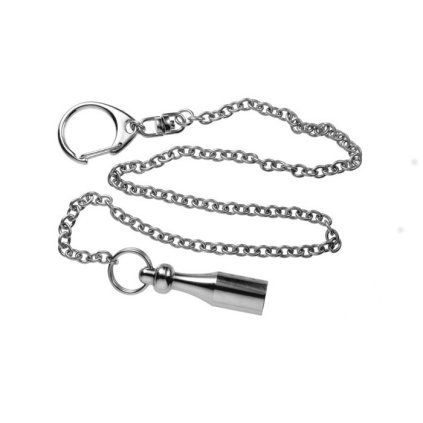
Conical sorting magnet with chain
Compact neodymium magnet for quickly identifying ferromagnetic materials at recycling centres, scrap yards, workshops and recycling facilities.
- Powerful NdFeB neodymium magnet
- Magnetic flux density 5,300 Gs
- Pull-off force 25 N
- Weight approximately 75 g
- Designation MK 7/14
- Chain with carabiner to reduce the risk of loss
- Product code 50702
- Suitable for inspecting individual objects
- Force values are indicative and depend on the conditions of use
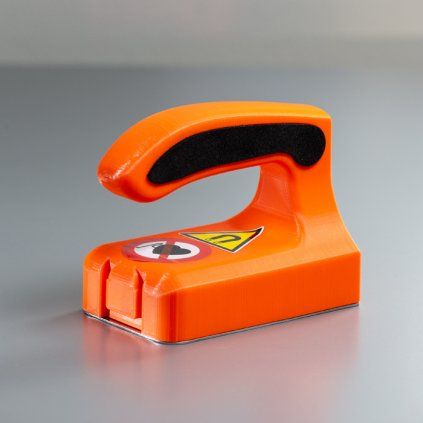
Super-strong sorting magnet 3D
Robust handheld neodymium magnet with a handle for inspecting larger volumes of non-magnetic material and locating hidden ferromagnetic objects.
- Powerful neodymium magnetic system
- Weight approximately 1.5 kg
- Maximum indicative range up to 200 mm
- Range depends on the shape and size of the object being detected
- Working surface temperature resistance up to 80 °C
- Rigid handle for manual use
- Product code 52008
- Suitable for compressed aluminium and mixed material
- Can also be used to collect nails through a protective cover
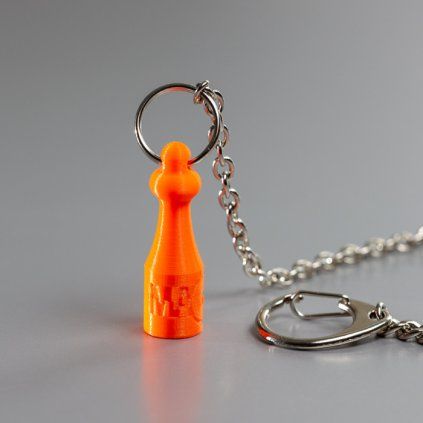
Plastic conical sorting magnet with chain
Lightweight conical magnet in a bright orange plastic casing for mobile inspection of the presence of ferromagnetic material.
- Powerful neodymium magnet
- Magnetic flux density 4,000 Gs
- Pull-off force 16 N
- Weight approximately 41 g
- Highly visible orange plastic casing
- Brass chain 50 cm long
- Carabiner for attachment to clothing
- Product code 52396
- Suitable for lightweight everyday metal inspection
Performance must be verified under real operating conditions
Magnetic flux density, pull-off force and magnetic field range are affected by the tested material, object shape, distance, surface finish and product wear. Carry out your own operating test before incorporating the magnet into a regular work procedure.
Frequently asked questions about sorting magnets
What is a sorting magnet?
A sorting magnet is a handheld tool designed for preliminary differentiation between ferromagnetic and non-magnetic materials.
Which metals does a magnet attract?
Primarily iron, ordinary steel, cast iron, nickel, cobalt and their ferromagnetic alloys.
Which metals does a magnet not attract?
It generally does not attract aluminium, copper, brass, bronze, lead, gold, silver or titanium.
Is every stainless steel non-magnetic?
No. Ferritic and martensitic stainless steels are generally magnetic. Austenitic grades may be non-magnetic or only weakly magnetic.
Can a magnet determine the exact type of stainless steel?
No. A magnet only indicates the degree of magnetic response. The exact grade must be determined using another analytical method.
Can a magnet identify aluminium?
Pure aluminium is not attracted by a magnet. A magnetic test primarily helps determine whether an aluminium object contains a steel component.
Why does an aluminium object react in one area?
It may contain a steel screw, spring, reinforcement or another ferromagnetic component.
Can a magnet distinguish iron from steel?
Not reliably. Both materials can show a strong magnetic response.
What does a magnetic flux density of 5,300 Gs mean?
It is the intensity of the magnetic field measured at a defined point on the working surface of the magnet.
What does a pull-off force of 25 N mean?
It is the force required to separate a defined steel test piece from the magnet under specified conditions.
Does 25 N correspond exactly to 2.5 kg?
Only very approximately under ideal conditions. A real object may be held with considerably less force.
Is a magnet with a higher Gs value always better?
Not automatically. The size of the working surface, pull-off force, field depth, ergonomics and intended use are also important.
Which magnet is suitable for a scrap yard?
For individual pieces, use a conical magnet. For larger compressed bales, use a super-strong magnet with a handle.
Which magnet is suitable for a recycling centre?
For ordinary mobile inspection, a conical magnet with a chain is practical. A testing rod can also be used for samples and mixtures.
What is the difference between a metal and plastic conical magnet?
The metal model offers higher performance, while the plastic version is lighter and more visible thanks to its orange casing.
What is the chain used for?
It allows the magnet to be attached to clothing and reduces the risk of losing it.
Can metal objects be lifted using the chain?
No. The chain and carabiner are primarily intended to prevent loss of the magnet.
What is a magnetic testing rod?
A handheld rod with a longer magnetic surface used to inspect samples and capture ferromagnetic contaminants.
How is a testing rod cleaned?
On a model with a movable core, the magnetic section is moved away from the active zone so that the captured contaminants can fall away easily.
Can a testing rod be used in liquid?
Only if the specific product is intended for the particular liquid, temperature and chemical environment.
Is a testing rod suitable for the food industry?
Selected stainless-steel models are, provided that they meet the material and hygiene requirements of the specific facility.
What does a magnetic range of up to 200 mm mean?
It is a maximum indicative value for a suitable large ferromagnetic object. Small parts may only be detectable from a short distance.
Can a magnet locate a metal profile behind plasterboard?
Yes, provided that the profile is ferromagnetic and not too deeply embedded. However, a magnet does not replace an electrical wiring detector.
Can a magnet locate an electrical cable?
Not reliably. A magnet may react to a metal conduit or steel component but cannot safely detect the electrical conductor itself.
Can a magnet collect nails from grass?
Yes. For easy release, place a cardboard or plastic cover over the magnetic surface.
Can a magnet be used on sand?
Yes, for collecting ferromagnetic objects, but sand and dirt may scratch the working surface.
Can a magnet be used in water?
Only if the complete product is designed for wet environments. Resistance of the magnetic core alone is not sufficient.
Is a plastic magnet water-resistant?
The plastic casing may partially protect the magnet, but suitability of the entire product for use in water must be confirmed by the manufacturer.
How can you prevent scratching the material?
Use a clean thin cloth, maintain a slight distance and do not slide the magnet across the surface.
Why does metal dust accumulate on a magnet?
Fine ferromagnetic particles are attracted to the strongest areas of the magnetic field.
How do you remove metal dust?
Use a non-magnetic scraper, brush or move the protective cover away. Wear protective gloves.
Can a magnet be cleaned with pressurised water?
Only if explicitly permitted by the manufacturer. Water may damage the magnet, casing or connecting components.
Can a sorting magnet crack?
Neodymium magnetic material is hard but brittle. Avoid dropping it and prevent severe impacts.
Can a magnet become weaker over time?
When used correctly, it is generally stable over the long term. High temperatures, a strong opposing field or damage can weaken it.
What temperature can the super-strong sorting magnet 3D withstand?
The working surface of the recommended model is resistant up to 80 °C. This value does not automatically apply to the entire handle and all structural components.
Can the magnet be placed on hot metal?
Only if the temperature does not exceed the limit for the complete product. Do not place it on hot material without confirmation from the manufacturer.
Is a sorting magnet a lifting device?
No. It is not intended for safely lifting or transporting loads.
Can it lift a heavy piece of steel?
It may attract it, but the construction, handle and chain may not be designed for safe lifting.
Can a magnet pinch fingers?
Yes. A large neodymium magnet in particular can snap towards a steel structure very quickly.
Can a magnet damage a phone?
A strong magnetic field may affect the compass, sensors, magnetic accessories and some sensitive components.
Can it damage a payment card?
A strong magnetic field can affect a traditional magnetic stripe.
Is it dangerous for pacemakers?
Powerful magnets may affect certain medical implants. Observe the distance specified by the device manufacturer.
How should a magnet be transported safely?
With a protective cover, away from steel tools and sensitive electronics. Hold a powerful magnet firmly by its handle.
How should a magnet be stored?
In a dry, stable location, away from children, steel structures, electronics and high temperatures.
How often should the magnet be inspected?
Visually before every use and, during regular industrial use, also through periodic magnetic performance measurements.
What should you do with a cracked plastic casing?
Do not continue using the product until it has been inspected or replaced. An exposed magnet may be more susceptible to damage.
Can a magnet be repaired with adhesive?
DIY repairs are not recommended for an industrial tool. Professional inspection or replacement is safer.
Is a sorting magnet suitable for children?
No. Powerful industrial magnets are not toys and can cause pinching or other injuries.
How can you verify that the magnet still works correctly?
Compare the results of regular magnetic flux density or pull-off force measurements using the same method.
Can a sorting magnet be custom-made?
For industrial applications, a different size, magnetic performance, handle or protective design for the magnetic surface can be discussed with the manufacturer.
Summary
Sorting magnets make it possible to quickly check whether an object or mixed material contains a ferromagnetic component. They are mainly used in scrap yards, recycling centres, recycling facilities, workshops and industry.
A conical magnet with a chain is suitable for quickly checking individual objects. The plastic version is lightweight and highly visible. A magnetic testing rod allows larger samples to be inspected, while a super-strong magnet with a handle is suitable for checking compressed bales and larger areas.
A magnetic test distinguishes between magnetic and non-magnetic materials but cannot accurately determine the chemical composition of an alloy. Another analytical method is required for precise identification.
When working, protect your fingers, sensitive surfaces, electronics and medical implants. Do not use a sorting magnet as a lifting device, and always verify the stated performance values under actual operating conditions.
Looking for a magnet for sorting metal scrap?
Choose from conical, plastic, swing-type, testing and super-strong sorting magnets for recycling centres, scrap yards and recycling facilities.