
Whiteboard Magnets: Which Ones Should You Choose?
Board Magnets: How to Choose the Right Type for the Office, School and Home
Board magnets make it easy to attach documents, photographs, notes, planning cards or shelf labels without adhesive or drawing pins. You can choose from simple coloured magnets, powerful neodymium models, magnetic symbols, letters, numbers, clips and pockets.
- Learn which boards and surfaces magnets will stick to.
- Find out how to choose a magnet according to the number and thickness of papers.
- Compare ferrite and neodymium office magnets.
- Discover magnetic smileys, letters, numbers, clips and pockets.
- Explore practical uses for planning, shelf labelling and home organisation.
- Learn about safety when using magnets around children.
- Explore recommended products and answers to frequently asked questions.
Do you need to keep work tasks constantly in sight, create a photo noticeboard or clearly label warehouse shelving? Board magnets allow documents to be quickly attached, moved and reused without damaging the surface with pins or adhesive.
However, not every magnet is suitable for every purpose. A lightweight coloured ferrite magnet may reliably hold one sheet of paper but may not be enough for a laminated document or several A4 sheets. Magnetic glass boards also require considerably stronger magnets than ordinary steel boards.
What are board magnets?
Board magnets are permanent magnets or products with a magnetic layer designed to attach to a ferromagnetic surface.
They may take the form of:
- round office magnets,
- neodymium magnets in a metal casing,
- coloured magnets in a plastic or silicone casing,
- magnetic clips and pegs,
- magnetic letters and numbers,
- symbols, arrows and smileys made from magnetic foil,
- magnetic document pockets,
- decorative magnets.
What can board magnets be used for?
- attaching documents and photographs,
- planning work tasks,
- marking deadlines and priorities,
- organising shifts and production processes,
- labelling warehouse shelving and filing cabinets,
- displaying menus, timetables and lists,
- creating themed or photo noticeboards,
- visual evaluation using colours and symbols.
Which surfaces will magnets stick to?
A magnet requires a surface containing enough ferromagnetic material, most commonly steel.
Magnets usually stick to:
- steel magnetic boards,
- magnetic whiteboards,
- steel shelving,
- metal filing cabinets,
- painted steel sheet,
- the side panels of some refrigerators,
- steel doors and cabinets,
- ferromagnetic adhesive strips.
Magnets will not stick by themselves to:
- wood,
- plastic,
- ordinary glass,
- aluminium,
- copper and brass,
- plasterboard,
- ordinary plaster,
- non-magnetic grades of stainless steel.
Is every whiteboard magnetic?
No. A white surface that can be written on with markers does not necessarily contain a steel backing.
For example, there are:
- magnetic whiteboards with a steel surface,
- non-magnetic whiteboards made from laminate or plastic,
- magnetic glass boards with a steel layer behind the glass,
- non-magnetic glass boards without a metal backing.
How can you test the board?
- Take an ordinary office magnet.
- Place it against several areas of the board.
- Check whether it holds without any paper.
- Add one sheet of paper.
- If the magnet slides or does not hold, you will need a stronger type or the board may not be magnetic.
Be careful with magnetic glass boards
The steel layer is hidden behind the glass, which significantly increases the distance between the magnet and the backing. An ordinary ferrite magnet often will not hold at all on a glass board. Use only extra-strong neodymium magnets designed for this type of board.
Will magnets stick to a stainless-steel refrigerator?
It depends on the material used for the front panel. Some stainless-steel surfaces are ferromagnetic, while others do not attract magnets or attract them only very weakly.
A modern refrigerator may also have a front panel made from glass, plastic or a non-magnetic stainless-steel alloy. Magnets may still stick to the steel side panels.
Before purchasing a larger set, always carry out a simple test with an ordinary magnet.
What affects a magnet's holding force?
The value stated by the manufacturer is generally measured on a clean, flat and sufficiently thick steel plate. Under normal conditions, the actual holding force is usually lower.
A magnet holds more weakly when:
- there are several sheets of paper between the magnet and board,
- the document is laminated,
- the board has a thick painted or glass layer,
- the steel sheet is very thin,
- the magnet does not make full contact,
- the surface is curved or uneven,
- there is dirt between the magnet and board,
- the load pulls downwards along the board,
- the board or door moves frequently.
Pull-off force and shear force
Pull-off force describes the force required to pull the magnet away from the steel surface at a right angle.
In normal use on a vertical board, however, papers pull the magnet downwards. This is a shear load, where the magnet will generally support less weight than during perpendicular pull-off.
A value in kilograms is not the load capacity for documents
A pull-off force of 4 kg does not mean that the magnet can safely hold a 4 kg object on a vertical board. The actual result depends on the direction of the load, surface, friction and contact area.
How strong should a board magnet be?
For one lightweight sheet of paper
A smaller ferrite office magnet or magnetic foil is usually sufficient.
For a photograph or postcard
A decorative magnet, neodymium magnet in a casing or smaller magnetic clip is suitable.
For several A4 sheets
Choose a neodymium magnet in a metal, plastic or silicone casing. A practical casing makes it easier to grip and remove.
For cardboard, newspapers or thicker material
A magnetic peg or clip that mechanically grips the document and attaches magnetically to the board may be more suitable.
For a document inside a protective sleeve
A magnetic pocket is more practical because it covers the entire sheet and protects it against dust, grease and damage.
Ferrite and neodymium board magnets
Ferrite magnets
Ferrite office magnets are affordable, durable and suitable for attaching lightweight papers.
Advantages
- affordable purchase price,
- good resistance to corrosion,
- wide choice of colours and sizes,
- suitable for ordinary office use,
- lower risk of pinching than with powerful neodymium magnets.
Disadvantages
- lower strength at the same size,
- larger dimensions required for higher holding force,
- unsuitable for magnetic glass boards,
- lower performance through several sheets of paper.
Neodymium magnets
Neodymium magnets provide high strength in a small size. They are often enclosed in a metal, plastic or silicone casing.
Advantages
- very high strength at a small size,
- ability to hold several sheets of paper,
- suitable for more demanding office use,
- compact and elegant design,
- selected models are suitable for glass boards.
Disadvantages
- higher purchase price,
- risk of pinching fingers,
- brittleness of the magnetic material itself,
- surface coating can be damaged by impact,
- greater safety precautions required in households with children.
Do not store powerful neodymium magnets directly next to weaker ferrite magnets
Under unsuitable conditions, a very strong neodymium magnetic field may affect weaker ferrite magnets. Store different magnet types separately and prevent them from colliding violently.
Magnets in a metal casing
A metal casing protects the neodymium magnet, concentrates its magnetic field and makes it easier to handle.
Advantages of a metal casing
- elegant appearance,
- easier handling,
- greater mechanical protection of the magnet,
- suitable for offices and meeting rooms,
- ability to hold more sheets than an ordinary ferrite magnet.
Before attaching the magnet, check that no steel shavings are stuck to its underside. A hard contaminant may scratch a painted board if the magnet is moved across the surface.
Magnets in a silicone casing
A silicone casing makes the magnet easier to grip, absorbs impact and helps protect the surface against direct contact with the hard magnet.
They are suitable, for example, for:
- planning boards,
- colour-coded priority marking,
- family organisers,
- school and office noticeboards,
- frequent repositioning.
However, the silicone layer also increases the distance from the steel backing. The manufacturer therefore needs to use a sufficiently powerful magnet so that the casing does not reduce the holding force too much.
Magnets in a plastic casing
A plastic casing offers good grip and a wide range of colour-coding options.
Stronger models can be used for:
- several sheets of paper,
- laminated instructions,
- planning cards,
- shift schedules,
- production documentation,
- marking important tasks.
Before using a powerful magnet on thin sheet metal, carry out a practical test. A thin surface may not allow the magnet to achieve its full strength.
Conical magnets
A magnet in a conical plastic casing is easy to grip and can be removed comfortably even when it has a high magnetic force.
Depending on its construction, it may function as:
- a strong document magnet,
- a holder for lightweight objects,
- a temporary hook on a suitable steel surface,
- a marking element on a board.
A board magnet is not automatically a hook
Before hanging clothing, keys or tools, verify that the specific product is intended for this type of load. Holding force on a vertical surface is usually significantly lower than laboratory pull-off force.
Magnetic smileys
Magnetic smileys are colourful symbols made from magnetic foil. They can be used to evaluate tasks, show project status or provide quick visual orientation on a planning board.
Possible meanings of the colours
- Green: completed, positive status or no problem.
- Yellow: in progress, neutral status or requires attention.
- Red: problem, incomplete or high priority.
Where can they be used?
- during meetings,
- for task evaluation,
- on production and quality boards,
- in a home planner,
- during project retrospectives,
- for quickly indicating mood or satisfaction.
The magnetic smileys in the recommended product card are decorative and organisational items, not children's toys.
Magnetic letters for shelf labelling
Magnetic letters and punctuation marks make it possible to repeatedly create labels on:
- steel warehouse shelving,
- filing cabinets,
- magnetic boards,
- planning boards,
- steel doors and cabinets,
- production information panels.
Advantages over adhesive labels
- they can be repositioned repeatedly,
- they leave no adhesive residue,
- the text can be changed quickly,
- missing characters can be added,
- they are suitable for frequently changing labels.
What should you watch out for?
- all letters must remain clearly visible,
- they may slide on dusty surfaces,
- thin magnetic foil is not intended to support heavy objects,
- small pieces must be kept out of reach of children,
- they are not children's educational toys unless explicitly stated by the manufacturer.
Magnetic shelf letters are not children's alphabet magnets
Letters intended for warehouse and filing-cabinet labelling may contain small magnetic pieces or sheets that do not meet the requirements for children's toys. For educational use, choose only a set with a clearly stated age recommendation.
Magnetic letters and numbers for children
A magnetic letter or number can only be used as an educational aid if the specific product is designed as a toy and is suitable for the child's age.
When choosing, check:
- age recommendation,
- product classification as a toy,
- size of individual pieces,
- strength of the bond between the magnetic layer and the product,
- resistance to tearing or breaking,
- manufacturer's safety warnings.
Do not use loose small magnets, torn magnetic foil or decorative fridge magnets as a substitute for a certified educational set.
Magnetic numbers
Magnetic numbers and mathematical symbols can be used in offices, warehouses and homes.
Examples of use
- labelling shelf positions,
- numbering warehouse locations,
- displaying production values,
- marking task order,
- updating deadlines and dates,
- creating simple maths exercises with a suitable children's set.
Apply the same safety rules to small magnetic numbers as to letters.
Magnetic clips and pegs
A magnetic clip combines mechanical document gripping with magnetic attachment to a board or refrigerator.
Advantages of clips
- they can hold a thicker stack of papers,
- papers do not need to be punched,
- the clip can be opened repeatedly,
- the magnet does not need to contact the board through all layers of the document,
- suitable for newspapers, cardboard or larger photographs.
Examples of use
- work instructions,
- receipts and orders,
- drawings,
- newspapers and magazines,
- thicker cards,
- temporary information signs.
The number of sheets a clip can hold depends on both the mechanical grip of the clip and the magnetic force holding it to the board.
Magnetic pockets
A magnetic pocket protects the inserted document while also allowing it to be repositioned quickly.
It is suitable for:
- work procedures,
- safety instructions,
- guidelines,
- timetables and menus,
- price lists,
- charts and results,
- production documentation.
Pockets for magnetic surfaces
These have a magnetic back or magnetic strips and attach directly to a steel board, cabinet or shelf.
Pockets for non-magnetic surfaces
These may have an adhesive backing that allows them to be attached to glass, wood, doors or smooth walls.
An adhesive pocket is not magnetically mounted
On a non-magnetic surface, the pocket is held by adhesive rather than a magnet. Before installation, the surface must be smooth, clean, degreased and dry.
Decorative board magnets
Felt, animal-shaped and other decorative magnets can hold lightweight photographs, postcards and notes.
Their main advantage is their appearance rather than maximum strength. Textile and plastic decorations increase the distance between the magnet and board.
They are suitable for:
- family photographs,
- postcards,
- lightweight children's drawings,
- personal notes,
- themed decoration.
A decorative magnet is not necessarily a children's toy even if it is shaped like an animal or colourful figure.
Coloured round magnets
Coloured ferrite magnets provide a simple and affordable solution for boards, flipcharts, refrigerators and other steel surfaces.
Advantages
- simple regular shape,
- easy colour coding,
- low weight,
- suitable for individual sheets,
- affordable price for larger sets.
How can colours be used for planning?
- Green: completed tasks.
- Yellow: tasks in progress.
- Red: urgent tasks.
- Blue: personal or administrative tasks.
- White: general information.
How do you create an effective planning board?
- Divide the board into logical sections.
- Assign a consistent meaning to each colour.
- Use short and clearly readable text.
- Use cards of the same format for tasks.
- Distinguish status using coloured magnets or smileys.
- Regularly remove outdated information.
- Do not overcrowd the board with too many decorations.
Example columns
- New tasks
- Planned
- In progress
- Waiting for review
- Completed
How do you label shelves with magnetic characters?
Magnetic letters and numbers are particularly suitable where labels change frequently.
Procedure
- Clean the front surface of the shelf.
- Check that it is made from magnetic steel.
- Establish a consistent labelling system.
- Position letters at the same height.
- Keep consistent spacing between numbers and codes.
- Check readability from the normal working distance.
- Store unused characters in a closed box.
When should another labelling method be used?
For permanent labelling, barcodes, mandatory safety information or outdoor environments, printed labels, durable pockets or mechanically mounted signs may be more suitable.
How do you create a magnetic surface on a wall?
Magnetic paint
So-called magnetic paint contains ferromagnetic particles. It is not itself a permanent magnet but creates a surface to which sufficiently powerful magnets can attach.
The resulting performance depends on:
- number of coats,
- amount of ferromagnetic particles,
- flatness of the wall,
- top decorative coating,
- strength of the magnets used.
Ordinary weak ferrite magnets may not hold sufficiently on magnetic paint. Carry out a test section before finishing the entire wall.
Adhesive steel strip
A ferromagnetic steel strip can be attached to a wall, cabinet or another non-magnetic surface to create a counterpart for magnets.
Before purchasing, check that it is actually a steel strip intended as a magnetic counterpart. Magnetic tape itself may not always be ideal for attaching other magnets.
Steel sheet or magnetic board
For a larger surface that will be used regularly, a securely mounted steel board is the most reliable option.
How can you prevent scratches on the board?
Scratches are often caused not by the magnet itself but by a small metal shaving stuck to its underside.
How can you protect the surface?
- clean magnets regularly,
- do not slide them across the board,
- tilt them away before repositioning,
- do not use cracked or chipped magnets,
- use a silicone or plastic casing on sensitive surfaces,
- remove iron dust before use.
How do you clean board magnets?
Plastic and silicone magnets
- wipe them with a soft damp cloth,
- remove metal shavings from the underside,
- allow them to dry before use,
- do not use aggressive solvents.
Metal casings
- clean them with a dry or slightly damp cloth,
- avoid prolonged contact with water,
- check for corrosion and sharp edges,
- do not use abrasive sponges.
Magnetic foil
- wipe it gently,
- do not bend it over a sharp edge,
- do not store it rolled to an excessively small diameter,
- protect the printed surface against scratches.
How should magnets be stored?
- In a dry environment.
- Out of reach of small children.
- Separated according to type and strength.
- Away from magnetic cards and sensitive electronics.
- Powerful neodymium magnets with suitable spacing material.
- Magnetic letters and numbers in a closed box.
- Magnetic foil stored flat or in a wide roll.
Safety when using board magnets
Basic safety rules
- Keep small magnets out of reach of children.
- Do not place magnets in the mouth, nose or ears.
- If swallowed, seek immediate medical assistance.
- Powerful neodymium magnets can pinch fingers.
- Do not allow brittle magnets to collide violently.
- Do not continue using a damaged or cracked magnet.
- Maintain a safe distance from pacemakers and other medical implants.
- Protect magnetic cards, watches, compasses and sensitive instruments.
- Magnets are not intended for suspending heavy objects above people.
- Do not use an office magnet as a children's toy unless explicitly designated as such by the manufacturer.
Why are swallowed magnets dangerous?
Multiple swallowed magnets can attract each other through the intestinal wall from different parts of the digestive tract.
This can cause:
- compression of tissue,
- perforation of the intestinal wall,
- intestinal blockage,
- bleeding and infection,
- the need for emergency surgery.
If swallowing is suspected, do not wait for symptoms to appear and seek immediate medical assistance.
How do you choose board magnets?
Answer these questions before purchasing
- Is the board actually magnetic?
- Is it a steel or glass board?
- How many sheets should one magnet hold?
- Will the documents be laminated?
- Do you need colour coding?
- Will the magnets be moved frequently?
- Should the magnet also have a decorative function?
- Do you need a symbol, letter, number or clip?
- Will small children be present nearby?
- Is there a risk of scratching a sensitive surface?
For an ordinary office board
Choose coloured ferrite magnets or neodymium magnets in a casing according to the number of sheets.
For a glass board
Use special powerful neodymium magnets designed for glass.
For task planning
Coloured magnets, smileys, arrows and magnetic cards are practical.
For warehouse labelling
Choose magnetic letters, numbers, labels or pockets.
For photographs and decorations
Decorative magnets, felt magnets or smaller magnets in an elegant casing are suitable.
For a larger stack of papers
Use a powerful neodymium magnet, magnetic clip or peg.
Recommended board magnets
The selected products represent three different uses: visual evaluation using smileys, shelf labelling with letters and ordinary document attachment using coloured magnets.
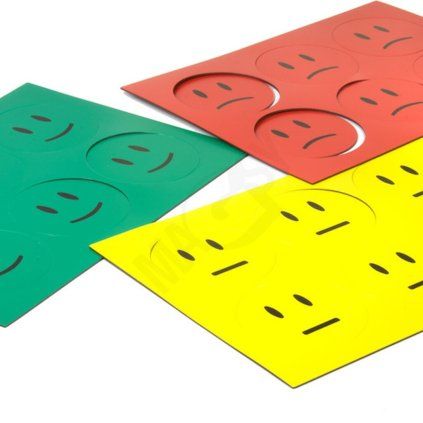
Magnetic smiley dia. 60 mm – three-colour set
Large magnetic symbols for evaluating tasks, plans, satisfaction or project status on magnetic boards and planning boards.
- 18 magnetic smileys in total
- 3 coloured A5 sheets
- 6 smileys on each sheet
- Green, yellow and red
- Diameter of one smiley 60 mm
- Magnetic foil thickness 1 mm
- Ferrite material
- Total set weight approximately 354 g
- Product code 10553
- Not a children's toy
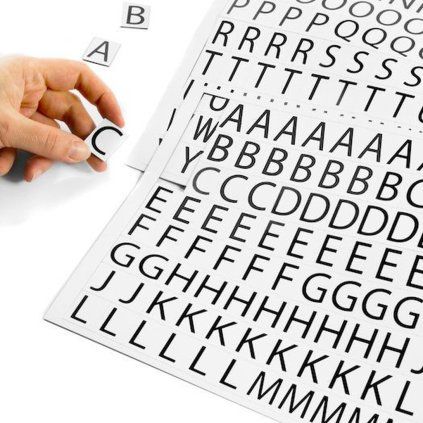
Magnetic letters for shelf identification
Set of magnetic letters and punctuation marks for repeatedly changeable labelling of warehouse shelving, filing cabinets, boards and planning panels.
- Pack contains 2 magnetic A4 sheets
- 120 characters on each A4 sheet
- Letters A–Z
- Punctuation and special characters
- Letter dimensions 20 × 25 mm
- Punctuation mark dimensions 12 × 25 mm
- Thickness 1 mm
- White background with black print
- Set weight approximately 510 g
- Product code 10560
- Not a children's toy
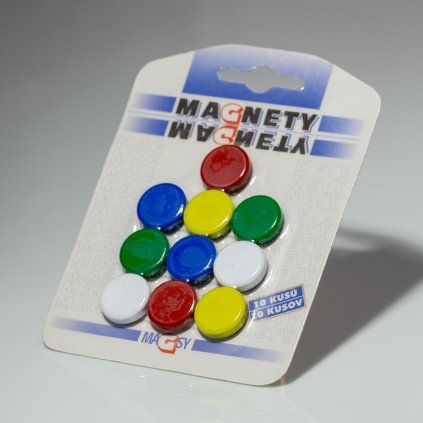
Packed coloured round magnet dia. 20 × 5 mm
Set of simple coloured ferrite magnets for attaching papers, letters, postcards and notes to a board, flipchart or refrigerator.
- Pack contains 10 pieces
- Diameter of one magnet 20 mm
- Height 5 mm
- Colour mix
- Weaker isotropic ferrite magnet
- Pull-off force approximately 0.22 kg
- Pull-off force approximately 2.2 N
- Pack weight approximately 78.65 g
- Designation BM/NB-A/0008
- Product code 60208
Always verify the number of sheets in practice
Actual holding force depends on the board material, document thickness, surface finish and direction of the load. Results achieved on a thick clean steel plate may differ significantly from those on an ordinary office board.
Frequently asked questions about board magnets
Will a magnet stick to every whiteboard?
No. The board must contain a ferromagnetic steel backing. Some whiteboards can be written on but are not magnetic.
How can I tell whether a board is magnetic?
Place an ordinary magnet against it. If it holds without paper, the board contains a suitable steel layer.
Why does an ordinary magnet not hold on a glass board?
The glass creates a large distance between the magnet and steel layer. A special powerful neodymium magnet is required.
Will magnets stick to a stainless-steel refrigerator?
It depends on the specific stainless-steel alloy and construction of the door. The front panel may be non-magnetic.
How many sheets can a magnet hold?
It depends on its strength, type of board, paper thickness and casing design. Carry out a practical test.
Can a ferrite magnet hold several A4 sheets?
A small weak ferrite magnet is intended mainly for one or a few lightweight sheets. For a larger stack, choose a neodymium magnet or clip.
Which magnet should I use for laminated paper?
A stronger neodymium magnet in an easy-to-grip casing or a magnetic pocket.
Which magnet is suitable for photographs?
A lightweight magnet with a smooth underside that will not dent or scratch the photograph.
Which magnet is suitable for the office?
For ordinary documents, use a coloured ferrite magnet. For several sheets, use a neodymium magnet in a metal, plastic or silicone casing.
What does pull-off force mean?
It is the force required to pull the magnet perpendicularly away from a defined steel surface.
Why does a magnet slide down a vertical board?
The magnet is subjected to shear force. Friction and the downward holding force are lower than the laboratory pull-off force.
Why does a magnet hold more weakly through paper?
Paper increases the distance between the magnet and steel board. Holding force decreases with every additional layer.
Will a magnet hold through a plastic pocket?
Yes, if it is strong enough. Thicker plastic increases the distance from the board.
Can a magnet be used on a wooden noticeboard?
Not without a steel counterpart. A steel strip or sheet can be attached to the noticeboard.
Can magnets be used on a wall?
Only if the wall has sufficiently effective magnetic paint or a steel panel.
Is magnetic paint actually magnetic?
It contains ferromagnetic particles but is not itself a permanent magnet. It serves as a surface for magnets.
Why does a magnet hold weakly on magnetic paint?
There may be too few coats, the magnet may be too weak or the decorative topcoat may increase the distance too much.
Can a magnet be attached to adhesive magnetic tape?
It depends on the construction and polarity of the tape. A ferromagnetic steel strip designed as a counterpart for magnets is more reliable.
Are magnetic smileys suitable for task evaluation?
Yes. Colours can be used to indicate positive, neutral and problematic status.
How many smileys are included in the recommended set?
18 pieces in total – six green, six yellow and six red symbols.
Are magnetic smileys toys?
No. The recommended product is an organisational and decorative tool, not a children's toy.
What are magnetic shelf letters used for?
For repeatedly changeable labelling of shelving, filing cabinets, boards and planning panels.
Does the letter set also include punctuation?
Yes. It contains letters A–Z and selected punctuation and special characters.
Are the letters suitable for children?
The recommended product is intended for shelf labelling, not as a children's toy.
Can magnetic letters be used on non-magnetic doors?
Yes, if a ferromagnetic strip or steel plate is attached first.
What are magnetic clips?
They are clips with a magnet that mechanically grip a document and attach to a steel surface.
Are clips suitable for larger amounts of paper?
Yes, provided that the strength of both the clip and magnet is sufficient. The actual number of sheets should be tested.
What is a magnetic pocket?
A transparent pocket with a magnetic back or magnetic strips for attaching a document.
Can a magnetic pocket be used outdoors?
Only if the specific product is designed for outdoor use and is resistant to water, UV radiation and temperature changes.
Can magnets scratch the board?
Yes, if a hard contaminant becomes trapped underneath them. Clean magnets before use and do not slide them across the surface.
How do you safely remove a magnet from the board?
Tilt it away from one edge. Do not try to pull a powerful magnet straight away from the surface across its full area.
Can a neodymium magnet crack?
Yes. Neodymium material is hard but brittle. Prevent magnets from colliding with each other or with a steel surface.
Can a ferrite magnet crack?
Yes. Ferrite is also brittle and may chip if dropped onto a hard floor.
Are magnets dangerous for children?
Small magnets present a serious hazard if swallowed. Keep them out of reach of children.
What should you do if a magnet is swallowed?
Seek immediate medical assistance. Do not wait for pain or other symptoms to appear.
Can magnets damage a payment card?
A strong magnetic field can affect a traditional magnetic stripe. Store cards separately.
Can magnets damage a phone?
An ordinary office magnet will generally not permanently damage a phone, but it may affect the compass, sensors or magnetic accessories.
Are magnets dangerous for pacemakers?
Powerful magnets may affect certain medical implants. Observe the distance specified by the manufacturer.
How do you clean magnets?
Use a soft cloth or gentle brush. Dry them thoroughly before use.
Can magnets be soaked?
Ferrite is corrosion-resistant, but the casing, adhesive or neodymium core may be damaged by water. Follow the product instructions.
Can a magnet become weaker over time?
Under normal use, a permanent magnet is generally stable for a long time. High temperatures, a strong opposing field or mechanical damage may weaken it.
How can coloured magnets be used for planning?
Assign one meaning to each colour, such as priority, responsible person or task status.
Is a magnet better than a drawing pin?
A magnet does not puncture the document or board and can be repositioned repeatedly. However, it requires a magnetic surface.
Is a magnet better than adhesive tape?
A magnet can be reused and leaves no adhesive residue. Tape may work on non-magnetic surfaces but may damage or dirty them.
Which magnet should I choose for a school board?
First check that the board is magnetic. Then choose easy-to-grip magnets suitable for the users' age and the weight of the materials.
Which magnet should I choose for a production board?
A durable coloured magnet, symbol, magnetic pocket or clip according to the type of documentation and working environment.
Which magnet should I choose for a warehouse?
Magnetic letters, numbers, labels and pockets that can be changed quickly when shelving is reorganised.
How often should magnets be inspected?
Regularly and always after being dropped, after the casing cracks or if holding force changes.
What should you do with a cracked magnet?
Do not continue using it. Safely collect sharp fragments and make sure children cannot access them.
Summary
Board magnets are used to attach documents, photographs, planning cards, shelf labels and other information materials to steel or another ferromagnetic surface.
For individual lightweight sheets, a coloured ferrite magnet is usually sufficient. For several sheets, laminated documents or a glass board, a powerful neodymium magnet is more suitable.
Magnetic smileys help with visual evaluation, letters and numbers with shelf labelling, while clips and pockets help secure thicker documentation.
Before purchasing, always check the type of board, number of sheets, direction of the load and safety requirements. Do not use magnetic symbols and letters as children's toys unless explicitly designated for this purpose by the manufacturer.
Choose board magnets according to how you plan to use them
Explore coloured office magnets, powerful neodymium models, letters, numbers, symbols, clips and other accessories.