
Strong Neodymium Magnets: Shapes, Grades and Selection
Strong magnets: how do you choose the right neodymium magnet?
Neodymium magnets offer high holding force even in small sizes. However, the kilogram rating alone is not enough when choosing. Shape, dimensions, magnetisation direction, temperature resistance and the operating environment also matter.
- A cylinder is versatile for holders, closures and technical projects.
- A block or cube fits easily into a right-angled construction.
- Pull force applies under ideal conditions.
- Nickel-plated magnets are mainly intended for dry indoor use.
Why are neodymium magnets so strong?
Neodymium magnets are made from an alloy of neodymium, iron and boron, known as NdFeB. Compared with ordinary ferrite magnets, they can offer much higher performance at a similar size.
They are used, for example, for:
- magnetic closures and catches,
- holders and mounting attachments,
- model making,
- sensors and switches,
- electric motors and loudspeakers,
- home and workshop projects.
What does pull force mean?
Pull force is the force needed to separate a magnet perpendicularly from a clean steel plate. As an approximation, 10 N corresponds to the force exerted by a mass of around 1 kg.
The stated value assumes:
- a flat steel plate of sufficient thickness,
- contact across the magnet’s entire face,
- a clean surface without paint, plastic or rust,
- a pull perpendicular to the surface.
Why does a magnet hold less in practice?
Paint, adhesive, a gap, curved surfaces, thin sheet metal or sideways loading reduce the actual force. Leave a sufficient margin for your application and test the magnet beforehand.
Which magnet shape should you choose?
Cylindrical magnet
Cylinders and flat discs are versatile. They fit easily into drilled holes and are suitable for round closures, holders or sensors.
Block or cube
A right-angled shape fits more easily into furniture, boxes, models and constructions with straight edges.
Magnet with a hole
If the magnet needs to be secured with a screw, choose a ready-made model with a straight or countersunk hole. Finished neodymium magnets should not be drilled with ordinary tools because they are brittle.
What do N35, N42 and N45 grades mean?
The number indicates the magnetic grade of the neodymium material used. A higher number usually means higher magnetic performance of the material.
However, this does not mean that every N45 magnet is stronger than an N35 magnet. The dimensions and shape of the particular product also greatly affect its final pull force.
Surface and temperature resistance
Neodymium material is prone to corrosion. Magnets are therefore often protected with nickel, zinc, epoxy or gold coatings, for example.
Use ordinary nickel-plated magnets mainly in dry indoor environments. A damaged protective layer may allow moisture to enter and cause oxidation.
The selected products are intended for temperatures up to 80 °C. For higher temperatures, choose a special neodymium grade or another magnetic material.
Safe handling
- Strong magnets can pinch fingers.
- Do not let them collide sharply.
- Neodymium material is hard but brittle.
- Stop using cracked or corroded magnets.
- Keep them out of reach of children.
- Protect medical implants, cards and sensitive electronics.
Recommended neodymium magnets
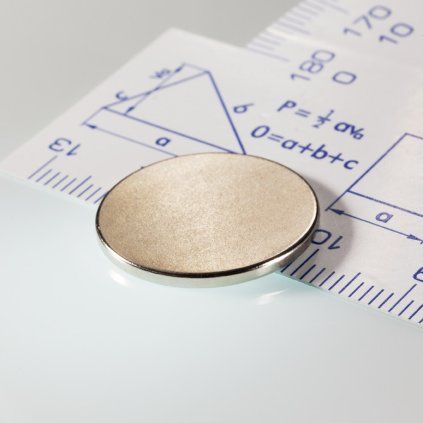
Neodymium cylinder magnet 20 × 1.5 mm
A thin magnet with a larger contact area for lightweight holders, closures and flat constructions.
- Diameter 20 mm
- Height 1.5 mm
- Pull force 14.4 N
- Approximate pull force 1.44 kg
- Weight 3.53 g
- Magnetic grade N35
- Nickel-plated surface
- Temperature resistance up to 80 °C
- Product code 20446
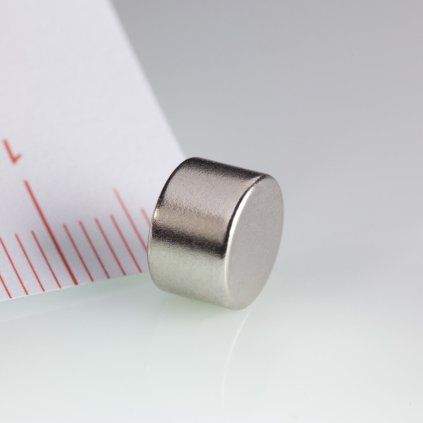
Neodymium cylinder magnet 8 × 5 mm
A compact cylinder in the higher N45 grade for applications with limited space and a need for greater strength.
- Diameter 8 mm
- Height 5 mm
- Pull force 20 N
- Approximate pull force 2 kg
- Weight 1.88 g
- Magnetic grade N45
- Nickel-plated surface
- Temperature resistance up to 80 °C
- Product code 20883
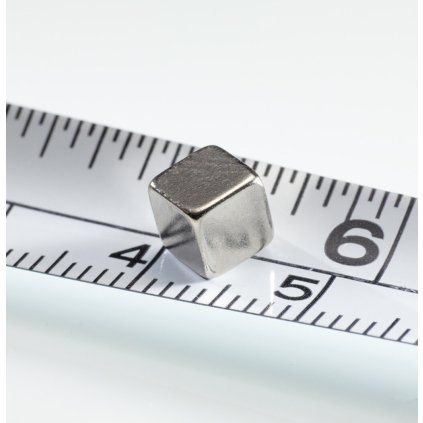
Neodymium cube magnet 5 × 5 × 5 mm
A small right-angled cube for model making, decorations, lightweight closures and precision technical assemblies.
- Dimensions 5 × 5 × 5 mm
- Pull force 11.9 N
- Approximate pull force 1.19 kg
- Weight 0.94 g
- Magnetic grade N42
- Magnetised perpendicular to the face
- Nickel-plated surface
- Temperature resistance up to 80 °C
- Product code 20716
Frequently asked questions
Are neodymium magnets the strongest?
Among commonly available permanent magnets, they provide very high performance in a small volume.
Is an N45 magnet always stronger than an N35?
No. The resulting force also depends on size, shape and magnetisation direction.
Does a magnet stick to every metal?
No. It strongly attracts mainly iron, ordinary steel and other ferromagnetic materials.
Can the magnet be used outdoors?
Ordinary nickel-plated models are mainly intended for dry indoor use. A suitably protected version is needed for damp environments.
What strength should I choose?
Allow for the loading direction, steel thickness, any gap and a safety margin. Testing the magnet in the actual application is best.
Summary
Choose a strong magnet according to pull force, shape, dimensions, material grade, magnetisation direction and the working environment.
Neodymium magnets suit applications requiring high performance in a small size. However, the stated force applies under ideal conditions and may be lower in a real construction.
Choose a strong magnet for your project
Compare cylindrical, block, ring and other neodymium magnets by dimensions and pull force.