
Magnetic Rods: Testing, Separation and Neodymium Rod Magnets
Magnetic rods: industrial separation and small technical projects
The term magnetic rod can refer to two different products. An industrial testing or separation rod captures ferromagnetic contaminants from mixtures. A small rod magnet is a long cylindrical permanent magnet for model making, sensors, holders and other technical applications.
- A testing rod is used to check material.
- Separation rods can be assembled into a magnetic grate.
- Small cylindrical magnets are built into products and equipment.
- Neodymium versions offer high strength at a small diameter.
Testing and separation rods
An industrial magnetic rod contains a magnetic core enclosed in a thin stainless steel casing. Ferromagnetic particles collect on its surface.
It is used, for example, for:
- checking dry and liquid mixtures,
- capturing iron swarf and wire fragments,
- protecting mills, crushers and other equipment,
- checking magnetic separation efficiency,
- building magnetic grates.
What is the difference between a testing rod and a fixed rod?
A testing rod has a sliding magnetic core and a plastic handle. After testing, the core is moved and contaminants fall easily from the surface.
Fixed separation rod has a core permanently enclosed inside. A threaded connection allows it to be installed in a frame, hopper or magnetic grate.
Use in food processing
Not every cylindrical magnet is automatically suitable for a food-processing operation. The whole construction, casing material, surface finish and cleaning method must be appropriate. Selected industrial rods are made from polished AISI 304 stainless steel.
Small neodymium rod magnets
A small rod magnet is a cylinder whose height is equal to or greater than its diameter. The poles are generally located on its circular ends.
Neodymium rod magnets are used, for example, in:
- sensors and magnetic switches,
- models and construction kits,
- small holders and closures,
- measuring instruments,
- technical and classroom demonstrations.
Some special models may be magnetised diametrically across the cylindrical surface. Always check the magnetisation direction in the specifications.
Neodymium or AlNiCo?
NdFeB neodymium magnet
- very high strength in a small volume,
- high resistance to demagnetisation,
- a wide choice of sizes,
- lower temperature resistance in standard grades,
- protection against moisture and corrosion is required.
AlNiCo magnet
- very good temperature stability,
- good corrosion resistance,
- suitable for sensors and high temperatures,
- lower energy performance than NdFeB,
- greater sensitivity to an unsuitable demagnetising field.
Chemical resistance to acids or solvents must be assessed for the particular alloy, operating temperature and environment.
How do you choose the right magnetic rod?
- Sample testing: a testing rod with a sliding core.
- Permanent separation: a fixed threaded rod.
- Limited space and high strength: a neodymium cylinder magnet.
- Higher temperatures: special NdFeB, SmCo or AlNiCo.
- Food processing: a hygienically suitable design with documented specifications.
Safety during use
- Neodymium magnets can pinch fingers.
- Do not let them collide sharply.
- Keep small magnets out of reach of children.
- Clean an industrial rod only after stopping the production line.
- Protect the magnetic casing from impact and punctures.
- Use nickel-plated magnets only in dry indoor environments.
Recommended magnetic rods
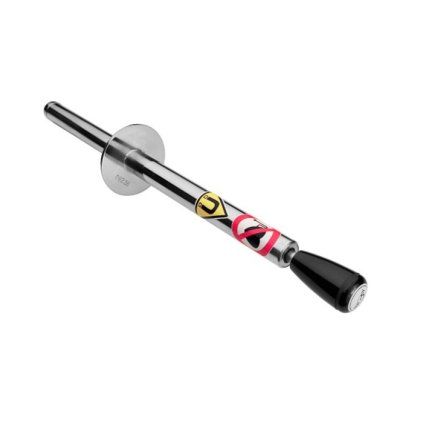
Magnetic testing rod 28 mm
A manual industrial rod for checking for ferromagnetic contamination in dry and suitable liquid materials.
- Magnetic section diameter 28 mm
- Magnetic section length 140 mm
- Magnetic flux density 10,257 Gs
- Pull force 81 N
- Weight 1.1 kg
- Neodymium magnetic core
- AISI 304 stainless steel
- Polished surface
- Temperature resistance up to 80 °C
- Product code 52943
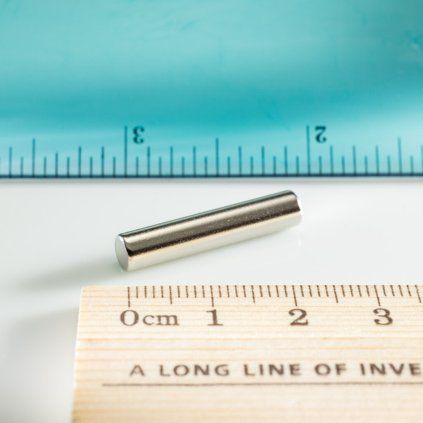
Neodymium cylinder magnet 5 × 25 mm
A long, slender magnet for sensors, models, demonstration assemblies and constructions with limited diameter.
- Diameter 5 mm
- Height 25 mm
- Pull force 11 N
- Approximate pull force 1.1 kg
- Weight 3.68 g
- Magnetic grade N45
- Magnetised parallel to the axis
- Nickel-plated surface
- Temperature resistance up to 80 °C
- Product code 280030
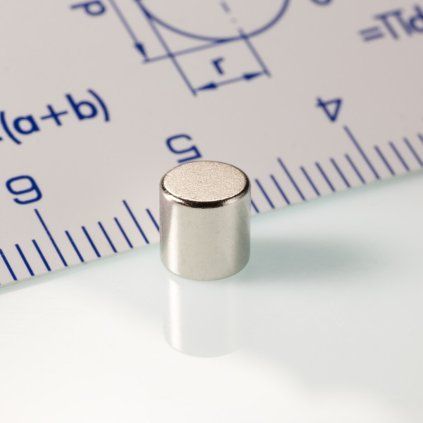
Neodymium cylinder magnet 5 × 5 mm
A small cylindrical magnet for model making, closures, sensors and other small technical projects.
- Diameter 5 mm
- Height 5 mm
- Pull force 11.3 N
- Approximate pull force 1.13 kg
- Weight 0.74 g
- Magnetic grade N45
- Magnetised parallel to the axis
- Nickel-plated surface
- Temperature resistance up to 80 °C
- Product code 20878
Frequently asked questions
Is a testing rod the same as a rod magnet?
No. A testing rod is an industrial tool with a magnetic core in a stainless steel casing. A rod magnet is an individual cylindrical permanent magnet.
How is a testing rod cleaned?
Hold it over a container and move the internal core to release the captured contaminants.
Does a magnetic rod capture every metal?
No. It mainly captures iron, ordinary steel and other ferromagnetic materials.
Is AlNiCo as strong as neodymium?
No. AlNiCo has lower energy performance but offers better stability at high temperatures.
Is every stainless steel casing suitable for food processing?
Not automatically. The material, surface, construction, cleanability and requirements of the specific operation must be assessed.
Summary
Industrial testing and separation rods capture ferromagnetic contaminants. Small rod magnets, by contrast, are built into models, sensors, holders and other devices.
Neodymium magnets offer high strength in a small size. AlNiCo is more suitable where high temperature stability matters more than maximum performance.
Choose a magnetic rod for your application
Compare industrial testing rods and small neodymium cylinders by size, performance and magnetisation method.