
Permanent Magnet vs Electromagnet: Key Differences and Uses
Permanent magnets and electromagnets: what is the difference?
A permanent magnet creates its own magnetic field without electrical power. An electromagnet, by contrast, needs an electric current, allowing its magnetic field to be switched on, switched off and adjusted.
- A permanent magnet works without electricity.
- An electromagnet creates a field using an electric current.
- High temperature or an unsuitable field can weaken a permanent magnet.
- An electromagnet’s strength depends on current, coil construction and the core used.
How does a permanent magnet work?
Permanent magnets are made from magnetically hard materials that retain the arrangement of their magnetic domains for a long time after magnetisation.
This allows them to create their own magnetic field without:
- a battery,
- a mains electrical connection,
- a coil or control electronics,
- a continuous energy supply.
Every permanent magnet has a north and a south pole. Opposite poles attract, while like poles repel.
Natural and manufactured magnets
Magnetite occurs naturally, and some pieces can be naturally magnetised. Most modern technical magnets, however, are manufactured industrially.
Common types of permanent magnets include:
- NdFeB neodymium magnets,
- ferrite or ceramic magnets,
- SmCo samarium magnets,
- AlNiCo magnets,
- flexible magnetic sheets and tapes.
The materials differ in strength, corrosion resistance, operating temperature and price.
Can a permanent magnet weaken?
“Permanent” does not mean that a magnet cannot be damaged or demagnetised. With correct use, it retains its properties for a very long time, but performance can be reduced by:
- exceeding the maximum operating temperature,
- heating above the Curie temperature,
- a strong opposing magnetic field,
- an alternating field with gradually decreasing intensity,
- corrosion or mechanical damage,
- sudden impacts in some magnetic materials.
The maximum operating temperature is usually lower than the Curie temperature. A magnet may therefore weaken irreversibly before completely losing its ferromagnetic properties.
Do not deliberately heat magnets or collide them
Neodymium magnets are hard and brittle. A sudden impact can crack them and send sharp fragments flying. Controlled demagnetisation belongs in a properly equipped specialist facility.
How does an electromagnet work?
An electromagnet consists of a conductor or coil carrying an electric current. The current creates a magnetic field around the conductor.
A simple example is a solenoid – a long coil consisting of many turns of wire. The magnetic field inside the coil depends mainly on:
- the electric current,
- the number of turns,
- the length and geometry of the coil,
- the material of the inserted core.
For a long coil without a ferromagnetic core, the field is approximately proportional to current when the construction is unchanged. For a coil with an iron core, the relationship is not indefinitely linear because the material can become magnetically saturated.
When the current is switched off, the coil’s field disappears or weakens considerably. However, a ferromagnetic core may retain some residual magnetisation.
When should you choose each type?
- Permanent magnet: when the field should remain active without a power supply.
- Electromagnet: when you need to switch the magnet on and off or adjust it.
- Permanent magnet: for holders, closures, sensors and office use.
- Electromagnet: for relays, valves, locks, motors and industrial handling.
Recommended permanent magnets
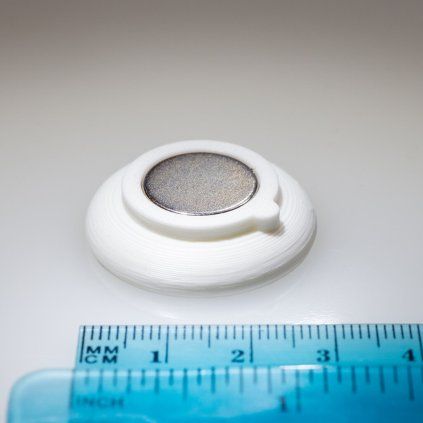
Strong magnet in a MAGSY plastic case
A neodymium magnet in a rounded plastic case for conveniently attaching documents to magnetic boards.
- Case diameter 30 mm
- Pull force 40 N
- Approximate force 4 kg
- Weight 10.9 g
- NdFeB neodymium magnet
- Printed plastic case
- Up to 25 A4 sheets according to the manufacturer
- Product code 60145

Neodymium cylinder magnet 20 × 5 mm
A strong permanent magnet for holders, closures, model making and technical assemblies in dry indoor environments.
- Diameter 20 mm
- Height 5 mm
- Pull force 42.4 N
- Approximate force 4.24 kg
- Weight 11.78 g
- Magnetic grade N30
- Axial magnetisation
- Nickel-plated surface
- Temperature resistance up to 80 °C
- Product code 20005

Neodymium cylinder magnet 15 × 1 mm
A thin magnet for lightweight closures, decorations, paper products and constructions with limited space.
- Diameter 15 mm
- Height 1 mm
- Pull force 8.2 N
- Approximate force 0.82 kg
- Weight 1.3 g
- Magnetic grade N42
- Axial magnetisation
- Nickel-plated surface
- Temperature resistance up to 80 °C
- Product code 20261
What does pull force mean?
The stated force applies under ideal conditions: the magnet’s entire face touches clean, flat steel of sufficient thickness and is pulled away perpendicularly. Paint, rust, gaps, thin sheet metal or sideways loading significantly reduce holding force.
Frequently asked questions
Does a permanent magnet need electricity?
No. It creates its own magnetic field without electrical power.
Can a permanent magnet lose strength?
Yes. High temperature, a strong opposing field, corrosion or mechanical damage can weaken it.
Does a solenoid create an electric or magnetic field?
Direct current in a coil creates a magnetic field. A changing current and magnetic field can also induce an electric field.
Does an electromagnet’s field disappear immediately when switched off?
The coil’s field collapses quickly, but a ferromagnetic core may retain some residual magnetisation.
Is an electromagnet always stronger than a permanent magnet?
No. It depends on construction, current, cooling, the core and the size of the device.
Summary
A permanent magnet creates a long-lasting magnetic field without electrical energy. An electromagnet uses current in a coil, so its field can be controlled and switched off.
Even a permanent magnet is not indestructible. When choosing and using one, respect its operating temperature, environment, pull force and risk of mechanical damage.
Choose a permanent magnet for your application
Compare neodymium, ferrite, samarium and other magnets by size, strength and temperature resistance.