
Magnetic Pick-Up Tools and Belt Magnets: A Practical Guide
Practical magnetic tools for workshops and garages
Magnetic tools make it easier to keep screws organised and retrieve steel objects from places your hand cannot reach. A belt magnet keeps small fasteners close at hand, a flexible rod reaches between engine components, and a telescopic magnet extends your reach by tens of centimetres.
- A belt magnet is suitable for machine screws, wood screws and nails.
- A flexible magnet reaches into irregular spaces.
- A telescopic rod helps in deep or narrow gaps.
- These tools mainly pick up iron and steel, not all metals.
Why are magnetic tools useful?
Magnetic tools let you quickly pick up ferromagnetic objects without complicated dismantling or searching across the floor.
They are useful, for example, when:
- repairing cars and motorcycles,
- assembling furniture,
- servicing machines and appliances,
- working in a workshop or garage,
- searching for dropped screws, nuts and tools.
A magnet mainly picks up ordinary steel, iron and cast iron. It does not attract aluminium, copper, brass or most non-magnetic stainless steels.
Belt magnet
The magnet attaches to a work belt using a clip on the back. You no longer need to keep screws in your pockets or hold them dangerously in your mouth.
It is particularly useful for:
- machine screws and wood screws,
- nails,
- nuts and washers,
- smaller bits.
Keep heavy pliers, hammers, sharp tools and electrical devices in a secure mechanical holster. A belt magnet is not a safety holder for heavy tools.
Flexible magnetic pick-up tool
The bendable rod can be shaped to fit between hoses, cables or engine components. On the flexible automotive magnet, the magnetic tip stays retracted until the spring in the handle is pressed.
This reduces unwanted attachment to surrounding metal parts while inserting the tool.
Telescopic magnetic pick-up tool
A telescopic magnet has an extendable steel rod that can be adjusted to the depth of the space.
It can help retrieve, for example:
- a dropped screw or nut,
- a key from behind furniture,
- nails from grass,
- a small tool from an engine compartment,
- a steel component from a deep container.
Which type should you choose?
- Fasteners while working: a belt magnet.
- An irregular engine compartment: a flexible magnetic pick-up tool.
- A straight, deep gap: a telescopic magnet.
How do you use a magnetic pick-up tool?
- Check that the object you are looking for responds to a magnet.
- If working inside a machine, switch it off and secure it against start-up.
- Insert the rod slowly to avoid damaging cables or hoses.
- Once the object is caught, withdraw it smoothly.
- Remove the object over a safe surface.
- Clean the magnetic tip after work.
The stated force applies under suitable conditions
Rust, grease, paint, a curved shape or a small contact area reduce the actual holding force. Do not use a magnetic pick-up tool as load-lifting equipment or above people.
Working safely
- Do not insert a magnetic rod into a running machine or engine.
- Do not use it near exposed live electrical parts.
- Protect sensitive sensors, watches and magnetic cards.
- Wear work gloves when removing sharp objects you have retrieved.
- Do not use the rod as a pry bar.
- Stop using a damaged telescopic section, handle or magnetic tip.
Recommended magnetic tools
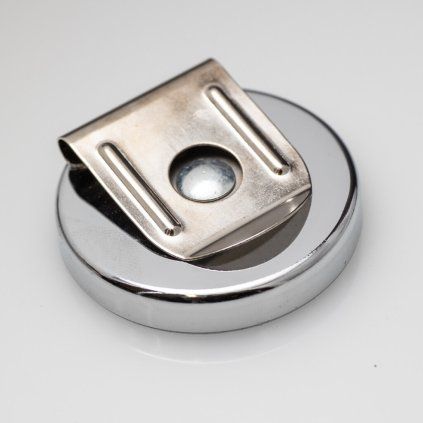
Belt magnet
A compact aid for keeping small steel fasteners close at hand during assembly.
- Magnet diameter 50 mm
- Weight 77.65 g
- Clip on the back
- For machine screws, wood screws and nails
- Product code 10666
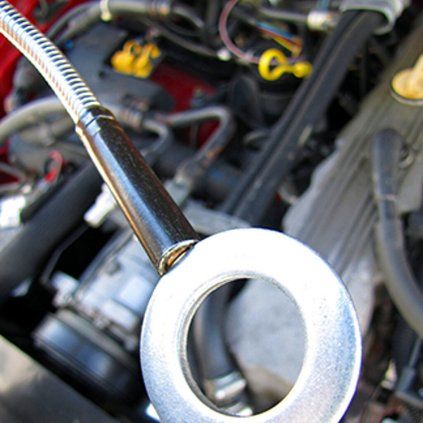
Flexible automotive magnetic pick-up tool
A bendable magnetic tool with a retractable tip for finding parts in engine compartments and between metal components.
- Overall reach 570 mm
- Magnetic section diameter 10 mm
- Weight 173.5 g
- NdFeB neodymium magnet
- Rated holding force up to 900 g
- Flexible rod
- Retractable magnetic tip
- Product code 10254
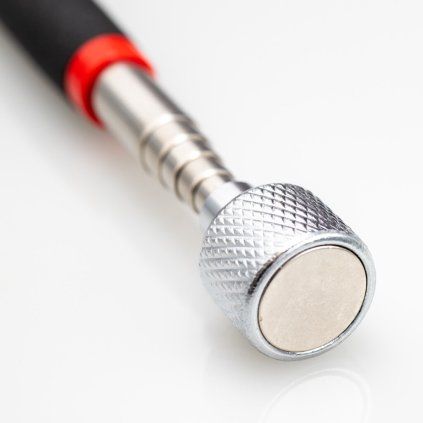
Telescopic magnetic pick-up tool
A lightweight extendable rod for finding steel objects in deeper but readily accessible gaps.
- Retracted length 190 mm
- Maximum length 770 mm
- Weight 80 g
- NdFeB neodymium magnet
- Rated holding force up to 6.8 kg
- Lightweight foam handle
- Product code 30026
Important: the stated 6.8 kg applies with suitable contact against a clean steel object. This tool is not designed for lifting loads.
View productFrequently asked questions
Will a magnetic pick-up tool attract every metal?
No. It works mainly with iron, ordinary steel and other ferromagnetic materials.
What is the difference between flexible and telescopic magnets?
A flexible rod can bend around obstacles. A telescopic rod extends but remains mostly straight.
Can a magnet retrieve a screw from an engine?
Yes, provided that the engine is off, the screw is ferromagnetic and the magnetic tip can safely reach it.
Will a belt magnet hold tools?
It is mainly designed for small fasteners. Heavy and sharp tools belong in a mechanical holster.
Can a neodymium magnet be drilled or cut?
Finished neodymium magnets are brittle and are not normally machined. Grinding or drilling can cause cracking, heat and flammable dust.
Summary
A belt magnet keeps small fasteners close at hand. A flexible magnetic pick-up tool suits irregular engine compartments, while a telescopic model extends your reach into deeper gaps.
Choose the tool according to the shape of the space and the weight of the object to be retrieved. The stated holding force applies only under suitable conditions and does not replace safe lifting equipment.
Keep screws and dropped components under control
Choose a belt magnet, flexible automotive magnet or telescopic rod to suit the job.