
Magnetic Hooks: Where Can You Use Them?
Magnetic Hooks: How They Work, How Much They Can Hold and Where to Use Them Safely
A magnetic hook allows you to hang lighter equipment, tools, an information sign or a decoration on a suitable steel surface without drilling or adhesive. Its greatest advantage is easy repositioning, but the actual load capacity depends significantly on the surface, direction of the load and method of use.
- Learn how a magnetic hook works.
- Compare neodymium and ferrite versions.
- Understand the difference between pull-off force and shear force.
- Find out how to choose the right diameter and magnetic performance.
- Learn which metals a magnetic hook will attach to.
- Discover safe ways to use magnetic hooks at home, in the office and in the workshop.
- Learn about the risks of moisture, thin sheet metal, high temperatures and overhead suspension.
- Explore recommended products and answers to frequently asked questions.
Magnetic hooks are a practical solution wherever a flat ferromagnetic surface is available and drilling, adhesive or permanent modification of the surface is undesirable.
You can move the hook to another location within seconds. When correctly selected and safely loaded, it can help organise tools, keys, cables, lightweight kitchen utensils, information materials or workshop accessories.
However, it is not a lifting device or a safety anchor point. A value stated in kilograms does not mean that the same weight can be safely suspended from a vertical wall.
What is a magnetic hook?
A magnetic hook generally consists of two basic parts:
- a pot magnet or magnetic holder containing a neodymium or ferrite magnet,
- a screw-in hook attached to the internal thread of the pot magnet.
The magnet is usually enclosed in a steel casing. The casing protects the magnetic material and helps direct the magnetic field towards the active contact surface.
On some models, the hook can be unscrewed and replaced with another compatible component with the same thread, such as an eye bolt. The replacement component must have the appropriate dimensions, strength and intended use.
Quick answer: how does a magnetic hook work?
The pot magnet is attracted to a steel surface and the hook allows a lightweight object to be suspended. The highest holding force is achieved on a clean, flat and sufficiently thick steel surface when the force acts perpendicular to the surface.
How does a steel casing improve magnetic performance?
A standalone disc magnet creates a magnetic field on both sides. A steel casing guides and concentrates part of this field towards the open working surface.
As a result, the pot magnet can:
- achieve greater force on the contact side,
- make better use of the volume of magnetic material,
- partially protect the brittle magnet against impact,
- provide a strong thread for a hook or eye,
- withstand ordinary handling better than an unprotected magnet.
However, the steel casing does not protect the entire product against water, corrosion, chemicals or temperatures above its permitted limit.
Neodymium or ferrite magnetic hook?
Neodymium magnetic hook
A neodymium magnet offers high magnetic force with a small diameter and low weight.
Advantages
- high strength in a compact size,
- low weight,
- suitable for confined spaces,
- wide selection of diameters and colours,
- easy repositioning.
Disadvantages
- neodymium material is brittle,
- it is generally more sensitive to high temperatures,
- it may corrode if the protective coating is damaged,
- powerful models can pinch fingers,
- sudden impact against steel can damage the surface.
Ferrite magnetic hook
A ferrite magnet is weaker than a neodymium magnet of comparable volume, but it offers good corrosion resistance and the magnetic material itself may have a higher temperature resistance.
Advantages
- good corrosion resistance of the magnetic material itself,
- higher temperature resistance on some models,
- long-term stability of magnetic properties,
- more affordable magnetic material.
Disadvantages
- a larger size is required to achieve the same force,
- higher weight for comparable magnetic performance,
- ferrite is also brittle and may crack on impact,
- lower performance in compact applications.
When should you choose each type?
- Neodymium hook: when you need high force with a small diameter.
- Ferrite hook: when a larger size is acceptable and you need a durable magnetic material.
- Higher temperatures: choose according to the temperature limit of the entire product, not just the magnet.
- Humid environments: do not use ordinary stock magnetic hooks unless the manufacturer explicitly approves them for such conditions.
Which materials will a magnetic hook attach to?
A magnetic hook requires a ferromagnetic surface.
It will usually hold on:
- ordinary structural steel,
- carbon steel,
- steel sheet,
- steel cabinets and shelving,
- steel doors,
- cast iron,
- ferritic stainless steel,
- martensitic stainless steel.
It will not attach directly to:
- aluminium,
- copper,
- brass,
- bronze,
- zinc,
- plastic,
- wood,
- glass,
- ordinary plaster,
- most austenitic stainless steels.
Will the hook attach to stainless steel?
It depends on the specific grade. The term “stainless steel” does not describe a single material.
- Ferritic stainless steels are generally magnetic.
- Martensitic stainless steels are generally magnetic.
- Austenitic stainless steels may be non-magnetic or only weakly magnetic.
Before hanging anything, carry out a simple test with an ordinary magnet directly at the intended mounting location.
Will a magnetic hook attach to galvanised sheet metal?
The zinc layer itself is not magnetic, but there may be ferromagnetic steel underneath it. The hook may therefore hold if:
- the base sheet is actually made from steel,
- it is not too thin,
- the surface is flat,
- the zinc and other protective layers are not excessively thick,
- the load is sufficiently light.
However, a galvanised gutter is not automatically a safe mounting location. It is usually thin, curved and exposed to rain, wind and temperature changes. Do not use ordinary magnetic hooks designed for dry indoor environments on it.
What does the pull-off force of a magnetic hook mean?
Pull-off force describes the force required to separate the magnet perpendicularly from a defined steel test plate.
For example, a value of 120 N corresponds under ideal conditions to approximately the force generated by a mass of 12 kg. However, this does not mean that you can safely hang a 12 kg object from the hook on a vertical wall.
Ideal measurement conditions include:
- a clean steel plate,
- a flat surface,
- sufficient sheet thickness,
- full contact across the entire working surface,
- perpendicular pull away from the surface,
- no vibration, impact or movement.
The stated force is not the safe load capacity of the hook
The value in kilograms is primarily used to compare magnets. For practical suspension, you must allow a substantial safety margin and test the hook on the specific surface.
The difference between horizontal and vertical use
Magnet underneath a horizontal steel ceiling
The suspended object pulls the magnet approximately perpendicular to the mounting surface. This direction is more similar to the laboratory measurement of pull-off force.
Even so, this type of suspension is not suitable above people, workplaces, beds, seating areas or anywhere else where a falling object could cause injury.
Magnet on a vertical steel wall
The object pulls the hook downwards. The magnet therefore does not try to pull directly away from the surface but instead tends to slide down it.
The resulting force is mainly influenced by friction between the pot magnet and the mounting surface. Load capacity on a vertical wall is therefore usually significantly lower than the stated pull-off force.
Magnet on top of a horizontal surface
If the magnet rests on a steel surface and the object does not lift or move it, the assembly may be more stable. However, the direction of force acting on the hook still matters.
A simple example
A hook rated at 12 kg may withstand a high perpendicular pull on a thick horizontal steel plate. On a painted vertical cabinet, however, it may begin to slide at a load many times lower.
What reduces the actual holding force?
- thin steel sheet,
- a curved surface,
- a thick layer of paint,
- plastic or rubber foil,
- rust, grease and dust,
- metal shavings underneath the magnet,
- contact with only part of the magnetic surface,
- sideways force,
- swinging of the suspended object,
- vibration,
- impact,
- leverage created by a long object,
- higher temperatures,
- damage or wear of the magnet.
Why does sheet thickness matter?
A magnet requires enough ferromagnetic material through which the magnetic circuit can close.
Very thin sheet metal may:
- become magnetically saturated,
- flex mechanically,
- vibrate,
- detach from its supporting structure,
- be dented by a powerful magnet.
A hook may therefore hold considerably less effectively on a thin appliance casing or lightweight metal cabinet than on a thick steel plate.
Why does the surface finish matter?
Every layer between the magnet and steel increases the distance and therefore reduces magnetic force.
This may include:
- paint,
- powder coating,
- plastic foil,
- a rubber pad,
- a zinc layer,
- dirt,
- textile or paper.
A thin protective layer can help prevent scratches, but a reduction in holding force must be expected.
How do you choose the size of a magnetic hook?
Small diameter
Suitable for:
- keys,
- lightweight cables,
- tea towels,
- small information signs,
- lightweight kitchen utensils,
- small workshop accessories.
Medium diameter
Suitable for:
- lighter tools,
- bundles of cables,
- organising equipment on shelving,
- larger information signs,
- textile organisers,
- lightweight decorations.
Large diameter
It offers a larger active surface and generally greater force. However, it also:
- snaps towards steel more forcefully,
- is more difficult to remove,
- may damage thin sheet metal,
- presents a greater pinching hazard,
- requires more careful practical testing.
How do you attach a magnetic hook correctly?
- Make sure the surface is ferromagnetic.
- Check its thickness, strength and stability.
- Clean the contact surface of the magnet.
- Clean the steel mounting surface.
- Check that the hook is properly tightened in the thread.
- Move the magnet towards the surface slowly and at a slight angle.
- Keep your fingers away from the space between the magnet and steel.
- Allow the pot magnet to make full contact.
- Initially hang only a very lightweight object.
- Increase the load gradually.
- Check whether the magnet begins to slide or tilt.
Do not allow a powerful magnet to snap against steel
Impact can pinch fingers, chip the magnetic material, damage paintwork or dent thin sheet metal.
How do you test the hook safely?
- First test it above a floor or soft surface.
- Use an object that will not cause damage if it falls.
- Add load in small increments.
- Leave the load in place for an extended period.
- Simulate normal movement, door opening or mild vibration.
- Check whether the magnet has moved.
- Maintain a sufficient safety margin.
- If the magnet slides even slightly, use a lighter object or a stronger solution.
Do not carry out a practical load test above a person, electronics, glass or other sensitive equipment.
How do you remove a magnetic hook?
Do not pull a powerful magnet directly away from the surface across its entire contact area unless necessary.
Safer procedure
- Remove the suspended object.
- Grip the body of the pot magnet rather than only the hook.
- Tilt one side of the magnet away from the surface.
- Gradually reduce the contact area.
- Once released, immediately move the magnet away from the steel.
Do not use the hook as a long lever if this could damage the thread or pull it out.
Can the hook be replaced with an eye or screw?
On screw-in models, the hook can only be replaced with a component:
- with the same thread type and size,
- with sufficient strength,
- with a suitable thread length,
- that will not press against the magnetic core,
- that is designed for the intended direction of loading.
An excessively long screw may damage the internal part of the pot magnet. An incorrect thread may damage the threaded insert.
Where can magnetic hooks be used safely?
In the workshop
- on the side of a sturdy steel cabinet,
- on heavy-duty metal shelving,
- on a workshop trolley,
- for lightweight coiled cables,
- for work gloves,
- for safety glasses in a case,
- for lightweight hand tools with a suitable eye,
- for information cards and instructions.
Do not position hooks close to rotating machinery, moving components or areas where a falling tool could cause injury.
In a warehouse
- for shelf labelling,
- for lightweight information signs,
- for hanging empty bags,
- for lightweight scanning accessories,
- for organisational cards,
- for lightweight coiled cables.
Do not hang heavy goods or objects above warehouse aisles from a magnetic hook.
In the office
- on a steel filing cabinet,
- on a metal cabinet,
- for lightweight headphones,
- for a charging cable,
- for a lightweight set of keys,
- for a name badge or information card,
- for a lightweight textile organiser.
In the hallway
- for individual keys,
- for a lightweight high-visibility vest,
- for an empty textile bag,
- for a small dog's lead without the animal attached,
- for a lightweight hat or scarf.
A fixed mechanical coat hook is safer for heavy handbags, jackets or backpacks.
In a dry area of the kitchen
- for a lightweight tea towel,
- for a silicone oven glove,
- for a lightweight measuring cup with an eye,
- for a small information card,
- for a lightweight coiled cable away from heat sources.
The hook must not be placed near a sink, steam, grease, an open flame or a hot cooking surface.
At a trade fair or exhibition stand
- for lightweight information signs,
- for textile decorations,
- for directional signs,
- for lightweight cables,
- for presentation materials.
All suspended components must be positioned away from areas above visitors and, where necessary, secured with an independent mechanical safety element.
Can the hook be used on a refrigerator?
Yes, provided that the specific section of the casing is made from magnetic steel and the hook carries only a lightweight object.
Before use, check:
- whether the magnet actually holds in that location,
- whether the casing flexes,
- whether the hook may damage the paint,
- whether opening the door causes it to slide,
- whether the object interferes with the handle or seal.
Do not hang heavy cookware, bottles or other objects with a risk of falling from thin refrigerator doors.
Can the hook be used on a washing machine or dishwasher?
Only for very lightweight objects and after testing. The appliance may vibrate during operation, causing the magnet to move gradually.
Do not place the hook:
- near water,
- in an area exposed to condensation,
- on a moving door if the object could interfere with it,
- above electrical sockets,
- where a falling object could damage the appliance.
Can the hook be used on a cooker hood?
Only if the cooker hood has a sufficiently thick magnetic steel surface and the hook is kept away from heat, steam and grease.
Do not position it:
- directly above the hob,
- in a stream of hot air,
- on a thin decorative cover,
- for heavy or sharp utensils,
- where an object could fall into food or onto a person.
Can the hook be used on a radiator?
A magnet may hold on a steel radiator, but this requires caution.
You must consider:
- surface temperature,
- material and thickness of the casing,
- curvature of the radiator,
- surface paint,
- the risk of heat damaging the suspended object.
The temperature resistance stated for a product may apply only to the magnet itself, not to the paint, hook or complete assembly. Do not place the product on a hot radiator unless its suitability has been confirmed.
Can a magnetic hook be used in a bathroom?
Not the ordinary recommended models. They are intended for dry indoor environments.
Do not use them:
- inside a shower enclosure,
- near a bath,
- near a washbasin,
- on a permanently wet drying rack,
- in areas with condensation,
- where water may splash onto the product.
For humid environments, you need a product with a suitable construction, protective coating and explicit approval from the manufacturer.
A surface coating does not guarantee waterproofing
Nickel plating, paint or a plastic surface may slow corrosion, but this does not make an ordinary magnetic hook suitable for a shower, washbasin area or permanent outdoor use.
Can magnetic hooks be used outdoors or in the garden?
Do not use ordinary models designed for dry indoor environments outdoors. Rain, dew, condensation, UV radiation and temperature changes may damage:
- the magnetic material,
- the steel casing,
- the thread,
- the surface coating,
- painted coloured components.
Outdoor use also introduces wind, vibration and dynamic loading, which may cause the suspended object to slide or come loose.
Why should you not hang a flowerpot from a magnetic hook?
A flowerpot creates a high and variable load. Its weight increases significantly after watering and, outdoors, it is also affected by wind.
Suspension is particularly risky:
- on a thin gutter,
- on curved sheet metal,
- above a pavement,
- above a patio or seating area,
- in a humid environment,
- without independent mechanical safety securing.
Use a fixed mechanical holder designed for the weight of the flowerpot and outdoor conditions.
Can the hook be used in a car?
Only for lightweight objects on a suitable internal steel structure and away from vehicle safety systems.
Do not use it:
- in the path of an airbag,
- near the pedals,
- in the driver's field of view,
- for heavy objects,
- for loose cargo,
- where it could become a dangerous projectile in a collision.
Vibration and impact while driving may significantly reduce the safety of magnetic suspension.
Is a magnetic hook suitable for tools?
Yes, provided that the tool is lightweight, has a suitable eye or opening and the hook is attached to a sturdy steel structure.
Suitable examples may include:
- lightweight scissors,
- work gloves,
- a small paintbrush,
- a lightweight tape measure with a loop,
- a small set of keys,
- safety glasses in a case,
- a lightweight coiled cable.
Unsuitable examples include:
- a heavy hammer,
- power tools,
- large garden shears,
- a sharp tool above a work area,
- equipment that could cause injury if it falls,
- an object creating significant leverage.
Can the hook be used for cables?
Yes, for lightweight coiled cables in a dry environment.
Make sure that:
- the cable is not live while being handled,
- it is not suspended by its connector,
- it does not create excessive pulling force,
- it does not pass over a sharp edge of the hook,
- it does not obstruct a walkway,
- it cannot be caught by moving machinery.
Can lighting be suspended from the hook?
Only small, lightweight decorative lighting and only after thorough testing. Even then, independent mechanical safety securing is advisable.
Do not use a magnetic hook as the only supporting element for:
- a heavy light fitting,
- lighting above people,
- permanent electrical installation,
- outdoor string lights,
- lighting near water or high temperatures.
Can the hook be used to retrieve keys from a drain or well?
An ordinary magnetic hook is not designed for magnet fishing or underwater use.
Such use may cause:
- corrosion,
- loss of the magnet,
- loosening of the screw-in hook,
- the hook catching on pipework,
- damage to the drain or trap,
- contact with hazardous contaminants.
For retrieving objects, use a telescopic magnet, suitable mechanical retrieval tool or fishing magnet designed for the particular environment.
Why should you not use a magnetic hook as a fishing magnet?
- it is not designed for immersion in water,
- the hook can easily catch on an obstacle,
- the thread may loosen during movement,
- the construction is not protected against prolonged moisture,
- the product is not designed for pulling with a rope,
- it may not have a suitable eye for a secure knot.
How can you reduce the risk of the hook sliding?
Holding force on a vertical surface can only be increased to a limited extent.
The following can help:
- a clean and dry mounting surface,
- thicker steel sheet,
- a larger magnet diameter,
- a lighter suspended object,
- keeping the load as close to the surface as possible,
- reducing swinging and vibration,
- using a rubber-coated magnet designed for higher shear force.
Rubber coating increases friction but also creates a gap between the magnet and steel. The resulting performance depends on the construction of the specific product.
How do you prevent the hook from loosening?
Before every use, check that the hook is properly tightened in its thread.
Loading, swinging or repeated rotation can gradually loosen the thread.
Check in particular:
- that the hook is fully screwed in,
- that the thread is undamaged,
- for cracks around the threaded insert,
- for corrosion,
- for deformation of the hook,
- whether it loosens during normal handling.
Only use thread-locking adhesive if the manufacturer permits it for the specific product.
How do you clean a magnetic hook?
- Remove the suspended object.
- Remove the magnet from the steel surface.
- Wear work gloves.
- Move metal shavings towards the edge using a plastic or other non-magnetic tool.
- Wipe the surface with a dry, soft cloth.
- Inspect the thread and hook.
- Remove grease with a product approved by the manufacturer.
- Allow all parts to dry completely before further use.
What should you avoid?
- immersing the product in water,
- washing it in a dishwasher,
- pressurised water,
- aggressive chemicals,
- sandpaper,
- hammer blows,
- drilling or cutting the pot magnet.
How can you prevent surface scratches?
Scratching is often caused not by the magnet itself but by a steel shaving trapped underneath it.
- Clean both surfaces before attaching the magnet.
- Do not slide the magnet across paintwork.
- Tilt it away when removing it.
- Test it in a concealed location on sensitive surfaces.
- Do not use a damaged or sharp pot magnet.
- If you use protective foil, expect a reduction in holding force.
How should magnetic hooks be stored?
- In a dry indoor environment.
- Away from direct sunlight and high temperatures.
- Away from loose steel tools.
- With spacing material between powerful magnets.
- Away from magnetic cards and sensitive electronics.
- Out of reach of small children.
- So that they cannot snap violently towards a steel shelf.
- With the active surface clean and protected.
Safety when using magnetic hooks
Basic safety rules
- Only use hooks on a suitable ferromagnetic surface.
- Always verify the actual holding force in practice.
- Maintain a substantial safety margin.
- Do not suspend objects above people.
- Do not use the hook as a lifting or anchoring device.
- Protect your fingers from pinching.
- Do not allow powerful magnets to snap against steel.
- Use ordinary models only in dry indoor environments.
- Maintain a safe distance from pacemakers and other medical implants.
- Protect magnetic cards, watches, compasses and sensitive equipment.
- Do not exceed the temperature permitted for the complete product.
- Do not continue using a damaged, cracked or corroded hook.
Why should magnetic hooks be kept away from small children?
A powerful magnet can pinch a child's fingers. A loose magnetic component also presents a serious swallowing hazard.
Therefore:
- keep hooks out of reach of children,
- do not use them as toys,
- do not leave them on low areas of a refrigerator,
- inspect their construction regularly,
- inspect them after being dropped,
- discard them immediately if the magnet or hook becomes loose.
How do you choose a magnetic hook?
Answer these questions before purchasing
- How heavy is the object you want to hang?
- Will the magnet be used on a vertical or horizontal surface?
- How thick is the steel mounting surface?
- Is the surface flat or curved?
- Is the surface painted or rubber-coated?
- Will the assembly be exposed to vibration?
- Is it a dry indoor environment?
- Could anyone walk underneath the object?
- Do you need low weight or higher temperature resistance?
- Will the hook be repositioned regularly?
For keys, cables and lightweight items
A smaller neodymium hook, for example with a diameter of 16 to 20 mm, is usually sufficient.
For lighter tools and information signs
A neodymium model with a diameter of approximately 25 to 32 mm may be suitable.
For higher magnet temperatures
A ferrite version may be considered. However, the temperature limits of the hook, surface coating and complete construction must always be checked.
For a vertical painted wall
Choose a significantly stronger model than the weight of the object alone would suggest and test the load in practice.
For humid or outdoor environments
Do not use ordinary models. Ask the manufacturer for a solution designed for the specific conditions.
Recommended magnetic hooks
The selected products represent a compact neodymium hook, a larger ferrite version and a powerful coloured neodymium model with a diameter of 32 mm.
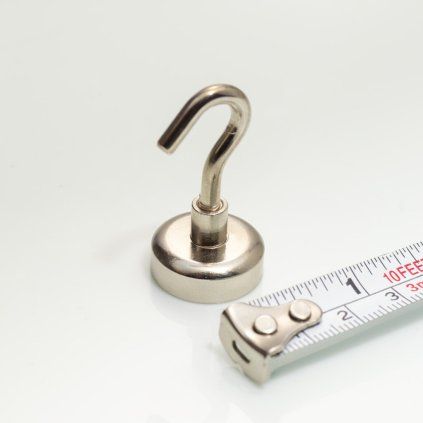
Silver magnetic hook, diameter 20 mm
Compact neodymium hook for hanging lightweight objects from a suitable flat steel surface in a dry indoor environment.
- Pot magnet diameter 20 mm
- NdFeB neodymium magnet
- Pull-off force approximately 12 kg
- Pull-off force 120 N
- Weight approximately 21 g
- Temperature resistance of the magnet itself up to 80 °C
- Silver finish
- Screw-in hook
- Product code 20515
- Designed for dry indoor environments
Warning: the 12 kg value applies under ideal conditions with perpendicular pull-off. On a painted vertical surface, the practical holding force may be significantly lower.
View product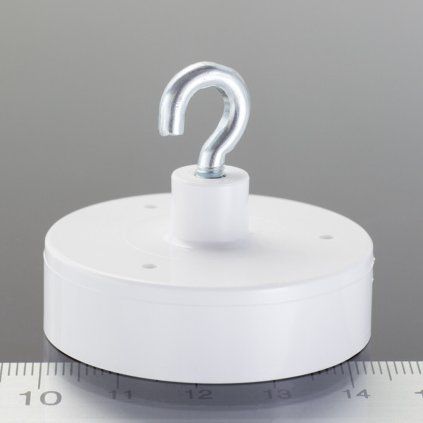
Pot magnet with hook dia. 43 × 12.5 mm
Larger ferrite magnetic hook for lightweight workshop, warehouse and organisational use on a suitable steel surface.
- Pot magnet diameter 43 mm
- Pot magnet height 12.5 mm
- Ferrite magnet
- Pull-off force approximately 12 kg
- Pull-off force 120 N
- Weight approximately 84 g
- Temperature resistance of the magnet itself up to 200 °C
- Designation MC-H dia. 43 × 12.5
- Product code 27032
- Designed for dry indoor environments
Warning: the 200 °C value applies to the magnet itself. The hook, surface finish and other product components may not withstand this temperature.
View product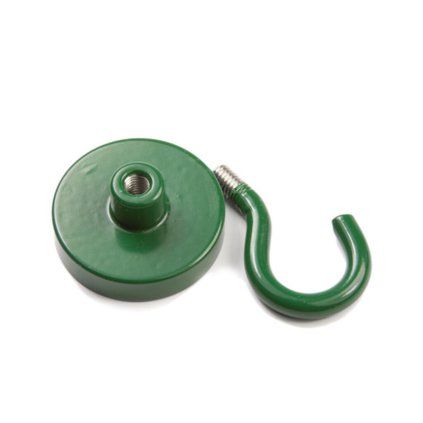
Pot magnet with hook dia. 32 mm – green
Powerful green neodymium magnetic hook for organising lighter equipment, tools or information signs.
- Pot magnet diameter 32 mm
- NdFeB neodymium magnet
- Pull-off force approximately 28 kg
- Pull-off force 280 N
- Weight approximately 53 g
- Temperature resistance of the magnet itself up to 80 °C
- Green painted finish
- Designation MC-H 32 N-Z
- Product code 27123
- Designed for dry indoor environments
Warning: do not suspend this powerful model above people either. On vertical, thin or painted sheet metal, it may hold with considerably less force than 280 N.
View productA stronger model is not a substitute for safe suspension
If a falling object could cause injury, equipment damage or other serious harm, use a fixed mechanical holder or independent safety securing.
Frequently asked questions about magnetic hooks
What is a magnetic hook?
A pot magnet with a screw-in hook that can be attached to a suitable steel surface without drilling.
Which materials will the hook attach to?
Iron, ordinary steel, cast iron and some magnetic grades of stainless steel.
Will it attach to aluminium?
No. Aluminium is not ferromagnetic.
Will it attach to copper or brass?
No. Ordinary permanent magnets are not attracted to copper or brass.
Will it attach to stainless steel?
Some grades yes, others no. The material must be tested beforehand.
Will it attach to galvanised sheet metal?
Yes, provided that there is sufficiently thick steel underneath the zinc layer. The holding force may be low on thin or curved sheet metal.
Will it attach to a refrigerator?
Only if the relevant part of the casing is magnetic. Some stainless-steel or glass doors do not attract magnets.
Will it attach to a radiator?
It may hold on a steel radiator, but the temperature, curvature, paint and manufacturer's recommendations must be taken into account.
Will it attach to a glass board?
Not directly to the glass. A magnetic glass board has a steel layer behind the glass and requires a very powerful magnet designed for this purpose.
Will it attach to wood or plastic?
Not without a steel counterpart.
What does a force of 12 kg mean?
It is an indicative pull-off force under ideal conditions, not a safe load capacity on a vertical wall.
What does 120 N mean?
It is the force required to separate the magnet perpendicularly from a steel test plate under specified conditions.
Why does the hook slide down a wall?
Friction is crucial on a vertical surface. Excessive weight, thin sheet metal, paint, dirt or vibration may cause sliding.
Why is the force different on a ceiling than on a wall?
On a ceiling, the load acts more in the direction of perpendicular pull-off. On a wall, the magnet tends to slide downwards.
Can I hang an object weighing the amount stated for the product?
Not automatically. A substantial safety margin and practical testing on the specific surface are required.
How large should the safety margin be?
It depends on the environment and the consequences of a potential fall. Do not rely on a magnetic hook alone for safety-critical applications.
Why does paint reduce the force?
A layer of paint increases the distance between the magnet and steel.
Why does thin sheet metal reduce the force?
It may not contain enough steel to close the magnetic circuit effectively and may also flex.
Can protective foil be placed underneath the magnet?
Yes, but it will reduce the holding force. The result must be tested again.
How can scratches be prevented?
Clean both the magnet and mounting surface and do not slide the magnet across the surface.
How do you remove a magnetic hook?
Tilt one side of the pot magnet away and gradually reduce the contact area.
Can the hook be unscrewed?
Yes, on screw-in models. Always tighten it securely again before use.
Can the hook be replaced with an eye?
Yes, but only with a compatible component with the same thread and sufficient strength.
Can the thread loosen?
Yes. Vibration and repeated rotation can gradually loosen it.
Can thread-locking adhesive be used?
Only if the manufacturer permits it for the specific product.
Is a neodymium hook stronger than a ferrite hook?
At the same size, it is generally significantly stronger.
Is a ferrite hook more resistant to heat?
The ferrite magnet itself may have greater temperature resistance. However, the limit of the complete product may be lower.
Can the hook be placed on a hot surface?
Only if the temperature does not exceed the limit of the complete assembly. The manufacturer's stated value may apply only to the magnet.
Can a magnetic hook be used in a bathroom?
Not the ordinary recommended models. They are designed for dry indoor environments.
Can it be used near a kitchen sink?
This is not recommended because of splashing water, steam and grease.
Can it be used outdoors?
Not unless the manufacturer explicitly specifies outdoor use.
Can the hook be attached to a gutter?
This is not recommended. Gutters are exposed to moisture and wind and are usually thin and curved.
Can a flowerpot be hung from it?
Use a fixed mechanical holder for a flowerpot. Its weight changes after watering and it is exposed to wind outdoors.
Can a jacket be hung from the hook?
A lightweight garment may hold on a suitable surface, but hang a heavy jacket from a mechanical coat hook.
Can a handbag be hung from it?
This is not recommended if it is heavy or if a fall could cause damage.
Can keys be hung from it?
Yes. This is a typical lightweight application on a suitable steel surface.
Can tools be hung from it?
Only lightweight tools and only where a falling tool would not endanger anyone.
Can the hook be used for knives?
Do not hang sharp objects from an ordinary magnetic hook where they could fall. A magnetic knife strip designed for knives is safer.
Can a light be hung from the hook?
Only a very lightweight decoration with independent safety securing. Use fixed mounting for permanent lighting.
Can the hook be used in a car?
Only for lightweight objects away from airbags, pedals and the driver's area. Vibration may loosen the suspension.
Can it be used in a caravan?
Only on a suitable steel structure, in a dry interior and for lightweight objects.
Can it be used at a trade fair stand?
Yes, for lightweight signs and decorations provided they are not suspended above visitors.
Can the hook be used to retrieve keys from a drain?
An ordinary hook is not designed for water or magnet fishing. Use an appropriate retrieval tool.
Can it be lowered into a well?
No. Ordinary models are not designed for immersion, rope pulling or prolonged moisture.
Can the hook be used as an anchor point?
No. It is not designed for securing people, ropes, ladders or safety equipment.
Can it be used for lifting loads?
No. A magnetic hook is not a lifting magnet.
Can a swing be hung from the hook?
Absolutely not. Only certified mechanical anchoring should be used for people and dynamic loads.
Can a fire extinguisher be hung from the hook?
No. Safety equipment must be attached using an approved mechanical holder.
Can two hooks be used together?
Yes, for distributing a lightweight load, but perfectly even load distribution cannot be assumed.
Do two hooks double the load capacity?
Not automatically. One hook may carry most of the load while the other carries only a small part.
Can hooks affect each other?
Yes, if they are very close together. They may attract each other, move or alter the distribution of the magnetic field.
Can a powerful magnet dent sheet metal?
Yes, especially if it strikes a thin appliance or cabinet casing suddenly.
Can a magnetic hook crack?
Yes. Both neodymium and ferrite magnetic materials are brittle.
How can I recognise a damaged hook?
It may have a cracked casing, deformed hook, damaged thread, corrosion or noticeably reduced holding force.
Can a damaged magnet be repaired?
DIY gluing or welding is not recommended. Replacing the product is safer.
How do you clean the hook?
Use a dry soft cloth and a non-magnetic tool for removing metal shavings.
Can it be washed under running water?
Do not soak ordinary recommended models.
How often should the thread be checked?
Before every load and after any significant movement or vibration.
Can a magnet become weaker over time?
When used correctly, it is generally stable over the long term. High temperatures or damage may weaken it.
Can it damage a phone?
A powerful magnetic field may affect the compass, sensors or magnetic accessories.
Can it damage a payment card?
Yes, it may affect data stored on a traditional magnetic stripe.
Is it dangerous for pacemakers?
Powerful magnets may affect certain medical implants. Follow the manufacturer's instructions.
Are magnetic hooks suitable for children?
No. Powerful magnets can pinch fingers and damaged components may present a swallowing hazard.
How should the hook be stored safely?
In a dry place, away from steel tools, children, electronics and high temperatures.
Which hook should I choose for a vertical cabinet?
Choose a model with a substantial force reserve that does not slide during a practical test. Use a mechanical holder for heavy objects.
Is a larger diameter always better?
No. A larger magnet is generally stronger, but it is heavier, more difficult to remove and may damage a thin mounting surface.
Is a coloured painted finish practical?
It makes hooks easier to distinguish but may be more sensitive to scratching and high temperatures.
How can I determine the actual load capacity?
Carry out a safe test on the specific mounting surface, in the specific direction of loading and with a substantial safety margin.
Summary
A magnetic hook makes it possible to quickly hang lightweight objects from a flat steel surface without drilling or adhesive. It consists of a pot magnet and a screw-in hook.
Neodymium models provide high force with a small diameter. Ferrite versions are larger and heavier, but the magnetic material itself may offer greater temperature resistance.
The stated pull-off force applies under ideal conditions with perpendicular loading. On a vertical painted cabinet, the actual load capacity is usually considerably lower because of shear loading.
Use ordinary recommended hooks only in dry indoor environments. Do not place them in bathrooms, near sinks, outdoors, in wells or on gutters. Do not suspend objects above people and do not use them as anchoring or lifting devices.
Looking for a practical magnetic hook?
Choose a neodymium or ferrite model according to its diameter, indicative pull-off force, mounting surface and direction of loading.