
Magnetic holders – how can they make your life easier?
Magnetic Holders for the Workshop, Home and Office
Magnetic holders help organise tools, screws, cables, knives, drinks and other items without having to store everything in drawers or boxes. Some attach directly to a steel surface, while others use an adhesive base with magnetic clips.
- Discover the most common types of magnetic holders.
- Learn which surfaces magnetic holders work on.
- Find out how to choose a holder according to load and mounting method.
- Explore their use in the workshop, kitchen, office and car.
- Understand the difference between a magnetic base and an adhesive strip.
- Learn the basic safety rules and correct maintenance.
- Explore three specific products and answers to frequently asked questions.
A magnetic holder uses permanent magnets to temporarily secure an object or the holder itself. Its main advantage is fast handling. The holder can be attached, moved or removed without drilling whenever a suitable ferromagnetic surface is available.
However, not all magnetic holders work in the same way. A tool holder may contain a magnetic mat, a wrist holder attracts small screws, while a cable organiser may use an adhesive strip to which individual clips attach magnetically.
How does a magnetic holder work?
A permanent magnet creates a magnetic field. When it comes close to a ferromagnetic material such as ordinary steel, an attractive force is generated.
The magnet can perform two different functions:
- It attaches the holder to a steel surface – for example, a cup holder attached to a metal cabinet.
- It holds objects on the holder – for example, a magnetic mat for screwdrivers or a wrist holder for screws.
First determine which part is magnetic
On some products, the entire holder attaches magnetically to a steel surface. Others are stuck to the desk and only the movable clips are magnetic. Always check the mounting method of the specific product.
Which surfaces will a magnetic holder stick to?
A magnetic holder requires a sufficiently strong ferromagnetic surface.
Suitable surfaces
- ordinary steel sheet,
- steel cabinet or shelf,
- metal workshop bench,
- painted steel structure,
- side panel of some refrigerators,
- ferromagnetic noticeboard,
- steel door or door frame.
Unsuitable surfaces
- wood,
- plastic,
- glass,
- aluminium,
- copper,
- brass,
- plasterboard,
- ordinary plaster,
- some grades of stainless steel.
A holder can only be mounted on a non-magnetic surface if it has an adhesive, screw-mounted or other fixing element. Another option is to attach a steel counterpart.
Will a magnet hold on stainless steel?
Some grades of stainless steel are attracted by a magnet while others are not. Ferritic and martensitic stainless steels are usually magnetic, while austenitic grades may be non-magnetic or only weakly magnetic.
The easiest option is to test the intended location with an ordinary magnet before purchasing. Carry out the test exactly where the holder will be supporting the load.
What affects the actual load capacity of a holder?
Magnetic force is usually measured on a clean, flat and sufficiently thick steel plate. Under real operating conditions, the holder may support considerably less.
Holding force is reduced by:
- thin steel sheet,
- a layer of paint or foil,
- rust and dirt,
- a curved surface,
- a small contact area,
- a gap between the magnet and surface,
- sideways force,
- vibration and impact,
- leverage created by a long or heavy object.
Pull and shear force are not the same
A magnet usually resists direct pull-off more effectively than sliding down a vertical surface. A holder that feels secure on a horizontal steel table may slide down a vertical cabinet when loaded.
How should you test a magnetic holder correctly?
- Clean both the magnetic surface and the mounting surface.
- Attach the holder without any load.
- Check that it sits flat against the entire surface.
- Gradually add objects, starting with the lightest.
- Check whether the holder begins to slide or tilt.
- Carry out several normal movements around the holder.
- For vertical mounting, leave the load in place for a while.
- Do not use the holder at the limit of its stability.
Do not leave sensitive objects, electronics or parts of the body underneath the holder until its stability has been verified.
Magnetic tool holder
A magnetic tool holder can take the form of a rigid strip or a flexible magnetic mat. It is designed to hold ferromagnetic tools and small fasteners.
What can it hold?
- steel screwdrivers,
- spanners,
- pliers,
- bits,
- drill bits,
- screws and bolts,
- nuts and washers,
- small metal components.
What might not hold on it?
- aluminium tools,
- plastic handles without a sufficiently large steel component,
- non-magnetic stainless steel,
- tools that are too heavy,
- tools with a small contact area,
- bulky objects that create significant leverage.
Flexible magnetic mat
A flexible holder can be placed on a workbench, attached to a suitable steel surface or rolled up after use. It helps keep tools and fasteners in one place.
When used on a vertical surface, verify that both the product construction and mounting surface are suitable for this position. Heavy tools may pull the mat downwards.
Rigid magnetic strip
A rigid strip is generally screwed or bonded to a wall. Its front surface is magnetic and is used to hold tools.
For heavier tools and permanent loads, a screw-mounted version is safer than relying on adhesive alone.
Where should you place a magnetic tool holder?
- above the workbench,
- on the side of a metal workshop cabinet,
- inside a drawer for small fasteners,
- on a workshop trolley,
- next to a frequently used machine,
- on the workbench while dismantling equipment,
- in the boot of a car during repairs.
Do not place the holder where a falling tool could hit someone, damage machinery or fall into moving equipment.
Magnetic wrist holder
A magnetic wrist holder wraps around the wrist or forearm like a wide wristband. Small ferromagnetic objects can be placed on its magnetic surface before starting work.
What is it suitable for?
- screws,
- bolts,
- nails,
- nuts,
- washers,
- small bits,
- small steel components.
When is it most useful?
- when working on a ladder,
- during overhead assembly,
- inside a cabinet or piece of furniture,
- when working in a confined space,
- when there is nowhere to place a box of screws,
- during plasterboard or timber construction work.
How should you put it on correctly?
- Wrap the wristband around your wrist or forearm.
- Fasten it using the hook-and-loop strap.
- It must not restrict blood circulation or hand movement.
- Place only small and lightweight objects on the magnetic section.
- Before using power tools, make sure nothing protrudes.
- After work, remove all screws and metal shavings.
Sharp or heavy tools do not belong on your wrist
The holder is primarily intended for small fasteners. A knife, drill bit, long nail or heavy tool may injure your hand, catch on clothing or fall off.
What should you watch out for when using power tools?
A wristband carrying screws must not come into contact with the rotating parts of a drill, grinder, saw or screwdriver.
- Do not leave long screws protruding towards your palm.
- Keep your wrist away from a rotating chuck.
- Remove metal parts before working near electrical conductors.
- Do not use the wristband near equipment that may be sensitive to magnetic fields.
- When welding, keep it away from hot parts and the electric arc.
Magnetic phone holder for a car
A magnetic phone holder allows a mobile device to be positioned within the driver's or passenger's field of view.
The phone may be attached using:
- a metal plate inserted inside the case,
- a metal counterpart bonded to the phone or case,
- a magnetic system integrated into the phone or case.
How should the holder be positioned safely?
- it must not restrict the driver's view,
- it must not be positioned in the path of an airbag,
- the phone must be reachable without dangerous leaning,
- the holder must not obstruct vehicle controls,
- its stability on uneven roads must be checked before driving,
- the phone should not be handled manually while driving.
Can the magnet affect the phone?
Modern phones are generally compatible with ordinary magnetic holders. However, the magnetic field may temporarily affect certain sensors, the compass or accessories.
A metal plate may also interfere with wireless charging if positioned between the phone and charging coil.
Magnetic cable holder
A magnetic cable organiser usually consists of a base strip and several separate clips.
It is important to distinguish between the two parts:
- The base strip may be self-adhesive and can attach to glass, wood, metal or plastic.
- The cable clips attach magnetically to the base strip and can be moved.
The magnet itself therefore does not necessarily attach the entire strip to the desk. On a non-magnetic surface, the base is held in place by the adhesive layer.
Where can a cable organiser be installed?
- on the edge of a desk,
- behind a monitor,
- on a bedside table,
- next to a charging station,
- on the side of a cabinet,
- in an office meeting room.
How should you attach the base strip correctly?
- Choose a smooth and flat surface.
- Clean and degrease the surface.
- Allow it to dry completely.
- Remove the protective film from the adhesive tape.
- Position the strip accurately and press it firmly into place.
- Before loading, observe the curing time recommended by the adhesive manufacturer.
On a rough, dusty, greasy or damp surface, the adhesive layer may gradually fail.
Magnetic knife holder
A magnetic knife strip helps store suitable knives and kitchen utensils away from worktops and drawers.
Advantages
- knives are clearly organised,
- they do not take up drawer space,
- the blades do not rub against one another,
- frequently used utensils are quickly accessible,
- the strip can also serve as a design feature.
What should you watch out for?
- the knife must be magnetic,
- the strip must be securely mounted,
- a heavy knife must not slide down the surface,
- the blade must be kept out of reach of children,
- the strip should not be installed above an area where a falling knife could injure someone,
- the knife should be placed flat against the strip in a controlled manner.
Not every stainless-steel knife is magnetic
Before installing the entire strip, test each knife with an ordinary magnet. Some stainless-steel alloys may be attracted only weakly or not at all.
Magnetic cup and bottle holder
A magnetic drink holder attaches to a suitable steel surface. It can be useful in a workshop, garage, warehouse, on a metal shelf or on a workshop cabinet.
Suitable locations
- side of a steel workshop cabinet,
- metal shelving,
- ferromagnetic workshop panel,
- steel door frame outside a walkway,
- side of some refrigerators.
Unsuitable locations
- plastic car dashboard,
- thin or curved sheet metal,
- an area above electronics,
- a surface exposed to strong vibrations,
- a location where spilled liquid could cause damage,
- an area in the path of a person or moving equipment.
If the rear magnetic section is fitted with a plastic protective film, it helps protect painted metal surfaces. However, even a protective layer will not prevent scratching if a sharp metal shaving becomes trapped underneath.
How should you safely test a drink holder?
- Make sure the surface is genuinely magnetic.
- Clean the magnetic base and steel surface.
- Attach the empty holder.
- Place an empty cup or bottle inside.
- Gradually add liquid.
- Check whether the holder begins to slide or tilt.
- Test normal vibrations and movement around it.
- Do not use a container that sits loosely or tips easily inside the holder.
Be careful with hot drinks
Do not use a holder with a hot drink where sliding or tipping could cause scalding. Always test the magnetic attachment with a cold liquid first.
How do you choose the right magnetic holder?
Answer these questions before purchasing
- What should the holder support?
- How many objects do you want to place on it?
- What is their total weight?
- Will the holder be horizontal or vertical?
- Is the mounting surface genuinely ferromagnetic?
- Is the surface flat, clean and sufficiently thick?
- Will the holder be exposed to vibration?
- Could it come into contact with water, oil or high temperatures?
- Could a falling object injure someone?
- Do you need to move the holder frequently?
For frequent repositioning
A holder that attaches directly to a steel surface using a magnet is suitable. It can be removed without drilling or adhesive.
For permanent installation
For heavy objects, a securely screwed strip or mechanical holder is safer.
For a non-magnetic desk
Choose an adhesive cable organiser or a holder with screw mounting.
For small screws during work
A magnetic wristband or magnetic tray is practical.
For a larger tool set
Choose a larger magnetic mat or rigid strip with suitable mounting.
How can you prevent surface scratches?
Scratches are often caused not by the magnet itself but by a metal shaving or hard contaminant trapped between the holder and surface.
- Clean the magnetic surface before attaching the holder.
- Do not slide the holder across the surface.
- Tilt it away first when repositioning it.
- Regularly remove iron dust.
- Use a rubber-coated or protected holder on sensitive paint.
- Replace damaged protective film in good time.
How do you clean a magnetic holder?
The cleaning method depends on the holder material. Most products can be wiped with a dry or slightly damp cloth.
General procedure
- Remove all stored objects.
- Remove the holder from the mounting surface.
- Remove metal shavings with a non-magnetic scraper.
- Wipe the surface with a soft cloth.
- Clean fibres and dust from the hook-and-loop fastening.
- Do not unnecessarily soak adhesive bases.
- Allow the product to dry before using it again.
- Inspect seams, magnets and mounting components.
What should you avoid?
- aggressive solvents,
- abrasive sponges,
- rapid heating,
- prolonged immersion in water,
- hammer blows,
- drilling or cutting the magnetic section yourself.
How should magnetic holders be stored?
- In a dry environment.
- Away from loose metal shavings.
- Away from sensitive electronics and magnetic cards.
- So that strong magnets cannot snap violently together.
- Out of reach of small children.
- Without heavy loads deforming flexible mats.
- With clean contact surfaces.
Safety when using magnetic holders
Basic safety rules
- Always test the holder before loading it.
- Do not exceed the load capacity or dimensional limits of the product.
- Do not use the holder as the only means of suspension above people.
- Protect your fingers from being pinched by the magnet.
- Do not place sharp or long tools on your wrist.
- Only place knives on a securely mounted strip.
- Keep hot drinks away from locations where they could fall.
- A phone holder must not obstruct the driver's view or vehicle safety systems.
- Keep strong magnets away from pacemakers and other medical implants.
- Protect magnetic cards, watches, sensors and sensitive measuring instruments.
- Do not continue using a damaged or loose magnetic holder.
- Magnetic holders are not children's toys.
Recommended magnetic holders
The selected products represent three different applications: a flexible tool mat, a drink holder for steel surfaces and a wristband for small fasteners.
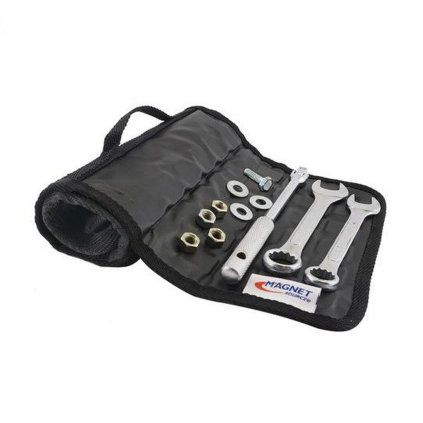
Magnetic tool holder M
Flexible magnetic mat for holding tools, screws, nuts and other ferromagnetic components during workshop work or repairs.
- Size stated in the product name approximately 46 × 16 cm
- Technical length on the product page 450 mm
- Width 160 mm
- Thickness 6 mm
- Weight approximately 700 g
- Can be rolled up
- Suitable for tools of different sizes
- Product code 10604
- Practical for a workbench, workshop trolley or steel surface
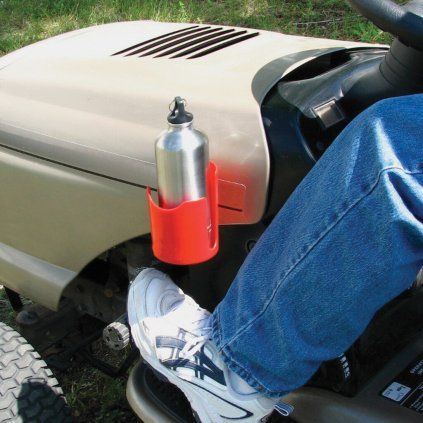
Magnetic cup holder – red
Drink holder designed to attach to a suitable ferromagnetic surface such as a steel workshop cabinet, shelf or workshop panel.
- Red finish
- Designed for a cup or suitable bottle
- Magnetic attachment to a steel surface
- Can be repositioned quickly
- Protective layer on the rear magnetic section
- Suitable for workshops, warehouses or garages
- Product code 10262
- Stability must be verified with the specific container and mounting surface
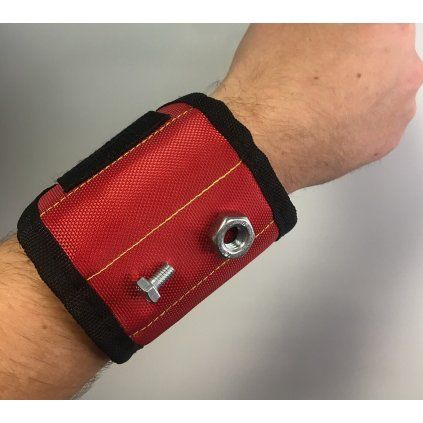
Magnetic wrist holder – red
Work wristband for holding screws, bolts, nails, nuts and other small ferromagnetic components.
- Red finish
- Magnetic areas for small fasteners
- Hook-and-loop fastening
- Adjustable to fit the wrist
- Suitable when working on a ladder or overhead
- Keeps screws and bolts within easy reach
- Product code 30024
- Not intended for heavy or sharp tools
Verify actual performance before regular use
The result depends on the material of the object, mounting surface, contact area, weight and direction of the load. Do not use a magnetic holder at the limit of its stability or where falling could cause injury or damage.
Frequently asked questions about magnetic holders
What is a magnetic holder?
It is a tool that uses a permanent magnet either to attach the holder to a steel surface or to hold ferromagnetic objects.
Which surfaces will a magnetic holder stick to?
Suitable ferromagnetic steel. It will not stick directly to wood, glass, plastic, aluminium or an ordinary wall.
Will a magnet stick to every metal?
No. Aluminium, copper, brass and many other metals are not ferromagnetic.
Will a magnetic holder stick to stainless steel?
It depends on the specific grade. Some stainless steels are magnetic while others are not.
How can I tell whether a surface is suitable?
Place an ordinary magnet against it. Test exactly where the holder will be installed.
Can the holder be used on wood?
Only if it has an adhesive, screw-mounted or other fixing base. A magnet alone will not stick to wood.
Can it be used on glass?
Only with an adhesive base or a special steel counterpart. A magnet is not attracted to glass.
Why does the holder slide down a vertical surface?
A magnet resists shear force less effectively than direct pull-off. Thin sheet metal, paint, dirt or excessive load may also be responsible.
Why does the holder hold weakly on thin sheet metal?
Thin sheet may not close the magnetic circuit effectively and can also flex.
Will a stronger magnet help?
It can, but only if the mounting surface is suitable and the holder construction matches the load. A stronger magnet will not solve a non-magnetic surface.
Can paper or foil be placed underneath the holder?
Yes, but every additional gap reduces magnetic force. Thick foil may cause the holder to slide.
Can a magnetic holder scratch the surface?
Yes, if a metal shaving or other hard contaminant is trapped on its back. Clean both surfaces before attaching it.
How should a magnetic holder be moved?
Tilt it away from one edge before lifting it. Do not slide it across sensitive paintwork.
Will a magnetic mat hold every tool?
No. The tool must contain a ferromagnetic component and must not be too heavy or bulky.
Will bits and drill bits stick to a magnetic mat?
Ordinary steel bits and drill bits usually will. Non-magnetic alloys may not.
Can a magnetic mat with tools be hung vertically?
Only if the product is suitable for this use and a practical test confirms sufficient stability.
Can a flexible holder be rolled up?
The recommended M model can be rolled up. Do not fold it sharply over an edge.
How do you remove metal shavings from a magnetic mat?
Move them towards the edge using a plastic or other non-magnetic scraper. Wear gloves.
What is a magnetic wrist holder used for?
For keeping small screws, bolts, nails, nuts and bits directly on your wrist.
How is the wrist holder fastened?
The recommended red model uses a hook-and-loop fastening.
Does the wristband need to be tight?
It must stay securely in place but must not restrict circulation, sensation or hand movement.
Can a drill bit be attached to the wrist holder?
This is not recommended. A sharp or long object may injure your hand or catch on tools.
Can stainless-steel screws be attached to the holder?
Some stainless-steel screws may hold weakly or not at all. It depends on the specific alloy.
Is the wrist holder suitable when working on a ladder?
Yes, it helps keep small fasteners within reach. However, it must not replace safe storage of tools.
Can it be used while welding?
Keep it away from the immediate welding area. Metal parts can become hot and the magnet may attract weld spatter.
Is a magnetic cup holder suitable for a refrigerator?
Yes, on a suitable steel section. First verify the holding force and stability with the specific cup.
Can a drink holder be used on a plastic dashboard?
Not directly using the magnet. Plastic is not ferromagnetic.
Is it suitable for hot coffee?
Only after thoroughly verifying stability. A falling hot drink can cause scalding.
What type of bottle can be placed inside the holder?
Only a container that fits securely and does not create excessive leverage.
What if the holder tilts with a full cup?
Do not use it. Choose a lighter container, stronger mounting surface or another attachment method.
How does a magnetic cable organiser work?
The base strip may be bonded to a desk and the individual clips then attach to it magnetically.
Will a cable organiser stick to wood?
The adhesive base will, provided that the surface is smooth, clean and degreased.
Can an adhesive strip be repositioned?
Once removed, the original adhesive layer may no longer hold reliably.
Why did the adhesive holder come loose?
The surface may have been greasy, dusty, rough or damp. Excessive loading may also be the cause.
Will a magnetic strip hold every kitchen knife?
No. The knife must be made from sufficiently magnetic steel.
Is a magnetic knife strip safe?
Yes, provided that it is installed correctly, the knives hold securely and the strip is out of reach of children.
How do you remove a knife from the strip?
Hold the handle and carefully tilt the blade away. Do not drag the cutting edge uncontrollably across the strip.
Can magnets blunt a knife?
The magnetic field does not blunt the edge. Mechanical damage may occur if the blade strikes or is dragged across a hard surface.
Can a magnet damage a phone?
An ordinary holder may affect the compass and certain sensors. A metal plate may also interfere with wireless charging.
Where should a phone holder not be positioned inside a car?
In the driver's field of view, in the deployment path of an airbag or where it obstructs vehicle controls.
Can the phone fall off while driving?
Yes, if the magnet is weak, the phone is heavy, the surface is uneven or the vehicle hits a major bump. Test stability before driving.
Can magnetic holders damage payment cards?
A strong magnetic field can damage a traditional magnetic stripe. Keep cards separate from magnets.
Are magnetic holders dangerous for pacemakers?
Strong magnets may affect certain medical implants. Follow the instructions provided by their manufacturer.
Are magnetic holders suitable for children?
They are not toys. Keep small magnets and metal components out of reach of young children.
What should you do with a damaged holder?
If the magnet has become loose or cracked, or if a seam or mounting component is damaged, stop using the product.
Can a magnetic holder be repaired with adhesive?
A lightweight decorative holder may sometimes be repairable with suitable adhesive, but for a holder carrying tools, a knife or a hot drink, replacement is safer.
Can a magnet become weaker over time?
Under normal use it is generally stable. High temperatures, strong opposing magnetic fields or mechanical damage may weaken it.
Can a magnetic holder be used outdoors?
Only if the specific product is designed for outdoor use. Moisture may damage the magnet, textile, adhesive or metal components.
How should you choose a holder for heavy tools?
Choose a rigid screw-mounted holder with sufficient load capacity. A flexible mat is not automatically suitable for hanging heavy tools.
Is magnetic or mechanical mounting better?
Magnetic mounting is faster and easier to reposition. Mechanical fixing is more suitable for high, long-term or safety-critical loads.
Summary
Magnetic holders help organise tools, cables, knives, drinks, phones and small fasteners. They allow quick attachment and repositioning without drilling whenever a suitable steel surface is available.
Not all holders attach to the surface magnetically. A cable organiser may have an adhesive base while only the individual clips use magnetic attachment.
Before purchasing, check the mounting surface material, installation method, holder orientation and weight of the stored items. Actual holding force is affected by sheet thickness, contact area, paint, contamination and vibration.
Do not use magnetic holders as the only safety element above people or for objects whose fall could cause serious injury. Always verify stability in practice first.
Looking for a practical magnetic holder?
Choose a holder for tools, your wrist, drinks, cables, knives or a mobile phone according to the mounting surface and intended use.