
11 ways to attach a magnet
How to mount a magnet: 11 ways to glue, screw and install it
A magnet can be mounted in several ways – by attaching it directly to steel, gluing it, screwing it in place, inserting it into a prepared hole or using a magnetic holder. The correct method depends on the type of magnet, the material of the mounting surface, the load, the environment and whether the connection needs to be permanent or removable.
- Find out which materials a magnet will hold on without any additional mounting.
- Learn how to create a magnetic surface on wood, plastic or a wall.
- Understand the difference between a magnet, a steel counterpart and a magnetic holder.
- Learn how to glue, screw or insert a magnet correctly.
- Discover the risk of cracking a neodymium magnet during installation.
- See solutions for furniture, textiles, decorations and technical structures.
- Find answers to the most common questions about mounting magnets.
Magnets are used in furniture catches, holders, cases, decorations, machine fixtures, textile products and electronics. However, the magnet itself often needs to be securely connected to a supporting structure.
Neodymium magnets are extremely strong, but they are also hard and brittle. Incorrect pressure, impact or excessive tightening of a screw can chip the surface coating or crack the entire magnet.
What is the best way to mount a magnet?
There is no single method suitable for every application. First, you need to determine what material the mounting surface is made from, how the magnet will be loaded and whether the connection should be removable later.
Quick selection by situation
- You have a steel surface: place the magnet directly on it.
- The surface is not magnetic: attach a steel counterpart or a self-adhesive metal strip.
- You need permanent hidden mounting: glue the magnet into a prepared hole.
- You need secure mechanical mounting: use a magnet with a hole or a magnetic holder.
- You do not want to drill: use a suitable adhesive or a self-adhesive magnet.
- You are working with textiles: choose a sew-in magnet in a protective PVC cover.
- You are making a furniture catch: use a magnetic attachment set or a ready-made furniture magnet.
1. Attaching a magnet directly to a steel surface
The quickest option is to place the magnet directly onto a ferromagnetic surface. No adhesive, drilling or additional mounting components are required, and the magnet can be repositioned at any time.
It holds best on clean, smooth, flat and sufficiently thick steel. Holding force is reduced by paint, coatings, plastic, rubber, rust, unevenness or an air gap.
Which materials will a magnet hold on?
- iron,
- ordinary carbon steel,
- some magnetic grades of stainless steel,
- steel sheets, profiles and structures,
- metal cabinets and shelving,
- magnetic boards,
- some refrigerator doors and household appliances,
- steel door frames, beams and supports,
- suitable parts of a vehicle body.
Which materials will a magnet normally not hold on?
- aluminium,
- copper and brass,
- glass,
- wood,
- plastic,
- plaster,
- some non-magnetic grades of stainless steel.
The term “metal” therefore does not automatically mean that a material is magnetic. It is best to test the surface in advance with a small magnet.
Can a magnet join two metal objects?
Yes. You can place a magnet between two suitable steel parts and use it as a removable connection. The resulting force depends on the shape of the magnet, contact area, steel thickness and any gap between the parts.
2. Attaching a magnet to a self-adhesive steel strip
If the surface is not magnetic, you can attach a self-adhesive steel strip to it. The magnet then holds onto the metal side of the strip.
The strip is not itself a magnet. It acts as a ferromagnetic counterpart to which neodymium, office and other magnets can attach.
For slightly uneven surfaces, a self-adhesive metal strip with a foam adhesive layer is suitable. The foam helps compensate for small irregularities between the surface and the strip.
Where can a self-adhesive steel strip be used?
- on a wall in an office or children's room,
- on a wooden cabinet,
- on a plastic cover,
- on doors,
- on furniture,
- on an exhibition panel,
- for attaching photographs, notes and drawings.
Watch out for sharp edges
The metal strip can be cut with scissors, but the cut edges may be sharp. Wear work gloves when trimming it and deburr or cover the edges as necessary.
3. Attaching a magnet to a screwed-on steel counterpart
A steel disc, washer or plate can be screwed onto a non-magnetic surface. The magnet then holds onto the steel counterpart without the magnet itself needing to be glued or drilled.
The counterpart can be, for example:
- a steel disc,
- a steel washer,
- a small steel plate,
- a washer with a hole for a countersunk screw,
- a steel component supplied in an attachment set.
This method creates a secure but removable connection. It is suitable for furniture doors, covers, frames, decorations or removable panels.
Why use an attachment set?
A magnetic attachment set contains a compatible magnet, steel counterpart and mounting screws. You do not need to find a counterpart with the correct diameter and hole separately.
4. Inserting a magnet into a prepared hole
A magnet can be inserted into a pre-drilled or milled hole in wood, plastic or another material. The result is a clean and almost invisible installation.
This method is used, for example, when making:
- magnetic knife holders,
- furniture catches,
- wooden boxes,
- models and decorations,
- removable covers,
- technical fixtures.
Should the magnet fit tightly in the hole?
The hole should match the dimensions of the magnet, but it should not be so tight that the magnet needs to be hammered or forcefully pressed into place. A neodymium magnet could crack or chip under pressure.
It is better to leave a small installation clearance and secure the magnet with a thin layer of suitable adhesive.
How deep should the hole be?
The magnet can be flush with the surface or slightly recessed. If a layer of wood, plastic or adhesive remains between the magnet and the steel counterpart, the holding force will be reduced.
5. Creating a magnetic wall using magnetic paint
Magnetic paint contains small ferromagnetic particles. After several coats are applied, it creates a surface to which suitable magnets can attach.
The paint can be used, for example, on:
- walls in children's rooms,
- office noticeboards,
- display areas,
- parts of a kitchen,
- school and creative areas.
Once dry, the magnetic layer can be painted over with ordinary interior paint. The resulting holding force depends on the quantity of ferromagnetic particles, the number of coats, the thickness of the top coat and the strength of the magnets used.
Magnetic paint is not a magnet
The coating itself does not create a magnetic field. It contains iron particles that act as a counterpart for a magnet. For good results, use stronger neodymium magnets and follow the paint manufacturer's instructions.
6. Screwing in a magnet with a hole
For mechanical mounting, neodymium magnets are manufactured with cylindrical or countersunk holes. The hole is created during production, so there is no need to drill the finished magnet.
Magnets with holes are used, for example, for:
- mounting furniture components,
- removable panels and covers,
- holders and fixtures,
- exhibition structures,
- wooden and plastic products,
- technical equipment.
How do you screw a magnet in correctly?
- Use a screw that matches the shape and size of the hole.
- The mounting surface must be flat and free from dirt.
- Tighten the screw slowly and evenly.
- Do not apply side pressure to the edge of the hole.
- Do not tighten the magnet with the same force as an ordinary metal washer.
Magnets are brittle
For small neodymium magnets and attachment sets, a maximum tightening torque of approximately 2 Nm is often recommended. Always follow the value specified for the particular product.
7. Gluing a magnet
A magnet can be glued to wood, plastic, metal, ceramics or another material. However, the result depends on correct surface preparation and choosing a suitable adhesive.
Which adhesive should you use for a magnet?
A construction adhesive, epoxy adhesive or a special adhesive designed for magnets may be suitable. The adhesive must be compatible with both the magnet's surface coating and the material of the mounting surface.
The following are also important when making your selection:
- operating temperature,
- humidity,
- vibration and impacts,
- flexibility of the bond,
- curing time,
- the way the magnet is loaded.
How do you glue a magnet correctly?
- Clean both the magnet surface and the mounting surface.
- Remove grease using a suitable degreasing agent.
- Allow both surfaces to dry completely.
- Apply an even layer of adhesive.
- Press the magnet into place and secure it against movement.
- Observe the curing time specified by the adhesive manufacturer.
- Do not load the joint until the adhesive has fully cured.
Should the magnet surface be sanded before gluing?
Coarse sanding is not recommended. It could damage the protective nickel, zinc or other surface coating and increase the risk of corrosion.
If the adhesive manufacturer recommends light roughening, proceed very carefully and first verify that it is suitable for the specific surface coating of the magnet.
8. Mechanical mounting using a magnetic holder
A magnetic holder contains a permanent magnet mounted inside a steel housing. The housing protects the magnet and concentrates the magnetic field on the working side.
Magnetic holders may have:
- a hole for a countersunk screw,
- an internal thread,
- an external thread or threaded stud,
- a hook or eye,
- a cylindrical housing,
- protective rubber coating.
When is a holder more suitable than a separate magnet?
A holder is suitable when you need easier mechanical installation, protection for the magnet or a threaded connection to a structural component.
However, bear in mind that a standard holder primarily works from its open working side. The rear side covered by the steel housing has a significantly weaker effect.
9. Furniture and door magnets in housings
Door and furniture magnets are ready for direct installation. The magnetic component is usually housed in a plastic or metal casing with holes for screws.
They are used, for example, for:
- kitchen and bathroom cabinet doors,
- cabinets and chests of drawers,
- inspection covers,
- sliding or folding doors,
- light technical covers,
- removable furniture panels.
The advantage is easy installation without drilling or machining the magnet itself. A suitable steel counterpart is usually included.
10. Sewing a magnet into fabric
Sew-in magnets are designed for curtains, bags, pockets, covers and other textile products. The magnet is enclosed in a flexible plastic or PVC cover that can be sewn to the fabric.
Where can a sew-in magnet be used?
- in handbags and bags,
- in fabric pockets,
- on curtains and hanging decorations,
- in protective covers,
- in home accessories,
- in costumes and stage decorations,
- for removable textile components.
How do you sew in a magnet?
Sew around the edge of the PVC cover, not through the magnet itself. The cover must remain undamaged and the magnet should be secured against movement inside the textile product.
Take care when using a sewing machine
A strong magnet can attract metal parts of the sewing machine, needles, pins and scissors. Keep the magnet under control while working and prevent it from snapping suddenly towards the machine mechanism.
11. Self-adhesive magnets
Self-adhesive magnets have a prepared adhesive layer with a protective film on one side. They are suitable for quick installation without separate adhesive and without drilling.
They are available as:
- cylindrical magnets,
- block magnets,
- self-adhesive magnetic strips,
- self-adhesive magnetic foil,
- N/S paired sets in which two magnets attract each other.
How do you attach a self-adhesive magnet correctly?
- Check that the mounting surface is smooth and flat.
- Clean and thoroughly degrease the surface.
- Allow the surface to dry.
- Remove the protective film without touching the adhesive layer.
- Position the magnet accurately and press it down firmly.
- Do not load the bond for several hours after installation.
The adhesive layer will hold significantly less effectively on rough, dusty, greasy or damp surfaces.
Is a self-adhesive magnet suitable for high temperatures?
Standard self-adhesive neodymium magnets are often designed for temperatures of approximately up to 80 °C. However, the adhesive used may reduce the operating limit. Self-adhesive designs are therefore not suitable for permanently hot or humid environments unless the manufacturer explicitly states otherwise.
Which mounting method should you choose?
Recommendations by application
- Photographs and notes on a wall: self-adhesive steel strip.
- Furniture doors: magnetic attachment set or furniture magnet.
- Hidden joint in wood: magnet glued into a milled hole.
- Removable technical cover: magnet with a hole or magnetic holder.
- Lightweight object without drilling: self-adhesive magnet.
- Textile product: sew-in magnet in a PVC cover.
- Magnetic wall: magnetic paint, steel foil or magnetic board.
- Humid or outdoor environment: protected magnetic system designed for the relevant environment.
- Safety-critical connection: mechanical mounting with separate secondary retention.
What affects the strength of a magnetic connection?
The resulting force does not depend solely on the magnet itself. The conditions in which the magnet is used have a major influence.
- material and thickness of the steel counterpart,
- flatness and cleanliness of the contact surface,
- size of the air gap,
- paint, adhesive, rubber or plastic between the magnet and steel,
- load direction,
- sideways sliding,
- vibration and impacts,
- operating temperature,
- humidity and corrosion,
- quality of the glued or screwed connection.
Breakaway force is not automatically the load capacity
The stated breakaway force generally refers to pulling the magnet perpendicular to a clean and sufficiently thick steel plate. On a vertical surface, a loaded magnet may slide at a significantly lower force.
Safety when mounting magnets
What should you watch out for?
- Do not drill, cut or grind neodymium magnets with ordinary tools.
- Tighten magnets with holes only with appropriate force.
- Do not allow strong magnets to collide with each other.
- Protect your fingers from being pinched during handling.
- Wear work gloves and safety glasses when handling larger magnets.
- Keep small magnets out of reach of children.
- Maintain a safe distance from devices sensitive to magnetic fields.
- Use mechanical secondary retention for heavy objects or objects mounted in hazardous positions.
- Do not load a glued joint before the adhesive has fully cured.
- Do not use a damaged or corroded magnet in an important assembly.
Recommended products
The selected products represent three different mounting methods: creating a magnetic surface on a non-magnetic substrate, making a complete removable screw-mounted connection and attaching a magnet to textiles.

Self-adhesive metal strip 35 × 1.15 mm
A white steel strip with a foam self-adhesive layer creates a surface on wood, plastic or walls to which neodymium and other magnets can attach.
- Length 1 m
- Width 35 mm
- Total thickness 1.15 mm
- Foam adhesive layer 1 mm thick
- Weight approximately 75 g
- Can be cut with scissors
- Suitable for smooth and slightly uneven surfaces
- This is a metal counterpart, not a magnetic strip

Magnetic attachment set, dia. 18 mm
Complete set for creating a secure and removable magnetic connection. It contains a neodymium magnet, a steel counterpart and two stainless-steel screws.
- Magnet diameter 18 mm
- Magnet height 4 mm
- Steel counterpart with hole
- 2 stainless-steel screws 4 × 35 mm
- Breakaway force in tension approximately 22 N
- Breakaway force in shear approximately 4.8 N
- Temperature resistance up to 80 °C
- Maximum recommended tightening torque 2 Nm
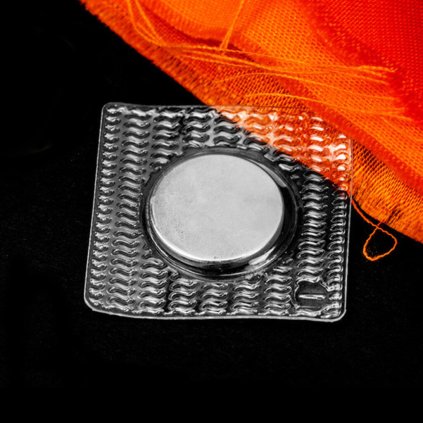
Sew-in NdFeB magnet, dia. 18 × 2 mm
Powerful neodymium magnet in a flexible square PVC cover for sewing onto fabric, curtains, bags, covers or other textile components.
- Magnet diameter 18 mm
- Magnet height 2 mm
- PVC cover dimensions 35 × 35 mm
- Breakaway force approximately 19 N
- Breakaway force approximately 1.9 kg
- Weight approximately 4 g
- NdFeB neodymium magnet
- Zinc-plated magnet surface
Breakaway force is indicative
The stated values correspond to measurements or calculations under specified conditions. The actual force is affected by the surface, gap, counterpart, load direction and mounting method. Always test the final connection directly in the specific application.
Frequently asked questions about mounting magnets
What surfaces will a magnet hold on?
A magnet holds primarily on iron and suitable magnetic steel. It will not hold on aluminium, copper, brass, wood, plastic or glass without a steel counterpart.
Will a magnet hold on stainless steel?
It depends on the particular grade of stainless steel. Some stainless steels are magnetic, while others are only weakly magnetic or not magnetic at all. The surface should therefore be tested in advance.
How do you attach a magnet to wood?
You can glue the magnet into a prepared hole, screw in a version with a hole, or attach a steel counterpart to the wood for the magnet to hold onto.
How do you attach a magnet to plastic?
Suitable methods include gluing, using a self-adhesive magnet or mechanically inserting the magnet into a prepared housing. Another option is to attach a steel strip or counterpart to the plastic.
How do you attach a magnet to a wall?
You can attach a steel strip or magnetic board to the wall, or use magnetic paint. A magnet will not hold directly on ordinary plaster.
Can a magnet be glued with superglue?
It may work in some small applications, but a brittle bond may not tolerate impacts, temperature changes or different rates of thermal expansion between materials. A construction or epoxy adhesive designed for the relevant materials is often more suitable.
What should you use to degrease a magnet before gluing?
Use a product suitable for both the magnet's surface coating and the mounting surface. Do not use an aggressive chemical without checking compatibility, as it could damage the coating or the material being bonded.
How long should the adhesive be left to cure?
Follow the adhesive manufacturer's instructions. Some adhesives reach handling strength quickly but do not achieve full strength until several hours or days later.
Can I drill a hole into a neodymium magnet?
Do not normally drill a finished neodymium magnet. It is brittle, can crack, heat up and lose its protective surface coating. Choose a magnet with a factory-made hole instead.
How tightly should a magnet with a countersunk hole be screwed down?
Tighten the magnet only lightly. For some small products, a maximum torque of approximately 2 Nm is recommended, but always check the value specified for the particular product.
Why did the magnet crack when it was screwed in?
The likely cause is excessive tightening, an uneven mounting surface, an incorrect screw shape or side pressure on the hole. A neodymium magnet is not flexible like a steel washer.
How can you prevent a magnet from sliding down a wall?
Use a larger contact area, a rubber-coated magnetic holder or a mechanical stop. On a vertical surface, friction is just as important as breakaway force.
Is it better to glue or screw a magnet in place?
Gluing is suitable for hidden mounting and places where you do not want to drill. Screwing creates a removable connection and often withstands long-term loading better. Mechanical mounting is preferable for higher-risk applications.
How do you attach a magnet without drilling?
Use a self-adhesive magnet, construction adhesive, a self-adhesive steel strip or direct attachment to a steel surface.
How do you attach a magnet to fabric?
The safest option is a sew-in magnet in a PVC cover. The cover is sewn around its perimeter and protects the fabric from direct contact with the edges of the magnet.
Can a magnet be sewn directly into fabric without a cover?
A hard magnet on its own may damage the fabric, shift around or corrode when exposed to moisture. A magnet enclosed in a sew-in cover is more suitable.
How do you create a magnetic connection between two wooden parts?
Insert a magnet into one part and a steel counterpart into the other. You can also use a pair of magnets, but you must check the correct pole orientation before installation.
Why do two inserted magnets repel each other?
The magnets are facing each other with like poles. Always test their orientation before gluing them in place and mark the working sides.
Can a magnet damage a painted surface?
Yes, especially if dust, sand or metal filings are trapped between the magnet and the surface. Use a rubber-coated holder or a protective layer on sensitive surfaces.
Is a self-adhesive magnet suitable for outdoor use?
Standard self-adhesive magnets are not designed for permanent humidity or outdoor conditions. Water can damage the magnet and reduce the adhesion of the adhesive layer.
Can a glued magnet be the only safety restraint?
If an object coming loose could cause injury or significant damage, also use mechanical secondary retention. Adhesive or a standard magnetic connection should not be the only safety element.
Summary
A magnet can be mounted by attaching it directly to steel, using a steel counterpart, adhesive, a self-adhesive layer, a screw, a magnetic holder or a sew-in cover.
For non-magnetic surfaces, you can add a steel strip, washer, board or coating containing ferromagnetic particles. For a secure removable connection, a magnetic attachment set or magnetic holder is suitable.
Neodymium magnets are strong but brittle. Do not expose them to impacts, side pressure or excessive tightening during installation. Always test glued, screwed and self-adhesive connections under real conditions and add mechanical secondary retention in hazardous applications.
Looking for the right magnet or mounting method?
Choose from neodymium magnets, attachment sets, magnetic holders, self-adhesive strips and sew-in magnets for household, craft and technical applications.