
Which Metals Are Magnetic? Ferromagnetism Explained
Ferromagnetic materials: which metals do magnets attract?
An ordinary magnet strongly attracts mainly iron, nickel, cobalt and many types of steel. Aluminium responds only very weakly, while copper, silver, gold and lead show practically no attraction to an ordinary magnet.
- Iron, nickel and cobalt are ferromagnetic.
- Aluminium is weakly paramagnetic.
- Copper, gold, silver and lead are diamagnetic.
- The magnetic response of steel depends on its composition and structure.
- Neodymium magnets are among the strongest permanent magnets.
What is ferromagnetism?
Ferromagnetism is a property of materials that respond strongly to an external magnetic field and can themselves become magnetised.
Inside a ferromagnetic material are regions called magnetic domains. Within each domain, the atoms’ magnetic moments are aligned predominantly in the same direction.
In an unmagnetised object, individual domains may point in different directions. When a magnet approaches, their arrangement changes and the material begins to show a strong magnetic response.
Common ferromagnetic materials include:
- iron,
- nickel,
- cobalt,
- most ordinary carbon steels,
- cast iron,
- some types of stainless steel,
- some rare-earth alloys and compounds.
Quick overview of magnetic metals
- Iron: strongly magnetic.
- Nickel: ferromagnetic.
- Cobalt: ferromagnetic.
- Ordinary steel: usually strongly magnetic.
- Aluminium: only very weakly paramagnetic.
- Copper, gold, silver and lead: an ordinary magnet barely attracts them.
Is steel always magnetic?
Steel is an alloy of iron and other elements. Most ordinary structural and carbon steels are magnetic, but some stainless steels respond only weakly or not at all.
- Ferritic stainless steel: usually magnetic.
- Martensitic stainless steel: usually magnetic.
- Austenitic stainless steel: often non-magnetic or only weakly magnetic.
A magnetic test alone therefore cannot identify the precise type of steel or its chemical composition.
Is aluminium magnetic?
Aluminium is paramagnetic. A sufficiently strong magnetic field attracts it very weakly, but this response is practically undetectable with an ordinary permanent magnet.
If a magnet sticks strongly to an aluminium product, it probably contains:
- a steel screw,
- iron reinforcement,
- a steel core,
- another ferromagnetic component.
Are copper, gold, silver or lead magnetic?
These pure metals are diamagnetic. In an external magnetic field, they produce a very weak magnetic response in the opposite direction.
In everyday practice, this means:
- a magnet will not lift copper,
- a magnet does not attract pure gold,
- a magnet does not attract pure silver,
- lead does not stick to an ordinary magnet.
However, jewellery or coins may contain nickel, iron, a steel core or another magnetic constituent. A magnetic test is therefore not proof of a metal’s authenticity or purity.
Is chromium magnetic?
The magnetic behaviour of pure chromium is more complex. At ordinary room temperature, it is not ferromagnetic and an ordinary magnet does not attract it strongly.
However, a chrome-plated component often responds to a magnet because the thin chromium layer is applied to ferromagnetic steel.
What is paramagnetism?
Paramagnetic materials are weakly attracted by an external magnetic field. Once the field is removed, they do not normally retain significant magnetisation.
Examples of paramagnetic substances include:
- aluminium,
- magnesium,
- platinum,
- oxygen,
- some transition-metal compounds.
What is diamagnetism?
A diamagnetic material develops weak magnetisation in the opposite direction to an applied magnetic field. It is therefore very weakly pushed out of regions with a stronger field.
Examples of diamagnetic substances include:
- copper,
- gold,
- silver,
- lead,
- zinc,
- bismuth,
- water,
- glass.
For most of these materials, the repulsion is so weak that you cannot observe it with an ordinary magnet.
What is the Curie temperature?
Every ferromagnetic material has a characteristic threshold called the Curie temperature. Above it, the long-range ordering of magnetic moments breaks down and the material becomes paramagnetic.
However, a permanent magnet can begin to lose performance irreversibly at a much lower maximum operating temperature.
Do not heat or break magnets
Heating, sudden impacts or a strong opposing magnetic field can weaken or damage a magnet. Both neodymium and ferrite magnets are brittle and may crack on impact.
Which permanent magnet is strongest?
NdFeB neodymium magnets offer the highest performance among commonly available permanent magnets at a comparable volume.
Their advantages include:
- high strength in small sizes,
- a wide choice of shapes,
- suitability for holders, closures and sensors,
- self-adhesive or screw-mounted options.
Ferrite magnets are weaker but resist corrosion and higher temperatures well. They suit less demanding or cost-sensitive applications.
How can you test a material easily?
- Use a magnet of known strength.
- Clean the magnet and the surface being tested.
- Bring the magnet closer slowly.
- Test at several points.
- Compare the result with a known piece of steel.
Strong attraction indicates the presence of ferromagnetic material. A weak or absent response does not, however, precisely identify the object’s chemical composition.
Recommended magnets
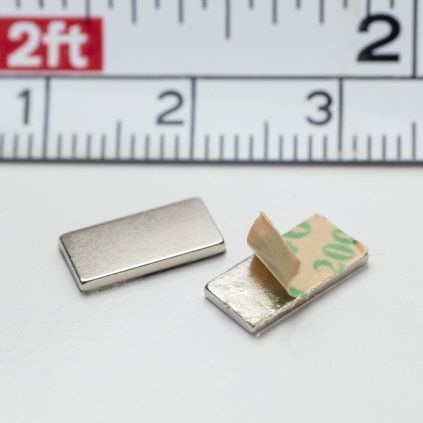
Self-adhesive neodymium magnets 10 × 5 × 1 mm
A set of two oppositely oriented magnets for making a magnetic closure for a box, lightweight cover or decoration.
- Dimensions of one magnet 10 × 5 × 1 mm
- Set contains 2 pieces
- Opposite N/S magnetisation directions
- Pull force of one magnet 5.5 N
- Set weight 0.76 g
- Magnetic grade N35
- 3M 467 MP self-adhesive layer
- Nickel-plated surface
- Temperature resistance up to 80 °C
- Product code 20321.S
Tip: bond the magnets only to a smooth, clean, dry and grease-free surface.
View product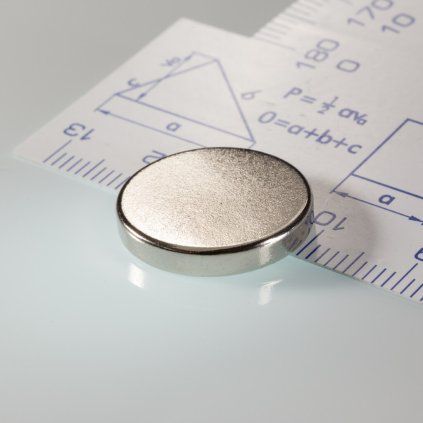
Neodymium cylinder magnet 18 × 3 mm
A flat neodymium magnet with a larger contact area for holders, closures and technical projects.
- Diameter 18 mm
- Height 3 mm
- Pull force 38.2 N
- Approximate pull force 3.82 kg
- Weight 5.73 g
- Magnetic grade N35
- Magnetised parallel to the axis
- Nickel-plated surface
- Temperature resistance up to 80 °C
- Product code 20405
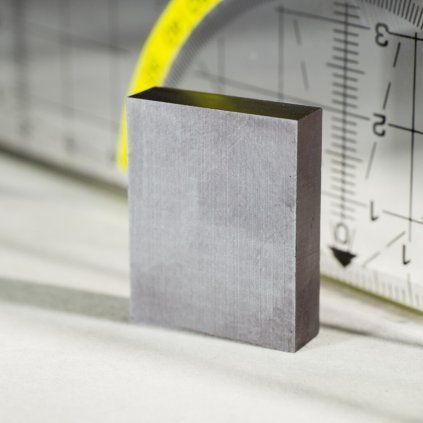
Ferrite block magnet 25 × 20 × 6 mm
A durable ferrite magnet for simple holders, classroom demonstrations and less demanding technical applications.
- Dimensions 25 × 20 × 6 mm
- Pull force 12 N
- Approximate pull force 1.2 kg
- Weight 14.75 g
- MF35 anisotropic ferrite
- Temperature resistance up to 200 °C
- Product code 10341
Frequently asked questions
Is copper magnetic?
Pure copper is diamagnetic and shows practically no attraction to an ordinary magnet.
Are gold or silver magnetic?
Pure gold and silver are diamagnetic. A magnetic response from jewellery may indicate another alloy or a steel component.
Is aluminium magnetic?
It is weakly paramagnetic, but an ordinary permanent magnet will generally neither lift nor hold it.
Is every steel magnetic?
No. Most ordinary steels are, but some austenitic stainless steels are non-magnetic or only weakly magnetic.
Is a neodymium magnet stronger than a ferrite magnet?
At similar dimensions, a neodymium magnet is usually much stronger. Ferrite, however, resists corrosion and higher temperatures better.
Summary
A magnet strongly attracts mainly iron, nickel, cobalt, cast iron and many types of steel. Aluminium is only weakly paramagnetic, while copper, gold, silver and lead are diamagnetic.
Neodymium magnets offer high strength in a small size. Ferrite magnets are weaker but affordable, corrosion-resistant and suitable for higher operating temperatures.
Choose a magnet by material and strength
Compare neodymium, ferrite, self-adhesive and other permanent magnets for home and technical use.