
How Magnets Are Made: Materials, Sintering and Magnetisation
How are permanent magnets made?
Magnet manufacturing usually involves material preparation, pressing or casting, heat treatment, precision finishing, surface protection and final magnetisation. The exact process depends on whether the magnet is neodymium, ferrite, samarium or AlNiCo.
- Neodymium and ferrite magnets are often made using powder metallurgy.
- Pressing is followed by sintering at high temperature.
- The blank is ground or cut to precise dimensions.
- Neodymium magnets need protection against corrosion.
- The product acquires its magnetic field during final magnetisation.
The basic magnet manufacturing process
There is no single process suitable for all permanent magnets. However, powder metallurgy is commonly used for sintered neodymium, samarium and ferrite magnets.
- Raw materials are prepared in the required proportions.
- The material is crushed and milled into a fine powder.
- The powder is placed in a mould and pressed.
- For anisotropic magnets, the particles are aligned by a magnetic field during pressing.
- The compact is sintered at high temperature.
- The blank is ground, cut or otherwise finished.
- Depending on the material, a protective coating is applied.
- The product is magnetised using a strong pulsed field.
- Dimensional and magnetic inspection follows.
How are neodymium magnets made?
NdFeB neodymium magnets are made from an alloy of neodymium, iron, boron and other additives that adjust their properties.
The basic process:
- raw materials are melted in a vacuum or protective atmosphere,
- the solidified alloy is milled into a very fine powder,
- particles are aligned in the required direction using a magnetic field,
- the powder is pressed and sintered,
- the blank is cut and ground to its final dimensions,
- the surface is protected with nickel, zinc or epoxy, for example,
- the magnet is finally magnetised.
Sintered neodymium material is very hard and also brittle. Precise dimensions are therefore achieved through diamond grinding, cutting or electrical discharge machining.
Why are neodymium magnets plated?
NdFeB alloy is sensitive to moisture and corrosion. A protective nickel, zinc or epoxy layer limits the access of water and air to the magnetic material.
How are ferrite magnets made?
Ferrite magnets are ceramic materials based on oxides of iron and other elements, such as strontium or barium.
Manufacture usually involves:
- mixing and heat-treating raw materials,
- milling into a fine powder,
- dry or wet pressing in a mould,
- sintering at high temperature,
- grinding functional surfaces,
- magnetisation and final inspection.
Anisotropic ferrite magnets are aligned in a magnetic field during manufacture to achieve higher performance in a specified direction.
How are AlNiCo magnets made?
AlNiCo magnets contain mainly iron, aluminium, nickel and cobalt. They can be made by casting into moulds or by powder metallurgy.
For cast versions, solidification is followed by:
- controlled heat treatment,
- cooling in a magnetic field for anisotropic grades,
- grinding important surfaces,
- assembly into a magnetic circuit where required,
- final magnetisation.
AlNiCo has very good temperature stability, but compared with neodymium it is more easily partially demagnetised by an unsuitable opposing field.
When does a magnet actually become magnetic?
After pressing, sintering and grinding, the product may not yet have a pronounced external magnetic field. It acquires this during magnetisation.
The magnet is placed in a coil or special fixture that uses a short, very strong magnetic pulse to align its magnetic domains in the required direction.
How is quality checked?
Depending on the product type, checks focus mainly on:
- length, width, height and dimensional tolerances,
- cracks, chips and edge condition,
- the thickness and integrity of the coating,
- magnetisation direction and pole positions,
- magnetic flux density,
- magnetic flux or magnetic moment,
- pull force under defined conditions.
Do not drill or cut finished magnets with ordinary tools
Sintered neodymium and ferrite magnets are hard and brittle. Drilling or grinding them at home may cause cracking, overheating and hazardous dust. If you need a hole, choose a magnet manufactured in the required shape.
Selected magnets
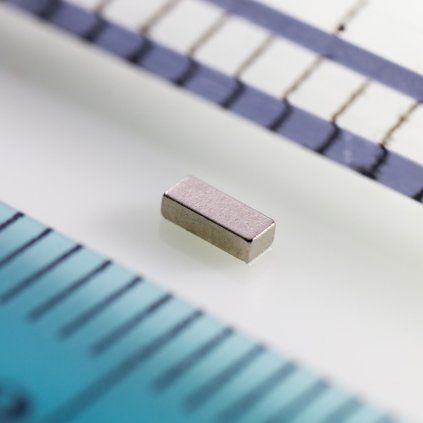
Neodymium block magnet 3 × 1.2 × 0.8 mm
A very small magnet for model making, miniature closures, electronics and precision technical assemblies.
- Dimensions 3 × 1.2 × 0.8 mm
- Pull force 0.8 N
- Weight 0.03 g
- Magnetic grade N35
- Magnetised perpendicular to the face
- Nickel-plated surface
- Temperature resistance up to 80 °C
- Product code 24058
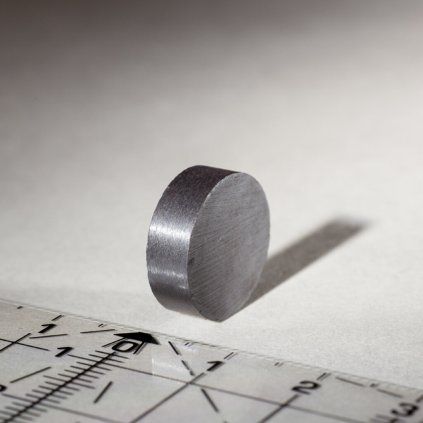
Ferrite cylinder magnet 15 × 5 mm
An affordable magnet for simple holders, classroom experiments and less demanding technical applications.
- Diameter 15 mm
- Height 5 mm
- Pull force 5.5 N
- Weight 4.4 g
- MF35 anisotropic ferrite
- Temperature resistance up to 200 °C
- Product code 10337
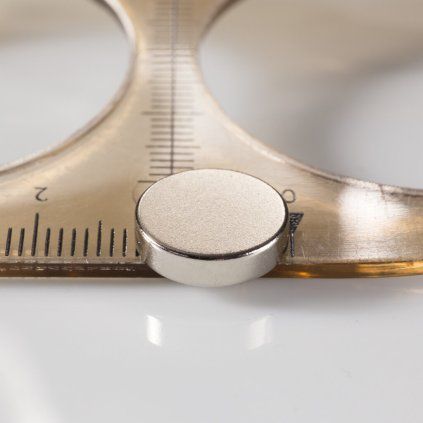
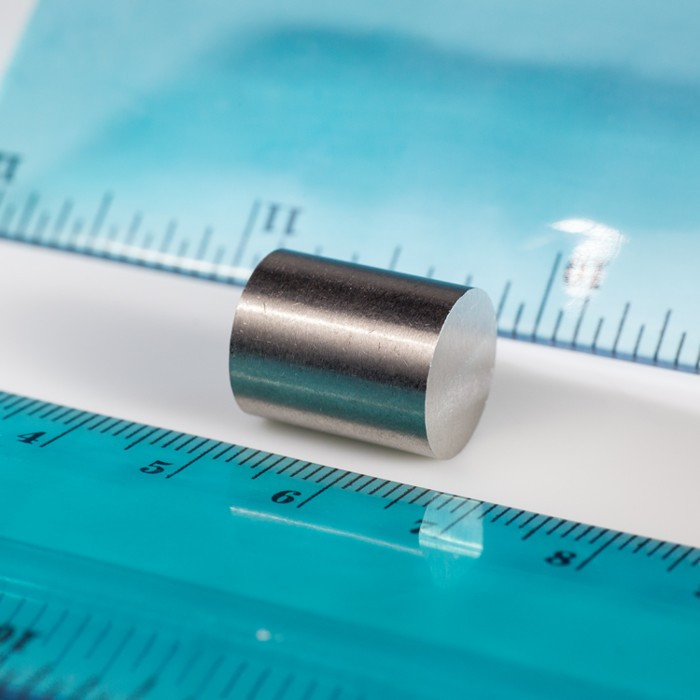
Neodymium cylinder magnet 12 × 3 mm
A compact permanent magnet for holders, closures, model making and small technical projects.
- Diameter 12 mm
- Height 3 mm
- Pull force 20.3 N
- Weight 2.65 g
- VMM4 neodymium material
- Magnetised parallel to the axis
- Nickel-plated surface
- Temperature resistance up to 80 °C
- Product code 20067
Frequently asked questions
Are magnets already magnetic after pressing?
Not necessarily. They usually acquire a pronounced external field only during final magnetisation.
Why are magnets sintered?
Sintering densifies the pressed powder and creates a solid magnetic material with the required structure.
Why are neodymium magnets nickel-plated?
The nickel layer protects the NdFeB material from moisture and corrosion.
Can a magnet be made in any shape?
Many shapes are technically possible, but complex holes and edges increase cost and the risk of damage.
How is a magnet’s strength checked?
By measuring magnetic field, flux or pull force under predefined conditions.
Summary
Sintered magnets are most often made by milling raw materials, pressing the fine powder and sintering at high temperature. Precision grinding, surface protection where needed and magnetisation follow.
Neodymium magnets offer high performance but need protection against corrosion. Ferrite magnets are ceramic, durable and affordable. AlNiCo is often cast and excels in temperature stability.
Choose a magnet by material and manufacturing method
Compare neodymium, ferrite, samarium and AlNiCo magnets by strength, dimensions and temperature resistance.