
Magnet Fishing Finds: Discoveries, Equipment and Safety
The most interesting magnet fishing finds
When magnet fishing, you never know in advance what is hidden at the bottom of a river, pond or well. Alongside ordinary screws and metal waste, you may come across a bicycle, tools, a safe, coins or an object of historical value.
- A magnet mainly picks up iron and steel objects.
- A double-sided model is practical for dragging along the bottom.
- A single-sided magnet is suitable for lowering vertically.
- Do not clean or dismantle weapons, ammunition or suspicious finds.
Magnet fishing combines searching for unexpected objects with removing metal waste from water. Every find may have its own story, although its true origin usually cannot be determined by appearance alone.
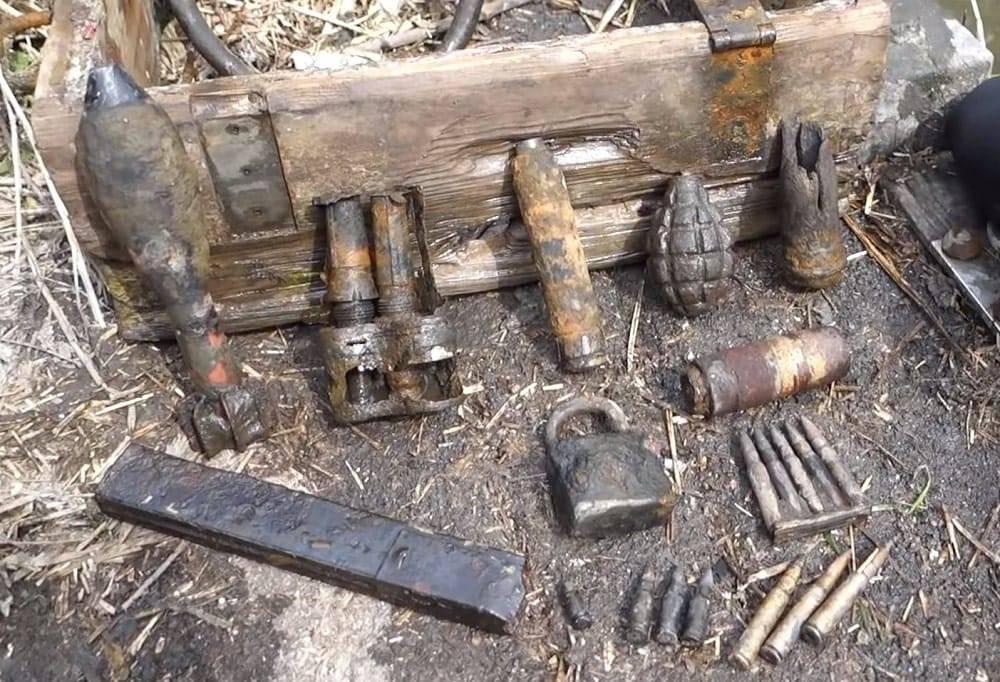
What can you find with a fishing magnet?
Ordinary metal waste
The most common finds include screws, nails, wire, sheet metal, parts of tools and other iron debris. Afterwards, take them to a suitable waste collection container rather than leaving them on the bank.
Bicycles and larger objects
Bicycles, shopping trolleys, road signs or machine parts may turn up in urban rivers and canals. The magnet alone is often not enough to retrieve them, and an additional strong rope or suitable hook may be needed.
Safes, keys and more valuable items
A safe, a bunch of keys or another unusual find may have an identifiable owner or be connected with a crime. Do not dismantle the object; contact the police.
Historical objects
Old coins, pieces of equipment, tools or other objects may have archaeological value. Do not clean the find with aggressive substances. Record the exact location and contact a museum or archaeological organisation.
What should you do if you find a weapon or ammunition?
- Stop handling the object.
- Do not try to clean it or detach it from the magnet.
- Do not take it home or to a police station.
- Keep other people away.
- Move to a safe distance and contact the police. In the Czech Republic, call 158.
Single-sided or double-sided magnet?
Single-sided fishing magnet
Its main active face is on the underside. It is particularly suitable for lowering vertically into a well, shaft or drain, or from a pier.
Double-sided fishing magnet
It has a magnetic face on both sides. When dragged along the bottom, it can catch an object regardless of which side turns downwards. A side eye makes it easier to guide along the bottom.
The strength stated in kilograms applies under ideal conditions
Rust, mud, paint, curved surfaces and contact with only a small part of the magnet can significantly reduce the actual holding force.
Examples of unusual finds
Safety when magnet fishing
- Wear sturdy gloves and closed-toe footwear.
- Never wrap the rope around your hand or body.
- A strong magnet can pinch fingers or damage a boat.
- Do not enter unfamiliar water to retrieve a stuck magnet.
- Do not use a car to pull the magnet out.
- Before fishing, check the rules set by the landowner and the manager of the body of water.
- After use, clean and dry the magnet and inspect its surface.
Recommended fishing magnets
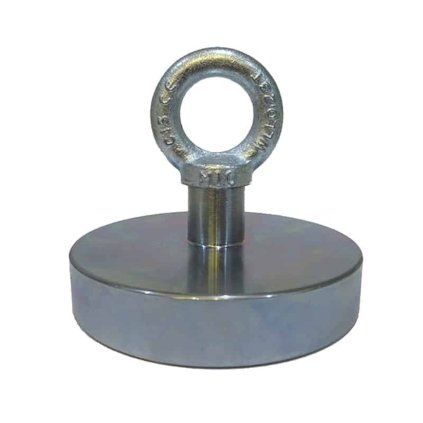
Fishing magnet 530 kg
A large single-sided magnet with an eye for lowering into wells, shafts and deeper places.
- Diameter 100 mm
- Weight 1.1 kg
- Rated strength 530 kg
- N38 neodymium magnet
- Nickel-plated surface
- Lifting eye for a rope
- Product code 10585
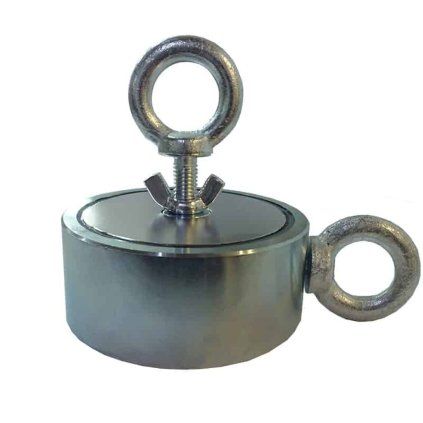
Double-sided fishing magnet 2× 500 kg
A double-sided model with an eye that can be fitted on the top or side.
- Diameter 100 mm
- Two active magnetic faces
- Rated strength 2× 500 kg
- N38 neodymium magnet
- The eye can be attached on the top or side
- A strong rope rated to at least 560 kg is recommended
- Product code 10587
Note: the product page lists different weights in the description and the specification table.
View product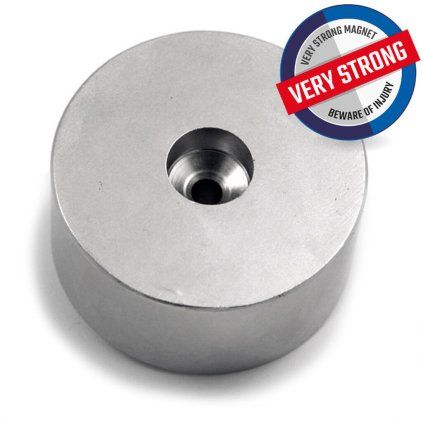
Neodymium magnet with a hole, 60 × 30 mm
A compact cylindrical magnet with a hole for attaching a strong rope.
- Diameter 60 mm
- Height 30 mm
- Weight 700 g
- Pull force 118 kg
- N45 neodymium magnet
- 6 mm through-hole
- Temperature resistance up to 80 °C
- Product code 28025
Important: clean and dry the magnet thoroughly after use. Damaged nickel plating can lead to corrosion.
View productFrequently asked questions
What is most commonly found when magnet fishing?
Screws, nails, wire, sheet metal and other ordinary iron waste.
Is a single-sided or double-sided magnet better?
A single-sided magnet is suitable for lowering vertically. A double-sided magnet is more useful for dragging along the bottom.
Can I keep a safe or bicycle I find?
The find may have an owner or be connected with a crime. Reporting it to the police is the safer option.
What should I do if I find old ammunition?
Do not handle it. Move away and contact the police. In the Czech Republic, call 158.
How should I care for the magnet after use?
Remove dirt, rinse it according to the manufacturer’s instructions, dry it thoroughly and inspect the surface coating.
Summary
Magnet fishing can uncover ordinary metal waste as well as unexpected historical or suspicious finds. A double-sided magnet offers the greatest chance of catching an object when dragging along the bottom.
Do not clean or dismantle weapons, ammunition or possible archaeological finds. Follow safety rules and clean and dry both the magnet and rope after every use.
Set out to discover unexpected finds
Choose a single-sided or double-sided fishing magnet and add a strong rope appropriate to its strength.