
Which Magnet Is Strongest? Pull Force and Grades Explained
Which magnet is strongest?
Among commonly manufactured permanent magnets, NdFeB neodymium magnets deliver the highest performance. However, the strength of a particular magnet is determined not only by its material, but also by its size, shape, magnetic grade, magnetisation direction and conditions of use.
- Neodymium magnets offer high strength in a small volume.
- Pull force is often used for practical comparisons.
- A larger magnet is not automatically more suitable for every application.
- Paint, a gap, rust and thin sheet metal reduce the resulting force.
What does “the strongest magnet” mean?
Magnets can be compared in several ways. We can distinguish between:
- the performance of the magnetic material itself,
- magnetic flux density at the surface,
- the pull force of a particular product,
- the reach of the magnetic field,
- resistance to demagnetisation.
When comparing materials of similar dimensions, the strongest are usually neodymium magnets. However, when comparing finished products, a large ferrite magnet can outperform a very small neodymium magnet.
What is pull force?
Pull force indicates the force required to separate a magnet perpendicularly from a steel plate under specified conditions.
As an approximate rule:
10 N corresponds roughly to the force exerted by a mass of 1 kg.
For example, a magnet with a pull force of 63.7 N corresponds to approximately 6.37 kg under ideal conditions using this rounded conversion.
Pull force measurement conditions
- a clean, flat steel plate,
- steel at least 10 mm thick,
- full-face contact with the magnet,
- a pull perpendicular to the surface,
- no paint, rust or other intermediate layer.
What reduces a magnet’s actual strength?
- paint, adhesive, plastic or rubber between the magnet and steel,
- rust, grease and dirt,
- thin or curved sheet metal,
- contact with only part of the magnetic face,
- sideways loading,
- vibration and sudden movements,
- high temperature,
- a large distance from the steel object.
On a vertical wall, a magnet usually tends to slide, so its practical load capacity is often much lower than its stated pull force.
Why are neodymium magnets so strong?
Neodymium magnets are made from an alloy of neodymium, iron and boron, known as NdFeB. Their high magnetic performance makes it possible to create a strong magnet in a relatively small size.
They are used, for example, in:
- electric motors and generators,
- loudspeakers and headphones,
- sensors,
- magnetic holders and closures,
- models and technical projects,
- industrial equipment.
What do the designations N35, N38 and N42 mean?
The designation indicates the magnetic grade of the neodymium material. A higher number generally means a higher maximum energy product of the material.
However, this does not mean that every N42 magnet will be stronger than an N35 magnet. A large lower-grade magnet may have a substantially higher pull force than a small higher-grade magnet.
How do you choose a suitable magnet?
Before buying, consider:
- the required holding force,
- the available space,
- the loading direction,
- the thickness of the steel counterpart,
- the operating temperature,
- humidity and the risk of corrosion,
- how the magnet will be mounted.
Safe handling
- Strong magnets can pinch fingers.
- Neodymium magnets are hard but brittle.
- Do not let them collide sharply.
- Wear gloves and safety glasses when handling larger magnets.
- Keep them out of reach of children.
- Protect pacemakers, cards and sensitive electronics.
Recommended neodymium magnets
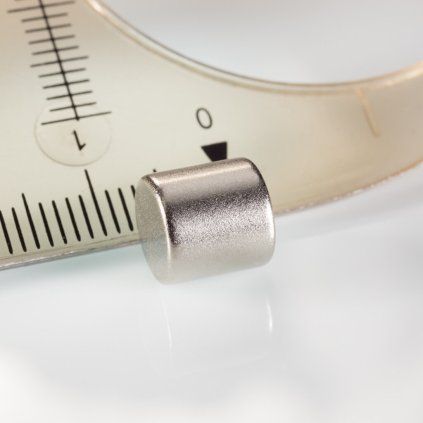
Neodymium cylinder magnet 8 × 8 mm
A small, versatile magnet for holders, closures, model making and technical projects.
- Diameter 8 mm
- Height 8 mm
- Pull force 21.5 N
- Approximate pull force 2.15 kg
- Weight 3 g
- Magnetic grade N35
- Nickel-plated surface
- Temperature resistance up to 80 °C
- Product code 20092
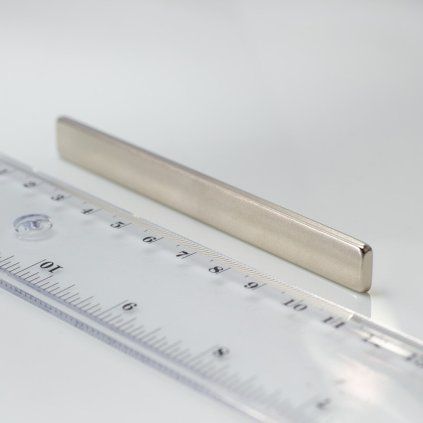
Neodymium block magnet 100 × 10 × 3 mm
A long, flat magnet for technical constructions and applications requiring a large contact area.
- Dimensions 100 × 10 × 3 mm
- Pull force 155 N
- Approximate pull force 15.5 kg
- Weight 23 g
- Magnetic grade N38
- Magnetised perpendicular to the face
- Nickel-plated surface
- Temperature resistance up to 80 °C
- Product code 20324
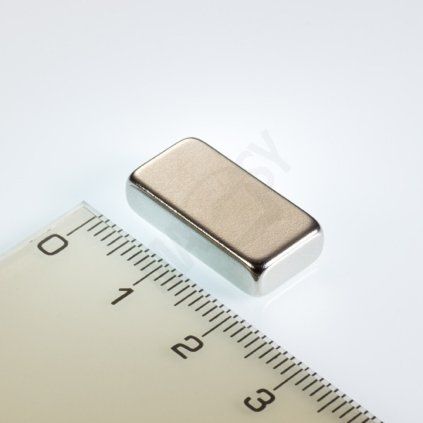
Neodymium block magnet 20 × 10 × 5 mm
A compact block magnet in the higher N42 grade for holders, closures and technical projects.
- Dimensions 20 × 10 × 5 mm
- Pull force 63.7 N
- Approximate pull force 6.37 kg
- Weight 7.5 g
- Magnetic grade N42
- Magnetised perpendicular to the face
- Nickel-plated surface
- Temperature resistance up to 80 °C
- Product code 20735
Frequently asked questions
Are neodymium magnets the strongest?
Among commonly manufactured permanent magnets, they offer the highest performance at a comparable volume.
Is an N42 magnet always stronger than an N35?
No. The dimensions, shape and magnetisation of the particular magnet also matter.
What does a pull force of 15.5 kg mean?
It is an approximate result for a perpendicular pull from a clean steel plate of sufficient thickness.
Why does a magnet hold less in practice?
Possible causes include thin sheet metal, paint, rust, a gap, curvature or sideways loading.
Can a neodymium magnet be used outdoors?
Ordinary nickel-plated models are mainly intended for dry indoor use. In damp conditions, corrosion can start if the surface is damaged.
Summary
Neodymium magnets are the strongest commonly manufactured permanent magnets at a comparable volume. However, the performance of a particular magnet depends on its size, shape, grade and use.
Do not choose solely on the basis of the N35 or N42 designation. Compare mainly pull force, dimensions, loading direction, the mounting surface and the working environment.
Choose a magnet by its actual strength
Compare the dimensions, pull force, magnetic grade and temperature resistance of individual models.