
How to Separate Strong Neodymium Magnets Safely
How can you safely separate two strong neodymium magnets?
Do not try to pull joined magnets straight apart. It is much easier to slide one magnet sideways, use the edge of a sturdy table or, for stronger magnets, a wooden wedge.
- Slide small magnets sideways with your thumb.
- Separate medium-strength magnets over the edge of a table.
- Use a wooden wedge or a separator for strong magnets.
- Do not use a hammer or a metal chisel.
- Wear gloves and safety glasses when handling magnets.
Why are neodymium magnets so strong?
Neodymium magnets are made from an alloy of neodymium, iron and boron, known as NdFeB. They provide very high magnetic strength in a small size.
They are used, for example, in:
- electric motors,
- loudspeakers and headphones,
- hard drives,
- sensors,
- magnetic holders,
- electronics and industrial equipment.
Modern NdFeB magnets began to develop in the 1980s, not just in the 1990s.
Why are joined magnets difficult to separate?
When two magnets touch across their entire faces, the distance between them is minimal and the attractive force is very high.
Pulling them straight apart requires much more force than sliding them sideways. The most effective method is therefore to reduce the shared contact area by gradually sliding one magnet away.
The simplest rule
Do not pull the magnets apart perpendicular to their faces. Slide one sideways and immediately move it to a safe distance once separated.
How do you separate small magnets?
- Place the joined magnets on a stable surface.
- Hold the bottom magnet with one hand.
- Slide the top magnet sideways with your thumb.
- Once most of the contact is lost, carefully lift it away.
- Immediately move the magnets far enough apart.
This method is suitable for small discs, cylinders and blocks with a lower holding force.
How do you use the edge of a table?
For medium-strength magnets, the straight edge of a sturdy workbench can help.
- Place the joined magnets on the table.
- Let one magnet extend over the edge.
- Hold the other firmly on the table.
- Push the protruding magnet down along the edge.
- Once separated, move it aside immediately.
The table surface must be sturdy and able to withstand the pressure of the magnet without damage. Hold the magnets so they cannot snap back together after separation.
How do you separate stronger magnets?
If the table-edge method is not enough, use a sturdy wooden wedge or a simple magnet separator.
- Place the magnets on the edge of a stable table.
- Hold them firmly.
- Slowly push the wooden wedge between the magnets.
- Gradually reduce their shared contact area.
- Once released, separate the magnets safely.
Do not use a hammer
Neodymium magnets are hard but brittle. A blow from a hammer or metal wedge can damage the nickel plating, break the magnet and send sharp fragments flying.
How do you safely bring magnets back together?
Do not let them snap directly together freely.
- Place one magnet on a stable surface.
- Put a piece of wood, cardboard or a plastic spacer on top.
- Place the second magnet on the spacer.
- Slowly slide it towards the edge.
- Bring the magnets together in a controlled way without a sudden impact.
How should you store magnets?
- Place a plastic, wooden or cardboard spacer between strong magnets.
- Keep them indoors in a dry environment.
- Protect the nickel plating from scratches.
- Do not store them loose among steel tools.
- Keep them out of reach of children.
- Protect payment cards, watches and sensitive electronics.
Safe handling
- Strong magnets can pinch fingers or skin.
- Wear sturdy gloves when handling larger magnets.
- Safety glasses protect your eyes from possible fragments.
- Do not allow magnets to collide violently.
- Stop using a cracked or chipped magnet.
- Small magnets pose a serious risk if swallowed.
Recommended neodymium magnets
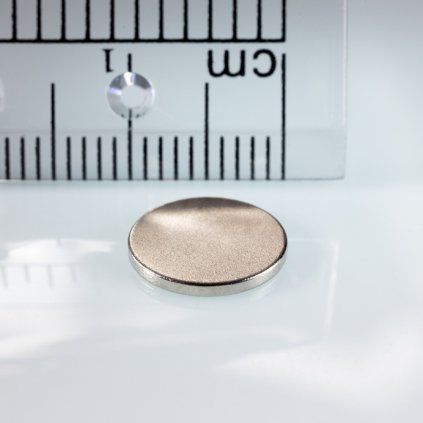
Neodymium cylinder magnet 10 × 1.5 mm
A thin disc magnet suitable for holders, closures, model making and smaller home projects.
- Diameter 10 mm
- Height 1.5 mm
- Pull force 9.9 N
- Approximate pull force 0.99 kg
- Approximate weight 0.9 g
- Magnetic grade N35
- Nickel-plated surface
- Temperature resistance up to 80 °C
- Product code 24048
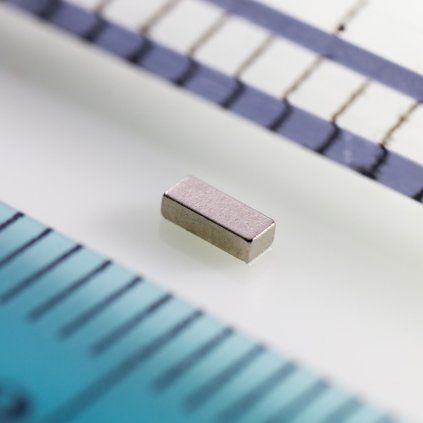
Neodymium block magnet 3 × 1.2 × 0.8 mm
A very small block magnet for model making, small closures, electronics and miniature constructions.
- Dimensions 3 × 1.2 × 0.8 mm
- Pull force 0.8 N
- Magnetic grade N35
- Magnetised perpendicular to the face
- Nickel-plated surface
- Temperature resistance up to 80 °C
- Product code 24058
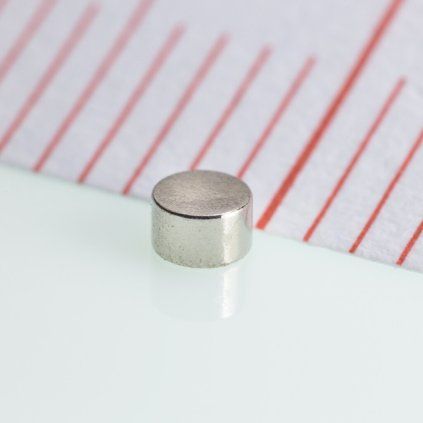
Neodymium cylinder magnet 2 × 1.2 mm
A miniature magnet in the higher N45 grade for very small constructions, models, switches and closures.
- Diameter 2 mm
- Height 1.2 mm
- Pull force 1.4 N
- Approximate pull force 0.14 kg
- Approximate weight 0.03 g
- Magnetic grade N45
- Nickel-plated surface
- Temperature resistance up to 80 °C
- Product code 20165.Z
Frequently asked questions
Why should you not pull magnets straight apart?
Pulling them straight apart requires greater force. Sliding them sideways gradually reduces their shared contact area.
Can you separate magnets with a hammer?
No. The magnet may crack, and sharp fragments can injure your eyes or hands.
How do you separate very strong magnets?
Use a wooden wedge or a sturdy separator that moves the magnet sideways in a controlled way.
Why does a magnet attach again after separation?
It is still too close. Move it to a safe distance immediately after separation.
How can you prevent magnets from joining again?
Insert a wooden, plastic or cardboard spacer between the magnets.
Is a neodymium magnet impact-resistant?
No. Despite its metallic appearance, it is brittle, much like a ceramic material.
Summary
Separate small magnets by sliding them sideways. For stronger magnets, use the edge of a table, a wooden wedge or a separating tool.
Do not use a hammer or a metal chisel. Neodymium magnets can crack, damage their surfaces and send sharp fragments flying.
Place spacers between magnets when storing them. Keep strong magnets away from children, electronics, payment cards and medical implants.
Choose a neodymium magnet by size and strength
Browse cylindrical, block, ring and other neodymium magnets for home, model-making and industrial use.