
How to Tie a Rope for Magnet Fishing?
How to Tie a Rope to a Fishing Magnet and Which Rope to Choose
A properly tied rethreaded figure-eight knot is a suitable choice for attaching a rope directly to the eye of a fishing magnet. The knot must be neatly dressed, firmly tightened and checked before every throw. Choosing an abrasion-resistant rope with a sufficient strength margin is equally important.
- Learn which rope is suitable for magnet fishing.
- Understand the difference between rope load capacity and safe working load.
- Learn how to tie a rethreaded figure-eight knot directly through the magnet eye.
- Compare the figure-eight, double figure-eight, bowline and slip knot.
- Find out how to inspect the eye, thread, knot and complete assembly.
- Learn what to do if the magnet becomes stuck without entering the water dangerously.
- Discover how to care for wet rope, essential safety rules, recommended products and FAQs.
When magnet fishing, a powerful magnet alone is not enough. You also need a suitable rope, a secure connection to the magnet, protective gloves and the correct working procedure.
A mistake in the knot or a damaged rope can result in the loss of both the magnet and the recovered object. If a highly tensioned rope breaks, its end may also move uncontrollably, causing a person to fall or injuring people nearby.
Which knot is best for a fishing magnet?
For directly attaching a rope to a closed magnet eye, a practical choice is the rethreaded figure-eight knot, sometimes also called a retraced or follow-through figure-eight.
Its advantages include:
- a clear shape that is easy to inspect,
- the rope passes directly through the magnet eye,
- when correctly tightened, it creates a secure loop,
- crossed strands are easy to see,
- it can be visually inspected before every use.
Quick answer: how do you tie a rope to a magnet?
Create a simple figure-eight near the free end of the rope, pass the end through the magnet eye and feed it back exactly alongside the original knot. Dress all strands neatly, reduce the size of the loop and firmly tighten each strand separately.
What do you need before tying the knot?
- a fishing magnet with a secure eye,
- a strong rope suitable for magnet fishing,
- work gloves,
- enough space to handle the rope,
- good lighting,
- optionally, a non-magnetic tool for removing contaminants.
Inspect the magnet eye before tying
The inside of the eye must not have:
- sharp burrs,
- cracks,
- severe corrosion,
- deformation,
- a damaged weld,
- a loose or damaged thread.
A sharp edge can gradually cut through even a very strong rope as it repeatedly moves against it.
Is the screw-in eye tightened correctly?
On magnets with a screw-in eye, the thread must be clean, undamaged and screwed in completely. The eye must not be attached using only a few turns of the thread.
If the manufacturer permits the use of a thread-locking product, follow their instructions exactly. An unsuitable adhesive may prevent servicing or damage certain materials.
How do you tie a rethreaded figure-eight knot step by step?
1. Leave a sufficiently long rope end
Prepare enough free rope to create the knot. Once finished, a substantial tail must remain beyond the knot, not just a few millimetres.
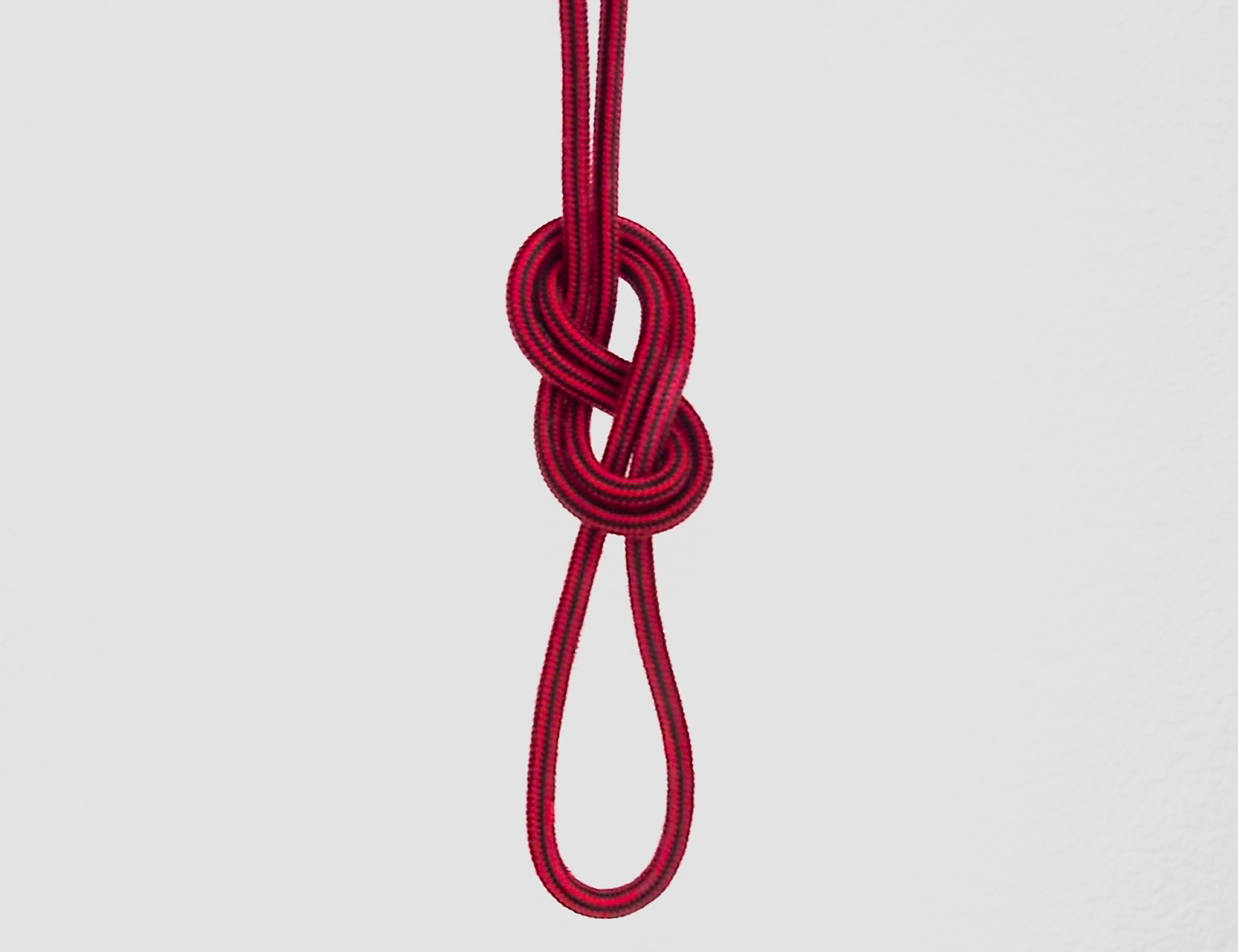
2. Create a simple figure-eight
Tie a loose figure-eight in the rope, but do not tighten it yet. The knot must remain loose enough for you to retrace its path.
3. Pass the end through the magnet eye
Feed the free end completely through the magnet eye. The rope must not pass over a sharp outer edge or through only part of the eye.
4. Retrace the original figure-eight
Feed the rope end back exactly alongside the first strand. Follow the entire path of the original knot until the free end emerges on the opposite side.
5. Dress all strands neatly
The strands should lie next to one another. They must not cross, twist or pile up on top of each other.
6. Adjust the size of the loop
The loop around the eye should be small enough not to catch unnecessarily, but the knot itself should not rest directly against the structure of the eye.
7. Tighten the knot thoroughly
Gradually pull each of the four strands. Simply pulling hard on the main rope is not enough. The knot must be tightened evenly throughout its entire path.
8. Check the free end
A sufficiently long tail must remain beyond the knot. If it is too short, variable loading may gradually pull the end into the knot.
9. Carry out a test load
Before the first throw, load the assembly in a controlled manner above a solid surface. Check that the knot does not shift and that the eye is not damaging the rope.
A simple figure-eight alone does not attach the magnet
A knot tied only in the free end of the rope acts merely as a stopper. To attach the rope to a closed eye, the end must pass through the eye and then retrace the complete path of the original figure-eight.
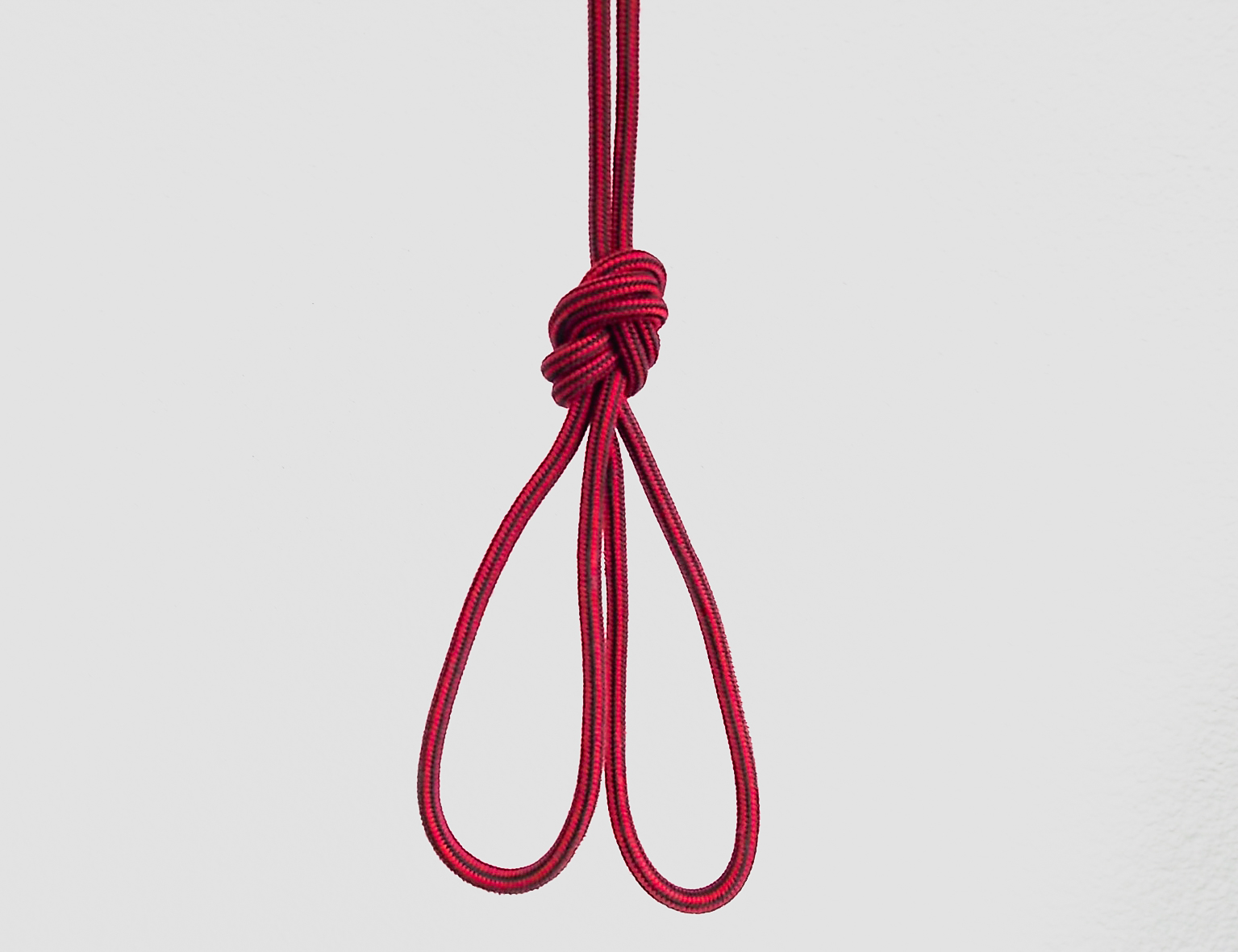
Double figure-eight loop
A double figure-eight creates a double loop. It is particularly useful where the load needs to be distributed between two suitable anchor points or where appropriate connecting equipment is used.
For ordinary direct attachment to a single fishing magnet eye, however, it may not be necessary. A correctly tied rethreaded figure-eight is generally easier to inspect.
When should you not use a double loop?
- if you do not know how to distribute the load evenly,
- if one loop could catch or cross over,
- if the connecting element does not have a suitable load rating,
- if you cannot correctly inspect the more complex knot,
- if a simple rethreaded figure-eight is more practical for a single eye.
Bowline
A bowline creates a fixed loop that does not tighten around the eye under load. After heavy loading, it is often easier to untie than some slip knots.
However, safe use requires correct technique and a sufficiently long free end. With some ropes and variable loading, a suitable backup knot may also be used.
Advantages of the bowline
- it does not tighten around the eye,
- it can often be untied relatively easily after loading,
- it has a compact shape,
- it is suitable for experienced users.
Disadvantages
- it is more difficult to inspect than a neatly tied figure-eight,
- an incorrectly tied bowline may look similar to a correct one,
- it requires a sufficiently long free end,
- it is not ideal for someone tying the knot from memory for the first time beside the water.
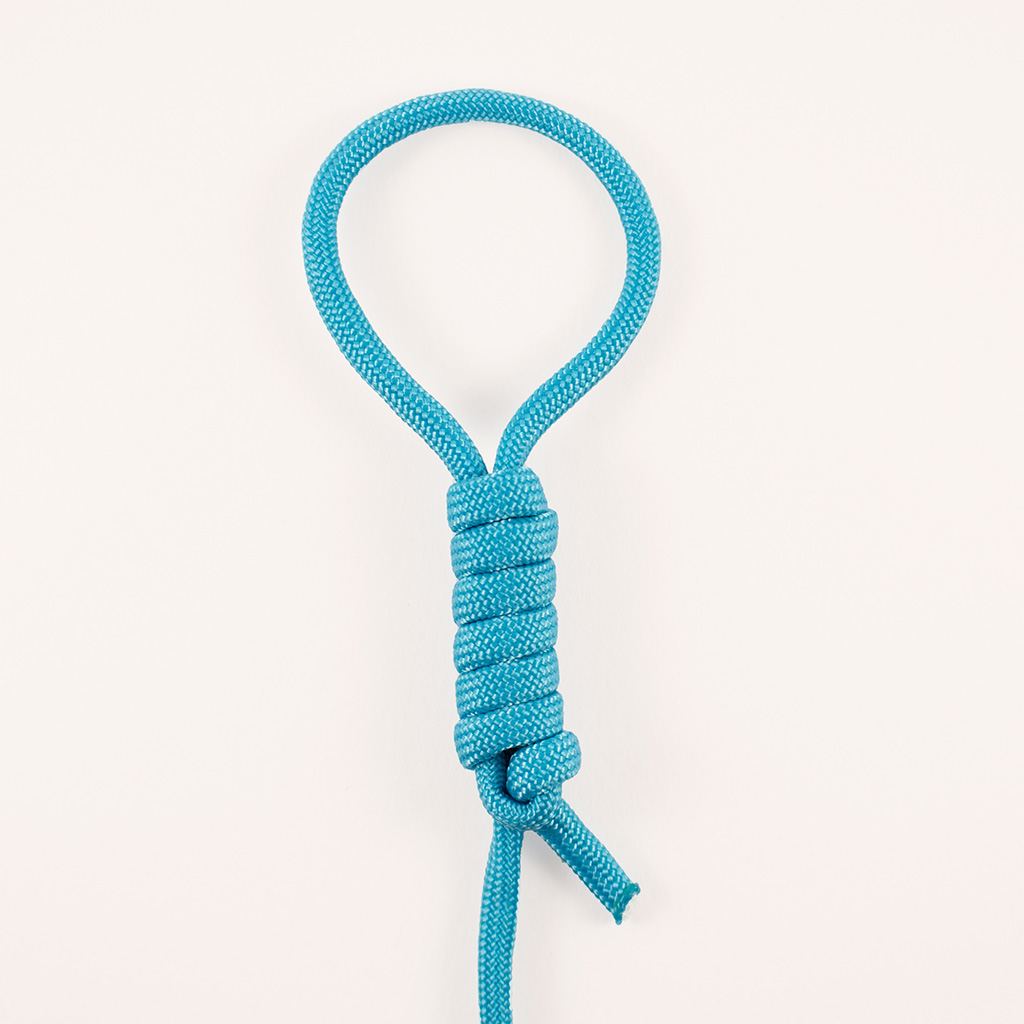
Noose or slip knot
A slip knot tightens around the eye under load. It is used by some magnet fishers, but as a universal first choice it has several disadvantages.
- it can become very difficult to untie after heavy loading,
- it tightens onto a small radius,
- it can be more difficult to inspect,
- if the number of turns or rope path is incorrect, it may not work properly,
- it can place considerable stress on the rope if the eye is rough or damaged.
A rethreaded figure-eight is easier for beginners to inspect
Only use a slip knot if you understand its exact construction, know how to inspect it and expect that it may tighten extremely firmly after heavy loading.
Can the magnet be attached using a carabiner?
A carabiner or shackle can allow the rope to be detached quickly from the magnet. However, it also adds another potential point of failure to the assembly.
Only use a connecting element that:
- has a manufacturer-specified load rating,
- is designed for genuine mechanical loading,
- has a secure closure,
- is not deformed or corroded,
- has no sharp edges,
- matches the diameter of the magnet eye.
A cheap decorative keyring carabiner is not a suitable connecting element for magnet fishing.
Advantage of tying directly
When the rope is tied directly through a smooth eye, the carabiner is eliminated, along with another connection that could open, deform or catch underwater.
Which rope is best for magnet fishing?
A suitable rope must be strong, abrasion-resistant, easy to handle when wet and compatible with the magnet being used.
Important rope properties
- sufficient strength with a safety margin,
- abrasion resistance,
- low stretch,
- good grip when wearing wet gloves,
- low water absorption,
- resistance to repeated bending,
- suitable diameter for the eye and knot,
- sufficient length.
Why is polyester rope used?
Polyester rope offers a good combination of strength, abrasion resistance, relatively low stretch and low water absorption.
Compared with a highly elastic rope, it provides better feedback from the magnet. This makes it easier to feel when the magnet has caught on an object, stone or structure.
Advantages of polyester
- relatively low stretch,
- good abrasion resistance,
- low water absorption,
- more stable magnet control,
- good strength,
- suitable for repeated use in water.
Are all climbing ropes unsuitable?
Not all of them, but an ordinary dynamic climbing rope is designed to stretch and absorb energy during a fall. It may therefore be impractical for magnet fishing.
Static and semi-static ropes stretch less, but this does not automatically make them suitable. Important factors include:
- strength and intended use,
- abrasion resistance,
- behaviour when wet,
- diameter,
- compatibility with the eye,
- condition and history of the rope.
Do not use an old rope of unknown history
A rope of unknown origin may have been damaged by UV radiation, chemicals, overloading or internal wear that is not visible at first glance.
Which rope diameter should you choose?
A thicker rope is generally easier to grip and cuts into gloves less. However, it is heavier, more difficult to throw and takes up more space.
The recommended products have:
- a diameter of 5 mm for the rope with a stated load capacity of 340 kg,
- a diameter of 6 mm for the rope with a stated load capacity of 560 kg.
The diameter must also allow the rope to pass safely through the eye and enable the chosen knot to be tied correctly.
Rope load capacity is not the same as safe working load
Do not automatically interpret a stated “load capacity of 340 kg” or “load capacity of 560 kg” as a safe recovery weight.
The overall strength of the assembly is affected by:
- the rope testing method,
- the safety factor,
- the specific knot,
- the radius of the eye,
- abrasion and age of the rope,
- dynamic shock loading,
- direction of the load,
- condition of all connecting elements.
Every knot weakens the rope where it is bent and compressed. There must therefore be a sufficient margin between the expected load and the declared strength.
The entire assembly is only as strong as its weakest component
A powerful magnet, weak rope, poor-quality carabiner or damaged eye do not create a safe setup. Assess all components together.
How are magnet strength and rope strength related?
The pull-off force of a magnet is usually determined under ideal conditions on a clean, flat and sufficiently thick steel surface.
This does not mean that the magnet can safely lift an object of the same weight from water. Rust, mud, curvature and a small contact area significantly reduce magnetic holding force.
At the same time, if the magnet becomes attached to a large steel structure, the load may exceed the ordinary weight of a recovered object. Do not choose a rope only according to the weight of the items you expect to find.
Which rope length should you choose?
15-metre rope
Suitable, for example, for:
- smaller rivers and streams,
- ponds and lakes when fishing close to the bank,
- lower jetties,
- shallower wells and shafts,
- beginners who want a more manageable setup.
30-metre rope
May be suitable for:
- higher bridges,
- deeper wells,
- wider bodies of water,
- longer throws,
- changing the direction of pull along the bank.
Disadvantages of a longer rope
- higher weight when wet,
- greater risk of tangling,
- more loops on the bank,
- more difficult handling,
- greater chance of catching on obstacles.
How should you secure the free end of the rope?
The end of the rope must not disappear into the water during a throw. Secure it before handling the magnet.
Possible securing methods
- a fixed anchor point with sufficient load capacity,
- a suitable loop around a solid structure,
- a separate secure attachment designed for rope,
- controlled storage in a suitable container with the free end physically secured.
Never wrap the rope around your body
Do not wrap it around your wrist, waist, leg or neck. A stuck magnet, heavy recovered object or passing boat could pull you into the water or cause serious injury.
How should you prepare the rope before the first throw?
- Lay the rope out on a clean surface.
- Remove knots, twists and loops.
- Inspect its entire length visually and by hand.
- Secure the free end safely.
- Dress and tighten the knot at the magnet again.
- Inspect the eye and any threaded connection.
- Lay the rope in loose loops so that it can run out smoothly during the throw.
- Check the area around you.
What should you look for when inspecting the rope?
- frayed areas,
- cuts and damaged braiding,
- flattened or hardened sections,
- traces of chemicals,
- burnt or melted fibres,
- heavy contamination with sand,
- damage close to the knot.
How do you throw a magnet safely?
- Make sure there are no people, animals or vehicles nearby.
- Check the space above your head and behind you.
- Make sure the free end of the rope is secured.
- Hold the magnet so that it cannot snap towards a railing or steel structure.
- Throw in a controlled manner rather than using an uncontrolled powerful swing.
- After impact, allow the magnet to sink to the bottom.
- Handle the rope while wearing gloves and do not create loops around your feet.
How can you tell that the magnet has caught something?
When pulling slowly, you may feel:
- a sudden increase in resistance,
- a brief metallic snap,
- a change in the direction of the rope,
- irregular movement of an object along the bottom,
- significantly greater weight while pulling upwards.
Do not immediately pull with maximum force. First determine whether the magnet is attached to a movable object or a fixed structure.
What should you do if the magnet or rope becomes stuck?
The magnet may become caught on a bridge structure, steel reinforcement, a large object, branch, stone or another underwater obstacle.
Safe procedure
- Stop pulling hard.
- Release some of the tension in the rope.
- Move several metres along the bank.
- Try pulling from another angle.
- Use short, controlled movements.
- Try pulling opposite to the direction in which the magnet became stuck.
- If possible, use a second rope or hook from a stable position on the bank.
- If releasing the magnet would require entering the water dangerously, stop the attempt.
What should you not do?
- do not repeatedly jerk the rope with maximum force,
- do not wrap the rope around your body,
- do not pull the assembly using a vehicle,
- do not enter unknown or fast-flowing water,
- do not jump into the water from a bridge or jetty,
- do not climb over railings,
- do not stand directly in line with a highly tensioned rope,
- do not put yourself or anyone else at risk just to recover the magnet.
Do not enter unknown water to recover a magnet
A river, pond or flooded shaft may contain currents, mud, sudden depth changes, sharp objects, branches and other hazards. If the assembly cannot be released safely from the bank, it may be necessary to abandon the magnet.
Why should you not jerk a stuck rope violently?
A sudden jerk creates short-term dynamic loading that may be considerably greater than a steady pull.
Possible risks include:
- breaking a damaged rope,
- shifting or tightening the knot,
- damaging the magnet eye,
- releasing a heavy object towards the operator,
- causing a person to fall backwards,
- uncontrolled whipping of the rope end,
- damaging the structure to which the magnet is attached.
It is much safer to release the tension, change the pulling angle and use small controlled movements.
How should you retrieve a heavy object?
- Keep the rope evenly tensioned.
- Do not pull sharply.
- Move the object towards shallower water or a more accessible location.
- Change direction if the object catches on the bottom.
- Use another suitable rope or hook from a stable bank.
- For a very heavy object, ask another person for help.
- If there is a risk of falling, rope failure or entering the water, stop the attempt.
Magnetic holding force can suddenly decrease if the angle changes or the object is struck. Do not stand directly above the object being lifted.
Can a hook be lowered to a heavy object?
A hook can help take some of the load if it can be attached safely to a structural part of the object.
However, it must be:
- designed for the appropriate load,
- connected to a sufficiently strong rope,
- controlled from a stable position,
- used without anyone entering the water,
- kept away from other people.
An improvised hook may come loose and be thrown violently. Do not use it near other people.
How should you care for the rope after magnet fishing?
1. Remove coarse dirt
Mud, sand and small stones can enter the braid and damage the fibres during repeated bending.
2. Rinse the rope with clean water
After use in dirty or salt water, rinse the rope with clean fresh water. Do not use aggressive cleaning products unless approved by the manufacturer.
3. Allow it to dry completely
Lay the rope out or hang it loosely in the shade in a well-ventilated place. Do not dry it on a radiator, over an open flame or in prolonged direct sunlight.
4. Coil the dry rope loosely
Do not create sharp bends or compress the rope heavily during storage.
5. Inspect the knot and highly stressed areas
Pay particular attention to the section near the magnet eye and areas that have been dragged over concrete, stone or metal edges.
Do not store wet rope in a closed bag
Trapped moisture encourages odours, contamination and damage to some equipment components. Allow the rope to dry completely before packing it away.
When should the rope be discarded?
Do not continue using the rope if you find:
- a deep cut,
- severely frayed braiding,
- visible damage to the core,
- melted or burnt fibres,
- a hard or brittle section,
- severe chemical contamination,
- a significant change in diameter,
- damage following severe overloading,
- unknown history in the case of a used or found rope.
Covering a damaged area with tape is not sufficient. Tape restores the appearance, not the strength of the fibres.
Does the knot need to be untied after every use?
It is advisable to untie it regularly, clean it and inspect the section of rope hidden inside the knot.
A wet knot left tightened for a long time may:
- hide abrasion,
- trap sand and dirt,
- become extremely difficult to untie,
- prevent complete drying,
- hide damage close to the eye.
If you leave the knot tied, inspect it thoroughly before each use and verify it with a controlled load test.
What should you do if you find a weapon or ammunition?
If the fishing magnet catches an object resembling a weapon, ammunition, grenade or other ordnance:
- stop handling the object,
- do not clean, turn or dismantle it,
- do not take it home or to a police station,
- keep other people away,
- move to a safe distance,
- call the Police of the Czech Republic on 158 or the emergency number 112,
- follow the operator's instructions.
Do not remove a suspicious object from the magnet
Old and heavily corroded ammunition may still be dangerous. Do not attempt to pull it away from the magnet or move it to a “safer” location.
Safety when working with a rope and fishing magnet
Basic safety rules
- Wear sturdy work gloves and closed footwear.
- Use a suitable life jacket near deep water.
- Do not go magnet fishing alone in a hazardous location.
- Never wrap the rope around your body.
- Do not stand inside accumulated loops of rope.
- Inspect the knot, eye and free end before every throw.
- Keep powerful magnets away from steel railings and vehicles.
- Do not enter unknown water to recover stuck equipment.
- Do not use a vehicle to pull a magnet free.
- Do not stand directly in line with an extremely tensioned rope.
- A fishing magnet is not a children's toy.
- Maintain a safe distance from pacemakers, electronics and magnetic cards.
Recommended equipment for magnet fishing
The selected products represent a complete starter set and two 15-metre polyester ropes with different diameters and manufacturer-stated load capacities.
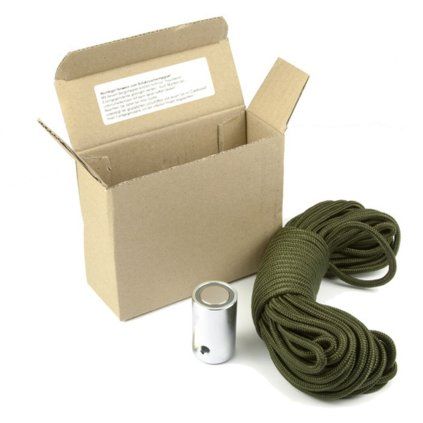
Fishing magnet 30 × 50 mm with 15 m rope
Smaller neodymium fishing magnet supplied with a rope for beginners and for finding smaller ferromagnetic objects.
- Magnet diameter 30 mm
- Magnet height 50 mm
- Pull-off force approximately 29.4 kg
- Pull-off force approximately 294 N
- Magnet weight approximately 436 g
- NdFeB neodymium magnet
- M6 thread
- Thread length approximately 11 mm
- Magnet temperature resistance up to 80 °C
- 15 m rope included
- Product code 10556
Warning: the stated pull-off force applies under defined conditions. The magnet may hold a real recovered object with considerably less force.
View product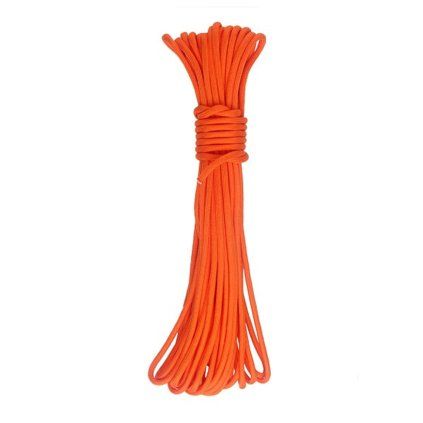
Rope 15 m, load capacity 560 kg
Stronger braided polyester rope with a braided core for magnet fishing and other activities requiring a strong, abrasion-resistant rope.
- Length 15 m
- Diameter 6 mm
- Diameter tolerance ± 0.1 mm
- Manufacturer-stated load capacity 560 kg
- PES material – polyester
- Braided construction with braided core
- Weight approximately 350 g
- Product code 10591
- Relatively low weight
- Abrasion-resistant
Warning: the stated 560 kg is not the safe working weight of a recovered object. Knots, abrasion and dynamic shock reduce the strength of the complete assembly.
View product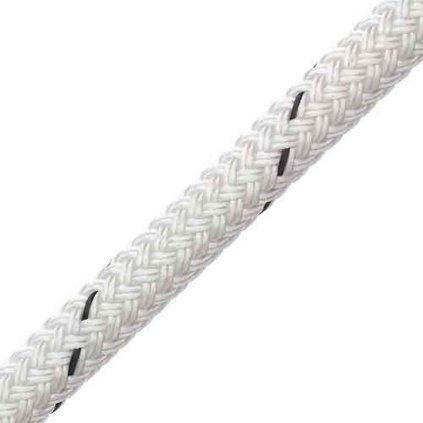
Rope 15 m, load capacity 340 kg
Lightweight braided polyester rope for smaller and medium-strength magnet fishing setups and fishing at ordinary distances from the bank.
- Length 15 m
- Diameter 5 mm
- Diameter tolerance ± 0.1 mm
- Manufacturer-stated load capacity 340 kg
- PES material – polyester
- Braided construction with braided core
- Weight approximately 224 g
- Product code 10589
- Compact size when packed
- Suitable for lighter setups
Warning: a rope with a stated load capacity of 340 kg is not suitable for utilising the full declared force of extremely powerful fishing magnets.
View productChoose rope with a sufficient safety margin
Do not base your choice only on the largest number shown for the magnet or rope. Consider the magnet weight, possible attachment to a fixed structure, the knot used, condition of the eye, abrasion and handling method.
Frequently asked questions about tying a rope to a fishing magnet
Which knot should I use for a fishing magnet?
For attaching a rope directly to a closed eye, a correctly tied rethreaded figure-eight is an easy-to-inspect option.
Is an ordinary figure-eight at the end of the rope enough?
No. To attach the magnet, the rope end must pass through the eye and then precisely retrace the original figure-eight.
Does the knot need to be fully tightened?
Yes. All strands must be neatly aligned and each strand should be tightened separately.
How long should the tail be after the knot?
Long enough that variable loading cannot pull it into the knot. Do not leave only a few millimetres.
Is a backup knot necessary?
On a correctly tied figure-eight, a backup knot does not replace proper tightening. On some setups, it is added as additional security for a long free end.
Is a bowline suitable?
Yes, for someone who can tie and inspect it reliably and uses a sufficiently long free end, together with an appropriate backup knot where necessary.
Is a slip knot suitable?
It can work, but it tightens strongly, can be difficult to untie after loading and is harder for beginners to inspect.
Can the rope be attached using a carabiner?
Yes, but only with a carabiner that has a declared load rating and a secure closure. Decorative keyring carabiners are not suitable.
Is direct tying better than using a carabiner?
Direct tying eliminates one connecting element. A carabiner allows faster replacement but adds another possible failure point.
How often should the knot be inspected?
Before every throw, after heavy loading, after the magnet becomes stuck and whenever you notice movement or crossed strands.
Does the knot need to be untied after every use?
Not necessarily, but regular untying allows the section of rope hidden inside the knot to be inspected and dried.
How can I recognise a badly tied figure-eight?
The strands cross, the knot is irregular, it is not fully tightened or the remaining free end is too short.
Why can the knot not be untied after loading?
It may have been heavily tightened, the rope may be dirty or a tightening type of knot may have been used. Loosen it gradually without using sharp tools.
Can the knot be loosened with a screwdriver?
A metal tool can damage the fibres. Use a suitable blunt non-magnetic tool and proceed carefully.
Which rope should I use for magnet fishing?
A strong, abrasion-resistant, low-stretch rope suitable for the intended use. The recommended ropes are made from polyester.
Why should the rope not stretch too much?
A lower-stretch rope provides better feedback while pulling and reduces the amount of energy that could be released uncontrollably if the rope breaks or the magnet suddenly comes free.
Is dynamic climbing rope suitable?
It is not ideal because it is designed to stretch significantly when arresting a fall.
Is static climbing rope suitable?
It may have more suitable stretch characteristics, but its strength, condition, abrasion resistance and suitability for wet environments must still be checked.
Which rope diameter should I choose?
It depends on the magnet, eye, required strength and handling comfort. The recommended products have diameters of 5 and 6 mm.
Is 5 mm rope strong enough?
The manufacturer states a load capacity of 340 kg for the recommended model. Safety is still affected by the knot, wear and the complete assembly.
Is 6 mm rope better?
The thicker recommended model has a higher stated load capacity and is easier to grip. However, it is heavier and takes up more space.
What does a load capacity of 560 kg mean?
It is a parameter stated by the rope manufacturer. It is not automatically the safe working weight of a recovered object.
Does a knot reduce rope strength?
Yes. The rope is bent and compressed inside the knot, so the complete assembly does not retain the same strength as a straight, undamaged rope.
Is a safety margin necessary?
Yes. Because of knots, abrasion, impacts and the unknown nature of whatever the magnet catches, a substantial margin is required.
Is a 15-metre or 30-metre rope better?
Fifteen metres is easier to handle close to the bank. Thirty metres is useful for higher bridges, deeper wells and greater distances.
Is there any point buying an unnecessarily long rope?
Not always. A longer rope is heavier, tangles more easily and creates more loops on the bank.
How can rope tangling be prevented?
Lay the rope in loose, regular loops or use a suitable container from which it can feed out smoothly.
Does the free end need to be secured?
Yes. The free end must be safely secured before every throw.
Can I wrap the end around my wrist?
No. A stuck magnet or heavy object could pull you over or cause injury.
Can the rope be tied to a railing?
Only if this is permitted, the railing is sufficiently strong and the knot does not endanger traffic or other people. Public structures cannot automatically be used as anchor points.
How can I tell that the magnet has caught something?
When pulling slowly, you may feel increased resistance, a change in direction or a sudden metallic snap.
What should I do if the magnet becomes stuck?
Release the tension, change the pulling angle and use small controlled movements.
Should I jerk the rope hard?
No. Sudden jerking can overload the rope, knot and eye and may release an object uncontrollably.
Should I enter the water to recover the magnet?
Not in unknown, deep or fast-flowing water. Recovering equipment is not worth the risk of drowning or injury.
Can the magnet be pulled free using a car?
No. The rope, connection or magnet may fail and parts of the assembly could be thrown dangerously.
Can a second rope with a hook be used?
Yes, provided that the entire procedure can be carried out safely from a stable bank and the equipment has sufficient strength.
How should the rope be washed after use?
Rinse it with clean water, remove sand and allow it to dry completely in the shade.
Can wet rope be coiled immediately?
This is not recommended. It should dry completely first.
Can rope be dried on a radiator?
High temperatures are not recommended. Allow the rope to dry naturally in a ventilated place.
Can the rope be washed in a washing machine?
Only if the manufacturer of the specific rope permits it. Otherwise, use gentle hand rinsing.
How do you remove sand from the rope?
Rinse with clean water and flush it gently. Sand trapped in the fibres can contribute to internal abrasion.
When should the rope be replaced?
After a deep cut, severe fraying, damage to the core, melted fibres or unknown extreme loading.
Can a damaged section be repaired with tape?
No. Tape does not restore the strength of damaged fibres.
What should you do if the magnet catches ammunition?
Do not handle it or remove it from the magnet. Move away and contact the Police of the Czech Republic on 158 or 112.
Is the starter magnet with a 15 m rope suitable for beginners?
A smaller magnet with a pull-off force of 29.4 kg is easier to handle than very heavy and extremely powerful fishing magnets.
Is a fishing magnet suitable for children?
No. Powerful magnets can pinch fingers, crack and eject sharp fragments.
Summary
For directly attaching a rope to a fishing magnet eye, a clear rethreaded figure-eight knot is a suitable choice. The rope end must pass through the eye, retrace the complete original knot and leave a sufficiently long tail when finished.
Choose the rope according to the entire magnet fishing setup, not only according to the expected weight of recovered objects. Knots, abrasion, the condition of the eye, shock loading and connecting elements all reduce actual strength.
Polyester rope offers good abrasion resistance, low water absorption and relatively low stretch. For ordinary use, 15-metre versions with diameters of 5 and 6 mm are available.
If the magnet becomes stuck, do not jerk it with maximum force and do not enter unknown water to recover the equipment. Release the tension, change the pulling angle and stop the attempt if the magnet cannot be recovered safely from the bank.
Need a strong rope for magnet fishing?
Choose a polyester rope according to its length, diameter and stated load capacity, and practise tying it securely on dry land before the first use.