
Fishing Magnets on YouTube
Magnet Fishing: How to Get Started, Which Magnet to Choose and What to Watch Out For
Magnet fishing is the search for ferromagnetic objects in water using a powerful magnet attached to a rope. Instead of fish, you may pull screws, tools, bicycles, road signs and even objects of historical value from a river, pond, canal or well.
- Learn what magnet fishing is and how it works.
- Find out how to choose a fishing magnet, rope and other equipment.
- Understand the difference between single-sided and double-sided magnets.
- Learn the correct procedure for tying, throwing and retrieving a magnet.
- Find out what to do if the magnet becomes stuck underwater.
- Learn what to do if you find a weapon, ammunition or historical object.
- Explore safety rules, recommended products and frequently asked questions.
Magnet fishing is often compared to treasure hunting. You lower or throw a fishing magnet into the water, allow it to sink to the bottom and slowly pull it across the surface or around structures where iron and steel objects may be located.
However, it is not just a leisure activity. A powerful neodymium magnet, deep water, a slippery bank and an unknown find can all present serious risks. Before your first attempt, it is therefore important to prepare the correct equipment and understand the safe procedure.
What is magnet fishing?
Magnet fishing is an activity in which a powerful permanent magnet is used to locate and retrieve ferromagnetic objects from water, mud, canals, wells or other difficult-to-access locations.
The magnet is attached to a strong rope. Once lowered into the water, it is moved along the bottom or close to structures. If it comes sufficiently close to an iron or steel object, the magnetic field attracts it.
What can you find while magnet fishing?
- bolts, screws, nuts and washers,
- nails, chains and steel cables,
- tools and machine parts,
- bicycles and scooters,
- road signs and metal structures,
- keys, locks and safes,
- coins containing a ferromagnetic component,
- old weapons, cartridges or ammunition,
- objects that may have historical value.
How does magnet fishing work?
- Securely attach the fishing magnet to a suitable rope.
- Check the bank, surrounding area and the space behind you.
- Lower or throw the magnet into the water.
- Allow it to sink to the bottom.
- Slowly pull it across the bottom or around the selected structure.
- When an object is caught, pull smoothly without sudden jerking.
- Bring the find to a safe location on the bank.
- Inspect, sort and safely dispose of or handle the object.
- Clean and dry the magnet and rope after finishing.
The best results are not achieved by throwing violently or pulling quickly. The magnet needs enough time to approach an object and create the largest possible contact area.
Magnet fishing in practice
The following video demonstrates the basic principle of searching for objects using a fishing magnet:
Treat the video only as a demonstration of the principle. Always adapt the handling method to the location, equipment weight, water current and the safety of people nearby.
What equipment do you need for magnet fishing?
Fishing magnet
The basic piece of equipment is a powerful neodymium magnet with an eye, thread or another secure element for attaching a rope. An ordinary small magnet is unsuitable – it may not provide enough force, may have an unsuitable construction or may not allow the rope to be attached safely.
Strong rope
The rope must withstand abrasion, water and repeated loading. Its load capacity must correspond to the entire setup and the expected load.
Remember that:
- a knot can reduce the actual strength of the rope,
- a wet or damaged rope may have poorer properties,
- the rope wears when pulled across a concrete edge,
- the strength of the complete setup is determined by its weakest component,
- the stated force of the magnet is not automatically the safe weight of a recovered object.
Protective gloves
Sturdy work gloves protect your hands from wet rope, sharp shavings, hooks, rusty edges and pinching by the magnet.
Safety glasses
Neodymium magnets are hard but brittle. They can crack during a severe impact and eject sharp fragments.
Plastic container or strong bag
Do not leave recovered screws, wires, sheet metal and other waste on the bank. Bring a container in which the objects can be stored safely and subsequently taken for appropriate disposal or recycling.
Disinfectant and basic first-aid kit
Rusty, sharp and contaminated objects can cause cuts or puncture wounds. Serious or deeply contaminated injuries should be treated professionally.
Life jacket
Use an appropriate life jacket near deep water, strong currents, high banks or when working from a jetty or boat.
Do not go magnet fishing alone in a hazardous location
Near deep water, slippery banks or strong currents, it is safer to work with at least one other person. They can call for help, secure the area or assist without anyone having to enter the water.
How do you choose a fishing magnet?
Do not base your choice only on the highest number stated in kilograms. The construction, active surface, method of attaching the rope, magnet weight and location where you intend to use it are also important.
Single-sided fishing magnet
A single-sided magnet has its active magnetic surface mainly on the underside. It is suitable for:
- vertical lowering from a bank, bridge or jetty,
- retrieving objects from a well or shaft,
- situations where the magnet lands with its active surface on the object,
- strong perpendicular pulling.
Double-sided fishing magnet
A double-sided magnet has an active magnetic surface on both sides and may capture objects more effectively when dragged horizontally across the bottom.
It is suitable for:
- throwing from the bank,
- dragging along the bottom of a river or pond,
- searching a larger area,
- situations where you cannot control which side of the magnet lands downwards.
Magnet with a top eye
An eye positioned on top is primarily suitable for vertical lowering and retrieval.
Magnet with a side eye
A side rope attachment is useful for dragging the magnet horizontally across the bottom. The specific construction must be designed for this direction of loading.
How strong should your fishing magnet be?
For a beginner, a lighter magnet may be more practical because it can be handled safely and repeatedly thrown without excessive physical effort.
A stronger magnet makes sense when:
- you are looking for larger steel objects,
- you are working at greater depth,
- the bottom is covered with sediment,
- you need to overcome layers of rust and contamination,
- you have a suitable rope and a safe place to work.
A value of 530 kg does not mean that you can safely retrieve an object weighing 530 kg
The stated magnetic or pull-off force applies to measurements under ideal conditions on a clean, flat and sufficiently thick steel surface. A rusty, curved, muddy or partially contacted object will be held with significantly less force.
How do you choose a rope for magnet fishing?
Choose the rope according to the magnet, expected load, water depth and distance from the bank.
Rope length
- 15 metres: suitable for smaller rivers, ponds, wells and magnet fishing close to the bank.
- 30 metres: suitable for wider bodies of water, high bridges and longer throws.
A longer rope provides greater reach, but it is heavier, more difficult to untangle and creates more loops during use.
Rope diameter
A thicker rope is easier to grip and usually withstands greater loading. An excessively thin rope may cut into your hands during heavy pulling.
Rope material
Strong braided ropes, for example polyester ropes, are used for magnet fishing. Important properties include abrasion resistance, low water absorption and sufficient strength.
Rope load capacity
The rope's load capacity must exceed the expected load and should include a safety margin. Also allow for reduced strength at the knot and gradual wear.
A rope rated at 340 kg cannot make full use of the stated 530 kg force of the magnet
The entire setup is only as strong as its weakest component. A magnet with a very high stated force requires a suitable rope, knot, eye and other connecting components.
How do you attach the rope to a fishing magnet?
The knot must be strong, correctly tightened and suitable for the particular rope and eye. A figure-eight knot or bowline is commonly used, but only if you know how to tie it correctly.
Basic rules
- Inspect the magnet eye and thread before tying the rope.
- Remove any damaged or frayed section of rope.
- Leave a sufficiently long free end after tying the knot.
- Tighten the knot firmly several times.
- Carry out a load test above a solid surface before the first throw.
- Inspect the knot regularly throughout use.
- If the eye is screw-mounted, also check that it is not loosening.
- Only use thread-locking adhesive if the manufacturer permits it.
Should you use a carabiner?
Only use a sufficiently strong connecting component designed for the expected load. A cheap decorative carabiner may become the weakest point in the entire setup.
How do you choose a suitable location?
Before starting, make sure that you can work at the location safely and with the required permission. Magnet fishing is not automatically suitable on every bank, bridge or water structure.
Check in particular:
- the owner or administrator of the land and body of water,
- local operating rules and visitor regulations,
- restrictions in protected areas,
- restrictions on access to private land,
- boat traffic and navigation,
- proximity to a weir, dam, lock or other technical structure,
- traffic on and underneath bridges,
- the presence of electrical wiring or sensitive equipment,
- whether recovered objects can be stored safely.
Unsuitable locations
- slippery, high or unstable banks,
- strong currents and flooded rivers,
- weirs, turbines, locks and outlets,
- active harbours and navigation routes,
- railway and road bridges without a safe working area,
- locations where access is prohibited,
- protected or archaeologically significant areas without checking the rules beforehand,
- private land without permission.
How do you throw a fishing magnet correctly?
- Lay the rope out on the ground so that it does not become tangled.
- Secure the end of the rope to a suitable fixed point or hold it in a way that cannot pull a person into the water.
- Check the space in front of you, behind you and above your head.
- Make sure there are no people, animals, vehicles or electrical wiring within range.
- Only swing the magnet in a controlled manner.
- Throw it away from people and structures.
- Allow the magnet to sink to the bottom after it lands.
- Pull the rope slowly and smoothly.
Never wrap the rope around your hand, waist or body
If the magnet catches a heavy object, branch or structure, the rope could pull you over, injure you or drag you into the water.
How do you drag the magnet along the bottom?
Do not pull the magnet too quickly. Slower movement increases the chance that the magnetic surface will make contact with an object.
Possible techniques
- Vertical lowering: suitable from a well, jetty or low bridge.
- Fan-shaped throws: gradually search different directions from the bank.
- Dragging along the bank: suitable for finding objects discarded close to the edge.
- Inspecting a structure: move slowly around a jetty, bridge pier or steel wall.
Do not place the magnet inside moving machinery, turbines, weirs, pumps or anywhere it could become a dangerous obstruction.
What should you do when the magnet catches something?
- Stop making rapid movements.
- Keep the rope tensioned.
- Pull slowly and evenly.
- If the object is heavy, change the direction of pull.
- Move the object towards shallower water or a safer location.
- Do not enter deep or flowing water.
- Only handle sharp objects while wearing sturdy gloves.
- Leave an unknown or dangerous-looking object where it is and contact the police.
What should you do if the fishing magnet becomes stuck?
The magnet may become caught on a steel structure, underneath a stone, between branches or inside an opening.
First try to:
- release the tension and change direction,
- move several metres along the bank,
- pull the magnet from the opposite direction,
- use small controlled movements instead of violent jerking,
- wait for a change in the current or rope position.
What should you avoid?
- do not wrap the rope around your body,
- do not enter deep or opaque water,
- do not climb onto an unstable structure,
- do not pull the rope using a vehicle,
- do not use an uncertified winch or pulley,
- do not stand directly in line with a heavily tensioned rope,
- do not continue if there is a risk of falling or breaking the rope.
Sometimes it is safer to abandon the magnet
If it cannot be released without entering dangerous water, damaging a structure or applying unsafe pulling force, do not attempt to recover it at any cost. Loose rope must not be left behind as a dangerous obstruction.
What should you do with an ordinary find?
Do not leave recovered screws, sheet metal, wires or other waste on the bank. Place sharp items in a rigid container and take them for appropriate disposal or to a recycling centre.
Do not automatically keep an object that clearly belongs to someone or may have significant value. Return it to the known owner, local authority or the Police of the Czech Republic.
What should you do if you find a weapon?
Do not clean, dismantle or take home a firearm, its main components, ammunition or any object resembling a weapon.
- Stop handling the object.
- Do not check whether the weapon is loaded or functional.
- Do not turn it or operate any components.
- Make sure other people do not approach it.
- From a safe location, call the Police of the Czech Republic on 158.
- Follow the operator's instructions.
What should you do if you find a grenade, ammunition or explosive?
Never handle a suspicious object
- Do not touch it or attempt to remove it from the magnet.
- Do not carry, turn or clean it.
- Do not take it to a police station.
- Move to a safe distance.
- Warn other people.
- Call 158 or 112.
- Describe the find and identify the location as accurately as possible.
- Follow the instructions of the police and bomb disposal specialist.
Old and heavily corroded ammunition may still be functional. Even slight movement may disturb a degraded safety mechanism.
What should you do if you may have found an archaeological object?
Old coins, weapons, tools, vessels or other historical objects may constitute an archaeological find, particularly if they come from an older layer of the riverbed or if several related objects are found in the same place.
In this case:
- do not continue handling the object or disturbing the location,
- record the exact location and circumstances of the find,
- report the find no later than the following day to the Archaeological Institute or nearest museum, or through the local authority,
- do not clean it aggressively or separate its components,
- do not continue disturbing the same location,
- follow the instructions of the relevant specialist organisation.
Is magnet fishing legal in the Czech Republic?
There is no single universal rule that automatically permits magnet fishing everywhere without additional conditions.
Before starting, therefore check:
- permission from the landowner or administrator,
- rules of the administrator of the body of water or water structure,
- local regulations and operating rules,
- restrictions in nature reserves, national parks or other protected areas,
- rules governing access to bridges, jetties, dams or harbour structures,
- whether the activity could interfere with navigation, fishing, technical equipment or public safety.
Do not go magnet fishing on private property without permission or anywhere you could damage a structure, disturb a protected area or endanger other people.
How can you protect the environment?
- Take away all recovered waste.
- Do not leave rusty objects on the bank.
- Do not damage vegetation or riverbank plants.
- Do not enter nesting areas or closed protected locations.
- Do not throw recovered objects back into the water.
- Do not use oils or chemicals directly next to the water.
- After finishing, check that no rope or sharp objects remain at the location.
How do you care for a fishing magnet?
A neodymium magnet may corrode if its protective coating is damaged. Clean and dry it thoroughly after every use.
- Remove mud, algae and captured metal particles.
- Rinse the magnet with clean water if its construction allows it.
- Dry it thoroughly.
- Inspect the surface coating, eye and thread.
- Do not continue using a damaged or cracked magnet.
- Store it in a dry place.
- Keep it separate from steel tools and other magnets.
How do you care for the rope?
- Rinse away mud and sand after use.
- Allow it to dry completely while laid out.
- Do not coil wet rope inside a closed container.
- Check for abrasion, cuts and frayed areas.
- Cut away a damaged section or replace the rope.
- Store it away from sunlight, sharp edges and chemicals.
Safety when magnet fishing
Basic safety rules
- A powerful fishing magnet is not a toy.
- Children may only be present under direct adult supervision.
- Wear sturdy gloves and closed footwear.
- Wear a life jacket near hazardous water.
- Never wrap the rope around your body.
- Do not throw the magnet near people, animals or vehicles.
- Do not enter the water to recover a stuck magnet.
- Do not touch an unknown weapon, cartridge or ammunition.
- Keep powerful magnets away from pacemakers and other medical implants.
- Protect electronics, magnetic cards, watches and sensitive equipment.
- Do not use a damaged magnet, eye, carabiner or rope.
Recommended equipment for magnet fishing
The selected products represent a powerful fishing magnet with an eye, a separate polyester rope and a technical cylindrical magnet with a hole for a custom-designed setup.
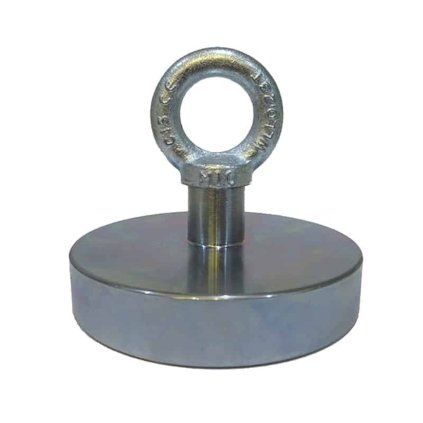
Fishing magnet 530 kg
Powerful neodymium fishing magnet with a pulling eye for retrieving ferromagnetic objects from water, wells, canals and other difficult-to-access locations.
- Magnet diameter 100 mm
- Height approximately 86 mm
- Stated magnetic force 530 kg
- N38 neodymium material
- Nickel-plated surface finish
- Pulling eye for attaching a rope
- Weight approximately 1,100 g
- Designed for more experienced users and heavier finds
Warning: the 530 kg value applies under defined ideal conditions. Rust, mud, uneven surfaces and incomplete contact significantly reduce the actual force in water.
View product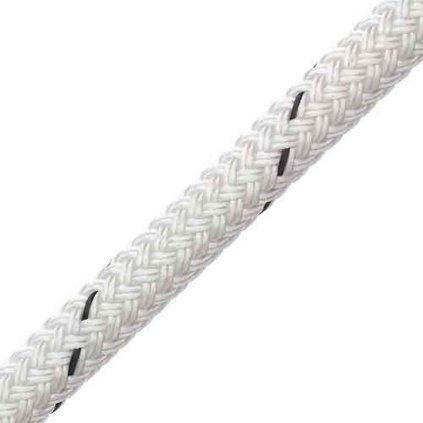
Rope 15 m, load capacity 340 kg
Braided polyester rope for magnet fishing, retrieving objects from wells and other activities requiring a strong and durable rope.
- Length 15 m
- Diameter 5 mm
- Stated load capacity 340 kg
- Polyester material
- Braided construction
- Weight approximately 224 g
- Abrasion-resistant
- Suitable for lighter and medium-strength setups
Warning: knots and abrasion can reduce rope strength. This rope is not suitable for utilising the full stated force of the 530 kg fishing magnet.
View product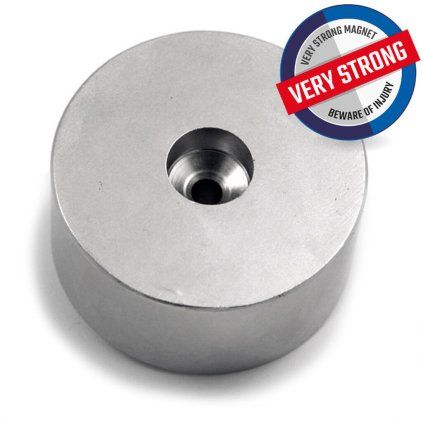
Neodymium magnet with hole dia. 60 × 30 mm
Large cylindrical neodymium magnet with a through hole for a custom technical mounting solution and retrieval of ferromagnetic objects.
- Diameter 60 mm
- Height 30 mm
- Through hole 6 mm
- Pull-off force approximately 118 kg
- Pull-off force approximately 1,180 N
- Magnetic grade VMM8-N45
- Temperature resistance up to 80 °C
- Weight approximately 700 g
- Rope and suspension eye not included
Warning: this is not a complete magnet fishing set. The product page also states a restriction to dry environments. Before using it in water, confirm its suitability, mounting method and moisture protection with the seller.
View productAll components of the setup must be compatible
The magnet, rope, knot, eye, carabiner or shackle must all have appropriate strength. Overall safety is determined not by the strongest component but by the weakest point in the complete setup.
Frequently asked questions about magnet fishing
What is magnet fishing?
Magnet fishing is the search for and retrieval of ferromagnetic objects from water using a powerful magnet attached to a rope.
Which magnet is best for a beginner?
For beginners, a medium-strength magnet with a secure eye that is not excessively heavy and can be thrown and retrieved repeatedly with reasonable comfort is more practical.
Is a single-sided or double-sided fishing magnet better?
A single-sided magnet is suitable for vertical lowering. A double-sided magnet is more practical for throwing and dragging along the bottom because it can capture objects on both sides.
What does a magnet strength of 530 kg mean?
It is a value achieved or stated under defined conditions on a suitable steel surface. It does not mean that the magnet can safely lift every object weighing 530 kg.
How strong should the rope be?
The rope's load capacity must correspond to the magnet, method of use and expected load. Allow a safety margin and remember that knots reduce strength.
How long should the rope be?
For ordinary magnet fishing close to the bank, 15 m is generally sufficient. A 30 m rope may be more suitable for wider water or a high bridge.
Which knot should I use?
A correctly tied figure-eight knot or bowline can be used. The knot must suit the type of rope and should be loaded and inspected before use.
Should the end of the rope be tied to a tree?
The rope must be secured so that it cannot disappear into the water, but the anchor point must be strong and must not endanger other people. Do not attach it to road signs, railings or someone else's structure without permission.
Can magnet fishing be done from a bridge?
Only if there is enough safe space on the bridge and the activity is not prohibited. You must not endanger road traffic on the bridge, navigation underneath it or people nearby.
Can magnet fishing be done in a pond?
Check the owner or administrator, access to the land, local rules and any nature-protection restrictions beforehand.
Can magnet fishing be done in a river?
Yes, but only in a suitable and safe location after checking local rules. Avoid strong currents, weirs, navigation routes and technical structures.
Do I need a fishing licence?
Magnet fishing is not fishing for fish. However, this does not automatically grant permission to use every location. Check the owner's or administrator's consent and local restrictions.
What will a magnet attract in water?
Primarily iron, ordinary steel, cast iron and other ferromagnetic materials. It will not attract aluminium, copper, brass or most non-magnetic objects.
Will a magnet attract coins?
Only coins containing enough ferromagnetic material. Ordinary fishing magnets will not attract copper, brass, silver or gold coins.
Will a magnet attract stainless steel?
Some stainless-steel grades will be attracted, while others only weakly or not at all. It depends on the specific alloy structure.
Why does the magnet not find anything?
There may be no ferromagnetic objects in the area, the magnet may be too far above the bottom or you may be pulling it too quickly.
Why does the object fall off while being retrieved?
The object may be rusty, curved, covered in mud or only touching the magnet over a small area. Sudden jerking may also cause it to fall off.
What should I do if the object is too heavy?
Do not try to pull it up by force from a dangerous position. Move it towards shallower water, change the direction of pull or stop the attempt.
What should I do if the magnet sticks to a bridge?
Release the tension and try pulling from another direction. Do not use a vehicle, climb over railings or endanger traffic.
How do I remove an object from a powerful magnet?
Slide the object sideways instead of pulling it directly away. Wear gloves and watch out for sharp edges and finger pinching.
What should I do with recovered metal waste?
Take it to a recycling centre or dispose of it in another appropriate way. Do not leave it on the bank or throw it back into the water.
Can I keep everything I find?
No. An object may have an owner, significant value, be a weapon or constitute an archaeological find. In such cases, follow the relevant reporting and handover procedure.
What should I do if I find a pistol?
Do not handle it, test whether it works or take it away. Secure the surrounding area and call the Police of the Czech Republic on 158.
What should I do if I find a grenade?
Do not touch, turn or carry it. Move away, warn other people and immediately call 158 or 112.
What should I do if I find old coins?
If they may have archaeological significance, do not disturb the location further and report the find to the Archaeological Institute or nearest museum.
Is magnet fishing dangerous?
It can be. Risks include powerful magnets, deep water, slippery banks, sharp objects, tensioned rope, weapons and unexploded ammunition.
Is magnet fishing suitable for children?
Powerful fishing magnets are not toys. A child may only be present under direct adult supervision and must not independently handle a heavy magnet or unknown find.
Can a fishing magnet pinch fingers?
Yes. A powerful neodymium magnet can snap towards a steel object and cause bruising or more serious injury.
Can the magnet damage a phone?
A powerful magnetic field may affect certain sensors, magnetic accessories, cards, watches and sensitive equipment. Keep phones and electronics at a sufficient distance.
Is the magnet dangerous for pacemakers?
A powerful magnetic field may affect certain medical implants. Observe the safe distance specified by the manufacturer.
How can you prevent a fishing magnet from rusting?
Clean and thoroughly dry it after use and inspect the surface coating. Damage to the nickel plating allows water to reach the neodymium material.
How often should the rope be inspected?
Before every use and after heavy loading or pulling over a sharp edge. Replace any rope that is frayed, cut or chemically damaged.
Can you go magnet fishing in winter?
Yes, but only under safe conditions. Ice, frost, cold water and stiff wet rope significantly increase the risk of slipping and hypothermia.
Can a fishing magnet be used in seawater?
Salt water significantly accelerates corrosion. Use a product designed for the environment and rinse it immediately with fresh water after use before drying it thoroughly.
How do you finish magnet fishing safely?
Take away all recovered objects, clean the surrounding area, inspect the rope and equipment and make sure no sharp objects or dangerous loops remain at the location.
Summary
Magnet fishing is the search for ferromagnetic objects in water using a powerful magnet and rope. It can be an interesting leisure activity as well as a way to remove some metal waste from waterways.
When choosing equipment, consider the magnet construction, weight, active surface, rope attachment method and the actual strength of the complete setup. The stated magnet force in kilograms does not represent the safe load capacity for every recovered object.
Before starting, check the owner's or administrator's permission and local rules. Do not go magnet fishing near hazardous currents, weirs, navigation routes, sensitive technical equipment or in prohibited areas.
If you find a weapon, cartridge, ammunition or explosive, do not handle it and call the police. Report any object that may have archaeological value to the relevant specialist institution.
Want to get started with magnet fishing?
Choose a fishing magnet, strong rope and other equipment according to the required force, rope length and intended use.