
Ferrofluid Explained: Magnetic Liquid, Spikes and Uses
Ferrofluid: a liquid that responds to magnetic fields
Ferrofluid is a liquid containing very small magnetic particles. When a strong magnet is brought close, it moves towards the strongest part of the magnetic field and can form characteristic spiky patterns on its surface.
- It contains iron oxide nanoparticles.
- The particles are dispersed in an oil- or water-based liquid.
- Without a magnet, it behaves like an ordinary dark liquid.
- A strong neodymium magnet produces the most pronounced effect.
What is ferrofluid?
Ferrofluid is a stable mixture consisting of:
- magnetic nanoparticles, most commonly magnetite,
- a carrier liquid, such as oil or water,
- a surfactant that prevents particles from clumping together.
The individual particles are so small that they remain dispersed in the liquid. When a magnet approaches, their magnetic moments align with its field and the liquid starts to move.
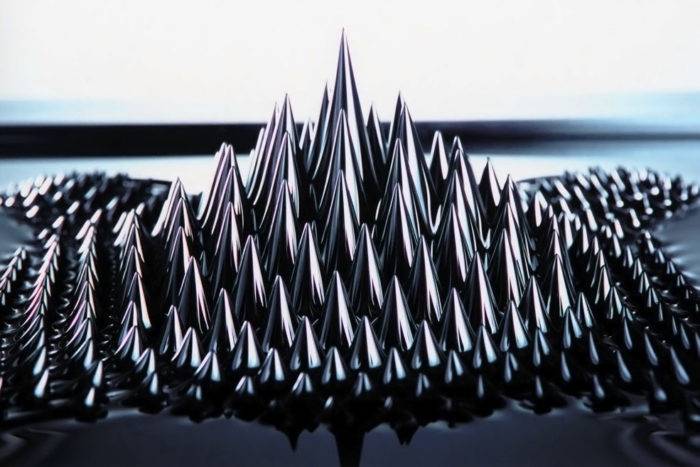
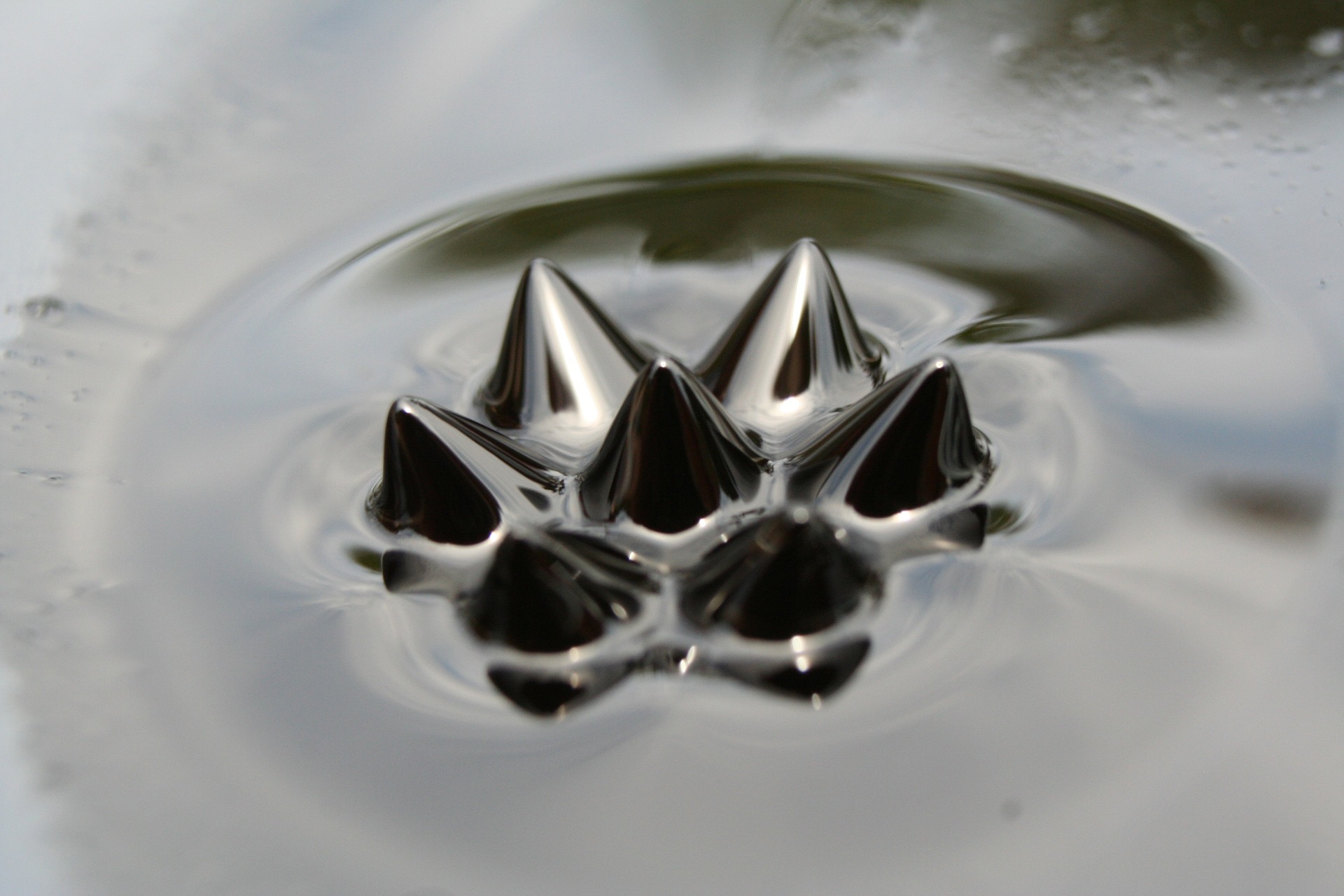
Why does ferrofluid form spikes?
In a strong magnetic field, magnetic force competes with gravity and the liquid’s surface tension. The ferrofluid therefore forms regular spikes aligned with the magnetic field.
This phenomenon is called the normal-field instability. When the magnet is moved away, the spikes disappear and the liquid returns to its original shape.
Does ferrofluid really flow uphill?
Only when a sufficiently strong, non-uniform magnetic field pulls it upwards. Gravity is not being violated: the magnetic force at that point is simply stronger than the gravitational force.
Is ferrofluid permanently magnetic?
No. Ordinary ferrofluid responds to an external magnetic field, but once the field is removed, the nanoparticles’ magnetic moments become randomly oriented again.
The liquid therefore:
- is not a permanent magnet,
- does not independently attract metal objects over the long term,
- responds mainly in the presence of an external field.
Where is ferrofluid used?
Loudspeakers
Ferrofluid is placed in the gap around the voice coil. It helps dissipate heat, damp unwanted movement and improve the speaker’s power handling.
Magnetic seals
A magnetic field holds the liquid in a precisely defined position, where it can form a sealing barrier around a rotating shaft.
Technical and laboratory applications
Ferrofluid is also used in magnetic field research, sensors, material separation and specialised heat transfer systems.
However, it is not a universal substitute for ordinary lubricant or coolant. Each ferrofluid has a specific composition, viscosity and chemical compatibility.
A simple ferrofluid experiment
- Seal the ferrofluid in a transparent, leakproof container.
- Place the container on a stable, washable surface.
- Bring the magnet towards the outside of the container wall.
- Observe the liquid’s movement and the formation of spikes.
- Try different distances and faces of the magnet.
Ferrofluid stains and makes a mess
- Keep it in a closed container during the experiment.
- Wear protective gloves and safety glasses.
- Avoid contact with skin, eyes and clothing.
- Do not pour the liquid down a drain.
- Follow the safety data sheet for the particular product.
- This experiment is not suitable for young children.
Which magnet should you use?
A neodymium magnet is usually better for producing pronounced ferrofluid shapes. A ferrite magnet of similar size is weaker but can be used for a subtler demonstration.
Always bring the magnet closer from outside the container. Immersing it directly can soil the magnet and encourage corrosion in a nickel-plated neodymium magnet.
Recommended magnets for experiments
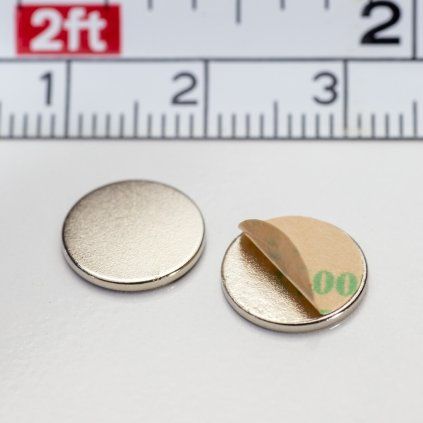
Self-adhesive neodymium magnets 10 × 1 mm
A pair of thin magnets with opposite polarity, suitable for small demonstration assemblies or magnetic closures.
- Diameter 10 mm
- Height 1 mm
- Set of 2 pieces
- Pull force 5.5 N
- Magnetic grade N35
- 3M 467 MP self-adhesive layer
- Temperature resistance up to 80 °C
- Product code 20309.S
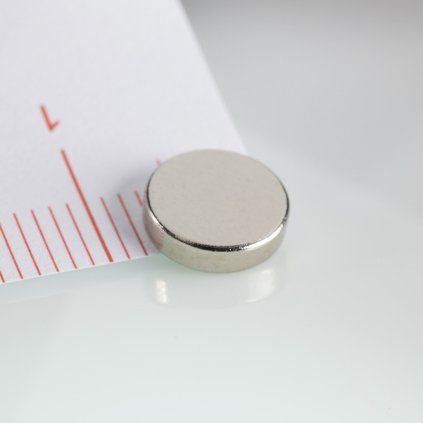
Neodymium cylinder magnet 8 × 2 mm
A compact neodymium magnet for small technical projects and demonstrating ferrofluid’s response through a container wall.
- Diameter 8 mm
- Height 2 mm
- Pull force 6.8 N
- Weight 0.75 g
- Magnetic grade N30
- Nickel-plated surface
- Temperature resistance up to 80 °C
- Product code 20003
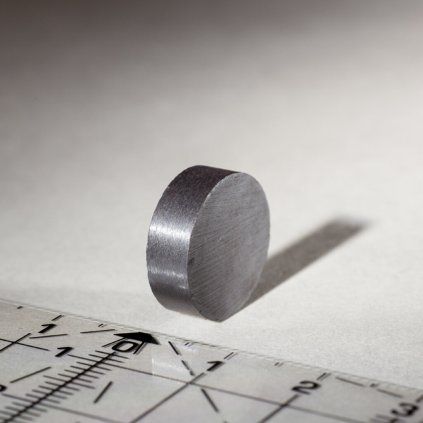
Ferrite cylinder magnet 15 × 5 mm
A larger ferrite magnet for subtler experiments, classroom demonstrations and simple magnetic projects.
- Diameter 15 mm
- Height 5 mm
- Pull force 5.5 N
- Weight 4.4 g
- MF35 anisotropic ferrite
- Temperature resistance up to 200 °C
- Product code 10337
Frequently asked questions
Is ferrofluid a permanent magnet?
No. It becomes strongly magnetised in the presence of an external magnetic field.
Why does it form spikes?
The spikes result from the balance between magnetic force, gravity and the liquid’s surface tension.
Does ferrofluid contain hematite?
Some mixtures may use different iron oxides, but magnetite is the most common material.
Is a neodymium or ferrite magnet more suitable?
A neodymium magnet usually produces a more pronounced effect. A ferrite magnet is weaker and suitable for a subtler demonstration.
Can ferrofluid be poured directly onto a magnet?
This is not recommended. The liquid heavily soils the surface and may penetrate a damaged protective coating.
Summary
Ferrofluid is a liquid containing dispersed magnetic nanoparticles. In a magnetic field, it moves towards the strongest part of the field and can form characteristic spiky patterns.
For a home demonstration, use a sealed transparent container and bring the magnet close only from outside. Ferrofluid can stain heavily, and its use must follow the safety data sheet for the particular mixture.
Explore the effect of a magnetic field
Choose a compact neodymium or ferrite magnet for technical projects and safe demonstration experiments.