
Permanent Magnets: How They Work, Types and Durability
What is a permanent magnet?
A permanent magnet is a material that retains its own magnetic field for a long time after magnetisation, without an electrical power supply. It attracts ferromagnetic materials and attracts or repels other magnets depending on the orientation of their poles.
- “Permanent magnet” and “lasting magnet” refer to the same type of magnet.
- It does not need an electric current.
- Every magnet has a north and a south pole.
- High temperature, impact, corrosion or a strong opposing field can reduce its performance.
How does a permanent magnet work?
A permanent magnet contains magnetic regions called domains. During manufacture and magnetisation, a large proportion of these regions align in the same direction.
The result is a stable magnetic field with two pole regions:
- a north pole, N,
- a south pole, S.
Opposite poles attract and like poles repel. Breaking a permanent magnet does not create separate poles: each piece has its own north and south poles.
Permanent magnet versus electromagnet
Permanent magnet
- works without electrical power,
- has a magnetic field that remains present over the long term,
- cannot simply be switched on and off,
- is compact and requires no operating power.
Electromagnet
- creates a field when current passes through a coil,
- can be switched on and off,
- its strength can be regulated by current within certain limits,
- requires power and may heat up.
When should you choose each type?
A permanent magnet is suitable for closures, holders, sensors and applications without a power supply. An electromagnet suits applications where you need to control the magnetic force or switch it off completely.
Which materials are used to make permanent magnets?
NdFeB neodymium magnets
Neodymium magnets offer very high strength in small sizes. However, ordinary versions are sensitive to moisture and higher temperatures, so they usually have a protective coating.
SmCo samarium-cobalt magnets
Samarium magnets offer high temperature resistance and good corrosion resistance. They are used in demanding industrial and technical applications.
Ferrite magnets
Hard ferrites, also called ceramic magnets, are affordable, corrosion-resistant and tolerate higher temperatures well. At the same size, they are usually weaker than neodymium magnets.
AlNiCo magnets
They are made from alloys of aluminium, nickel and cobalt. They excel in temperature stability but are more sensitive to an opposing magnetic field.
Flexible magnets
Magnetic sheets and tapes contain ferrite powder in a flexible plastic binder. They are weaker but easy to cut and bend, and are used for labelling or advertising.
Is a permanent magnet truly permanent?
“Permanent” does not mean a magnet can never weaken. With correct use, it remains stable for a very long time, but its performance can be reduced by:
- exceeding the maximum operating temperature,
- heating towards the Curie temperature,
- a strong opposing magnetic field,
- sudden impacts and cracking,
- corrosion of the magnetic material,
- an unsuitable magnetic circuit design.
The maximum operating temperature is usually much lower than the Curie temperature. A magnet can therefore weaken irreversibly before reaching the temperature at which its ferromagnetic order disappears completely.
Do not demagnetise magnets by impact or fire
Blows can break a brittle magnet, while heating can damage its coating or cause irreversible performance loss. Controlled demagnetisation uses specialist equipment with an alternating magnetic field.
How do you choose a permanent magnet?
Before choosing, consider:
- the required pull force,
- dimensions and available space,
- the magnet’s shape,
- magnetisation direction,
- the operating temperature,
- humidity and the risk of corrosion,
- the mounting method,
- the direction of the actual load.
Pull force is measured by pulling the magnet perpendicularly from a clean steel plate of sufficient thickness. Paint, a gap, rust, thin sheet metal or sideways loading can reduce it significantly.
Selected permanent magnets
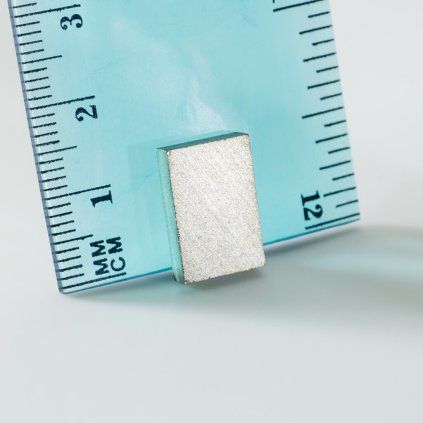
Samarium block magnet 15 × 10 × 3 mm
An SmCo magnet for applications where high temperature and corrosion resistance are important.
- Dimensions 15 × 10 × 3 mm
- SmCo material
- Temperature resistance up to 300 °C
- Without a conventional protective surface coating
- Magnetisation perpendicular to the face
- Product code 35021
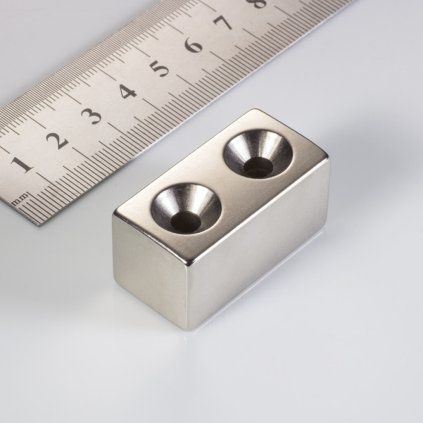
Neodymium block magnet 40 × 20 × 20 mm
A very strong, atypical magnet with two countersunk screw holes and a rounded section.
- Dimensions 40 × 20 × 20 mm
- Pull force 430 N
- Approximate pull force 43 kg
- Weight 120 g
- Magnetic grade N50
- Nickel-plated surface
- Temperature resistance up to 80 °C
- Product code 20177
Important: the high strength creates a risk of seriously pinched fingers. The magnet is not intended as certified lifting equipment.
View product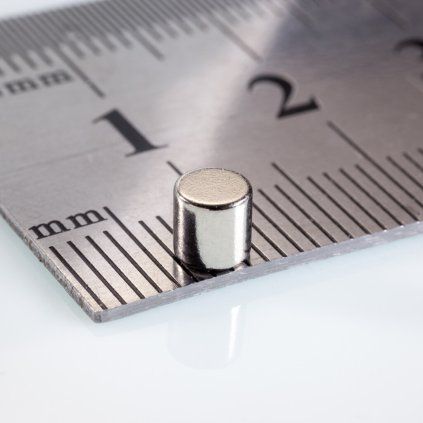
Neodymium magnet 4 × 4 mm, N40EH
A small, heat-resistant neodymium magnet for sensors and compact technical devices.
- Diameter 4 mm
- Height 4 mm
- Pull force 5.4 N
- Approximate pull force 0.54 kg
- Weight 0.38 g
- Magnetic grade N40EH
- Magnetised parallel to the axis
- Nickel-plated surface
- Temperature resistance up to 200 °C
- Product code 28055
Frequently asked questions
Do “lasting” and “permanent” magnet mean the same thing?
Yes. Both terms describe a magnet that retains its magnetic field over the long term without a power supply.
Can a permanent magnet weaken?
Yes. High temperature, corrosion, a strong opposing field or mechanical damage can reduce its performance.
What is the strongest type of permanent magnet?
At a comparable volume, commonly available NdFeB neodymium magnets provide the highest performance.
Which magnet should I choose for high temperatures?
Depending on the required temperature, you can choose a special neodymium grade, SmCo, AlNiCo or suitable ferrite.
Does a permanent magnet need electricity?
No. An electromagnet needs an electric current; a permanent magnet does not.
Summary
A permanent magnet retains its magnetic field for a long time without electrical power. It is mainly made from neodymium, samarium, ferrite or AlNiCo materials.
“Permanent” does not mean indestructible. Consider temperature, humidity, required strength, shape, coating and the type of loading when choosing.
Choose a permanent magnet for your application
Compare neodymium, samarium, ferrite and AlNiCo magnets by size, strength and temperature resistance.