
What Is a Magnetic Field? Poles, Field Lines and Experiments
How does a magnetic field work?
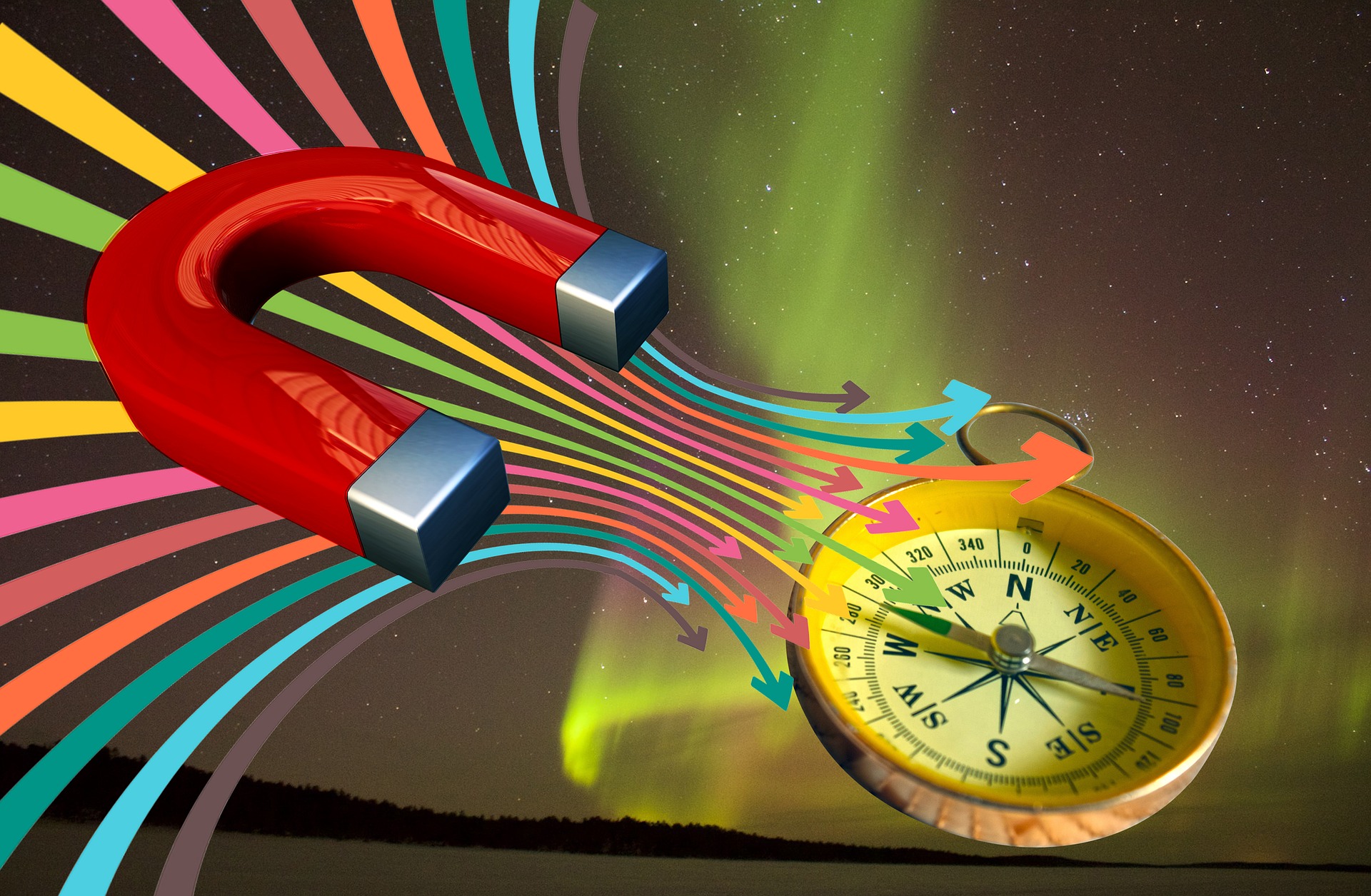
A magnetic field is the region around a magnet or current-carrying conductor in which magnetic forces act. It causes opposite magnetic poles to attract, like poles to repel, and ferromagnetic materials to respond when a magnet approaches.
- Every ordinary magnet has a north and a south pole.
- Opposite poles attract; like poles repel.
- Magnetic field lines form closed curves.
- An electric current also creates a magnetic field.
How is a magnetic field created?
In a permanent magnet, the magnetic field is mainly related to the magnetic moments of electrons and their arrangement within the material.
In ferromagnetic substances such as iron, nickel or cobalt, small regions called magnetic domains form. If these domains point in different directions, their effects largely cancel out.
During magnetisation, more domains align in the same direction and the object begins to produce a pronounced magnetic field.
Electromagnetic field
A magnetic field also forms around a conductor carrying an electric current. If the conductor is wound into a coil, the fields of the individual turns combine and become stronger inside the coil.
This principle is used, for example, in:
- electromagnets,
- electric motors,
- transformers,
- relays,
- loudspeakers,
- generators.
Why do magnets attract and repel?
A magnet has two pole regions:
- a north pole, N,
- a south pole, S.
When a north and south pole approach each other, an attractive force arises. When two north poles or two south poles approach, the magnets repel each other.
What happens if you break a magnet?
You do not create a separate north and south pole. Each piece becomes a smaller magnet with its own north and south poles.
What are magnetic field lines?
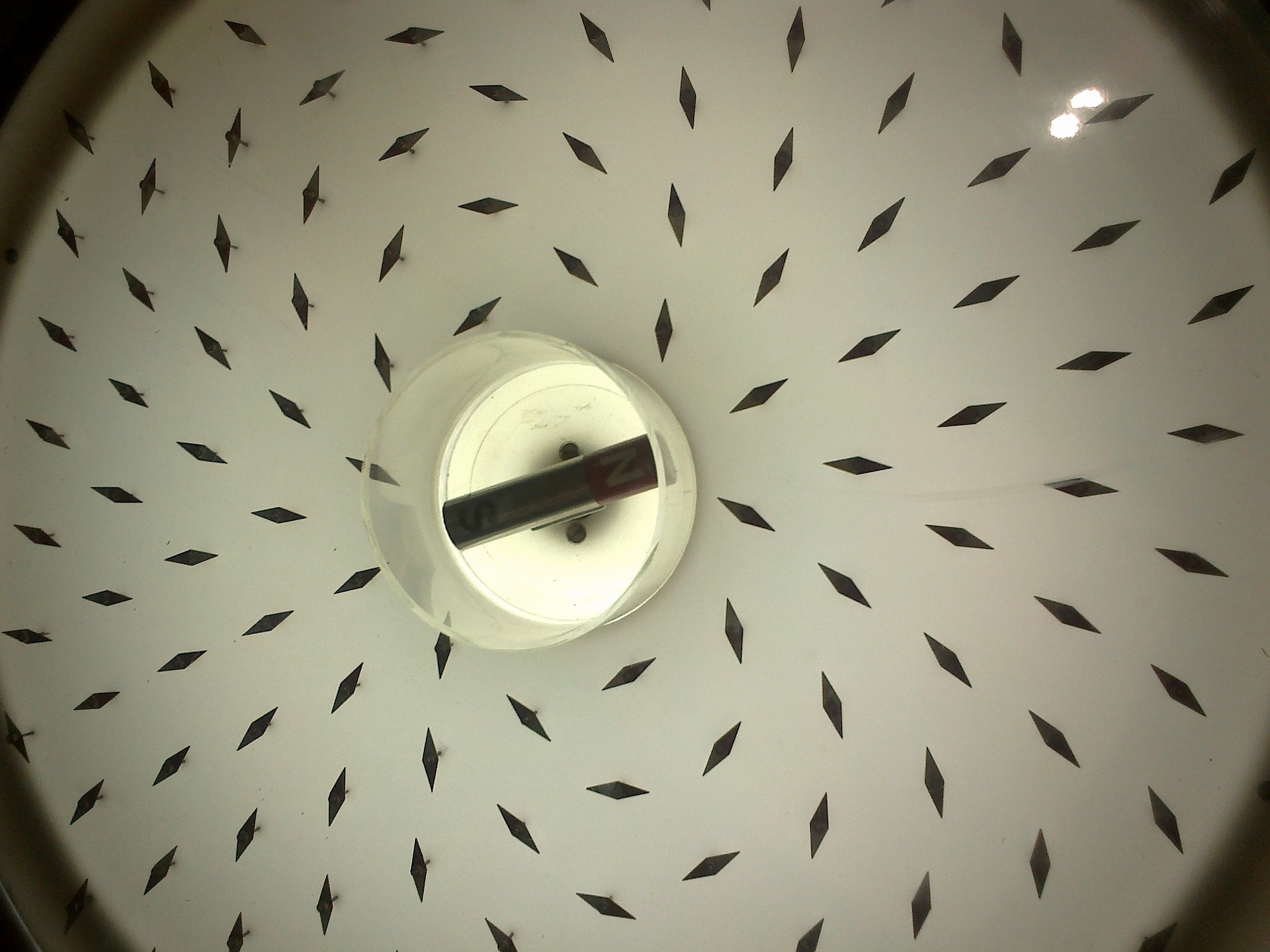
Magnetic field lines are imaginary lines used to show the direction and shape of a magnetic field.
Their properties are:
- they form closed loops,
- outside the magnet, they run from the north pole to the south pole,
- inside the magnet, they continue back towards the north pole,
- they do not cross one another,
- more closely spaced lines represent a stronger field.
The shape of a field can be observed easily using iron filings or a small compass.
Static and changing magnetic fields
Static magnetic field
Its strength and direction at a given point do not change with time. It is produced, for example, by a stationary permanent magnet or a coil supplied with a steady current.
Changing magnetic field
Its strength or direction changes over time. It can arise, for example:
- when an alternating current passes through a coil,
- when a magnet moves relative to the point being measured,
- when an electromagnet is switched on and off.
If the magnetic flux passing through an electrical circuit changes, an induced voltage can arise in it. This phenomenon is called electromagnetic induction.
The right-hand rule
The direction of the magnetic field around a current-carrying conductor can be determined using the right-hand rule:
- Imagine grasping the conductor with your right hand.
- Point your thumb in the direction of conventional current.
- Your curled fingers show the direction of the magnetic field lines.
For a coil, the fingers of your right hand follow the turns in the direction of current, while your thumb points in the direction of the magnetic field inside the coil and indicates its north pole.
A simple experiment with iron filings
- Place the magnet on a flat surface.
- Cover it with paper or a thin plastic sheet.
- Carefully add a small amount of iron filings.
- Tap the surface gently.
- The filings align with the magnetic field.
Experiment safety
Iron filings are sharp and must not get into eyes or mouths. Use a transparent closed container or a securely sealed bag, and check afterwards that no filings remain on the magnet.
Selected magnets for practical use
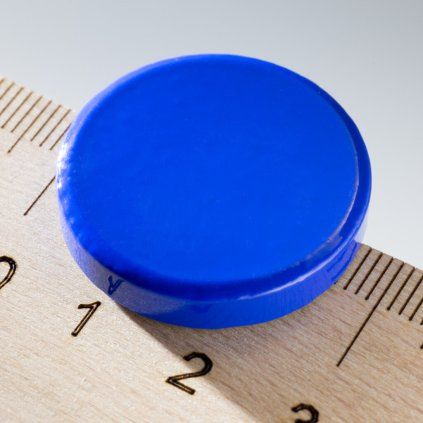
Round coloured magnet 26 × 5 mm
A weaker blue ferrite magnet for attaching papers, envelopes and photographs to a suitable magnetic board or steel surface.
- Diameter 26 mm
- Height 5 mm
- Pull force 3 N
- Approximate pull force 0.3 kg
- Weight 12.65 g
- Isotropic ferrite
- Blue finish
- Product code 60016
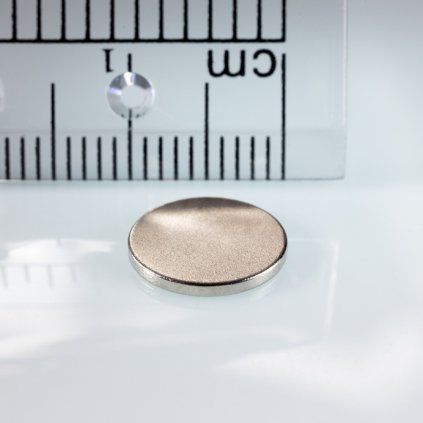
Neodymium cylinder magnet 10 × 1.5 mm
A thin neodymium magnet suitable for lightweight closures, model making and small technical projects.
- Diameter 10 mm
- Height 1.5 mm
- Pull force 9.9 N
- Approximate pull force 0.99 kg
- Weight 0.9 g
- Magnetic grade N35
- Nickel-plated surface
- Temperature resistance up to 80 °C
- Product code 24048
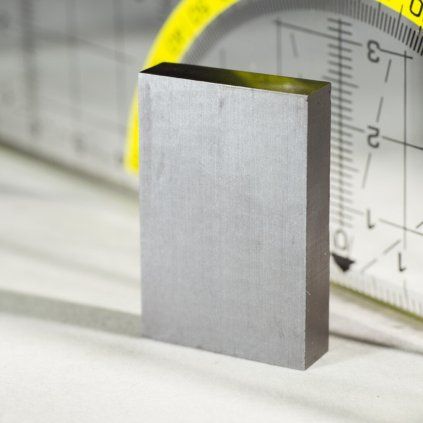
Ferrite block magnet 30 × 20 × 6 mm
An anisotropic ferrite magnet for simple holders, classroom experiments and less demanding technical uses.
- Dimensions in the name and designation: 30 × 20 × 6 mm
- Pull force 14 N
- Approximate pull force 1.4 kg
- Weight 17.45 g
- MF35 anisotropic ferrite
- Temperature resistance up to 250 °C
- Product code 10342
Note: the specification table on the product page currently shows different dimensions from the product name and designation. Confirm the size with the seller before ordering.
View productFrequently asked questions
Why do opposite poles attract?
Their magnetic fields arrange themselves in a way that produces an attractive force between the magnets.
Why do like poles repel?
When like poles approach, the magnetic fields are distorted and a repulsive force arises between the magnets.
Are magnetic field lines real?
They are a visual model used to represent the direction and strength of a magnetic field.
Does an electric current create a magnetic field?
Yes. A magnetic field in the form of concentric circles forms around a current-carrying wire.
Does a magnet stick to every metal?
No. It strongly attracts mainly iron, ordinary steel, cast iron and other ferromagnetic materials.
Summary
A magnetic field forms around permanent magnets and current-carrying conductors. In a permanent magnet, it is related to the arrangement of the electrons’ magnetic moments within the material.
Magnetic field lines form closed loops. Opposite poles attract and like poles repel. The field direction around a conductor or coil can be determined using the right-hand rule.
Explore magnetic fields in practice
Choose an office, ferrite or neodymium magnet according to its strength, dimensions and intended use.